
Only 20.7% of UAE .ae Homepages Render a Correct WhatsApp Link Preview: We Scanned 658 of Them (2027)
We parsed 658 of the UAE’s busiest .ae homepages and probed all 285 og:image URLs as the real Facebook crawler. 33.3% have zero Open Graph tags and only 20.7% render a correct WhatsApp preview.
- PUBLISHED
- 25 NOV 2026
- READ TIME
- 11 MIN
- AUTHOR
- AQUARIUS · DUBAI
- UNIT
- REV 2026.09
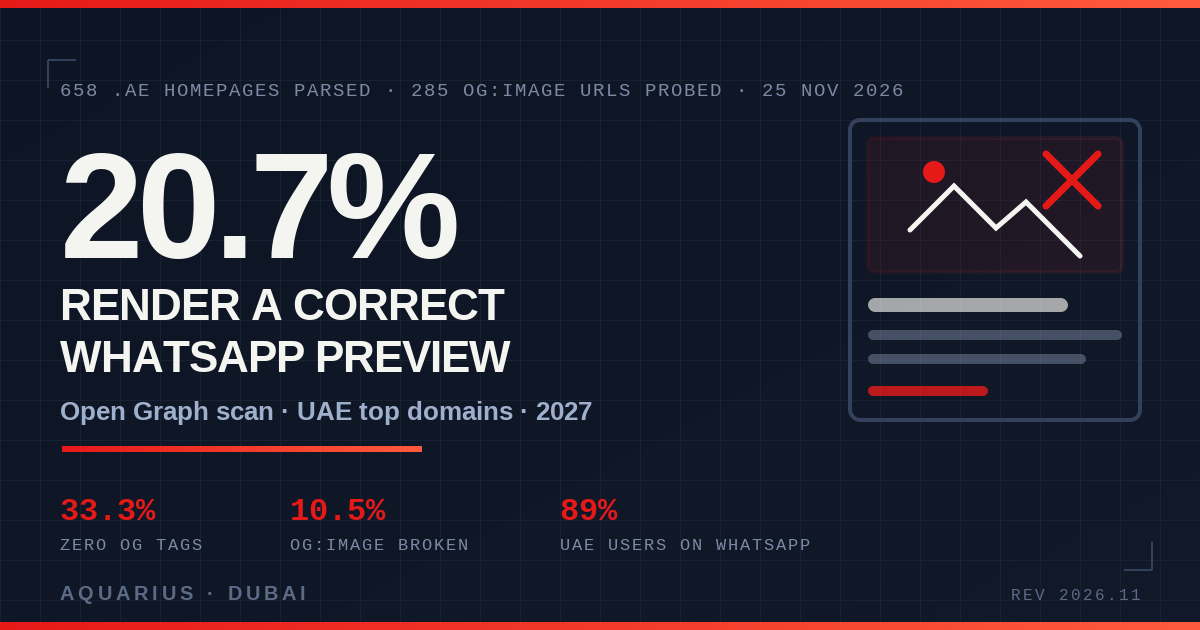
Short answer: on 25 November 2026 we fetched the homepages of the UAE’s most-visited .ae domains, parsed the <head> of 658 of them, and then probed all 285 og:image URLs with the real Facebook crawler user-agent. Only 136 of 658 — 20.7% can render a correct WhatsApp link preview. 219 (33.3%) carry no Open Graph tags at all. In a country where roughly 89% of internet users are on WhatsApp, four out of five of the busiest sites in the UAE hand their own marketing team a grey box.
The ad spend, the influencer, the Dubai Shopping Festival push — all of it funnels into a link someone forwards on WhatsApp. If that link has no og:image, or the image is a 403, or it is an SVG, the forward loses its thumbnail and its click-through collapses. Below is the full dataset, the eight distinct ways .ae sites break previews, and the fix order.
Why a link preview is a UAE-specific revenue problem
Three numbers set the stakes:
- WhatsApp reaches about 89% of UAE internet users aged 16+ — the highest-penetration platform in the country, ahead of Facebook (81.6%), Messenger (65.3%) and TikTok (59.7%). Dubai does business in WhatsApp groups, not in email threads.
- The UAE has roughly 11.3 million internet users against a population of 11.4 million — about 99% penetration — and 23 million active mobile connections. There is no meaningful offline segment to fall back on.
- Mobile is 67.8% of UAE pageviews versus 31.4% desktop (StatCounter, October 2026). The preview card is the first impression on the device almost everyone is using.
Unlike a Core Web Vitals problem, this one is binary. Either the card renders or it does not, and the person who notices is your customer, mid-conversation, deciding whether a forwarded link is worth a tap.
How we measured it
Same method as the rest of this series. We requested the UAE’s top-ranked .ae homepages over HTTPS with a current Chrome user-agent and got 778 responses from 781 attempts — 592 clean 200s, 109 connection failures, 61 bot-blocking 403s and a scatter of redirects. 658 returned parseable HTML.
For each one we extracted every <meta> and <link> tag in the head, recorded the byte offset of </head>, then resolved every og:image to an absolute URL and fetched it as facebookexternalhit/1.1 — the actual crawler Meta uses for WhatsApp previews. We parsed real dimensions out of each image file header rather than trusting the declared og:image:width.
The pass criteria are Meta’s own published link-preview requirements: og:title, og:description and og:url inside <head>; </head> within the first 300 KB; image under 600 KB, at least 300 px wide, no wider than 4:1. A site passes only if all of it holds.
The baseline: what 658 UAE homepages actually declare
| Tag | Sites with it | Share of 658 |
|---|---|---|
<title> | 638 | 97.0% |
meta description | 466 | 70.8% |
rel=canonical | 441 | 67.0% |
any og: tag | 439 | 66.7% |
og:title | 419 | 63.7% |
og:description | 376 | 57.1% |
og:type | 351 | 53.3% |
og:url | 331 | 50.3% |
og:image | 284 | 43.2% |
twitter:card | 291 | 44.2% |
twitter:image | 158 | 24.0% |
theme-color | 141 | 21.4% |
og:image:alt | 51 | 7.8% |
Read the gap between rows one and nine: 97% of these sites bothered with a <title>, 43.2% with an og:image. The Open Graph protocol lists four required properties — og:title, og:type, og:image, og:url — and only 227 sites (34.5%) have all four. The WhatsApp-relevant set is present on 237 (36.0%).
And having the tags is not the same as working. Of those 237 tag-complete sites, 91 (38.4%) have an og:image that fails at least one of Meta’s image rules. That is how 36.0% becomes 20.7%.
Eight ways .ae homepages break their own previews
1. The crawler gets blocked (10.5% of images)
We probed 285 image URLs as facebookexternalhit. 30 failed outright — 16 returned 403, nine returned 404, four failed to connect, one threw a 500. The 403s are the interesting ones: these are big retail and energy brands whose WAF or CDN bot rules block Meta’s crawler by default. The tag is perfect. The image is live in a browser. The preview is still blank, because the only client that matters was turned away at the edge.
2. The og:image is not an image (6 sites)
Six og:image URLs returned text/html with a 200 — a soft-404 page or an app shell where a JPEG should be. Five of the six are .gov.ae domains. A seventh served binary/octet-stream. These are the hardest to notice internally, because every automated check that only looks at the status code reports them green.
3. SVG (17 sites, 6.7%)
Seventeen homepages point og:image at an SVG. It is sharp, it is tiny, it is a perfectly sensible logo format — and WhatsApp and Facebook do not render it in previews. Silent failure, no error anywhere. (One site has already moved to AVIF, which has the same problem for different reasons.)
4. Too small (29 sites)
We could read real dimensions for 231 images. 29 (12.6%) are under the 300 px minimum width — down to 96×96 and 129×129. Another tell: 61 images (26.4%) are square or near-square, which almost always means someone pointed og:image at the favicon or the header logo. Only 125 of 231 reach 1200 px wide, and exactly 38 sites ship the canonical 1200×630.
5. Wrong shape (17 sites)
Seventeen images are wider than 4:1 and will be rejected or cropped to nothing — including an 8000×1558 banner and a 3960×893 hero. A wordmark is not a share card.
6. Too heavy (13 sites over 600 KB)
Median og:image weight across the corpus is a reasonable 41.6 KB. The tail is not: 13 images exceed Meta’s 600 KB ceiling, topping out at 3.9 MB and 3.1 MB, and 28 sit above the 300 KB mark where slow-network scrapes start timing out. If your site already failed our AVIF and WebP delivery scan, this is the same bytes problem wearing a different hat.
7. Relative and insecure URLs (36 sites)
22 of 284 (7.7%) og:image values are not absolute URLs — a leading slash or a bare filename, which the crawler cannot resolve because there is no base document in its context. A further 14 point at http://, which gets downgraded or dropped. Both are one-line fixes that nobody has made because nobody tested the card.
8. The head is too far down (27 sites)
Meta stops reading at 300 KB. 27 homepages do not close </head> before that cut-off — usually megabytes of inlined critical CSS and JSON state pushed above the fold of the document. Their Open Graph tags exist and are never seen. Four more never close </head> at all.
Three findings nobody expects
WordPress beats everyone. 101 of the 658 homepages are WordPress. 37.6% of them render a correct preview, versus 17.6% of everything else — and of the 57 running Yoast SEO, 50.9% pass. The most-maligned stack in UAE web development is twice as likely to get this right as a hand-rolled Next.js build, for one boring reason: the plugin ships the tags whether or not anyone thought about them.
Government is the worst segment. Of 63 .gov.ae homepages, 26 (41.3%) have zero Open Graph tags and only 4 (6.3%) render a correct preview. These are the pages citizens are most likely to forward to each other in a WhatsApp group.
46 sites declare a card they cannot fill. Forty-six homepages set twitter:card to summary_large_image while providing no image of any kind — no og:image, no twitter:image. Somebody copied a snippet. Three more put the wrong value in the field entirely: one large energy brand has a CDN image URL sitting in twitter:card, another has a full paragraph of marketing copy.
And the single worst line in the dataset: one .ae domain’s og:url points at a Brazilian bank’s domain. 23 sites in total have an og:url on a different host than the page itself — some legitimately (a .ae vanity domain pointing at the global .com), several not. One university’s og:url still exposes an internal CMS node path.
The Arabic gap
Only 154 of 658 sites (23.4%) declare og:locale at all, and the most common value is the protocol default, en_US (86 sites). Just 21 sites use en_AE, and only 21 declare any Arabic locale across every variant combined. Forty-four sites have Arabic script in their og:title or og:description.
In a market that is majority expatriate but constitutionally Arabic-first, telling Meta your page is en_US means the preview rendering, the text direction hints and the alternate-locale discovery all default to the wrong assumption. It is two lines of markup — og:locale plus og:locale:alternate — and 95% of the UAE’s busiest sites skip both.
What fixing it costs in Dubai, in AED
| Scope | What you get | Timeline | AED range |
|---|---|---|---|
| Link-preview audit | Every key template crawled as facebookexternalhit, tag map, image probe with real dimensions and bytes, head-budget check, ranked fix list | 2–4 days | AED 2,000 – 5,000 |
| Tag and crawler fix | Full OG and Twitter set templated per page type, absolute HTTPS image URLs, og:locale with Arabic alternate, WAF rule allowing Meta and X crawlers | 3–7 days | AED 3,000 – 8,000 |
| Branded share-card system | 1200×630 card template, auto-generated per page from title and category, PNG or JPEG under 300 KB, cache-busted on content change | 1–2 weeks | AED 5,000 – 14,000 |
| Head-budget refactor | Inlined CSS and JSON state moved below </head>, metadata hoisted into the first 300 KB, verified against the live crawler | 1–2 weeks | AED 4,000 – 12,000 |
| Full social-surface sprint | All four above, plus canonical and theme-color cleanup, preview regression check in CI, and a handover runbook | 3–4 weeks | AED 11,000 – 28,000 |
Now the arithmetic. The top of that table is AED 28,000, once. UAE e-commerce is worth roughly AED 45.1 billion in 2026 and is forecast to reach AED 67.2 billion by 2030, and a large share of that traffic arrives via a link someone sent to someone else. A forward with a proper card is a visual ad inside a trusted conversation; the same forward without one is a blue string of text that reads like spam. Lift shared-link click-through by a fraction of a percent on a store doing AED 500,000 a month and the audit line pays for itself inside a quarter.
Fix order, if you only have one afternoon
- Paste your homepage into Meta’s Sharing Debugger and your own WhatsApp. If the card is wrong, you are in the 79.3%.
- Make
og:imagean absolutehttps://URL to a PNG or JPEG, 1200×630, under 300 KB. Not SVG. Not the logo. curlthat image URL with-A 'facebookexternalhit/1.1'. A 403 means your WAF, not your markup, is breaking the preview.- Ship the full set:
og:title,og:description,og:url,og:type,og:image,og:image:width,og:image:height,og:image:alt,og:site_name,og:locale, plustwitter:cardandtwitter:image. - Check where
</head>lands:curl -s https://yoursite.ae/ | head -c 300000 | grep -c '</head>'. Zero means Meta never sees your tags.
FAQ
Does a missing og:image hurt Google rankings?
Not directly — Open Graph is not a ranking factor. It governs the click-through on every shared link, and on Discover-style surfaces the image is the unit of competition. Treat it as a traffic problem, not a metadata problem.
Why does my preview work on Facebook but not WhatsApp?
WhatsApp applies tighter limits than Facebook: it stops parsing at 300 KB of HTML, caps the image at 600 KB, wants at least 300 px of width and rejects anything wider than 4:1. A 2 MB hero or a card below a bloated inline-CSS block passes on one surface and fails on the other.
Do I need og:image:width and og:image:height?
They are not required, but they let the crawler reserve the right aspect ratio before the image downloads, which avoids the first-share flicker where a card appears small and corrects later. Only 19.3% of the sites we scanned declare them.
Why is my og:image returning 403 only for the crawler?
Most managed WAFs block unknown bot user-agents by default and facebookexternalhit is not always allow-listed. Add Meta’s and X’s crawler agents explicitly, or serve social images from a path with bot protection off.
Is this worth doing for an Arabic-language site?
More so. Only 21 of 658 UAE homepages declare any Arabic og:locale, so the field is effectively empty — a correct Arabic card in a WhatsApp group is a differentiator rather than table stakes right now.
Where to go from here
We run this scan on UAE sites for a living: your tags, your crawler access, your image bytes and dimensions, your head budget, and a ranked fix list with AED numbers against each line. Send us a domain and we will tell you what the Facebook crawler actually sees before you commit to anything. Get your link-preview audit, see where a social-surface sprint sits on pricing, or read the companion script-integrity audit from the same corpus of UAE homepages.