
Flutter vs React Native for Dubai Apps (2026): Costs, UAE PASS and How to Pick
Dubai runs 228.3 devices per 100 people and 81% Android. Which cross-platform stack to build on in 2026 - real benchmarks, UAE PASS support and AED cost ranges.
- PUBLISHED
- 18 SEPT 2026
- READ TIME
- 11 MIN
- AUTHOR
- AQUARIUS · DUBAI
- UNIT
- REV 2026.09
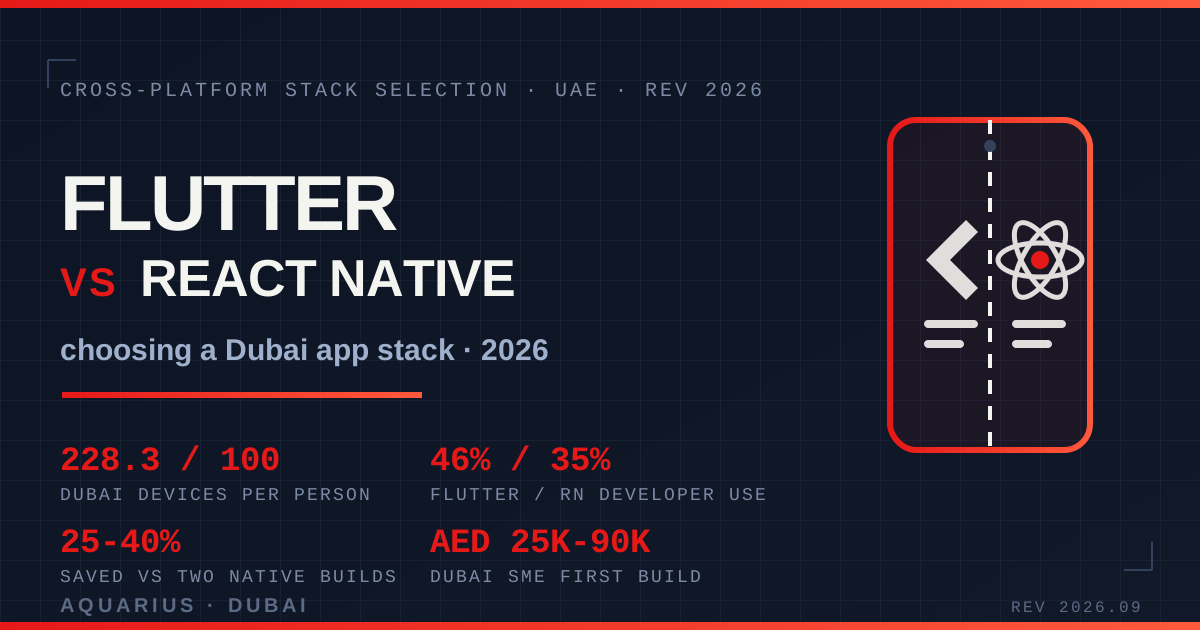
Short answer: For most Dubai businesses in 2026 the honest choice is Flutter when the app is design-heavy, animation-heavy and shipped by a small team, and React Native when the app must share logic with an existing React or Next.js web product or lean on a large JavaScript hiring pool. Both now ship near-native performance, both cut build cost by 25-40% versus two separate native apps, and both have working UAE PASS integrations. The framework is rarely what sinks a Dubai app project. What sinks it is picking the stack before checking which local integrations - UAE PASS, Aani, Network International, Arabic RTL - have maintained SDKs for that stack.
The Dubai numbers that set the stakes
Dubai is not a normal mobile market and you should not budget for it like one. Dubai's mobile market was worth AED 2.85 billion (about USD 777.8 million) in 2025, at a device penetration rate of 228.3 devices per 100 people - more than double the typical developed-market average. Across the UAE there were 22.1 million active cellular connections in early 2026, equal to 195% of the 11.4 million population, on near-total internet penetration of 99%.
Two more numbers change engineering decisions directly. Android holds 81.06% of UAE mobile OS share as of January 2026 - so an iOS-first build strategy imported from a US playbook is wrong here, and mid-range Android performance matters more than flagship iPhone frame rates. And UAE mobile and digital payment transaction value is forecast at USD 89.15 billion in 2026, with the national instant-payment rails already at 12.5 million users and roughly three-second transfers. An app that cannot take money natively in this market is leaving the fastest-moving part of the market alone.
The myth worth killing: "Flutter is faster, so pick Flutter." In 2026 both frameworks cleared the performance bar for 95% of commercial apps. The real cost difference shows up in hiring, in SDK maintenance, and in how much native code your integrations force you to write anyway.
What actually changed in both frameworks by 2026
React Native: the bridge is finally gone
Since version 0.76 the New Architecture - JSI, Fabric and TurboModules - is enabled by default in all React Native projects. That removed the asynchronous JSON bridge that caused most of React Native's historical reputation for jank, allowing synchronous JavaScript-to-native calls. Reported gains from the migration include roughly 40% faster startup, about 60% less UI-thread blocking on scroll-heavy screens and 15-25% lower memory use. If your only mental model of React Native is a 2021 project that stuttered on a product list, that model is out of date.
Flutter: Impeller is the default now
Flutter's Impeller renderer is no longer experimental - it is the default engine on iOS and on modern Android (API 29 and above), using precompiled shaders to remove the first-run shader-compilation jank that used to spoil Flutter demos. On Flutter's own gallery transitions benchmark, average frame rasterization time is now roughly half what it was under Skia. The API 29 floor is worth noting in a market as Android-heavy as the UAE: older budget handsets fall back to the legacy path, so test on the devices your customers actually carry, not on an emulator.
The ecosystem gap that still exists
On the 2024 Stack Overflow Developer Survey, Flutter was used by 9.4% of all developers versus 8.4% for React Native, and among people learning to code the gap widens to 11.1% against 6.7%. Within cross-platform work specifically the split is often quoted as 46% Flutter to 35% React Native - note that developers can report more than one framework, so these are adoption rates, not mutually exclusive market shares. Hiring tells the opposite story: React Native carries roughly 6,413 US LinkedIn job postings against Flutter's 1,068, about six times more, while Flutter specialists command higher salaries because supply is thinner. In Dubai that asymmetry is sharper still - the JavaScript talent pool here is deep, the Dart pool is not.
Side-by-side for a Dubai build
| Decision factor | Flutter | React Native |
|---|---|---|
| Rendering | Impeller default (iOS, Android API 29+); around 50% faster rasterization vs Skia | New Architecture default since 0.76; around 40% faster startup, 60% less UI-thread blocking |
| Best fit | Custom-designed, animation-rich UI; pixel-identical on both platforms | Apps sharing code, state logic or a design system with an existing React web app |
| Hiring in Dubai | Smaller Dart pool, higher day rates | Large JavaScript pool, easier and cheaper to staff and replace |
| UAE PASS | Multiple maintained packages, including app-to-app sign-in, SOP level detection, document sharing and PDF e-signature | Community module available; iOS 13+ required; thinner coverage of e-signature flows |
| Arabic and RTL | Directionality built into the widget layer; consistent across platforms | RTL supported, but layout parity needs more per-platform testing |
| Web reuse | Flutter Web works, but rarely the right answer for a marketing or SEO site | Direct code and skill reuse with React and Next.js sites |
| Watch out for | Larger binary size; legacy Android below API 29 falls back to Skia | Dependency churn; unmaintained native modules are the usual source of upgrade pain |
The UAE integrations decide more than the framework does
Here is the practical test we run before recommending a stack. List every local integration the app needs in year one - UAE PASS sign-in with Emirates ID, a UAE-acquired payment gateway, Aani or card-on-file, WhatsApp Business API notifications, Arabic RTL with correct numerals, delivery or mapping providers, and any regulator-specific hook such as DHA, RERA or VARA. Then check each one for a maintained SDK on the candidate framework.
UAE PASS is the clearest example. Flutter has several actively maintained packages covering app-to-app sign-in, full profile retrieval, SOP level detection (sop1, sop2, sop3), document sharing, PDF e-signature and token refresh. React Native has a community module that works for sign-in, with iOS 13 as the minimum, but thinner coverage of the signature and document flows - meaning a native bridge you write and then maintain yourself. That one difference can be worth more engineering hours than any benchmark on this page. If UAE PASS is on your roadmap, read our UAE PASS integration guide before the stack is locked.
The second test is the money path. With UAE digital payment value heading to USD 89.15 billion in 2026 and instant payments already at 12.5 million users, checkout is where a weak SDK costs revenue, not just time. Whichever framework you choose, insist that payments, push notifications and authentication run on first-party or well-maintained SDKs - never on an abandoned wrapper with a two-year-old last commit.
What each route costs in Dubai
Cross-platform is now the default here for a reason: more than 60% of new Dubai apps in 2026 are built on a single codebase, saving 25-40% against two native builds. Going fully native adds 40-60% to cost versus a single-codebase approach, and you pay that premium twice - once at build, then again on every feature for the life of the product. Most Dubai SMEs land between AED 25,000 and AED 90,000 for a first production build, with an MVP scope cutting initial spend by 30-50%.
| Scope | Typical Dubai range (AED) | Realistic timeline |
|---|---|---|
| MVP: auth, one core feature loop, push notifications | 25,000 - 45,000 | 5 - 8 weeks |
| Production app: payments, profiles, admin panel, analytics | 45,000 - 90,000 | 8 - 14 weeks |
| Regulated or integration-heavy (UAE PASS, DHA, RERA, ERP sync) | 90,000 - 220,000 | 14 - 24 weeks |
| Native iOS + Android instead of cross-platform | add 40 - 60% | add 30 - 50% time |
| Annual maintenance (both frameworks) | 15 - 25% of build cost per year | ongoing |
That maintenance line is the one most Dubai budgets ignore, and it is where an unmaintained native module turns into a five-figure surprise at the next iOS release. We break the numbers down in app maintenance cost in Dubai, and our current build packages are on the pricing page.
How Aquarius picks the stack
We do not have a house framework, and you should be suspicious of any Dubai agency that does - a one-framework shop will recommend its framework regardless of your roadmap. Our rule is simple. If you already run a React or Next.js product and want shared logic, a shared design system and easy hiring, we build React Native. If the app is consumer-facing, design-led, animation-heavy, needs deep UAE PASS work including e-signature, or must look identical on an AED 600 Android handset and an iPhone 17, we build Flutter. If the app is one narrow platform-specific job - CarPlay, complex background location, heavy on-device ML - we say native and keep the scope small.
Whichever way it lands, we ship the integration spike first: UAE PASS, payments and Arabic RTL proven in week one, before the UI budget is spent. If the spike fails, you have lost a week, not a quarter. Tell us what your app has to do and we will score both stacks against it and send you the reasoning, not a sales deck.
FAQ
Is Flutter or React Native faster in 2026?
Close enough that it should rarely decide the project. Flutter's Impeller renderer roughly halved frame rasterization time against Skia on Flutter's own transitions benchmark, while React Native's New Architecture delivered about 40% faster startup and 60% less UI-thread blocking on scroll-heavy screens. Both clear the bar for commercial apps. Test on mid-range Android - the devices that dominate UAE share - not on a flagship.
Which is cheaper to build in Dubai?
Build cost is roughly the same; both save 25-40% versus two native apps, with most Dubai SMEs paying AED 25,000 to AED 90,000 for a first production build. React Native usually costs less to staff and maintain in Dubai because the JavaScript hiring pool is far larger; Flutter can cost less overall when the design is complex, because you build one UI instead of reconciling two.
Does UAE PASS work with both?
Yes, but not equally. Flutter has several maintained packages covering app-to-app sign-in, SOP level detection, document sharing and PDF e-signature. React Native's community module handles sign-in with iOS 13 as the minimum, but expect to write and maintain native code for the signature and document flows.
Should we build native instead?
Only for a specific reason - heavy background location, on-device ML, deep OS integrations, or a platform-exclusive product. Native adds 40-60% to build cost and repeats that premium on every future feature, which is why over 60% of new Dubai apps in 2026 ship cross-platform.
Can we start cross-platform and go native later?
Yes, and it is a sensible sequence. Ship cross-platform to validate demand, keep your business logic in a clean API layer rather than in the UI, then rebuild only the one screen or module that genuinely needs native performance. An MVP-first approach cuts initial spend by 30-50%, which buys the evidence you need before committing to two codebases.