
We Scanned 787 .ae Homepages for Form Autofill: Only 6.3% of Fields Tell the Browser What They Are (2027 Data)
First-hand scan of 1,955 form fields on 787 .ae homepages: only 6.3% carry a real autocomplete token, 204 carry autocomplete="off", and 0 of 17 OTP fields are tagged for SMS autofill.
- PUBLISHED
- 26 NOV 2026
- READ TIME
- 13 MIN
- AUTHOR
- AQUARIUS · DUBAI
- UNIT
- REV 2026.09
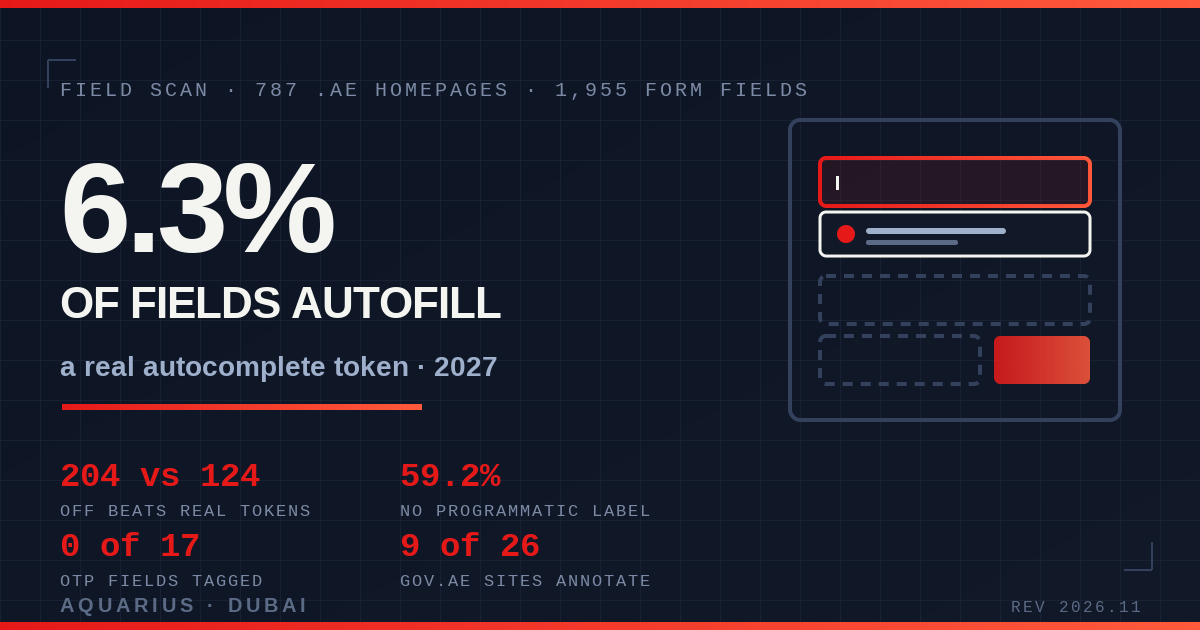
Short answer: we fetched 787 of the most-visited .ae homepages and read every form field in the HTML they served. Of 1,955 real input fields, only 124 — 6.3% — carry a valid autocomplete token that lets a browser fill them. 204 fields carry autocomplete="off". Across the UAE's busiest websites, switching autofill off outnumbers switching it on by 1.6 to 1.
Why a markup attribute is a revenue line in Dubai
Three numbers frame the stakes. First, the market: the EZDubai and Euromonitor International UAE E-commerce Landscape report puts UAE e-commerce at AED 42.2 billion (USD 11.5bn) in 2025, up from AED 17.6bn in 2020 — a 19% compound growth rate — and projects roughly AED 67.2bn by 2030, taking e-commerce past 20% of total retail. Second, the device: StatCounter put UAE traffic at 67.8% mobile against 31.37% desktop in October 2026. Those AED 42.2bn are being typed with thumbs.
Third, the cost of typing. Chrome's own engineering team, reporting on telemetry from thousands of forms across millions of page loads, found that users abandon forms 75% less frequently when they use autofill, and spend about 35% less time filling them. Chrome is explicit that this is a correlational study, not a controlled experiment — but the direction is backed by harder commerce data: Google reported in December 2024 that guest checkouts using autofill converted 45% better than guest checkouts without it. Against a 70.22% average cart abandonment rate (Baymard's unweighted average of 50 studies), a field the browser cannot fill is not a cosmetic issue.
Most Dubai businesses get this backwards. They buy traffic at AED 8–25 a click and then ship a mobile lead form where the browser has no idea which box is the email address.
What we measured, and how
We took 787 .ae hosts from a public popularity ranking, requested each homepage with a mobile Chrome user agent, followed redirects, and parsed every <input>, <select>, <textarea>, <form> and <label> element in the HTML returned. 683 hosts answered. 567 returned usable HTML; 116 answered non-2xx, of which 106 were bot-protection 403s.
Of those 567 pages, 421 ship at least one field, but most of those are a search box. 275 hosts (48.5%) ship at least one non-search field — a login, newsletter, enquiry, booking or checkout input. Those 275 hosts gave us 1,955 non-search fields, and that is the denominator for everything below.
One honest caveat: this is a static read of server-rendered HTML. Forms injected later by React, Vue or a chat widget are invisible to it, and 146 of the 567 pages ship no field markup at all. So these are floor numbers describing the markup that actually arrives in the first response — which is also the markup a crawler, a screen reader and a cold-start browser see.
The results: "off" beats "on"
| Measure | Count | Share |
|---|---|---|
| Hosts with a real (non-search) form field | 275 of 567 | 48.5% |
Those hosts using autocomplete anywhere | 96 of 275 | 34.9% |
Hosts with fields and zero autocomplete | 179 of 275 | 65.1% |
| Fields carrying the attribute at all | 336 of 1,955 | 17.2% |
— of which autocomplete="off" | 204 | 60.7% of those |
| — of which a valid autofill token | 124 | 6.3% of all fields |
— of which invalid junk (nope, random strings) | 6 | 1.8% of those |
| Fields with no programmatic label | 1,157 of 1,955 | 59.2% |
The entire valid-token census across the UAE's top 787 homepages is twelve values deep: email 51, tel 17, name 15, new-password 14, current-password 12, username 6, given-name 4, family-name 4, url 1. That is it. No address-line1, no postal-code, no cc-number, no one-time-code.
Email and phone: the two fields Dubai actually needs filled
We found 334 email fields. Only 239 (71.6%) use type="email", and only 53 (15.9%) declare autocomplete="email". The other 281 ask a user on a phone to type their address into a generic text box with a QWERTY keyboard and no "@" key in reach.
Phone fields are worse. Of 131 phone fields, only 61 (46.6%) use type="tel" — less than half — 17 declare autocomplete="tel", 10 set a pattern, and just 6 set an inputmode. Four are typed as number, which silently mangles a leading zero and shows spinner arrows on a phone number. Six fields across three hosts — including a major Dubai attraction — use type="phone", which is not an HTML input type at all and falls back to plain text. Only five placeholders anywhere mention +971.
Then there is the active sabotage: 68 fields apply autocomplete="off" to exactly the inputs a browser is best at filling — 25 email fields, 24 passwords, 16 name fields, 3 phone numbers. Thirty hosts go further and set autocomplete="off" at form level, 56 forms in total. Worth knowing: per web.dev's autofill guidance, browsers and password managers deliberately ignore off on password fields, because sites were using it to break password managers. So half of that effort does not even work — it just loses the email and name autofill that would have worked.
The OTP blind spot
Seventeen one-time-code fields appeared in the scan — OTP and verification inputs on a hospital portal, an insurer, a property platform, a retailer. Zero of them declare autocomplete="one-time-code".
This matters more in the UAE than almost anywhere, because SMS OTP is the default second factor here: the TDRA reports UAE PASS at 12.5 million registered users, 600 million logins and 12 million digitally signed documents. The fix is three attributes — type="text", inputmode="numeric", autocomplete="one-time-code" — after which iOS and Android offer the code straight from the notification, and Chrome's WebOTP API can read it with one tap. Seventeen for seventeen, nobody claimed it.
59.2% of fields are unlabelled, and 141 are anonymous
Autofill does not run on autocomplete alone. As web.dev documents, browsers store values against a field's name (and sometimes id), so a sensibly named field often autofills even untagged. That escape hatch is being closed too: 196 fields on 72 hosts carry opaque framework-generated names — one UAE federal financial site ships 13 fields whose name and id are both raw GUIDs — and 141 fields have neither a name nor an id. Nothing can learn those.
Meanwhile 1,157 of 1,955 fields (59.2%) have no programmatic label at all: no <label for>, no aria-label, no aria-labelledby. 569 of them lean on a placeholder, which vanishes the moment a user types and is not a label. This is the same pattern we found in our WCAG failure scan of .ae homepages: the failures cluster on the elements closest to the money.
The government problem
Fifty-nine .gov.ae hosts answered. Twenty-six ship real fields — 115 fields in total — and only 9 of those 26 use autocomplete anywhere; 27 of the 115 fields carry it. That is a compliance gap, not a style preference: WCAG Success Criterion 1.3.5 Identify Input Purpose is Level AA, and it is met by programmatically exposing a field's purpose using exactly these tokens. The UAE's National Policy for Digital Accessibility commits federal entities to "the Web Content Accessibility Guidelines (WCAG) 2.1 & 2.2 Level AA standards, as a minimum." An untagged email field on a federal form is an AA failure sitting in plain sight.
Arabic forms are doubly stranded
52 pages in the set serve dir="rtl", 35 of them with fields: 139 RTL form fields, exactly one of which sets dir on the field itself, and 16 of which carry a real token. Email addresses and phone numbers are left-to-right strings inside a right-to-left layout, so without a field-level dir="ltr" the caret and the +971 prefix jump around as the user types. We unpacked the wider pattern in our Arabic RTL readiness scan.
What correct markup looks like
This is the whole fix. Nine lines of attributes covering the fields 90% of Dubai lead forms and checkouts actually use, with what our scan found for each.
| Field | Correct markup | Found in scan |
|---|---|---|
type="email" + autocomplete="email" | 15.9% tagged | |
| UAE mobile | type="tel" + inputmode="tel" + autocomplete="tel" | 13.0% tagged |
| Full name | autocomplete="name" (or given-name / family-name when split) | 10.9% tagged |
| Login | autocomplete="username" + current-password | 6 username, 12 current-password sitewide |
| Signup password | autocomplete="new-password" (triggers suggested passwords) | 14 fields sitewide |
| SMS OTP | inputmode="numeric" + autocomplete="one-time-code" | 0 of 17 |
| Address | address-line1, address-level2 (Dubai), country | 0 fields |
| Card | cc-number, cc-exp, cc-csc (never off) | 0 fields |
| Arabic layout | add dir="ltr" to email, tel and numeric fields | 1 of 139 |
Two rules that catch most teams out. One: autocomplete must sit on the field, not only on the form, and the token has to be a real one — nope and random hashes appeared six times in our data and are simply ignored. Two: a visible <label for> is not optional decoration; it is what makes the field usable at 320px and what makes SC 1.3.5's sibling criteria pass.
What it costs to fix in Dubai
This is the cheapest conversion work available to a UAE business, because nothing has to be redesigned. No new layout, no new copy, no A/B test infrastructure — attributes on existing inputs. Typical Aquarius engagement ranges:
| Scope | Typical AED | Timeline |
|---|---|---|
One lead form: tokens, types, labels, +971 handling | 2,500 – 4,500 | 2 – 3 days |
| Full-site field audit (up to 10 forms) with a prioritised report | 6,000 – 9,500 | 1 week |
| Checkout or multi-step application rebuilt for autofill + OTP | 18,000 – 35,000 | 3 – 5 weeks |
| Quarterly re-scan against WCAG 1.3.5 after each release | 1,800 – 3,000 per quarter | ongoing |
How we run it: we scan your live HTML the way we scanned these 787 hosts, field by field, and hand back a table of every input with its current type, name, label state and token, next to what it should be. We fix them, then test on a real iPhone and a real Android with saved profiles — because the only proof that matters is the browser offering the right value on the first tap. Government and regulated clients get the findings mapped to SC 1.3.5 so the work is auditable.
Risk reversal: if our audit cannot find at least ten fields on your site that a browser currently refuses to fill, you pay nothing for it. On the evidence above — 65.1% of UAE sites with forms have zero tokens — that is a bet we are happy to take. See our pricing or send us your form URL and we will tell you what the browser sees before you commit to anything.
FAQ
Does autocomplete="off" actually stop autofill?
Partly, and unpredictably. Browsers honour it on ordinary fields, which is why 204 fields in this scan are losing autofill on purpose. They deliberately ignore it on password fields, because sites abused it to break password managers. So off reliably costs you conversions on email and name fields while failing at the thing it was added for.
Is autocomplete a legal requirement in the UAE?
For federal entities, effectively yes. WCAG SC 1.3.5 Identify Input Purpose is Level AA, and the UAE National Policy for Digital Accessibility sets WCAG 2.1 and 2.2 Level AA as the minimum for government digital services. Private companies are not bound by that policy, but the same criterion is what accessibility audits and procurement questionnaires test against.
We use React and our fields are generated. Does autofill still work?
Not well, which is what the data shows: 196 fields on 72 hosts have opaque generated names and 141 have no name or id at all. Browsers lean on name to recognise a field, so a GUID blinds the heuristic. With a generated form you must set the tokens explicitly — there is no fallback left.
How should a UAE phone field be built?
type="tel" with inputmode="tel" and autocomplete="tel", a visible label, and a separate non-editable +971 prefix or a country selector rather than a pattern that rejects the formats people actually paste. Never type="number": it drops leading zeros and renders spinners. And never type="phone" — it does not exist, though six fields in this scan use it.
Will one-time-code autofill work on all phones?
It works on iOS and Android where the SMS follows the expected format, and Chrome adds the WebOTP API for a one-tap read. Where it is unsupported, the attribute is ignored harmlessly — so there is no downside to shipping it, which makes 0 of 17 the most avoidable number in this dataset.
The one-line takeaway
Across 787 of the UAE's busiest homepages, the browser is told what a form field means 6.3% of the time, and told to stay out of the way 10.4% of the time. Every Dubai business buying mobile traffic is paying for taps it could have removed with an attribute. Send us one form URL — we will show you exactly which fields your users are typing by hand for no reason.