
Gold & Jewellery Ecommerce in Dubai (2026): Live Rate Pricing, Hallmarks, VAT and What It Costs to Build
The UAE traded AED 625 billion in precious metals in 2024, yet 84.9% of jewellery still sells offline. What a live-rate gold ecommerce build costs in AED, and the pricing engine most jewellers skip.
- PUBLISHED
- 14 SEPT 2026
- READ TIME
- 10 MIN
- AUTHOR
- AQUARIUS · DUBAI
- UNIT
- REV 2026.09
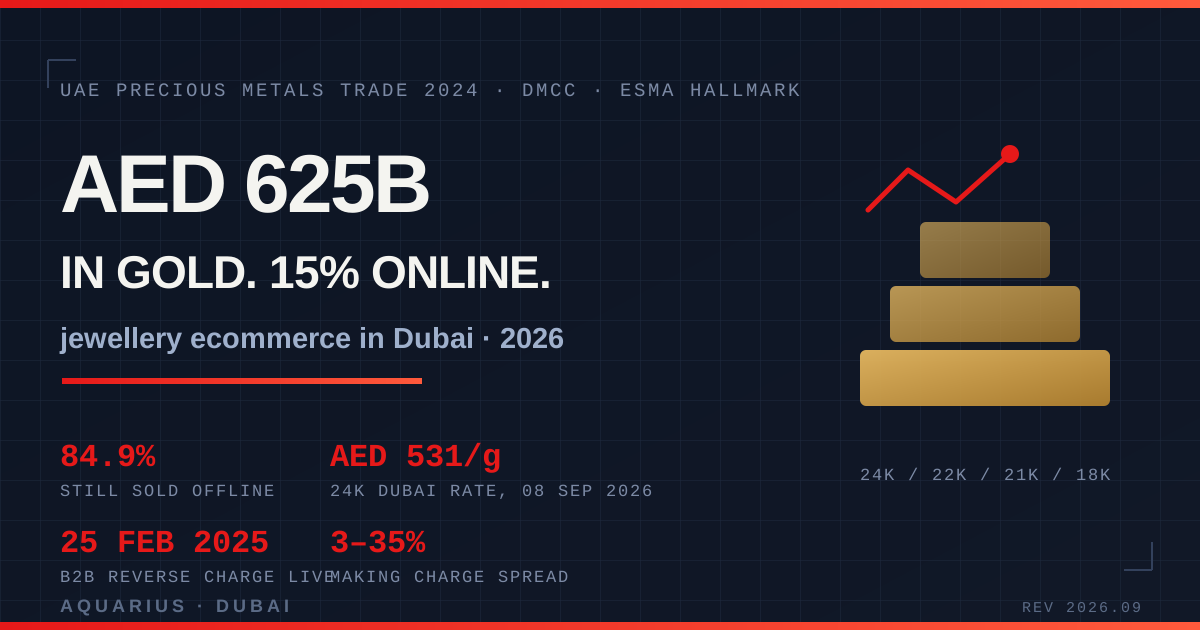
Short answer: A Dubai jewellery brand should budget AED 22,000–55,000 for a bilingual catalogue store with live gold-rate pricing, AED 60,000–150,000 for a full commerce build with a karat-wise rate engine, ESMA hallmark data, VAT logic and insured delivery, and AED 180,000–450,000 for a multi-branch platform with buyback, gold-savings schemes and ERP integration. The hard part is not the storefront. It is that gold has no fixed price — the Dubai Gold & Jewellery Group publishes a new rate every single day, and a jeweller who hard-codes prices into a template store is either bleeding margin or quoting customers a number they can disprove in four seconds on their phone.
Key takeaways
- The trade is vast, the online share is not. UAE foreign trade in precious metals hit roughly AED 625 billion (USD 170 billion) in 2024, up 27% year on year and 79% in two years — yet 84.9% of UAE jewellery still sold through offline stores in 2024.
- Dubai is the second-largest physical gold hub on earth, behind only Switzerland, with 1,500+ DMCC member companies across precious metals, stones and diamonds, and 300+ retailers inside the Deira Gold Souk alone.
- Price is a feed, not a field. On 8 September 2026 the Dubai rate was AED 531.00/g for 24K, AED 491.75 for 22K, AED 471.50 for 21K and AED 404.25 for 18K. Every licensed Dubai retailer charges that same published metal rate — you compete on making charge, not on gold.
- Making charges run 3–35% depending on craft: 3–8% machine-made chains and bangles, 8–15% standard necklaces and earrings, 15–25% intricate handmade, 20–35% antique and Jadau work. That spread is your entire online margin model.
- VAT is three different rules inside one catalogue. Jewellery carries 5% VAT; investment-grade metal at 99%+ purity in tradable form is zero-rated; and since 25 February 2025, Cabinet Decision No. 127 of 2024 applies the reverse charge mechanism to B2B supplies between VAT-registered businesses.
- Hallmarking is not optional online. Under the UAE National Precious Metals Assaying and Hallmarking Scheme administered by ESMA, every wrought gold article sold in the UAE — in a shop or on a website — must carry an official UAE or recognised foreign hallmark.
The market is enormous. The online slice is the only part still empty
Start with the size of the prize. UAE foreign trade in precious metals reached approximately AED 625 billion (USD 170 billion) in 2024, a 27% jump on the prior year and 79% growth across two years. Dubai is the world's second-largest physical gold trading hub after Switzerland, and DMCC now counts more than 1,500 member companies across precious metals, stones and diamonds. On the stones side, Dubai recorded a record USD 41.7 billion diamond trade in 2025, while UAE lab-grown diamond volumes surged 92% to a record 76.9 million carats.
Retail is a healthy slice of that. The UAE jewellery market was estimated at around USD 5 billion in 2025, forecast to reach USD 8.87 billion by 2035 at a 5.90% CAGR. The luxury segment alone was worth about USD 1.24 billion in 2025, heading to USD 2.24 billion by 2030 at a 10.36% CAGR — and Dubai holds roughly 52.73% of that UAE luxury share.
Now the number that should make every Dubai jeweller uncomfortable: offline retail stores held 84.9% of UAE jewellery distribution in 2024. Meanwhile the wider UAE ecommerce market hit USD 12.30 billion in 2026 with 11.04 million online shoppers, on its way to USD 21.01 billion by 2031 at an 11.29% CAGR. Fashion already takes a 22% category share and drives 38.7% of UAE ecommerce revenue. Jewellery sits directly adjacent to that spend and captures almost none of it, because most jewellers have a brochure site, not a store.
Why most Dubai jewellery sites fail: the pricing engine
Here is the thing almost every Dubai jeweller gets wrong. They put a Shopify or WooCommerce theme up, photograph 200 pieces, and type a price into each product. Two weeks later the gold rate has moved and all 200 prices are wrong. The team then either freezes the catalogue, marks everything “price on request” — killing conversion entirely — or quietly absorbs the swing.
The correct model is that a price is computed, never stored:
Retail price = (metal rate for karat × net weight in grams) + making charge + stone value + 5% VAT
The Dubai Gold & Jewellery Group publishes one daily rate per karat, and the Government of Dubai displays that live retail rate on outdoor boards in prominent trading locations including the Gold Souk. Every licensed retailer uses the same metal rate. So your product record stores karat, net weight, gross weight, stone weight, stone value and making-charge percentage — and the rate arrives from a feed. That single architectural decision is the difference between a catalogue you can run with 3,000 SKUs and one that needs a person re-typing prices every morning.
Two things ride on top of it. First, a rate-lock window: when a customer adds to cart, freeze the quoted rate for 10–20 minutes and show a countdown. Gold buyers understand this immediately, and it protects you from adverse movement between cart and capture. Second, a transparent price breakdown on the product page — metal, making, stones, VAT, as separate lines. Dubai buyers price-check against the souk. Showing the breakdown converts better than hiding it, because the only variable you actually control is the making charge, and an itemised page lets a 12% charge on fine handmade work justify itself against a machine-made 5%.
What actually has to be built
1. Karat-wise rate engine and product model
Daily rate ingestion for 24K, 22K, 21K and 18K, with manual override and an audit log. Weight-based product records. Per-category making-charge rules. A recalculation job that reprices the whole catalogue when a new rate lands, plus historical rate storage so you can reprint an invoice from three months ago at the rate it was actually sold at.
2. Hallmark and certification data as a first-class field
ESMA hallmarking applies to online sales exactly as it does in store, and UAE authorities have been tightening enforcement against fake certification in diamond jewellery. Practically: store the hallmark, purity, assaying centre and — for stones — the certificate number and lab, then surface them on the product page alongside a photo of the hallmark itself. This is a trust asset, not a compliance chore. It is the single strongest objection-killer for someone spending AED 9,000 on a piece they cannot hold.
3. VAT logic that handles three cases
Your checkout must distinguish: standard jewellery at 5%; investment precious metal — gold, silver or platinum at 99% purity or above in a form tradable on global bullion markets — at 0%; and B2B supply to another VAT-registered business under the reverse charge mechanism introduced by Cabinet Decision No. 127 of 2024, published 27 December 2024 and effective 25 February 2025, which replaced Cabinet Decision 25 of 2018 and widened the scope to gold, silver, palladium, platinum, natural and synthetic diamonds, pearls, rubies, sapphires and emeralds. Under RCM you do not charge the VAT — the registered buyer self-accounts for it, and your invoice has to say so. If you sell to trade as well as consumers, that is a customer-type flag driving invoice generation, not an accounting afterthought. Our guide to VAT-compliant ecommerce invoicing in the UAE covers the mandatory tax-invoice fields in detail.
4. High-value fulfilment
Insured courier with signature and ID verification on delivery, serialised packing with tamper-evident seals, KYC thresholds on large orders, and a returns policy that accounts for resized or engraved pieces. Cash on delivery, normal elsewhere in UAE ecommerce, needs a hard value ceiling here. And for tourists buying in store and claiming the UAE tourist VAT refund — roughly 85% of the VAT paid, less an admin fee — the POS and the online system should share one customer record so the refund flow does not break.
5. Payments and instalments
Network International, Telr, PayTabs, Tap or Stripe for cards, with 3-D Secure enforced at these ticket sizes. Buy-now-pay-later matters more in jewellery than almost any other category, because a bridal set is a planned, financed purchase — see our breakdown of Tabby and Tamara integration for Dubai stores. Gold-savings and instalment schemes, where a customer pays monthly and accumulates grams rather than dirhams, need a dedicated ledger and should never be bolted onto a generic subscription plugin.
What it costs in Dubai in 2026
Real AED ranges for a UAE-based build, excluding VAT, product photography and inventory:
| Tier | What you get | Typical AED | Timeline |
|---|---|---|---|
| Catalogue store | Bilingual EN/AR storefront, up to ~300 SKUs, daily rate feed with karat-wise auto-pricing, enquiry-to-WhatsApp, card payments | AED 22,000–55,000 | 3–5 weeks |
| Full commerce build | The above plus rate-lock cart, itemised price breakdown, hallmark and certificate records, 5% / 0% / reverse-charge VAT logic, insured delivery, BNPL, returns and exchange flows | AED 60,000–150,000 | 6–10 weeks |
| Multi-branch platform | The above plus branch-level stock, POS and ERP sync, buyback and old-gold exchange valuation, gold-savings scheme ledger, wholesale B2B portal with trade pricing tiers | AED 180,000–450,000 | 3–6 months |
Budget a further 15–20% of build cost annually for maintenance, rate-feed monitoring, security patching and support. Our full AED pricing is published upfront, and the general mechanics of UAE gateways, COD and shipping are covered in our guide to ecommerce website development in Dubai.
The cost of staying offline
Run the arithmetic on inaction. A mid-sized Dubai jeweller turning over AED 12 million a year in store, in a market where 84.9% of sales are still offline and UAE ecommerce is compounding at 11.29% a year toward USD 21.01 billion by 2031, is fighting for a shrinking share of walk-in footfall while the growth channel goes to brands that shipped a rate-engine store. Capturing even 8% of that revenue online — AED 960,000 a year — repays an AED 150,000 full build inside the first two quarters. Dubai's wholesale and retail trade sector alone produced AED 50.9 billion in real gross value added in Q1 2026, about 22% of Dubai's GDP, and the Dubai Traders programme added more than 2,400 new ecommerce sellers in its first year. The competitive set is forming right now.
How Aquarius builds it
We treat the rate engine as the core of the product and the storefront as a skin over it. That means a schema designed around karat and weight from day one, the daily published rate ingested and versioned, prices computed at render and locked at cart, VAT resolved by product class and customer type, and hallmark and certificate data rendered as a visible trust block rather than buried in a tab. Bilingual EN/AR with genuine RTL, not a translated theme. Full source-code handover, your cloud accounts, your data, fixed scope in AED, and a hard launch date. If your existing store already has the catalogue and the photography, we will often rebuild only the pricing and checkout layer — the cheapest version of this project is the one that reuses what already works.
FAQ
Can I legally sell gold jewellery online in Dubai?
Yes, with the right trade licence and the same hallmarking obligations as a physical shop. Under the UAE National Precious Metals Assaying and Hallmarking Scheme administered by ESMA, every wrought gold article sold in the UAE must carry an official UAE hallmark or a recognised foreign hallmark before it can legally be sold — online sales are explicitly included.
How do I price products when the gold rate changes daily?
Do not store prices. Store karat, net weight, stone value and making-charge percentage, then compute the price against the daily published rate. On 8 September 2026 that rate was AED 531.00/g for 24K and AED 491.75/g for 22K. Add a 10–20 minute rate lock at cart so the customer pays the price they were quoted.
Is VAT 5% on everything I sell?
No. Jewellery is standard-rated at 5%. Investment precious metals at 99% purity or higher, in a form tradable on global bullion markets, are zero-rated. And B2B supplies to other VAT-registered businesses fall under the reverse charge mechanism per Cabinet Decision No. 127 of 2024, effective 25 February 2025 — you do not charge VAT, the buyer self-accounts for it. Your checkout needs all three paths.
What making charge should I show online?
Whatever is true for the piece. Dubai making charges run 3–8% for machine-made chains and bangles, 8–15% for standard necklaces and earrings, 15–25% for intricate handmade work and 20–35% for antique or Jadau pieces. Showing it as a separate line beats hiding it inside one figure, because the metal rate is public and buyers will reverse-engineer your margin anyway.
How long does a jewellery ecommerce build take?
A bilingual catalogue store with live rate pricing takes 3–5 weeks. A full commerce build with rate-lock, hallmark records, three-case VAT and insured delivery takes 6–10 weeks. A multi-branch platform with POS and ERP sync, buyback valuation and a gold-savings ledger runs 3–6 months.
Start with the rate engine
The Dubai gold market is one of the largest and most transparent on the planet, and that transparency is exactly why a generic template store fails here: the metal price is public, so your website has to compete on trust, craft and clarity instead. Build the pricing engine first and the rest of the store becomes straightforward. Tell us your SKU count, karat mix and whether you sell to trade, and we will come back with a fixed AED scope and a launch date — usually within two working days.