
Google November 2026 Core Update: The Dubai Recovery Plan
Google's November 2026 core update started 10 Nov and is still rolling out. What changed, how to read your Search Console data, and what recovery costs in Dubai in AED.
- PUBLISHED
- 21 NOV 2026
- READ TIME
- 09 MIN
- AUTHOR
- AQUARIUS · DUBAI
- UNIT
- REV 2026.09
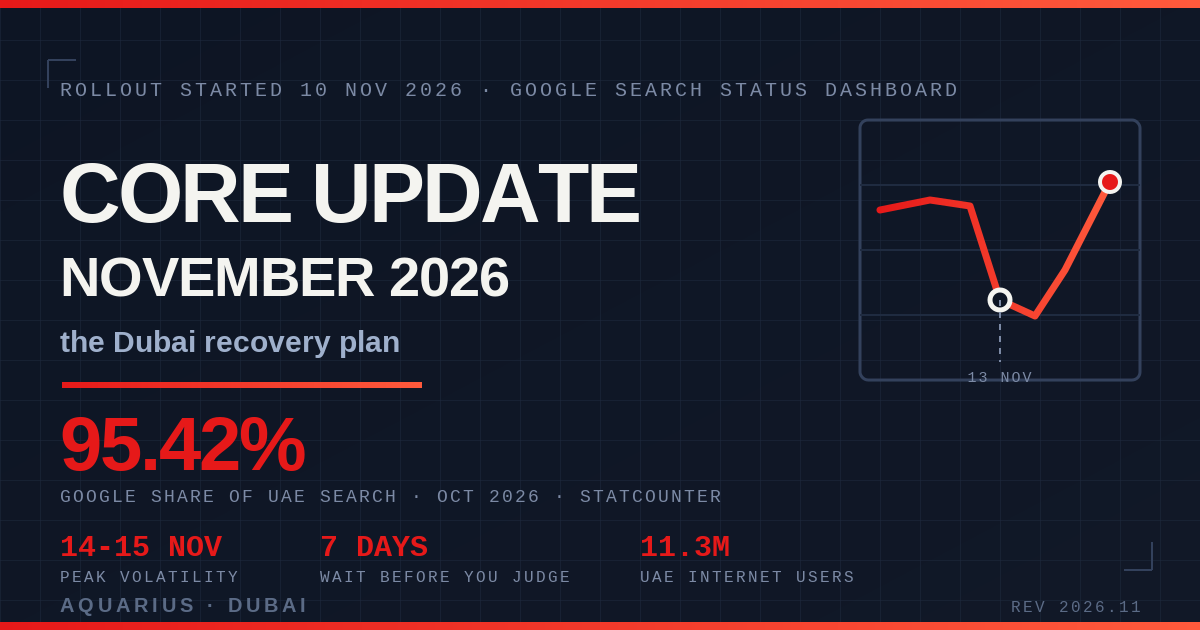
Short answer: Google’s November 2026 core update began rolling out on 10 November 2026 and was still listed as in progress on the Search Status Dashboard as of 21 November, with volatility peaking around 14–15 November. If your Dubai site lost rankings, Google’s own instruction is to wait until the rollout is marked complete and then at least one more week before you analyse anything — and to avoid changing content that is still performing.
That waiting period is exactly where most Dubai businesses get this wrong. Within 48 hours of a traffic dip, somebody rewrites the homepage, deletes 40 blog posts, swaps the agency and buys links. Then the rollout finishes, rankings partially settle back, and nobody can tell what the panic actually did.
Why a Google core update is a bigger deal in the UAE than almost anywhere
Google is not one channel among many here — it is close to the whole channel. StatCounter put Google at 95.42% of all UAE search traffic in October 2026 (Bing 2.71%, Yandex 1.33%, Yahoo 0.24%, DuckDuckGo 0.17%), and on UAE mobile the share has run as high as 98.08%. There is no meaningful second search engine to absorb a loss.
The audience behind that share is effectively the entire country. DataReportal’s Digital 2026 report counted 11.3 million internet users in the UAE at the end of 2025 — 99.0% penetration, up 288,000 users (+2.6%) year on year. When a core update reshuffles the first page, it reshuffles access to a near-fully-online market of 11.3 million people.
And this one landed in the worst possible week commercially: mid-November into December is peak season for Dubai retail, travel, fit-outs, school enrolment and year-end B2B budget spend.
What we actually know about the November 2026 core update
- Announced: Tuesday 10 November 2026, 10:06 US Pacific time, global, all languages.
- Expected duration: up to two weeks — which points to roughly 24 November 2026.
- Status: the Search Status Dashboard still showed no end time as of 20–21 November, so it is not confirmed finished.
- Volatility: trackers showed movement from 9 November, with the sharpest swings on 14–15 November; several analysts pegged the first real impact to Friday 13 November.
- Google’s stated aim: to better surface relevant, satisfying content from all types of sites.
Useful context: core updates have been getting faster, not slower. The March 2026 core update ran 12 days 4 hours and the May 2026 core update 11 days 21 hours, versus roughly 24 days for November 2024 and 26 days for November 2023. Shorter rollouts mean less time to misread noise as a verdict.
Read the pattern before you touch anything
A core update does not hand out a single punishment. It re-scores relevance, so the shape of your loss tells you what to fix. Use this matrix on Search Console data compared week-over-week against the week before 10 November — not against last month, and not against last year.
| What you see | Most likely cause | Correct response |
|---|---|---|
| Clicks down 5–15%, impressions flat, positions within 1–3 places | Normal rollout noise plus SERP layout shift | Nothing. Re-measure 7 days after completion. |
| Informational blog pages down hard, service and product pages stable | Thin or templated content being re-scored against better answers | Consolidate and genuinely deepen the best pages; delete nothing yet. |
| Impressions hold but CTR collapses on head terms | AI Overviews and SERP features eating the click, not a ranking loss | Optimise for citation and bottom-funnel intent — see our guide to AI Overviews in the UAE. |
| Whole site down 20%+ across every template | Site-wide quality or trust signal, or an unrelated technical fault | Full technical and E-E-A-T audit before any content work. |
| Drop starts before 9 November or after 24 November | Not the core update at all — migration, indexing, Core Web Vitals, tracking | Check logs and deploy history; a bad migration is a common culprit. |
Two rules make this matrix work. First, Google is explicit that for small drops “there’s no need to take drastic action (in fact, we recommend avoiding making changes to content that’s already performing well)”. Second, recovery is slow by design: Google says some changes take effect in a few days, but it could take several months — and sometimes not until the next core update. A fix shipped in November may not be scored until the next one.
The seven-day rule, written out
- Day 0 — confirm, don’t react. Check the Search Status Dashboard. If the update is still rolling, your data is mid-flight. Log the drop, change nothing.
- Rollout complete + 7 days. Only now open Search Console. Compare the latest full week with the week ending 9 November 2026.
- Segment, then diagnose. Split by template, by intent and by query type. Site-wide loss and page-type loss need opposite responses.
- Rule out the non-Google causes. Dubai sites commonly lose traffic in the same window from an expired SSL on a subdomain, a blocked staging robots.txt pushed live, or a theme update that killed internal links.
- Fix the worst 10 pages properly. Real added expertise, real UAE specifics — AED figures, local regulation, named locations — not a word-count top-up.
- Leave winners alone. The pages that gained are telling you what the new scoring likes.
- Expect the next core update to be the scoring moment. Judge the work then.
What recovery costs in Dubai in 2026
Core update recovery is not a product, it is scoped work. Dubai market rates for ongoing SEO run from roughly AED 1,500 to AED 50,000+ per month depending on competition and scope — our full breakdown is in the 2026 Dubai SEO cost guide. For recovery specifically, this is what the bands buy:
| Scope | Dubai rate (2026) | What it covers | First read-out |
|---|---|---|---|
| Diagnostic only | AED 1,500–5,000 one-off | Segmented Search Console analysis, technical rule-out, prioritised fix list | 7–10 days |
| SME recovery retainer | AED 3,000–8,000/month | Technical SEO, 4–12 content rebuilds a month, internal linking, tracking | Next core update |
| Competitive / multi-service | AED 3,000–10,000/month | Above plus entity and E-E-A-T work, PR-grade citations, AI-search visibility | Next core update |
| Enterprise / multi-market | AED 10,000–50,000+/month | Multi-domain, multi-language GCC rollout, log-file and crawl-budget work | 1–2 cycles |
Beware the AED 999–1,500 “recovery package”. After a core update it is almost always mass-generated content and link blasts — which is the behaviour Google’s own scaled content abuse policy targets. You can turn a 15% dip into a manual action for a monthly fee smaller than a team lunch.
The cost-of-inaction number is the one that should decide it: credible 2026 benchmarking puts organic search return at about AED 7.48 for every AED 1 invested. A Dubai SME on a AED 6,000/month retainer that sits out two core update cycles is not saving AED 36,000 — it is forgoing several times that in pipeline, in the one channel that owns 95% of UAE search.
How Aquarius handles a core update drop
We do not sell panic. Our first deliverable is a segmented diagnostic that tells you whether the November 2026 core update actually touched you — because in roughly half the cases we review, the drop traces to a deploy, a tag container or a migration, not to Google. If it is the update, you get a page-level fix list ranked by revenue impact, and we tell you plainly which pages to leave alone.
Risk reversal: the diagnostic is fixed-fee and the output is yours whether or not you retain us. If we cannot find a defensible cause, we say so and refund it. See what we do or send us the drop and we will tell you what it is.
FAQ
Has the November 2026 core update finished?
Not as of 21 November 2026. Google started it on 10 November, said it could take up to two weeks (around 24 November), and the Search Status Dashboard still showed no completion time. Always confirm there before analysing data.
How long does recovery from a core update take?
Google’s guidance is that some changes can take effect in a few days, but it could take several months — and improvements may not be reflected until the next core update. Plan in cycles, not weeks.
Should I delete low-traffic blog posts after a drop?
Rarely, and never during a rollout. Deletion removes internal links and historical signals. Consolidating several thin pages into one genuinely better page is the safer move, and only after you have confirmed content — not technical issues — caused the loss.
My rankings dropped but my Dubai competitors did too. What does that mean?
Usually that the whole query space was re-scored. Measure relative visibility, not absolute clicks: if everyone fell and you fell least, you gained share. Comparing yourself only against your own previous week hides that.
Can AI Overviews explain a drop that looks like a core update?
Yes, and it is the most common misdiagnosis in the UAE right now. If impressions hold and clicks fall, your position probably did not move — the SERP did. That is a different fix: being the cited source rather than the tenth blue link.
Sitting on an unexplained traffic drop from the last two weeks? Send us the Search Console screenshot — we will tell you whether it is the core update or something you can fix on Monday.