
We Parsed 21,274 Headings on 515 UAE Homepages: Only 15.7% Have a Clean Outline
We parsed every heading on 515 live .ae homepages on 28 Nov 2026. 25.6% have no H1, 57.3% skip a level, 49.1% do not start at H1, and only 15.7% have a clean outline.
- PUBLISHED
- 28 NOV 2026
- READ TIME
- 11 MIN
- AUTHOR
- AQUARIUS · DUBAI
- UNIT
- REV 2026.09
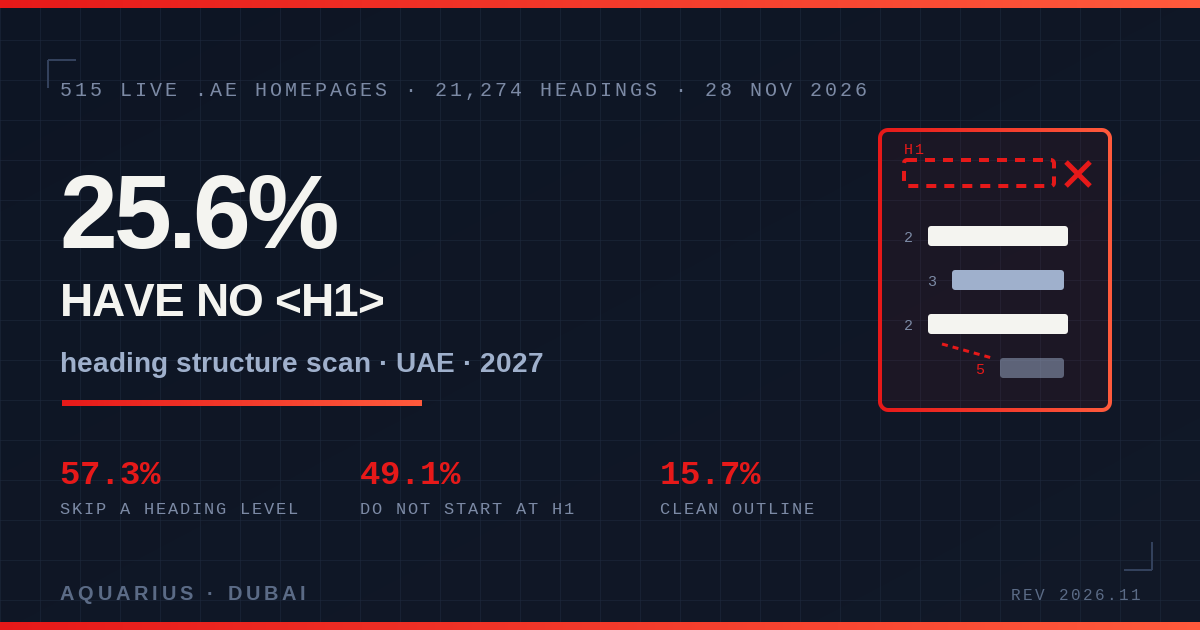
We parsed every heading on the 515 live .ae homepages that served real content on 28 November 2026 — 21,274 headings in total. 25.6% have no <h1> element at all, 49.1% do not start at <h1>, 57.3% skip at least one heading level, and only 15.7% have a clean outline. Google says heading order does not matter for ranking. Screen readers, Dubai’s accessibility rules and the AI engines that chunk your page before quoting it all disagree.
That is the myth most Dubai web teams still run on: “headings are an SEO thing, and Google figured it out years ago.” Half right. Google’s own starter guide says it plainly — “it doesn’t matter if you’re using them out of order.” But headings stopped being only an SEO signal the moment answer engines started retrieving passages instead of pages.
Why a heading outline is worth money in the UAE
The UAE is effectively fully online: 11.5 million internet users at 99.0% penetration (DataReportal, Digital 2027: United Arab Emirates), and search here is a Google monopoly — 95.42% of UAE search referrals in October 2026 (StatCounter). Dubai e-commerce alone moved AED 42.2 billion, about 15.7% of total retail, in EZDubai’s latest market report. There is no low-traffic excuse here.
Two things changed what headings do. In October 2020 Google shipped passage ranking, built to “improve 7 percent of search queries across all languages” by ranking individual sections rather than whole pages. Then in May 2025 AI Mode added query fan-out: one question becomes many sub-queries, and the engine assembles an answer from the passages it can isolate. Every retrieval-augmented system — AI Overviews, ChatGPT search, Perplexity — splits a page into chunks before it embeds them, and headings are the cheapest, most reliable chunk boundary there is. A homepage with no <h2> is one undifferentiated blob to the thing deciding whether to quote you.
Accessibility is the harder constraint. The TDRA’s National Policy for Digital Accessibility (March 2024) points UAE entities at WCAG 2.1 Level AA, and screen-reader users navigate by heading before anything else. Dubai’s Universal Design Code carries fines up to AED 200,000 for non-compliance. “Google doesn’t mind” is not the test anyone is actually graded on.
What we measured
We requested the 786 most-visited .ae hosts (Tranco), following redirects from apex to www with a mobile Chrome user agent. 592 returned a 2xx HTML homepage; 99 returned 403 bot blocks and 82 did not answer. We then dropped the 77 responses that were interstitials or bot walls with under 500 characters of text, leaving 515 real homepages as the measured set. For each we extracted every <h1>–<h6> in document order, its text, whether it was image-only, and whether it was hidden from sight.
| Heading signal | Live .ae homepages (515) | Global baseline |
|---|---|---|
| Headings per homepage (average) | 41.3 | 29.9 (WebAIM Million 2026) |
No <h1> element | 25.6% (132) | ~29% (Web Almanac 2025) |
No <h1> with any text | 28.3% (146) | ~34% (Web Almanac 2025) |
More than one non-empty <h1> | 15.0% (77) | 18.1% (WebAIM Million 2026) |
First heading is not an <h1> | 49.1% (253) | — |
| Skips at least one heading level | 57.3% (295) | 41.8% (WebAIM Million 2026) |
No <h2> with text (no chunk boundaries) | 8.7% (45) | — |
| Clean outline end to end | 15.7% (81) | — |
“Clean outline” is a deliberately plain bar: exactly one non-empty <h1>, the first heading on the page is that <h1>, no skipped levels anywhere, and at least two real <h2> sections. 81 of 515 homepages clear it. On <h1> presence the UAE is roughly at the global average; where it falls behind is order — 57.3% skip a level versus 41.8% worldwide, across 858 separate jumps.
The four failure patterns, by name
1. Plenty of headings, no <h1>. The Federal Tax Authority’s tax.gov.ae emits 57 headings and not one <h1>; its first heading is an <h2> reading “Column 0” — a layout artefact announced as a section title. The TDRA’s own tdra.gov.ae carries 245 headings and zero <h1>.
2. The <h1> exists but says nothing. adnoc.ae has three headings and its <h1> is completely empty. fonezone.ae has 102 headings, an empty <h1>, and opens with the <h2> “Your cart is empty.” On hsbc.ae the first of two <h1> elements is the logo image — alt text present, which is the right call, but it spends the page’s most valuable heading on a brand mark. Thirteen homepages in the set use a logo image as their <h1>.
3. The <h1> is a label, not a proposition. gulftoday.ae ships the literal <h1> “home.” dmcc.ae has 72 headings and a textbook clean outline — and then uses “Welcome to DMCC” as the <h1>. visitabudhabi.ae prints “Welcome to Guggenheim Abu Dhabi” twice, as two <h1>s, after an empty <h4>. Compare callgear.ae: “Business phone system and cloud PBX in Dubai and the UAE” — a sentence a retrieval engine can actually match a question against.
4. Levels used as font sizes. centralbank.ae has 107 headings, eight <h1> elements, and starts the document at <h5>. This is the dominant UAE pattern: heading tags chosen for how big the text looks, then overridden in CSS anyway.
Government sites fare worst. Of the 44 live .gov.ae homepages with real content, 29.5% have no <h1>, 77.3% skip a heading level, and just 3 of 44 (6.8%) have a clean outline — on the same sites the national accessibility policy applies to most directly.
The headings that only exist after JavaScript
This is the finding with the sharpest 2027 edge. 69 homepages served no headings at all to a crawler that does not run JavaScript. We re-fetched each with a desktop browser agent: 65 still had none. Of those, 29 were bot walls we cannot judge — and 26 were JavaScript shells whose headings are injected client-side.
We rendered two in a real browser. du.ae ships zero headings in HTML and nine after render — still no <h1>, starting at <h3>. Dubai’s public parking operator parkin.ae ships zero in HTML and 24 after render, with a hidden <h6> ahead of its <h1>.
Googlebot renders, so it sees those. The fetchers behind most AI answers largely do not. A heading that only exists post-hydration is a chunk boundary you are hiding from exactly the systems now deciding whether to cite you — which is the same structural problem we found in our scan of AI crawler rules on .ae sites, arriving from a different direction.
Fixing it: scope, cost and sequence
Heading structure is the cheapest technical win left on most UAE sites, because it is markup, not architecture. In practice:
- One
<h1>, carrying the proposition. “Villa maintenance and AMC contracts in Dubai” beats “Welcome.” Median<h1>length in our set is 31 characters — most are brand names, not answers. - Start at
<h1>, descend by one. Half the UAE market fails the first half of that sentence. - Never pick a level for its size. Pick the level, then style it.
- Headings must be in the HTML. Server-render them, or accept that non-rendering AI fetchers see an empty page.
- Give every section a real
<h2>. 45 homepages have no<h2>with text — nothing for a retrieval system to chunk on.
Cost in Dubai terms: a heading-and-outline pass on an existing brochure site is usually a few hours of front-end work, bundled into our Business Site builds from AED 2,500, or a line item on an existing codebase. Server-rendering headings on a client-side React or Vue site is the expensive case — that is a framework decision, and it sits with our custom app work from AED 10,000. The sequencing matters more than the spend: there is no point adding FAQ schema or chasing AI citations on a page whose sections an engine cannot separate, which is why we run this pass before the structured-data work.
The cost of inaction is now measurable. Pew Research (July 2025) found users click a result on just 8% of searches that show an AI summary, versus 15% without one. When the answer is assembled above your link, being quotable is the traffic. Headings are how you get quoted.
Honest limits
We read static HTML for the full census, so every count here is a floor — JavaScript-injected headings are invisible to the scan, which is why we re-checked the zero-heading hosts in a browser and reported them separately. We excluded 77 thin or bot-walled 200 responses rather than count them as failures, and 99 hosts blocked us outright. We judged homepages only; interior pages often differ. And a clean outline is a floor, not a ceiling — it says nothing about whether the words in the headings are worth reading.
FAQ
Does Google penalise a page with no <h1> or out-of-order headings?
No. Google’s SEO starter guide explicitly says heading order does not matter to Search, and there is no heading penalty. What you lose is passage-level clarity for AI retrieval, and you fail WCAG 1.3.1 for screen-reader users — which, under the TDRA’s accessibility policy, is the risk that actually carries consequences in the UAE.
Is more than one <h1> a problem?
It is allowed in HTML5 and Google tolerates it. It is still a bad idea: 15.0% of UAE homepages have several, and in practice it means nobody decided what the page is about. Screen-reader users get multiple competing “page titles” with no hierarchy between them.
How many headings should a Dubai homepage have?
Enough to label each real section — typically 8 to 20. UAE homepages average 41.3, which usually means component libraries emitting headings for card titles and carousel slides. Volume is not structure.
Do hidden or screen-reader-only headings count?
Yes, and they are legitimate: 64 homepages in our set use visually hidden headings to label landmarks like navigation and search. Just do not use them to hide keyword stuffing — and only 12 hosts used role="heading", which should be a last resort behind real <h1>–<h6> tags.
Will fixing headings improve my rankings?
Not directly, and anyone promising that is selling you something. It improves which passage of your page can be retrieved and quoted, and it fixes a real accessibility failure. Those are the two things that compound in 2027.
Want your outline checked?
We ran this scan on 515 UAE homepages; running it on yours takes an afternoon. If you want the heading structure, rendered-DOM gap and accessibility impact of your site written up in plain language — alongside the WCAG findings from the same .ae census — tell us your domain and we will send back what we find.