
DOM Size and HTML Payload: 529 .ae Homepages Scanned
We parsed the HTML of 529 live .ae homepages. Median 1,024 DOM nodes, 39.5% past Lighthouse's 1,400-node error line, and 9.9% shipping uncompressed HTML.
- PUBLISHED
- 28 NOV 2026
- READ TIME
- 09 MIN
- AUTHOR
- AQUARIUS · DUBAI
- UNIT
- REV 2026.09
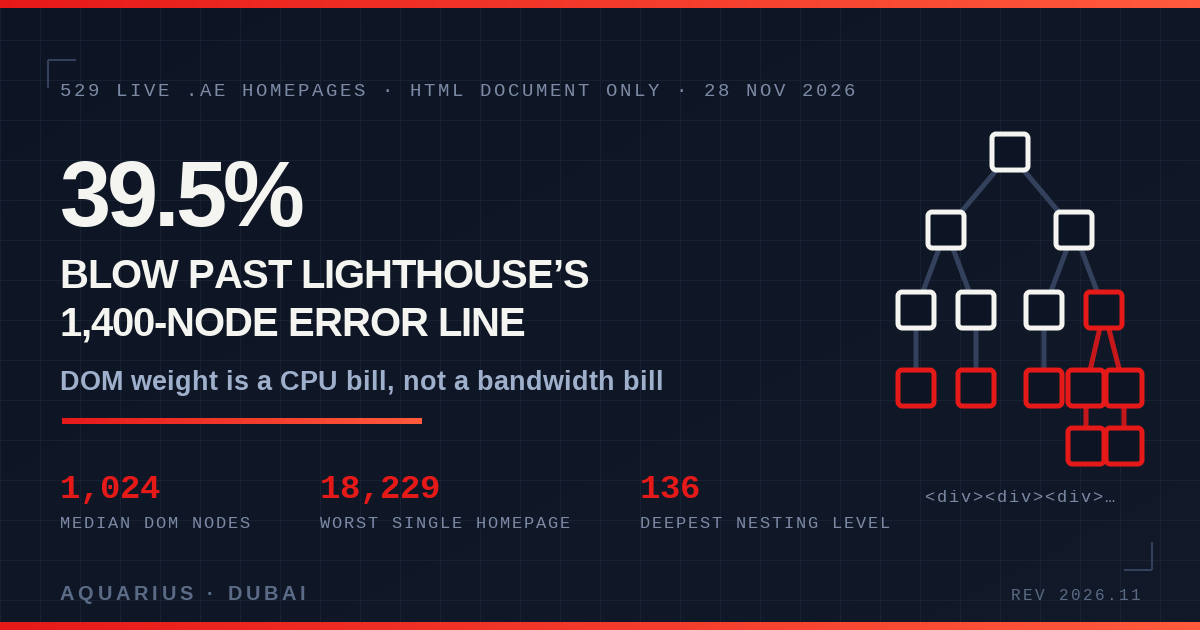
Across 529 live .ae homepages measured on 28 November 2026, the median homepage ships 1,024 DOM nodes and a 209 KB uncompressed HTML document — 39.5% of them blow past Lighthouse’s ~1,400-node error threshold before a single JavaScript file has run. That matters because the UAE has the fastest mobile network on earth and still cannot buy its way out of this: DOM weight is paid by the CPU, not the connection. A phone on 681 Mbps builds a 5,000-node page exactly as slowly as a phone on 20 Mbps.
This is first-hand measurement, not a survey. We fetched the HTML document of every host on the Tranco top .ae list and parsed it ourselves: element count, nesting depth, widest sibling group, inline script and style bytes, comment bytes, subresource references and third-party hosts. Every number below is from that scan.
TOFU: the UAE has world-beating bandwidth and mid-table markup
Three numbers frame the problem.
First, speed is not the constraint. The UAE ranks first in the world for median mobile download speed at 681.1 Mbps (Ookla Speedtest Global Index, September 2026) — more than 150 Mbps clear of second place. Second, the audience is overwhelmingly mobile: 67.8% of UAE web traffic came from phones in October 2026 (StatCounter), and a mid-range Android handset is where DOM cost actually lands. Third, the money is real: UAE e-commerce hit AED 42.2 billion in 2025, 15.7% of total UAE retail (EZDubai / Euromonitor), which works out to roughly AED 4.8 million of online retail every hour.
The Web Almanac states the mechanism plainly: “A page with 5,000 nodes (a ‘heavy’ DOM) will make scrolling feel laggy, regardless of how fast the internet connection is.” Thirty-four UAE homepages in our scan — 6.4% — are over that line.
What we actually measured
787 hosts probed, 688 responded, 569 returned a parseable HTML 200, and 529 had enough markup to count (we required at least 40 element nodes, which drops bot walls and parked shells). Honest caveat, stated up front: this is the HTML document only. No rendered page, no subresources, no JavaScript executed. So the node counts are pre-JavaScript and the byte figures exclude images, fonts, CSS and JS files. Every number here is a floor — the markup you ship before anything else happens.
| Metric (529 live .ae homepages, 28 Nov 2026) | Median | p90 | Worst | Global baseline |
|---|---|---|---|---|
| DOM element nodes | 1,024 | 3,745 | 18,229 | 594 median (Web Almanac 2024, mobile) |
| Maximum nesting depth | 18 | 30 | 136 | — |
| Widest sibling group (one parent) | 56 | 136 | 1,926 | — |
| HTML transferred over the wire | 39 KB | 172 KB | 1,604 KB | 33 KB median / 155 KB p90 (Almanac 2025, mobile) |
| HTML uncompressed | 209 KB | 996 KB | 6,773 KB | — |
<div> elements | 319 | 1,049 | 7,988 | — |
Inline <script> bytes in the document | 22 KB | 264 KB | 6,638 KB | — |
| External script references | 12 | 41 | 194 | — |
| Third-party hosts referenced | 3 | 6 | 15 | — |
Read that table honestly. On transferred bytes the UAE is only slightly heavier than the global web — 39 KB against the Almanac’s 33 KB. On node count the gap is wide: a median of 1,024 elements against a global median of 594 is 72% more markup, and it puts the typical UAE homepage past Lighthouse’s warning line rather than comfortably under it. Homepages are also the best-maintained page on any site, so treat these as the UAE’s ceiling. Category and product pages will be worse.
MOFU: the four ways UAE homepages get heavy
1. Too many nodes
Lighthouse’s DOM-size audit is explicit about its thresholds: it “warns when the body element has more than ~800 nodes” and “errors when the body element has more than ~1,400 nodes.” Our distribution against those two lines:
| DOM node band | Sites | Share | Median HTML transferred |
|---|---|---|---|
| Under 800 — passes clean | 216 | 40.8% | 14 KB |
| 800–1,400 — Lighthouse warning | 104 | 19.7% | 39 KB |
| 1,400–3,000 — Lighthouse error | 132 | 24.9% | 55 KB |
| Over 3,000 — severe | 77 | 14.6% | 106 KB |
The worst offenders are e-commerce. adventurehq.ae ships 18,229 element nodes including 5,204 <div>s — thirteen times the error threshold. babystore.ae ships 16,667, wondergifts.ae 15,320 (with 7,988 <div> elements on a single homepage), fnp.ae 10,294. The pattern is identical in each case: the entire mega-menu, every product card, and several carousels are all rendered server-side into the first response, so the browser pays for thousands of elements nobody scrolls to.
2. Nesting that defeats style recalculation
Depth is the quieter problem. Median nesting depth is a reasonable 18 levels, but centralbank.ae reaches 136 levels deep on its Arabic landing page, gdrfad.gov.ae 83, chemistwarehouse.ae 74. Deep trees make every style recalculation and layout pass more expensive, because selector matching walks ancestors. Lighthouse reports maximum depth and maximum child count alongside node total but publishes no numeric threshold for either — which is exactly why nobody fixes them.
At the other extreme, thepartfinder.ae has one parent element with 1,926 direct children. A single sibling group that wide is a worst case for layout and for any JavaScript that queries it.
3. Inline script shipped inside the HTML
This is where UAE pages get genuinely strange. The median homepage carries 22 KB of inline JavaScript in the document itself, but 33.6% carry more than 50 KB and the p90 is 264 KB. The record belongs to toyota.ae: a 6,638 KB inline script block inside the HTML document, making its raw homepage response 6.77 MB uncompressed (495 KB after gzip). marksandspencer.ae carries 3,745 KB inline, jumbo.ae 2,812 KB, lexus.ae 2,032 KB. Inline script cannot be cached separately, cannot be deferred, and blocks the parser where it sits.
Markup hygiene is thinner too: 31.0% of homepages inline more than 20 KB of CSS, 25.0% ship over 2 KB of HTML comments (one site ships 196 KB of them), and 27.4% of sites with ten or more images use loading="lazy" on none of them. That last one pairs badly with the image findings in our image delivery scan of the same corpus.
4. Compression simply switched off
Of the 513 homepages we re-fetched measuring true wire bytes, 51 — 9.9% — send their HTML with no text compression at all. Median uncompressed size for that group: 173 KB. Compressed peers achieve a median 5.65× reduction, so these sites are paying roughly five times the bytes for nothing. The list skews public sector: tdra.gov.ae sends 1,142 KB uncompressed, gcaa.gov.ae 1,257 KB, mof.gov.ae 580 KB, scad.gov.ae 514 KB. Across the 41 live .gov.ae homepages, median node count is 1,056 and 15 of 41 are over Lighthouse’s error threshold.
Enabling gzip or Brotli on HTML responses is a configuration line. It is the single cheapest win in this entire dataset.
Why bandwidth does not save you
The correlation between node count and HTML bytes in our data is r = 0.647 — real, but far from one. That looseness is the whole point. jumbo.ae has only 891 nodes yet transfers 1,604 KB of HTML; gisec.ae has 8,335 nodes in just 548 KB. Bytes and nodes are two separate bills, and only the first one is paid by the network.
Node count is paid by the main thread: parsing, style recalculation, layout, paint, and memory. On the field data side the Almanac’s CrUX numbers show what happens as pages get heavier — 57% of mobile home pages under 1 MB pass all three Core Web Vitals, falling to 45% at 2–3 MB and 30% at 5 MB or more. Worth noting CrUX only includes sites above a popularity threshold, so that skews optimistic.
The UAE-specific twist: 681 Mbps hides a byte problem completely and hides a node problem not at all. A heavy DOM shows up as sluggish scrolling, delayed tap response and INP failures that no amount of 5G fixes. If you want the field-metric side of this, see our guide to Core Web Vitals and speed optimisation for Dubai websites.
What a lean UAE homepage looks like
It is achievable here. parkin.ae ships 60 element nodes in a 14 KB document, three levels deep, zero <div>s. theuaelottery.ae ships 61 nodes in 7 KB. Those are app shells rather than content pages, so they are not a fair target for a retailer — but they prove the floor is low when markup is deliberate.
BOFU: what fixing this costs in Dubai
| Scope | AED range | Timeline | What you get |
|---|---|---|---|
| DOM and payload audit only | 2,500 – 5,000 | 2 – 3 days | Node, depth, sibling and byte census of your key templates, benchmarked against this 529-site corpus |
| Compression, comments and inline-asset cleanup | 4,000 – 9,000 | 3 – 7 days | Brotli/gzip on HTML, inline script and CSS extracted and cached, dead markup removed |
| Template DOM reduction | 12,000 – 30,000 | 2 – 5 weeks | Mega-menu and carousel deferral, product-grid pagination, nesting flattened, lazy-loading applied |
| Full Core Web Vitals programme | 25,000 – 60,000 | 6 – 10 weeks | DOM, images, fonts, scripts, LCP and INP, field monitoring |
The cost-of-inaction arithmetic is blunt. Deloitte and Google’s Milliseconds Make Millions found a 0.1-second improvement lifted retail conversion 8.4% and average order value 9.2%. A Dubai store turning over AED 500,000 a month is arguing about a five-figure monthly swing — against a markup cleanup that bills in the low thousands. See our pricing for how this packages with a build.
How Aquarius does it
We measure first, with the same method used for this article: the raw HTML document parsed element by element, node count and depth and widest sibling group recorded, inline script and style and comment bytes separated out, then a second pass that reads unbuffered wire bytes so compression is measured rather than assumed. You get your own numbers against the 529-site .ae benchmark above, not a generic Lighthouse screenshot.
Then we fix in cost order — compression, comments, inline extraction, then the expensive structural work — and re-measure in the field, because a lab score can move without the page getting faster.
Risk reversal: if your main templates come in under Lighthouse’s ~800-node warning threshold with HTML compression correctly enabled, we do not invoice the audit. With 59.2% of UAE homepages over that line and 9.9% shipping uncompressed HTML, that is a safe offer to make.
FAQ
What is a good DOM size for a Dubai website in 2026?
Under 800 element nodes in the body keeps you clear of Lighthouse’s warning entirely; under 1,400 keeps you out of the error. Only 40.8% of live .ae homepages manage the first. For an e-commerce homepage, 1,200–1,500 nodes is a realistic target — the 18,229 we found at the top of the range is not a necessity of the category, it is unpaginated grids and a fully rendered mega-menu.
Does a big DOM really matter if UAE internet is this fast?
Yes, and that is the central myth to bust. Node count costs CPU time on parse, style recalculation, layout and memory — none of which bandwidth touches. The Web Almanac puts it directly: a 5,000-node page “will make scrolling feel laggy, regardless of how fast the internet connection is.” With 67.8% of UAE traffic on mobile, the device, not the network, is your bottleneck.
How big should my HTML document be?
The global median HTML response is 33 KB on mobile (Web Almanac 2025); the UAE median is 39 KB. Anything over roughly 150 KB transferred puts you in the worst tenth of both populations. More useful than a target: check whether compression is on. 9.9% of UAE homepages ship uncompressed HTML at a median 173 KB, which a single server config line would cut about five-fold.
Is nesting depth or node count more important?
Node count, in almost every real case — it is what Lighthouse scores and what drives memory. Depth matters when it is pathological: our deepest site hits 136 levels, against a corpus median of 18. If your depth is under about 30 and your node count is over 1,400, fix the node count first.
Do these figures include images, CSS and JavaScript files?
No. We measured the HTML document response only, so total page weight is considerably higher — the Almanac puts the median mobile home page at 2,559 KB all-in, of which just 22 KB is HTML. Our node counts are also pre-JavaScript; client-rendered sites will build far more nodes than we recorded.
Where to start
Run one check today: open your homepage in Chrome DevTools, type document.querySelectorAll('*').length in the console, and compare it to 1,024. If you are over 1,400, the markup is the problem and no CDN upgrade will fix it. Send us the number and we will tell you which of the four failure modes above you are in — and what it costs to get out.