
Image Delivery on UAE Websites: We Scanned 540 .ae Homepages and Half Serve No AVIF or WebP
First-hand scan of 46,290 image tags on 540 .ae homepages: 50.9% ship no modern format, 21.1% of "JPEGs" are secretly WebP, zero .gov.ae sites use AVIF, and not one cf-polish header exists.
- PUBLISHED
- 24 NOV 2026
- READ TIME
- 12 MIN
- AUTHOR
- AQUARIUS · DUBAI
- UNIT
- REV 2026.09
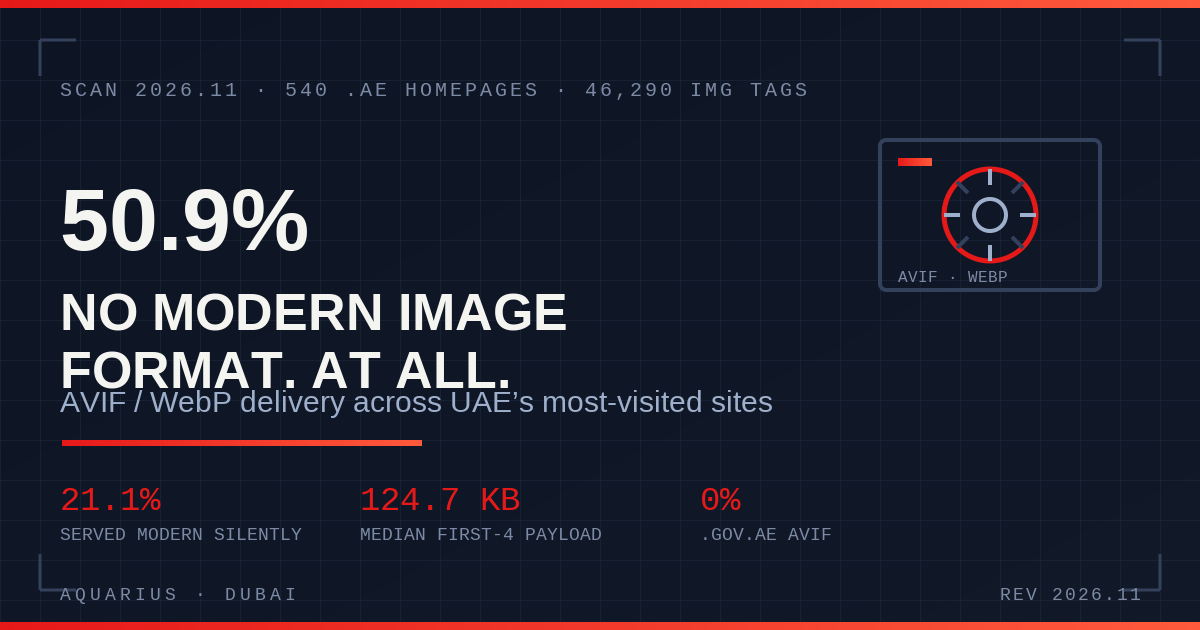
Short answer: on 24 November 2026 we parsed the homepages of 540 of the UAE's most-visited .ae websites and read 46,290 <img> tags. Exactly 275 of those sites — 50.9% — ship no modern image format at all: no AVIF, no WebP, not in the markup and not quietly negotiated behind the scenes. AVIF is supported by 96.71% of browsers worldwide, so half of the UAE's web is paying a legacy-format tax for compatibility it stopped needing years ago.
We did not take that number from a vendor report. We pulled every .ae host in the Tranco top-1M list, saved 662 homepages, parsed the image markup on 632 of them, then went back and byte-probed 1,354 real image URLs twice each — once with a Chrome Accept header that advertises AVIF and WebP, once with an old Safari header that does not — and captured image response headers on 367 hosts. Everything below is from that scan.
What UAE homepages actually serve (TOFU)
Three numbers set the stakes. First, images are the single heaviest thing on a page: the HTTP Archive Web Almanac 2025 puts the median desktop page at 1,059 KB of images and the median mobile page at 911 KB. Second, the image is the LCP element on 85.3% of desktop pages and 76% of mobile pages — so image delivery is Core Web Vitals for most sites. Third, 67.8% of UAE web traffic is mobile (StatCounter, October 2026), which is where the format penalty actually bites.
Here is the format picture across the 540 .ae hosts that had at least one image on the homepage.
| Format | Hosts using it | Share of hosts | Share of all 76,856 image URLs |
|---|---|---|---|
| PNG | 428 | 79.3% | 25.6% |
| JPG / JPEG | 335 | 62.0% | 43.5% |
| SVG | 303 | 56.1% | 13.2% |
| WebP | 221 | 40.9% | 16.3% |
| GIF | 66 | 12.2% | 0.6% |
| AVIF | 26 | 4.8% | 0.8% |
Twenty-six hosts out of 540 use AVIF anywhere on the homepage. The list is almost entirely retail and travel — emaar.ae, reebok.ae, kiabi.ae, dragonmart.ae, cleartrip.ae, babystore.ae, fnp.ae, adventurehq.ae — and 11 of those 26 pair AVIF with a <picture> element so older browsers get a fallback. That is the whole AVIF population of the UAE's most-visited domains.
The shareable number: UAE government sites serve zero AVIF
We isolated the 46 .gov.ae hosts in the sample that had homepage images (132 images total). The result is a clean sweep in the wrong direction: 0.0% AVIF, 21.7% WebP, 8.7% using srcset, 39.1% using lazy-loading, and 0.0% behind any image-transform CDN. Median government image: 21.5 KB. The p90: 206.4 KB. Dubai Municipality's homepage (dm.gov.ae) carries a single 2,349 KB JPEG in its first four images.
These are the sites every UAE resident is required to use — visa renewals, trade licences, utility accounts — loading on the same 4G connection as everything else.
The hidden half: 21.1% of "JPEG" URLs are not JPEGs
Markup is only half the story, and this is where most audits of UAE sites go wrong. We requested 1,354 image URLs twice, varying only the Accept header. Of the 1,107 URLs that end in a legacy extension (.jpg, .png), 234 — 21.1% — came back as WebP or AVIF to the Chrome request. 245 of 1,327 responses (18.5%) differed in bytes depending on which header we sent. Seventy-nine hosts negotiate format silently; the median saving where they do is 13.5 KB, or 37.5% off the legacy byte count.
So the real modern-format coverage is: 227 hosts (42.0%) declare AVIF or WebP in markup, 265 hosts (49.1%) deliver it by either path, and 275 hosts (50.9%) deliver it by neither. If you only read the HTML, you undercount the good sites. If you only probe bytes, you miss the ones that negotiate but never set Vary: Accept — only 74 of 367 hosts (20.2%) do, which means a shared cache can hand a WebP to a browser that cannot decode it.
Myth-bust: "we're on Cloudflare, images are handled"
This is the most common thing we hear in Dubai, and the data kills it. 170 of the 367 hosts we header-probed sit behind Cloudflare (46.3%). Cloudflare-fronted hosts do negotiate more often — 60 of 170 (35.3%) versus 19 of 197 (9.6%) elsewhere — so the CDN is clearly correlated with better delivery. But across every single image response we captured, we saw zero cf-polish headers. Polish, the feature that actually re-encodes your images to WebP or AVIF, is effectively unused on the UAE's Cloudflare estate. The negotiation we measured is coming from the e-commerce platform underneath, not from the CDN.
The second myth: "UAE internet is fast enough that image weight doesn't matter." The UAE is genuinely ranked first in the world for mobile speed at 681.14 Mbps (Ookla, September 2026). It does not save you. Bandwidth does not fix the time a 3 MB hero spends being decoded and painted on a mid-range Android, it does not fix the layout shift, and it does not fix the 45.2% of images in our sample that ship no width/height attributes at all.
What to fix, in the order that pays (MOFU)
We scored each host on four hygiene signals — modern format, srcset, lazy-loading below the fold, and explicit dimensions. Only 86 of 540 hosts (15.9%) have all four. Eighty-seven (16.1%) have none. Here is where the UAE sample sits on each, and what to do.
| Signal | UAE homepages | The fix | Typical gain |
|---|---|---|---|
| Modern format (AVIF/WebP) | 49.1% have it somewhere | <picture> with AVIF + WebP + legacy fallback | Web Almanac p90: JPG 278 KB → WebP 97 KB → AVIF 37 KB |
Responsive srcset | 34.3% of hosts; 20.7% of images | srcset + sizes, 3–4 widths | Mobile stops downloading desktop-width files |
| LCP image not lazy | 16.5% lazy-load their first raster image | Remove loading="lazy", add fetchpriority="high" | Removes a full round-trip from LCP |
| Explicit dimensions | 45.2% of images have both | width + height on every <img> | Kills image-driven CLS outright |
Vary: Accept when negotiating | 20.2% of hosts | One origin header | Prevents shared caches serving undecodable bytes |
Two of those rows deserve a note. The UAE lazy-loads its LCP image on 16.5% of hosts, which is almost exactly the 16–17% global figure — a bug the whole web shares, where a developer adds loading="lazy" to every image and delays the one image that defines the score. On the other side, 20.1% of UAE hosts already use fetchpriority="high" on their first raster image, slightly ahead of the 17% global rate. The UAE is not behind on hints. It is behind on bytes.
And the bytes are not evenly spread. Median image in our probe: 21.7 KB. The p90: 215.8 KB. The p99: 1,372.2 KB. Twenty images (1.5%) exceed 1 MB each. Per host, the first four images weigh a median 124.7 KB — but 332.5 KB at p75 and 925.8 KB at p90. The worst offenders are not small sites: cbd.ae carries 5,510 KB of carousel banners in its first four images, dubaifuture.ae 3,514 KB, fujairah.ae 3,318 KB, adib.ae 2,291 KB, hsbc.ae 2,270 KB. One host, solomia-home.ae, ships a single 14,102 KB PNG. Forty-five images across 27 hosts are PNGs over 200 KB — the classic signal of a photograph saved in the wrong format.
Your platform decides most of this
Cross-tabbing the scan against detected platforms explains most of the variance. The gap between the best and worst stack is larger than the gap between the best and worst development team.
| Platform | Hosts | AVIF | WebP | Lazy-load | srcset |
|---|---|---|---|---|---|
| Shopify | 37 | 24.3% | 67.6% | 91.9% | 94.6% |
| WordPress | 108 | 6.5% | 45.4% | 65.7% | 70.4% |
| Next.js | 63 | 6.3% | 31.7% | 88.9% | 58.7% |
| Magento | 14 | 0.0% | 50.0% | — | 0.0% |
| Joomla | 8 | 0.0% | 50.0% | — | — |
| Drupal | 9 | 0.0% | 33.3% | — | 0.0% |
| Salesforce Commerce | 10 | 0.0% | 0.0% | — | — |
Shopify stores get modern delivery for free and carry a median of 119 images per homepage without paying for it. Magento and Salesforce Commerce stores in the UAE are shipping the same catalogue images they shipped in 2018. If you are on one of those, the image work is a project, not a setting.
One caveat worth naming: 0.8% of all image URLs are AVIF, versus 16.3% WebP. WebP is the pragmatic default and AVIF is the win on top. Keep the fallback chain — StatCounter puts UC Browser at 2.67% of UAE browser share, and it still cannot decode AVIF. That is what <picture> is for, and only 24.4% of UAE hosts use one.
What it costs in Dubai, and what it returns (BOFU)
Image delivery is the cheapest performance work there is, because nothing about the design changes. Typical 2026 Dubai agency ranges, based on what we quote:
| Scope | What you get | AED | Timeline |
|---|---|---|---|
| Image delivery audit | Format + negotiation + LCP + CLS report on up to 20 templates, with the fix list | 2,500 – 4,500 | 3 – 5 days |
| Format pipeline | AVIF/WebP generation, <picture> fallbacks, Vary: Accept, CDN negotiation | 7,000 – 15,000 | 1 – 2 weeks |
| Responsive + LCP pass | srcset/sizes breakpoints, dimensions on every image, priority hints, preload | 6,000 – 12,000 | 1 – 2 weeks |
| Full CWV sprint | Images plus caching, compression and render-blocking work | 18,000 – 35,000 | 3 – 5 weeks |
The return side is documented. Deloitte and Google's Milliseconds Make Millions study measured a 0.1-second mobile load improvement producing an 8.4% lift in retail conversion and a 9.2% lift in average order value, and 10.1% in travel. Against a UAE e-commerce market Mordor Intelligence sizes at USD 12.30bn in 2026 growing to 21.01bn by 2031 at an 11.29% CAGR — with smartphones already handling 78.67% of orders — a one-week image pass on a store doing AED 500,000 a month is measured in days of payback, not quarters.
The cost of inaction is just as concrete: only 48% of mobile pages and 56% of desktop pages pass Core Web Vitals globally (Web Almanac 2025), and since the image is the LCP element on three-quarters of mobile pages, it is usually the image that decides which side you land on.
How we measured this, and what it cannot see
Source: Tranco top-1M, filtered to .ae, giving 781 hosts. We fetched 662 homepages successfully and parsed 632; 540 had at least one <img>. Markup was parsed for <img>, <source> and <picture> attributes. We then selected up to four first-party raster images per host and requested each twice with different Accept headers, recording status, content type and byte count. Image response headers were captured on 367 hosts.
Limits worth stating: homepages only, one geography, one point in time, and no JavaScript execution — so images injected by client-side rendering are invisible to the markup half of the scan, though the byte probe still catches negotiation on URLs we did find. Platform detection is signature-based and will miss headless setups.
FAQ
Should a UAE website use AVIF or WebP in 2026?
Both, in that order, with a legacy fallback. AVIF reaches 96.71% of browsers (Chrome 85+, Edge 121+, Safari 16.4+, Safari iOS 16+, Firefox 93+) and compresses hardest — Web Almanac's p90 AVIF image is 37 KB against 97 KB for WebP and 278 KB for JPG. WebP has near-universal support and is the safe default. Serve AVIF first via <source type="image/avif">, WebP second, then the original. In the UAE specifically, UC Browser's 2.67% share is the reason you keep the fallback rather than switching formats outright.
How do I check whether my own site already serves WebP?
Request one image twice and compare. curl -sI -H 'Accept: image/avif,image/webp,*/*' https://yourdomain.ae/hero.jpg then the same request with -H 'Accept: image/jpeg,*/*'. If the content-type changes between the two, your stack negotiates — and you should confirm vary: accept is present too. If both come back image/jpeg, you are in the 50.9%.
Does lazy-loading images always improve performance?
No, and this is the most common self-inflicted wound in our scan. loading="lazy" on the hero image delays the exact resource that defines LCP, because the browser will not fetch it until layout proves it is visible. 16.5% of the UAE hosts we checked lazy-load their first raster image. Lazy-load everything below the fold; give the hero loading="eager" and fetchpriority="high".
Is an image CDN worth it for a Dubai business?
If your catalogue changes often, yes — an image-transform CDN converts format and size on the fly and removes the build step entirely. But do not assume you already have one because you are behind a CDN: we found zero cf-polish headers across 170 Cloudflare-fronted .ae hosts, and no .gov.ae host used an image CDN at all. Being on Cloudflare and having Polish enabled are different things. Our note on CDN edge delivery costs in Dubai covers the pricing side.
What is the single highest-impact image fix?
Find your LCP image, make sure it is not lazy-loaded, give it fetchpriority="high", explicit width/height, and an AVIF/WebP source. That is one element on one template, and it moves both LCP and CLS. Everything else is cleanup.
Half the UAE's most-visited websites are shipping 2018-era image bytes to 2026 browsers that asked for better and were ignored. It is the rare performance problem with no design trade-off, no migration and no new vendor — just encoding. If you want to know which half you are in, send us your domain and we will run the scan on it; our Core Web Vitals guide and cache-header audit cover the two fixes that pair with it, and pricing has where a performance sprint sits.