
IAS 19 and UAE Gratuity in 2026: Why Your Dubai ERP Carries the Wrong Provision
A dirham yield curve now exists, so the IAS 19 discount rate is observable. The 2026 maths, the savings-scheme plan amendment, and the payroll fields no UAE ERP stores.
- PUBLISHED
- 14 NOV 2026
- READ TIME
- 13 MIN
- AUTHOR
- AQUARIUS · DUBAI
- UNIT
- REV 2026.09
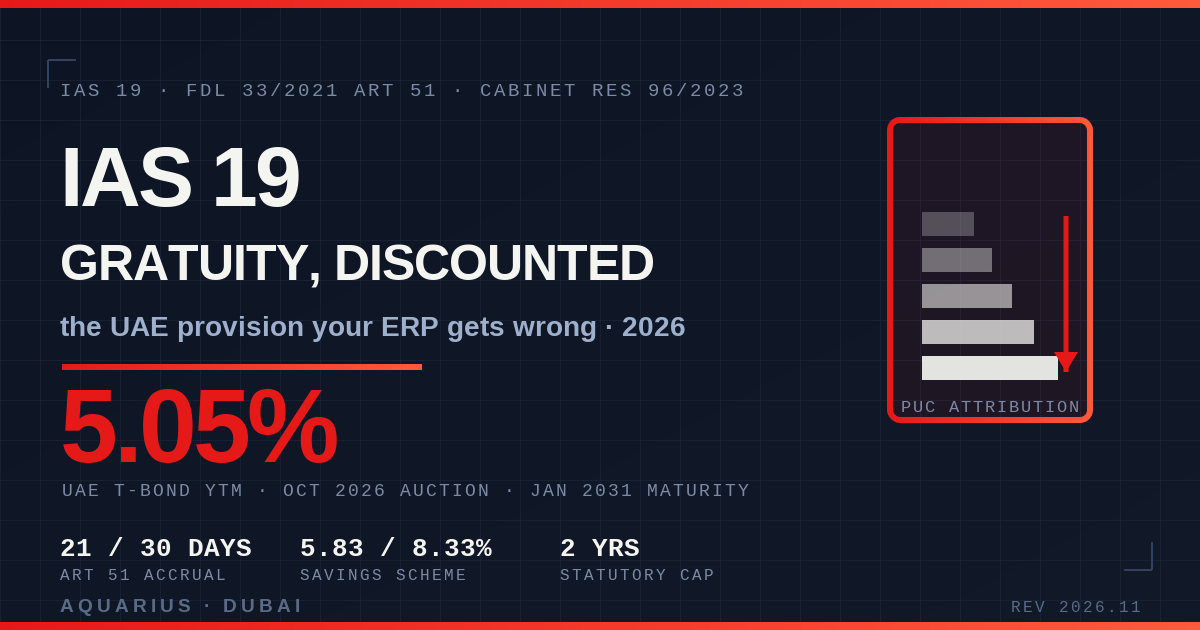
Short answer: UAE end-of-service gratuity is a defined benefit plan, so IAS 19 requires it to be measured with the projected unit credit method — a present value built from projected final salary, attrition and a discount rate — not the undiscounted “21 days of basic pay times years of service” figure almost every Dubai ERP posts. In 2026 that gap finally has a number attached to it: the UAE Ministry of Finance’s October 2026 treasury auction cleared at a 5.05% yield to maturity, up from 4.30% on the comparable January 2031 tranche in May 2026, and a discount rate that moves roughly 75 basis points in five months moves your obligation by double digits. If your last valuation assumed something near 4%, your FY2026 provision is wrong, and your auditor can check it against a published auction result.
The liability is growing faster than anyone is measuring it
Start with the exposure. MoHRE data reported in March 2026 put growth in the UAE private-sector workforce at 12.4% across 2025, with the number of registered establishments up 7.8%. That momentum carried into this year: the private-sector workforce expanded a further 2.5% in Q1 2026, and the skilled segment grew 1.5% in the same quarter. The Wage Protection System now covers roughly 99% of private-sector employees, which means the salary data underpinning every gratuity calculation in the country is already visible to the regulator in near real time.
Head a growing headcount into a service-linked benefit and the obligation compounds twice. Each new employee adds service cost from the day they pass one year of service. Each existing employee crosses the five-year line where Article 51 of Federal Decree-Law No. 33 of 2021 steps the accrual from 21 days of basic wage per year to 30 days per year, capped in total at two years’ wages. A 12.4% workforce expansion in a single year is not a payroll story. It is a balance-sheet story that most Dubai finance functions discover at audit.
The second number is the one that changed the maths this year. The UAE now has a functioning dirham-denominated sovereign yield curve. The Ministry of Finance’s October 2026 T-Sukuk and T-Bond auction drew AED 4.54 billion of bids against AED 1.1 billion issued — 4.1 times oversubscribed — and priced the sukuk tranche maturing October 2029 at a 4.95% yield to maturity and the bond tranche maturing January 2031 at 5.05%, at spreads of 19 and 26 basis points over comparable US Treasuries. In May 2026 the same programme cleared at 4.03% for September 2027 paper and 4.30% for January 2031. The US 10-year note, the proxy many UAE actuaries have leaned on for a decade, sat at 5.15% on 13 November 2026.
For years the honest answer to “what discount rate should a UAE entity use?” was that no deep dirham market existed, so you borrowed a curve. That excuse has an expiry date. There is now a published, regularly auctioned, dirham-denominated curve with observable yields at the tenors that matter for an eight-year average employment term. Whatever rate you pick, you now have to defend it against a number anyone can look up.
What IAS 19 actually requires, versus what your system produces
IAS 19 paragraph 67 requires an entity to use the projected unit credit method to determine the present value of its defined benefit obligation and the related current service cost. The method attributes a slice of the final benefit to each period of service, then discounts the lot. That is a materially different calculation from the one running inside a standard UAE payroll module.
| Input | What a typical Dubai ERP does | What IAS 19 requires |
|---|---|---|
| Salary | Current basic wage at the reporting date | Projected salary at exit, using a salary escalation assumption |
| Time value | None — the accrual is undiscounted | Discounted at a market yield on high-quality corporate bonds (para 83), or government bonds where no deep corporate market exists |
| Leavers | Assumes every employee stays to the reporting date and no further | An attrition or withdrawal assumption, plus mortality (paras 76–82) |
| Five-year step | Applied only once service actually passes five years | Anticipated in the attribution, because the projected benefit already reflects the step |
| Two-year cap | Rarely modelled at all | Modelled, because it truncates the projected benefit for long-service staff |
| Where the movement lands | One line in staff costs | Split: service cost and net interest to profit or loss, remeasurements to other comprehensive income (paras 120, 122) |
Those differences do not all push the same way, which is why the error is so persistent. Discounting pulls the obligation down. Salary escalation and the five-year step push it up. Attrition pulls it down for a high-turnover workforce and barely moves it for a stable one. The net can land within a rounding error of the simple accrual, or tens of percent away from it, and you cannot know which without running the calculation. Published UAE adviser surveys put typical assumptions in 2024–2025 around a 3.5% to 4.3% discount rate with roughly 3% baseline salary escalation and an average retention of about eight years, rising to 7% escalation in technology and finance and over 20% annual turnover in retail and logistics. Those are the dials. The point is that your system almost certainly has none of them.
The savings-scheme switch is a plan amendment, and it hits profit, not OCI
Here is the part that will catch Dubai groups this year, and the reason this is a software problem rather than an actuarial one. Cabinet Resolution No. 96 of 2023, issued 10 October 2023, created the voluntary alternative end-of-service benefits scheme. An employer that enrols staff stops accruing Article 51 gratuity and instead pays a monthly contribution into one MoHRE-approved, SCA-regulated fund: 5.83% of basic salary below five years of service and 8.33% at five years and over, due within 15 days of the start of each month. Employees may add voluntary contributions of up to 25% of salary. Four providers are approved as at 2026 — Ghaf Benefits, Daman Investments, National Bonds and First Abu Dhabi Bank. Participation is voluntary for the employer, but once an employee is enrolled it is mandatory for that employee.
MoHRE’s November 2025 guidance settled the accounting trigger. Preserved gratuity entitlements are calculated as at the date of enrolment, based on the employee’s basic salary at that date, and employers are not required to make retroactive contributions for prior service. Read that as an accountant rather than an HR manager and three things happen at once on the enrolment date:
- The salary escalation assumption dies for the preserved slice. That frozen entitlement no longer tracks future pay rises. The single largest upward driver of the obligation is switched off for everything accrued to date.
- Future service becomes a defined contribution plan. Under IAS 19 paragraph 51, defined contribution accounting recognises the contribution as an expense in the period the service is rendered. No actuary, no obligation beyond unpaid contributions, no remeasurement.
- The change in the obligation is past service cost. A change in benefits attributable to past service is a plan amendment under IAS 19 paragraphs 99 to 103, and past service cost is recognised immediately in profit or loss at the earlier of the amendment date and the date the related restructuring or termination costs are recognised. It does not go to OCI. It lands in this year’s earnings.
So an employer that enrols 300 staff mid-year books a one-off gain or loss in profit, in that period, driven entirely by removing future salary growth from the preserved benefit and remeasuring what remains. Nobody’s payroll module calculates that, because the inputs it needs are not fields anyone thought to create.
The five fields your payroll database is missing
Every Dubai system we audit for this is missing at least two of these. They are cheap to add before enrolment and expensive to reconstruct afterwards:
- Enrolment date per employee — not a company-level policy date. Staggered enrolment is normal and each date is its own measurement event.
- Frozen basic salary at enrolment — stored as its own immutable field, not derived from the current salary record, which will be overwritten at the next increment.
- Preserved entitlement in days and in AED — the Article 51 calculation struck at the enrolment date, kept as a standing liability separate from the contribution ledger.
- Contribution ledger by month, employee and rate band — because the 5.83% to 8.33% switch happens on a per-employee service anniversary, not on a company calendar.
- Provider and fund allocation — with the employee’s voluntary contribution tracked separately, since it is not an employer obligation and must not inflate the expense.
If you are building or rebuilding the payroll layer anyway, this is the moment to get it right. Our guide to HR and payroll software development in Dubai covers the WPS side of the same data model, and the end-of-service gratuity and savings scheme breakdown covers the calculation rules and MoHRE penalties in detail.
Where the movement goes, and why corporate tax notices
IAS 19 splits the annual movement in three. Current service cost and any past service cost go to profit or loss. Net interest on the net defined benefit liability goes to profit or loss. Remeasurements — actuarial gains and losses from changed assumptions or experience — go to other comprehensive income, and paragraph 122 prohibits ever reclassifying them to profit or loss. They sit in equity permanently.
That split matters for UAE corporate tax because of where the tax computation starts. Under Federal Decree-Law No. 47 of 2022 the starting point for taxable income is accounting income — the net profit or loss in the financial statements — subject to specified adjustments. The FTA’s Accounting Standards guide (issued 6 November 2023) addresses items presented in other comprehensive income that will not subsequently enter the taxable income calculation. So the 2026 discount-rate move creates a genuinely odd outcome: a large actuarial gain from rates rising from roughly 4.3% to 5.05% reduces your liability and increases your equity, while never passing through the line the 9% rate is applied to. Meanwhile the past service cost from a savings-scheme enrolment does pass through profit, in full, in one period.
Then there is deferred tax. A gratuity provision is a deductible temporary difference: the accounting liability exists now, the deduction follows the cash. That produces a deferred tax asset at 9%, recognised only to the extent future taxable profit is probable, and it has to be tracked against the provision balance rather than guessed at year end. Our IAS 12 deferred tax guide for Dubai businesses works through the register that makes this auditable, and the IAS 37 provisions guide covers why employee benefits are carved out of IAS 37 and governed here instead.
The smaller-company escape hatch, and its price
Not every Dubai business has to run a full actuarial valuation. For corporate tax purposes a business with revenue at or below AED 50 million may prepare its financial statements under IFRS for SMEs rather than full IFRS. Section 28 of that standard is deliberately lighter: paragraph 28.18 requires the projected unit credit method only if the entity can apply it without undue cost or effort, and paragraph 28.19 otherwise permits a simplified measurement that ignores future salary increases, ignores future service of current employees, and ignores the possibility of in-service mortality. If you take that route you must disclose that you used it and why the projected unit credit method would involve undue cost or effort.
Read the simplifications carefully and you will notice that an IFRS for SMEs entity applying 28.19 ends up with something close to the naive accrual its ERP already produces — discounted, but with no salary projection. Two Dubai companies with identical workforces, one above and one below the AED 50 million line, can therefore report materially different liabilities and materially different taxable incomes. That is not a loophole, it is a framework election, and it is worth making deliberately rather than discovering which one your auditor assumed.
What this costs in AED, and what it costs to get wrong
Pricing in the market is reasonably settled. A full IAS 19 actuarial valuation in the UAE runs roughly AED 30,000 to AED 100,000 depending on headcount and benefit complexity, and an actuarial review bolted onto an existing audit engagement typically runs AED 8,000 to AED 25,000. Reports come back in days, not weeks, once the data is clean — and that caveat is where the real cost sits. Most of the delay and most of the fee variance comes from reconstructing service histories, basic-versus-gross wage splits and enrolment dates that the payroll system never stored properly.
| Work | Typical Dubai range (2026) | What you get |
|---|---|---|
| Actuarial review as an audit add-on | AED 8,000 – 25,000 | A signed opinion on an existing provision; no data remediation |
| Full IAS 19 valuation | AED 30,000 – 100,000 | Projected unit credit model, assumption set, sensitivity and the paragraph 120 disclosure note |
| Payroll data layer: the five missing fields | AED 18,000 – 45,000 | Immutable enrolment and frozen-salary fields, preserved-entitlement register, contribution ledger by rate band |
| Provision and deferred tax reporting pack | AED 25,000 – 60,000 | Monthly provision roll-forward, profit-versus-OCI split, 9% deferred tax asset tracking, audit-ready export |
| Doing nothing | AED 0 now | A prior-period restatement under IAS 8 if the provision was materially wrong, plus every comparative reissued |
The cost of inaction is not the fee you avoided. It is that a provision error is cumulative and compounding: the discount rate has moved roughly 75 basis points in five months, the workforce grew 12.4% in a year, and the savings-scheme enrolment event books straight to profit. Three years of a stale accrual is not three small errors. It is one material misstatement with three comparatives attached, and it lands in the same file as your corporate tax return. We walked through what that remediation actually looks like in the IAS 38 capitalisation guide — the pattern is identical: a classification decided late is far more expensive than one decided at setup.
How Aquarius handles this
We are not actuaries and we do not pretend to be. What we build is the layer the actuary and the auditor both ask for and almost never receive: a payroll and ERP data model that stores enrolment dates, frozen salaries, preserved entitlements and contribution ledgers as first-class immutable records, with a monthly provision roll-forward that splits service cost, net interest and remeasurement into the right statements and carries the 9% deferred tax asset alongside. You hand your actuary a clean extract instead of a reconstruction project, which is usually the difference between the bottom and the top of that AED 30,000 to AED 100,000 range.
Scoped and quoted in AED before anything is built, with the data model reviewed by your auditor before we write code. If the review says your existing system already captures it, we tell you that and bill nothing for the build.
FAQ
Is UAE end-of-service gratuity a defined benefit or defined contribution plan?
Article 51 statutory gratuity is a defined benefit plan: the employer carries the obligation and the actuarial and investment risk, and the benefit depends on final salary and length of service. Enrolment in the Cabinet Resolution 96 of 2023 savings scheme converts future service to defined contribution accounting under IAS 19 paragraph 51, while the preserved pre-enrolment entitlement remains a defined benefit obligation of the employer.
What discount rate should a Dubai company use for its IAS 19 valuation in 2026?
IAS 19 paragraph 83 requires a market yield on high-quality corporate bonds of a currency and term consistent with the obligation, falling back to government bond yields where no deep corporate market exists. The UAE now publishes dirham-denominated sovereign auction results — 4.95% on October 2029 sukuk and 5.05% on January 2031 bonds in the October 2026 auction — so the rate should be evidenced against an observable curve and the choice documented. Your actuary sets the final figure; your job is to be able to show where it came from.
Does my ERP’s gratuity accrual satisfy IAS 19?
Almost certainly not, if it multiplies current basic salary by 21 or 30 days per year of completed service. That figure is undiscounted, assumes no future salary growth, assumes nobody leaves early, and usually ignores the two-year cap. It is a useful settlement estimate for an individual leaver and a poor measurement of the obligation as a whole.
Where do actuarial gains and losses go, and do they affect corporate tax?
Remeasurements go to other comprehensive income and IAS 19 paragraph 122 forbids reclassifying them to profit or loss later. Because the UAE corporate tax computation starts from accounting income in the profit or loss statement, items that stay in OCI do not enter taxable income unless an adjustment specifically brings them in. Confirm the treatment for your entity with a registered tax agent.
Do we need an actuary if our revenue is under AED 50 million?
Possibly not. A business at or below AED 50 million of revenue may report under IFRS for SMEs for corporate tax purposes, and paragraphs 28.18 and 28.19 permit a simplified measurement if the projected unit credit method would involve undue cost or effort — ignoring future salary increases, future service and in-service mortality — provided you disclose that you did so and why.
What happens to accrued gratuity when we join the savings scheme?
It is preserved, calculated as at the enrolment date on the basic salary at that date, and no retroactive contributions are required for prior service. Accounting-wise that is a plan amendment: the resulting change in the obligation is past service cost and goes immediately to profit or loss under IAS 19 paragraphs 99 to 103, not to OCI.
The practical takeaway
Three questions settle most of this before year end. What discount rate are we using and what published curve evidences it. Which employees are enrolled in the savings scheme, on what date, at what frozen basic salary. And does our chart of accounts have somewhere to put a remeasurement that must never touch profit. A finance function that can answer those three in writing has a defensible FY2026 provision. One that cannot is relying on a payroll formula that was never designed to measure a liability, in a year when the discount rate moved 75 basis points and the workforce grew by double digits.
Building or fixing the payroll and provision layer for a Dubai business in 2026? Talk to Aquarius — we will map the gaps against your auditor’s checklist and quote the build in AED. See what we build or how we price to start.
This article is general information on accounting, labour and tax treatment current as at 14 November 2026, not advice on your specific position. Confirm measurement and disclosure with your auditor, actuary or registered tax agent before filing.