
Capex or Expense? Website and App Build Costs Under IAS 38 and SIC-32 in Dubai 2026
Most Dubai websites cannot be capitalised at all. SIC-32 expenses every promotional build, IAS 38.71 makes the call permanent, and your framework choice moves 2026 taxable income.
- PUBLISHED
- 14 NOV 2026
- READ TIME
- 13 MIN
- AUTHOR
- AQUARIUS · DUBAI
- UNIT
- REV 2026.09
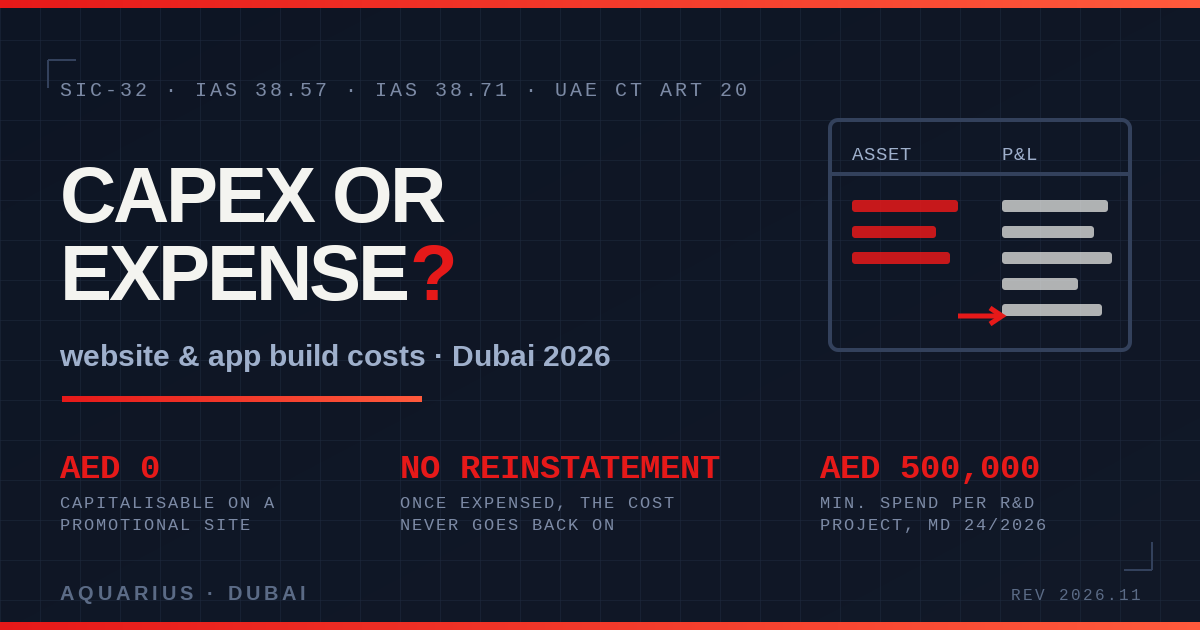
Short answer: Most Dubai websites cannot be capitalised at all. SIC-32 states plainly that an entity cannot demonstrate future economic benefits from a website built solely or primarily to promote and advertise its own products and services, so every dirham of that build is an expense when incurred. A custom platform that earns revenue directly — a booking engine, a marketplace, a SaaS product, a portal customers pay to use — can be capitalised, but only the application, infrastructure and design stages, only from the exact date the six IAS 38.57 tests are all met, and only if your reporting framework allows it at all. Under IFRS for SMEs, which the UAE Corporate Tax Law accepts below AED 50 million revenue, the answer is a flat no: every dirham of development is expensed.
This is the single most mispriced line in Dubai finance. A studio sends an invoice for AED 180,000 marked “website development”. The accountant sees a big number with the word “development” in it and books it to intangible assets. Twelve months later the auditor asks which of the six recognition tests were met and on what date, and nobody can answer, because the answer was never in the invoice. The cost did not change. The classification did — and with it the 2026 taxable income, the EBITDA the bank underwrote, and whether the spend can ever feed an R&D tax credit claim.
The numbers Dubai is making this decision on
The stakes are rising with the spend. Gartner puts MENA IT spending at USD 169 billion in 2026, with IT services across the region growing 8.3 percent that year. IDC has the UAE IT services market at USD 4.19 billion in 2025 rising to USD 6.16 billion by 2030, an 8.0 percent CAGR, and flags 2026 as a momentum trough as unresolved AI return-on-investment questions defer discretionary projects. Total UAE IT spending is tracking toward USD 24 billion in 2026.
At project level, the 2026 Dubai market prices out roughly like this: a basic business site at AED 3,500 to AED 8,000, a corporate or bilingual SME site at AED 12,000 to AED 55,000, an ecommerce build at AED 15,000 to AED 110,000 and up, and a custom web application or enterprise platform from AED 50,000 past AED 275,000. Mobile apps run AED 30,000 to AED 1,000,000 plus, with most SME production builds landing between AED 60,000 and AED 150,000 and ongoing work costing 15 to 25 percent of the build per year.
Those are no longer amounts that slip past an audit. Ministerial Decision No. 84 of 2025, effective 1 January 2025, requires audited financial statements from any taxable person with revenue above AED 50 million, from every Qualifying Free Zone Person regardless of size, and from every tax group. An AED 180,000 intangible sitting on a balance sheet with no capitalisation memo behind it is now a recurring audit finding, not a private judgement call.
SIC-32: five stages, and the sentence that expenses most Dubai websites
A website developed with internal expenditure is an internally generated intangible asset, which drops it into IAS 38. SIC-32 then splits the work into stages (paragraphs 2 and 3) and assigns each one a treatment (paragraph 9). The stages are not accounting abstractions — they map almost line-for-line onto a Dubai studio’s statement of work.
| SIC-32 stage | What it is on a real Dubai project | Treatment |
|---|---|---|
| Planning | Feasibility studies, defining objectives and specifications, evaluating alternatives, agency pitches, discovery workshops | Expense as incurred — treated like a research phase |
| Application and infrastructure development | Domain registration, hardware, operating software, building and installing the application, stress testing | Capitalise if IAS 38.57 is met |
| Graphical design development | Designing the appearance of web pages, design system, component library | Capitalise if IAS 38.57 is met |
| Content development | Creating, purchasing, preparing and uploading text and graphics | Capitalise only where it is not advertising or promoting your own products — otherwise expense |
| Operating | Post-launch maintenance, enhancements, content updates, hosting, retainers | Expense unless it meets the IAS 38.18 recognition criteria |
Now the sentence that decides the majority of cases. SIC-32 paragraph 8 requires an entity to demonstrate how the website will generate probable future economic benefits, and then closes the door: an entity is not able to demonstrate how a website developed solely or primarily for promoting and advertising its own products and services will generate probable future economic benefits, and consequently all expenditure on developing such a website shall be recognised as an expense when incurred.
Read that against the Dubai market. The corporate brochure site, the free-zone company profile, the real-estate project microsite, the restaurant’s menu-and-location site, the clinic’s services pages: all promotional. Capitalisable amount, AED 0. Not “AED 0 because it is small” — AED 0 because the standard says the benefit cannot be demonstrated, at any value.
SIC-32 also kills a favourite EBITDA trick in paragraph 10: the best estimate of a website’s useful life should be short. You do not get to park AED 200,000 on the balance sheet and amortise it across ten years because the brand guidelines say the design is timeless. One to three years is the defensible range for most builds, and your auditor will anchor there.
What does survive capitalisation in Dubai
Plenty, if the asset actually earns. A booking engine that takes payment. A logistics portal a client company pays a subscription for. A marketplace that clips a commission. A patient portal that reduces a measurable cost. These generate direct revenue or demonstrable cost savings, which is exactly the economic-benefit test SIC-32 points at. The pattern is simple: if a user can transact, you likely have an asset. If a user can only be persuaded, you have marketing spend.
The six tests, and why the date beats the tests
IAS 38.54 expenses all research. IAS 38.57 then allows a development-phase intangible to be recognised if, and only if, the entity can demonstrate all six of: technical feasibility of completing it, intention to complete and use or sell it, ability to use or sell it, how it will generate probable future economic benefits, availability of adequate technical, financial and other resources to complete it, and the ability to measure the attributable expenditure reliably.
Most Dubai projects do eventually satisfy all six. The problem is never the tests. It is IAS 38.65: capitalisation starts on the date the last of the six is met — and IAS 38.71 then shuts the door behind you:
“Expenditure on an intangible item that was initially recognised as an expense shall not be recognised as part of the cost of an intangible asset at a later date.”
That is a one-way door, and it is the most expensive paragraph in this article. A Dubai SME signs a phased contract in February, pays AED 60,000 for discovery and prototyping, and the bookkeeper expenses it because nothing exists yet. Correct. In June the board approves the full build, funding is in place, the architecture is proven — all six tests now met — and the finance manager tries to move the February and March costs onto the balance sheet along with everything else. Not allowed, ever. Those dirhams are permanently in the 2026 profit and loss account. The only costs that can be capitalised are those incurred on or after the June date.
Which means the control is not the accountant. It is the paperwork. The date the six tests were met has to exist as a written artefact — a board or budget approval, a signed phase-two statement of work, a go-live decision log — and the vendor’s invoices have to be granular enough to sit either side of it. A single end-of-project invoice reading “Website development — AED 180,000” cannot be split after the fact without the auditor treating the whole allocation as unsupported. Ask any Dubai studio to break an invoice down by SIC-32 stage and milestone date and most will, if you ask before kickoff. Almost none will offer.
The framework fork: the same build, two different answers
Here is where UAE Corporate Tax makes this a cash question rather than a presentation question. Article 20 determines taxable income from standalone financial statements prepared under accounting standards accepted in the State, and the FTA accepts exactly two: IFRS, and IFRS for SMEs for taxable persons whose revenue does not exceed AED 50 million. Article 28 allows a deduction for expenditure incurred wholly and exclusively for the business and not capital in nature; capitalised cost gets its relief later, through amortisation, under the general rules in Ministerial Decision No. 134 of 2023.
And the two accepted frameworks disagree. IFRS for SMEs Section 18 requires all research and development expenditure to be recognised as an expense when incurred — full stop. There is no six-test election. The IASB was asked repeatedly during its review to allow capitalisation of successful development and, in the third edition issued in February 2025 (effective for periods beginning on or after 1 January 2027), declined again. So the same AED 180,000 platform is an asset for a Dubai group on full IFRS and pure expense for the SME next door on IFRS for SMEs.
| AED 180,000 custom platform, built Jan–Sep 2026 | Full IFRS (with SIC-32 applied) | IFRS for SMEs (revenue under AED 50m) |
|---|---|---|
| Planning and discovery | AED 40,000 expensed | AED 40,000 expensed |
| Application, infrastructure, design | AED 110,000 capitalised | AED 110,000 expensed |
| Promotional content and launch marketing | AED 30,000 expensed | AED 30,000 expensed |
| Amortisation in 2026 (3-year life, 3 months in use) | AED 9,167 | n/a |
| 2026 deduction | AED 79,167 | AED 180,000 |
| Corporate Tax effect at 9 percent | Deduction worth AED 7,125 in 2026 | Deduction worth AED 16,200 in 2026 |
Over the asset’s life the total deduction is identical — this is timing, not a permanent difference. Timing is still worth real money in the UAE right now, for one reason: Small Business Relief treats a taxable person with revenue up to AED 3 million as having no taxable income, and it is available for tax periods ending on or before 31 December 2026. A deduction taken inside a relieved period is worth zero. The same deduction pushed into 2027 by capitalisation is worth 9 percent. Businesses crossing that line are the one group for whom capitalising is actively the better answer, and most of them are expensing by default.
The R&D tax credit link most Dubai SMEs will miss
From tax periods commencing on or after 1 January 2026, the UAE R&D Tax Credit — Cabinet Decision No. 215 of 2025, implemented by Ministerial Decision No. 24 of 2026 — gives a tiered credit against Corporate Tax: 15 percent on the first AED 1 million of qualifying R&D expenditure (minimum 2 R&D employees), 35 percent on the AED 1 million to AED 2 million band (minimum 6), and 50 percent on AED 2 million to AED 5 million (minimum 14). It is not refundable under MD 24/2026 despite the Cabinet Decision contemplating refundability in a later phase; unused credit carries forward.
Three details decide whether a software build can touch it, and all three bite in Dubai:
- Qualifying expenditure explicitly includes costs capitalised as internally generated intangibles under the applicable accounting standards, alongside staff costs, consumables, subcontracting and arm’s length cost contribution arrangements. Your IAS 38 capitalisation schedule is therefore a tax document, not just an audit one — and if IAS 38.71 already forced those costs into the P&L as expensed items with no project tracking behind them, reconstructing the claim is guesswork.
- Minimum AED 500,000 of expenditure per qualifying R&D project, per tax period. The typical AED 60,000 to AED 150,000 Dubai SME app does not reach it. Nor does a AED 180,000 platform. This is a credit for genuine engineering programmes, not for having a website built — and the honest answer most Dubai businesses need to hear is that they do not qualify.
- Pre-approval from the Emirates Research and Development Council is a hard prerequisite for every project, submitted through the TAWWER portal. For tax periods ending on or before 31 December 2026 the application is due within 40 business days of period end — 26 February 2027 for calendar-year filers. For periods ending after that, it must be in on or before the last day of the period itself. There is no retrospective rescue: a project nobody registered is a project with no credit.
If you are running a real engineering programme at that scale, read this alongside our breakdown of the UAE R&D tax credit for software development, and get the project structure right before the spend starts rather than after.
How we structure a build so the accounting actually works
None of this requires a different product. It requires a differently written statement of work, and that costs nothing if it is done at kickoff.
- Phase the contract on SIC-32 lines. Discovery and specification as one priced phase, application and infrastructure build as another, design system as another, content population and launch marketing explicitly separate. Your accountant then classifies from the invoice, not from a guess.
- Date the recognition event. We issue a written build-approval memo at the end of discovery that states what is technically feasible, what will be built, what it will earn or save, and that resources are committed. That memo is the IAS 38.65 date, in a form an auditor accepts.
- Invoice by milestone, with dates. Granular enough to fall cleanly either side of the recognition date, so IAS 38.71 never strands a cost you were entitled to capitalise.
- Separate the operating retainer from the build. Post-launch maintenance is an expense under SIC-32; bundling it into the build invoice contaminates the capitalised amount and invites the auditor to challenge the whole figure.
- Say when the answer is AED 0. If what you need is a promotional site, the right advice is that it is marketing spend, fully deductible now, and no amount of invoice engineering changes that. We would rather tell you that than help you build an intangible your auditor will write off.
For context on where these builds sit in a wider asset picture, see our guides to the fixed asset register and depreciation and to capital work in progress and IAS 23 borrowing costs, and our transparent AED pricing for how we phase and quote.
Frequently asked questions
Can I capitalise my company website in the UAE?
Only if it generates revenue or demonstrable savings directly. SIC-32 paragraph 8 states an entity cannot demonstrate probable future economic benefits for a website developed solely or primarily to promote and advertise its own products and services, so all expenditure on such a site is expensed when incurred. A brochure or corporate profile site is marketing spend. A booking engine, portal or marketplace can be an intangible asset.
Is a mobile app capex or expense under IFRS?
An internally generated app follows IAS 38. Research and planning are expensed; development is capitalised from the date all six IAS 38.57 tests are met and no earlier. Under IFRS for SMEs, which the UAE accepts for taxable persons with revenue up to AED 50 million, all development expenditure is expensed and capitalisation is not available at all.
Can I move previously expensed development costs onto the balance sheet later?
No. IAS 38.71 prohibits recognising expenditure initially recognised as an expense as part of the cost of an intangible asset at a later date. The correction is impossible, which is why the recognition date needs to be documented before the spend, not reconstructed at year end.
Does capitalising a website change my UAE Corporate Tax bill?
It changes the timing. Article 20 computes taxable income from IFRS or IFRS for SMEs financial statements, and Article 28 denies a current deduction for capital expenditure, so relief arrives through amortisation instead. Total relief over the asset’s life is the same. The timing matters most for businesses with revenue near AED 3 million using Small Business Relief for periods ending on or before 31 December 2026, where a deduction taken inside the relieved period is worth nothing.
How long should a website be amortised over in Dubai?
SIC-32 paragraph 10 says the best estimate of a website’s useful life should be short. One to three years is the defensible range for most builds. A longer life needs specific evidence about the platform, not a view about the brand, and is a common audit challenge.
Does my AED 150,000 app qualify for the UAE R&D tax credit?
No. Ministerial Decision No. 24 of 2026 sets a minimum of AED 500,000 of qualifying expenditure per R&D project per tax period, requires minimum R&D headcount per credit band, and makes Emirates Research and Development Council pre-approval through the TAWWER portal a prerequisite for every project. Ordinary website and app builds fall well below the threshold.
The practical takeaway
Classification is decided at kickoff, not at year end. Before you sign the next build, three questions settle almost everything: will a user transact on this thing, or only be persuaded by it; which accounting framework are we on; and what dated document proves when the six tests were met. Get those on paper and the accounting, the audit file and any future credit claim all fall out of the project plan for free. Miss them, and IAS 38.71 makes the mistake permanent.
Planning a web or app build in Dubai in 2026 and want it phased so the finance side holds up? Talk to Aquarius — we will scope it, quote it in AED by SIC-32 stage, and hand your accountant a file they can defend. See what we build to start.
This article is general information on accounting and tax treatment current as at 14 November 2026, not advice on your specific position. Confirm the classification with your auditor or registered tax agent before filing.