
IFRS 9 Expected Credit Loss in Dubai (2026): The Provision Matrix Your Auditor Will Accept
Around 40% of UAE B2B invoices are paid late and just over 2% of receivables are written off. How to build an IFRS 9 provision matrix in Dubai, what it costs in AED, and where VAT relief fits.
- PUBLISHED
- 12 NOV 2026
- READ TIME
- 12 MIN
- AUTHOR
- AQUARIUS · DUBAI
- UNIT
- REV 2026.09
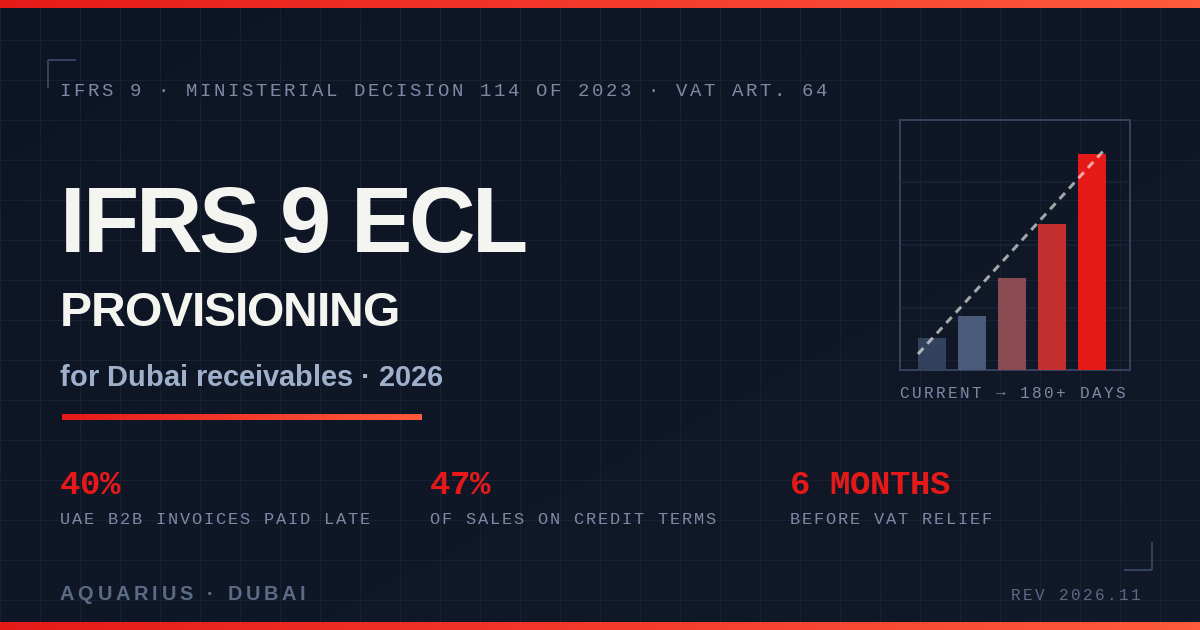
Short answer: IFRS 9 does not let you book a round-number bad-debt provision at year end. For ordinary trade receivables you must recognise a lifetime expected credit loss from day one, normally via a provision matrix — historical default rates by ageing bucket, adjusted for a forward-looking view. In the UAE that matrix is now an audit focus area, and the data to build it almost never exists in a usable form inside the ERP.
The receivables exposure Dubai is actually provisioning for
Three numbers set the stakes. Atradius’ 2026 UAE Payment Practices Barometer (published 31 July 2026) found that 47% of B2B sales in the UAE are made on credit, that around 40% of invoices are paid late, and that bad-debt write-offs now run at just over 2% of all B2B receivables. On an AED 50m book of credit sales, that write-off rate alone is roughly AED 1m a year leaving the business permanently.
The pressure is concentrated. Nearly half of the firms surveyed (49%) blamed customer cash-flow constraints for the delays; 47% reported higher financing needs as a direct result, 46% less liquidity headroom, and 38% difficulty planning cash flow at all. More than twice as many UAE firms said payment delays were rising as said they were falling. Construction and industrial supply chains were worst hit — unsurprising given retention terms. Roughly one in three UAE businesses has now taken up trade credit insurance.
Banks, meanwhile, have gone the other way. The Central Bank of the UAE reported the aggregate non-performing loan ratio at 2.6% gross and 1.2% net by August 2026 — a record low, against 8.2% in 2020 — with provision coverage of about 108.8%. That divergence matters for your audit: your bankers’ ECL models are mature and heavily supervised, which is exactly the benchmark your auditor now has in mind when they open your provision file.
Most Dubai businesses get this wrong in the same way: they book a provision, then assume it also reclaims the VAT. It does not. Only a write-off does — and only after six months.
What IFRS 9 requires for trade receivables
IFRS is mandatory for UAE corporate tax purposes under Ministerial Decision No. 114 of 2023, with IFRS for SMEs permitted where revenue does not exceed AED 50 million. Either way, the impairment model is the expected-credit-loss model, not the old “incurred loss” approach.
For trade receivables with no significant financing component, IFRS 9 gives you the simplified approach: recognise lifetime ECL immediately, with no staging assessment. For receivables with a financing element, intercompany loans and lease receivables, you are in the general three-stage model, where the rebuttable presumptions are a significant increase in credit risk at 30 days past due and default at 90 days past due.
The provision matrix, with a worked AED example
The practical expedient almost every Dubai business ends up using is a provision matrix: group receivables by ageing bucket (and, where risk profiles genuinely differ, by customer segment or sector), apply an observed historical loss rate to each, then overlay a forward-looking adjustment. Illustrative rates on an AED 10m book:
| Ageing bucket | Gross receivable (AED) | Loss rate | ECL (AED) |
|---|---|---|---|
| Current | 5,000,000 | 0.5% | 25,000 |
| 1–30 days | 2,500,000 | 1.5% | 37,500 |
| 31–60 days | 1,200,000 | 4% | 48,000 |
| 61–90 days | 700,000 | 10% | 70,000 |
| 91–180 days | 400,000 | 30% | 120,000 |
| 180+ days | 200,000 | 70% | 140,000 |
| Total | 10,000,000 | 3.8% | 440,500 |
Rates are illustrative — yours must be derived from your own default history. The point is the shape: an auditable, bucket-level number with a visible derivation, not a single journal entry. And note the blended 3.8% sits close to the ~2% national write-off rate once you allow for recoveries, which is the sanity check to run first.
The forward-looking overlay nobody documents
Historical rates alone fail the standard. IFRS 9 requires reasonable and supportable forward-looking information, and “we used last year’s numbers” is the single most common audit finding. In the UAE the usable anchors are public: the CBUAE Base Rate, held at 3.90% on 28 October 2026, which drives borrower debt-service costs; the dirham’s peg at 3.6725 to the US dollar, which removes FX from the equation for USD-invoiced customers but not for others; and sector signals — Atradius flags construction and industrials as the deteriorating segments. Document the link from each input to the rate adjustment. One page is enough; zero pages is a finding.
Retentions and contract assets
Construction and fit-out contracts are where the mechanics bite. Retention is typically 10% of certified work, released at practical completion or expiry of the defects-liability period. Retention that is still conditional on something other than the passage of time is a contract asset under IFRS 15, not a receivable — but it still carries ECL. On AED 1m of certified work, AED 100,000 of retention held for 18 months at a 1–8% loss rate is AED 1,000 to AED 8,000 of provision, plus discounting. The same split logic you may already have met in IFRS 16 lease accounting and IFRS 15 revenue recognition applies here: the standard is a data-modelling problem before it is an accounting one.
What it costs to build in Dubai
Off-the-shelf IFRS 9 ECL platforms — SAS, Moody’s Analytics, FIS, Oracle, Wolters Kluwer, Experian — are priced for banks, typically USD 30,000 to 75,000 per year (roughly AED 110,000 to 275,000) before implementation. For a corporate with a trade-receivables book, that is the wrong tool. What you need is a calculation and evidence layer on top of the ERP you already run.
| Scope | AED range | Timeline |
|---|---|---|
| Receivables data audit + provision matrix model (Excel/BI, documented) | 18,000 – 45,000 | 2–3 weeks |
| ECL engine on existing ERP: ageing feed, bucket rates, overlay, journal export | 45,000 – 110,000 | 4–7 weeks |
| Full credit-risk platform: staging, segment matrices, scenario overlays, audit trail | 150,000 – 320,000 | 10–16 weeks |
| Ongoing care: quarterly rate refresh, overlay update, audit support | 3,500 – 14,000/month | — |
See our pricing for how these bands are structured.
The VAT trap
Under Article 64 of the UAE VAT law, bad debt relief requires four things: the goods or services were supplied and VAT was accounted for; the consideration has been written off in full or part in your accounts; more than six months have passed since the date of supply; and you have notified the customer in writing of the write-off amount. An IFRS 9 ECL allowance satisfies none of them — it is a provision, not a write-off. FTA public clarification VATP024 is explicit on this. The customer must also reduce their recoverable input tax. Practical consequence: your ECL model and your VAT write-off register are two different artefacts, and the second one needs a notification trail. The collections side of the same ledger is where that trail usually goes missing.
Corporate tax: the realisation basis election
UAE corporate tax has no ECL-specific rule, so unrealised accounting provisions flow through taxable income unless you elect otherwise. Ministerial Decision No. 134 of 2023 allows an election to use the realisation basis — excluding unrealised gains and losses until realised — but it must be made in the first tax period and is irrevocable except with FTA approval. Get that decision wrong and you carry it permanently. Penalties for the downstream errors are mechanical: AED 500 for an incorrect return, AED 500 per month for late filing rising to AED 1,000 per month from month 13, and AED 10,000 for late registration, against a nine-month filing window.
How Aquarius builds it
We start with the ageing data, not the model. In most Dubai ERPs the invoice-level history needed for a defensible loss rate is there but unusable — credit notes applied to the wrong period, part-payments that reset the ageing clock, intercompany mixed into third-party. We rebuild that feed, derive bucket-level default rates from your own three-to-five-year history, attach the forward-looking overlay with its evidence, and output both the journal and the audit memo. The write-off register, with its six-month clock and notification log, comes out of the same pipeline. You keep the model: it is your ERP, your BI layer, your documentation.
FAQ
Can a small Dubai company just use a flat percentage provision?
No. A flat rate is not a provision matrix and will not survive review. It also costs money: at a blended rate derived properly, most trade books land between 1% and 4%, and flat 5% policies over-provision while still failing the documentation test.
Does an ECL provision reduce my VAT liability?
No. VAT relief under Article 64 requires an actual write-off in the accounts, more than six months since the date of supply, and written notification to the customer. A provision alone qualifies for none of it.
Do I need IFRS 9 if I report under IFRS for SMEs?
IFRS for SMEs is permitted under Ministerial Decision 114 of 2023 where revenue is AED 50 million or less. Its impairment model is simpler, but you still need an evidenced, receivable-level assessment — not a round number.
What about the CBUAE prudential filter?
That applied to banks only. The transitional arrangement that let banks add back Stage 1 and Stage 2 ECL to capital stepped down from 100% to 75%, 50% and 25% before reaching zero on 1 January 2025. It never applied to corporates.
How long does a usable ECL model take to build?
Two to three weeks for a documented matrix if your ageing data is clean, four to seven weeks if it has to be rebuilt first — which it usually does.
One last conversion number worth holding on to: with 47% of UAE B2B sales on credit and write-offs at 2% of receivables, a business doing AED 100m of credit sales is losing roughly AED 2m a year to bad debt. A provisioning model that surfaces deterioration at the 30-day mark instead of the 180-day mark pays for itself on a single recovered account.
Want your receivables data turned into an IFRS 9 model your auditor signs off first time? Talk to Aquarius — we will tell you in the first call whether your ageing data can carry a provision matrix, or has to be rebuilt.