
Revenue Recognition for Dubai SaaS and Subscription Businesses (2026): IFRS 15 and the AED 3m Trap
IFRS 15 decides what counts as revenue, and in the UAE that number drives your Small Business Relief, audit duty and e-invoicing phase. The rules, the AED 3m trap, and real 2026 costs.
- PUBLISHED
- 27 OCT 2026
- READ TIME
- 13 MIN
- AUTHOR
- AQUARIUS · DUBAI
- UNIT
- REV 2026.09
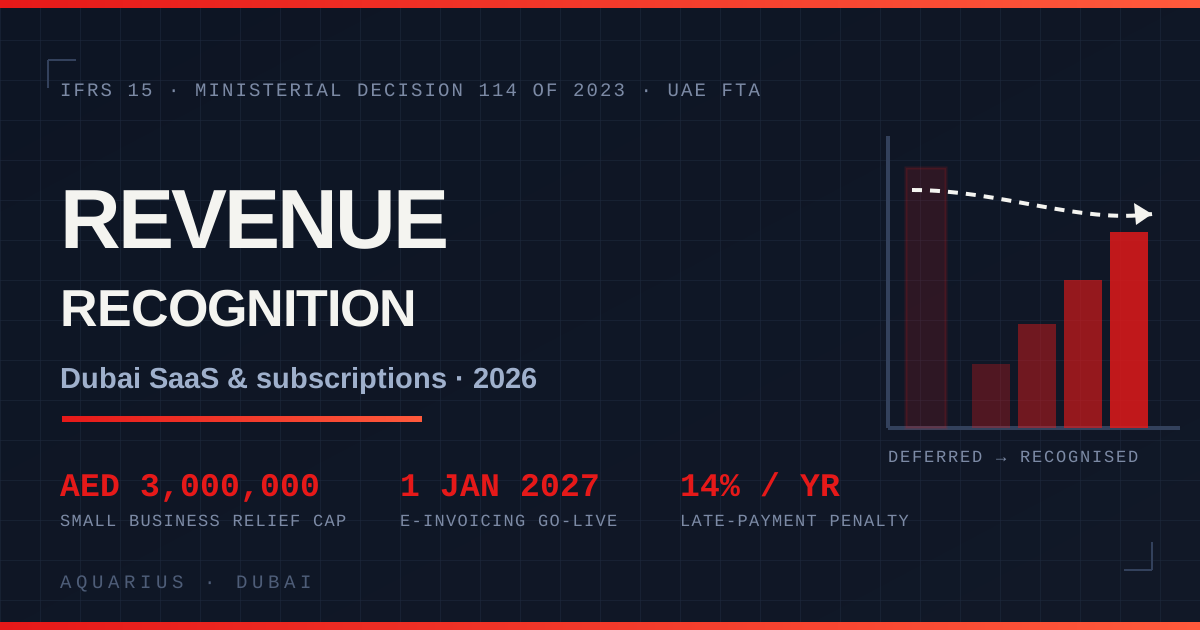
Under IFRS 15 you recognise revenue when you satisfy a performance obligation, not when you invoice and not when the cash lands. For a Dubai subscription business that means an annual plan billed up front is mostly a liability on day one, and a marketplace that only arranges a sale books its commission, not the gross transaction value. Getting that split wrong does not just distort your P&L: in the UAE it changes your Small Business Relief eligibility, your audit obligation and which e-invoicing phase you fall into.
Revenue recognition used to be an accountant’s problem. Since corporate tax arrived it is a product problem, because the number your billing system emits is the number the Federal Tax Authority reads. This guide covers the five-step IFRS 15 model, the four patterns that catch UAE SaaS and subscription companies, which accounting standard you are actually allowed to apply, the AED 3 million trap that costs businesses relief they were entitled to, what the software and build work costs in 2026, and what the penalties look like.
Three numbers that set the clock
- 640,000+ corporate tax registrants. The FTA reported that corporate tax registrants surpassed 640,000 ahead of the 30 September 2025 filing deadline for financial years ending 31 December 2024, with compliance rates it described as exceeding international benchmarks. The 9% rate on taxable income above AED 375,000 under Federal Decree-Law No. 47 of 2022 is now a routine annual event, and it is computed from your accounting revenue.
- 30 October 2026 and 1 January 2027. Under Ministerial Decisions No. 243 and 244 of 2025, businesses with annual revenue of AED 50 million or more must appoint an Accredited Service Provider by 30 October 2026 and go live with e-invoicing on 1 January 2027. Everyone else appoints an ASP by 31 March 2027 and goes live 1 July 2027; government entities follow on 1 October 2027. The voluntary pilot ran from July 2026. Your revenue figure decides which queue you are in — and a gross-vs-net error can move you a full phase earlier.
- Around AED 11.3 billion a year. The UAE cloud services market was estimated at USD 6.15 billion in 2026 with SaaS contributing roughly half of it, growing at a 7.21% CAGR to 2032. UAE enterprises put over USD 3.2 billion into SaaS applications in 2024 (about AED 11.8 billion), and average SaaS spend per employee here now exceeds AED 12,800 versus a global average near USD 2,900. There are a lot of UAE subscription contracts to account for, in both directions.
What IFRS 15 actually asks you to do
IFRS 15 replaced a patchwork of rules with one five-step model that applies to every contract with a customer, whether you sell software, maintenance, printing or professional services:
- Identify the contract. Enforceable rights and obligations — a signed MSA, a clicked terms-of-service, an approved purchase order.
- Identify the performance obligations. Each distinct promise in the contract. Platform access, implementation, training, support and hardware may be one obligation or five, depending on whether the customer can benefit from each on its own.
- Determine the transaction price. Including variable consideration — usage overages, volume rebates, service credits, early-termination refunds — constrained to the amount you expect not to reverse.
- Allocate the price to the obligations. On relative standalone selling prices, which is why discounting a bundle without an allocation policy is a reporting problem, not just a sales one.
- Recognise revenue as each obligation is satisfied. Over time for a subscription that provides continuous access; at a point in time for a perpetual licence delivered on a date.
Everything billed ahead of satisfaction sits as deferred revenue — a liability, not income. That single distinction is where most of the mistakes live.
The four patterns that trip up Dubai subscription businesses
1. Annual prepay booked as revenue on the invoice date
A customer signs a 12-month plan at AED 120,000 on 1 October 2026 and pays in full. At a 31 December 2026 year end you have earned three months: AED 30,000 of revenue and AED 90,000 of deferred revenue. Book the whole AED 120,000 in 2026 and you have overstated revenue by 300% for that contract, pulled tax forward, and created a 2027 that looks like a collapse.
2. Setup and onboarding fees treated as separate income
Most SaaS setup activity is not a distinct performance obligation, because the customer gains nothing from a configured account without the subscription that follows. Invoice AED 120,000 for a 12-month plan plus a AED 12,000 non-refundable setup fee and the usual answer is one obligation worth AED 132,000, recognised at AED 11,000 a month over the term. Training is different: a customer can benefit from it on its own and could have bought it elsewhere, so it is typically distinct and recognised when delivered.
3. Marketplace commission booked gross — the expensive one
IFRS 15.B34 makes you decide, for every good or service, whether you are a principal or an agent. A principal controls the good or service before it transfers to the customer and recognises the gross amount. An agent merely arranges for another party to provide it and recognises only its fee or commission — and that holds regardless of whether the gross cash passes through your account. The IFRS 15.B37 indicators point to agent treatment when another party is primarily responsible for fulfilment and you carry no inventory risk before, during or after the sale.
Plenty of Dubai platforms run gross merchandise value through a payment gateway and report GMV as revenue because that is the number the dashboard shows. If you never control the goods, that is not your revenue. The consequences are not cosmetic, as the next section shows.
4. Usage overages, credits and unused balances
Metered overages are variable consideration: estimate and constrain them, do not wait for the invoice. Service credits owed under an uptime SLA generally reduce the transaction price rather than becoming an expense. Prepaid wallet balances and multi-visit passes stay deferred until used or until breakage can be reliably estimated. If your billing system cannot report deferred balances by contract and by month, none of this is auditable.
| Contract element | Typical IFRS 15 treatment | Recognition timing |
|---|---|---|
| Monthly or annual platform access | Single obligation, series of distinct services | Ratably over the subscription term |
| Non-distinct setup / configuration fee | Combined with the subscription | Spread over the contract term |
| Training delivered as a workshop | Usually distinct | When the training is delivered |
| Perpetual licence plus annual support | Two obligations, price allocated | Licence at delivery, support over time |
| Usage overages | Variable consideration, constrained | As usage occurs |
| Marketplace sale you do not control | Agent — net presentation | Commission only, as the sale completes |
| Prepaid credits / multi-visit pass | Deferred revenue liability | On redemption, or on reliable breakage |
| Incremental cost of winning the contract | Capitalised contract asset | Amortised over the benefit period |
Which accounting standard you are allowed to use
This is settled law in the UAE, not a choice of house style. Ministerial Decision No. 114 of 2023 requires a taxable person to apply IFRS for corporate tax purposes, and permits IFRS for SMEs where revenue does not exceed AED 50 million — a lighter framework with reduced disclosure and simpler treatment of financial instruments, deferred tax and goodwill. IFRS for SMEs still carries a revenue-recognition model built on the same performance-obligation logic.
Three more rules worth pinning to the wall:
- Audited financial statements are required above AED 50 million of annual revenue, and for any Qualifying Free Zone Person claiming the 0% rate regardless of size.
- Cash basis is available by election only where revenue does not exceed AED 3 million in the tax period, or in exceptional circumstances, under Ministerial Decision No. 134 of 2023. Above that you are on accrual, which means IFRS 15 applies in full.
- The same decision allows a realisation basis election so that gains and losses on certain assets and liabilities are taxed only on a realisation event, which is a separate question from how you recognise customer revenue.
Filing is due nine months after the end of the tax period: a 31 December 2026 year end files and pays by 30 September 2027. One quiet concession — businesses that registered late have the AED 10,000 late-registration penalty waived if the first return is filed within seven months of the end of the first tax period, not nine.
The AED 3 million trap: how gross revenue costs you Small Business Relief
Small Business Relief lets a UAE resident juridical person with revenue at or below AED 3 million elect to be treated as having no taxable income. It was introduced by Ministerial Decision No. 73 of 2023 and was due to expire for tax periods ending after 31 December 2026 — until Ministerial Decision No. 131, issued on 7 August 2026, extended it to tax periods ending on or before 31 December 2029. It is not automatic: you elect it in the return, every year. Exceed AED 3 million in any tax period and the relief is simply unavailable for that period.
Now the part most Dubai businesses get wrong. For this test, revenue means the gross amount of income derived in the tax period, measured under the applicable accounting standards — IFRS or IFRS for SMEs. Revenue, not profit. So the IFRS 15 principal-versus-agent conclusion directly determines whether you clear the threshold.
Take a Dubai booking platform that processes AED 8.4 million of customer transactions and keeps a 12% commission of AED 1,008,000, with the suppliers responsible for fulfilment and no inventory risk on the platform. On a correct agent analysis its revenue is AED 1,008,000: comfortably under AED 3 million, relief elected, taxable income nil. Booked gross, its revenue is AED 8.4 million: relief gone. On, say, AED 900,000 of taxable income that is 9% of the amount above AED 375,000 — a AED 47,250 bill it did not owe, repeated every year the error persists. Push the same error past AED 50 million of GMV and you have also manufactured a mandatory audit and pulled yourself into e-invoicing Phase 1.
The threshold is tested on revenue, not margin. A low-margin platform that books gross can pay corporate tax, commission an audit and onboard an e-invoicing provider years before a correctly presented set of accounts would require any of it.
The reverse error is just as real: a genuine principal that nets its revenue down understates turnover, which is a misstatement an auditor will find and a voluntary disclosure will have to fix.
What it costs to get this right in 2026
Three routes, in rising order of cost. Spreadsheet schedules work until roughly a few hundred active contracts, then break on mid-term upgrades, proration and multi-currency. Off-the-shelf revenue-recognition software handles standard subscription shapes. Custom logic in your own product or ERP is the answer when your contracts are not standard — marketplace splits, project milestones, Arabic invoicing, UAE-specific VAT and e-invoicing fields.
| Option | List price (2026) | Approx. AED | Best fit |
|---|---|---|---|
| Chargebee Revenue Recognition (add-on) | Free to USD 250k cumulative billing, then from USD 299/mo; Performance USD 599/mo, 0.75% overage | From ~AED 1,100/mo | Mid-market SaaS already on Chargebee billing |
| Maxio | From USD 599/mo (Grow, to USD 100k monthly billing); Scale quoted above that | From ~AED 2,200/mo | Recurring plus usage billing with basic RevRec |
| Stripe Revenue Recognition | 0.25% of recognised revenue | ~AED 2,500 per AED 1m recognised | Stripe-native businesses, simple contracts |
| Zuora Revenue | Unpublished; typically USD 2,000+/mo at USD 50m+ ARR | From ~AED 7,300/mo | Enterprise, complex allocations |
| Custom module in your app or ERP | Project-based build | AED 35,000–140,000 build, then maintenance | Marketplaces, bundles, bilingual invoicing, e-invoicing fields |
Converted at AED 3.6725 to the US dollar. Note the percentage-of-revenue models: 0.25% looks small until you recognise AED 20 million, at which point AED 50,000 a year buys a lot of custom build. Our pricing page carries the current ranges, and ERP implementation cost in Dubai covers the bigger-system route.
What it costs if you get it wrong
Penalties sit in three stacks. Under Cabinet Decision No. 75 of 2023, failure to keep the required records is AED 10,000 per violation and AED 20,000 for a repeat within 24 months of the last one — and a deferred-revenue schedule you cannot reproduce is a records problem.
Cabinet Decision No. 129 of 2025 took effect on 14 April 2026 and rebuilt the regime. Late payment is now a flat 14% per annum computed monthly on unpaid tax, replacing the old compounding structure. Voluntary disclosure now costs 1% per month of the tax difference from the original filing deadline to the date of disclosure, in place of the previous 5%-to-40% step schedule — which makes self-correcting a revenue-recognition error dramatically cheaper than waiting to be audited, and makes delay linear and relentless.
E-invoicing has its own list under Cabinet Decision No. 106 of 2025: AED 5,000 per month for failing to implement or appoint an ASP within the deadline, AED 100 per invoice transmitted late (capped at AED 5,000 a month), and AED 1,000 per day for delays in notifying a system failure or a data update. Invoices must be structured and machine-readable in PINT-AE, the UAE Peppol specification — a PDF is not an e-invoice. The Electronic Invoicing Guidelines version 1.1, released 1 June 2026, added treatment for advance payments and retention billing, both of which are revenue-recognition questions wearing an invoicing hat.
How Aquarius builds this
We treat revenue recognition as a data-model decision, taken before the first invoice is issued rather than reconstructed at year end. In practice that means: contract and performance-obligation records as first-class entities, not a plan name on a user row; a deferred-revenue ledger that can produce a schedule by contract, by obligation and by month on demand; an explicit principal-or-agent flag per transaction type with the IFRS 15.B37 reasoning recorded against it; variable-consideration handling for overages and SLA credits; and invoice records already carrying the TRN, line-level VAT and structured fields the UAE e-invoicing regime will demand.
If you are building the billing engine itself, start with subscription billing and recurring payments in the UAE. If the gap is on the finance side, corporate tax and accounting software for Dubai SMEs covers the ledger end, and VAT on SaaS and digital products in the UAE handles the indirect-tax layer. We are developers, not your tax adviser — the accounting policy is signed off by your auditor, and we build the system that makes it true and provable.
FAQ
Does revenue recognition really affect my UAE corporate tax?
Yes, twice over. Taxable income starts from accounting net profit prepared under IFRS or IFRS for SMEs, so timing differences move tax between periods. And revenue as measured under those standards is the test for Small Business Relief at AED 3 million, mandatory audited financial statements at AED 50 million, and your e-invoicing phase.
Can I just use cash accounting and skip IFRS 15?
Only if revenue does not exceed AED 3 million in the tax period, or in exceptional circumstances, and only by election under Ministerial Decision No. 134 of 2023. Above that threshold the accrual basis applies and so does the full performance-obligation model.
My marketplace never touches the goods. Do I report GMV or commission?
Apply the IFRS 15.B34–B37 test per good or service. If another party is primarily responsible for fulfilment and you carry no inventory risk, you are likely an agent and report commission only, even though gross cash flows through you. Document the reasoning — your auditor and the FTA will both want it.
Is a non-refundable setup fee revenue when I invoice it?
Usually not. If the setup is not distinct from the subscription — the customer gets no benefit from it without the service — it combines with the subscription and is recognised over the contract term. Separately saleable training is the common exception.
I have been recognising revenue wrongly for two years. What now?
Fix the policy with your auditor, restate, and consider a voluntary disclosure. Since 14 April 2026 a voluntary disclosure costs 1% per month of the tax difference, measured from the original filing deadline — so the cost of correcting rises every month you wait, but it is far below what an audit finding plus the 14% annual late-payment charge would produce.
Get the revenue number right before January
The AED 50 million cohort has to appoint an e-invoicing provider by 30 October 2026 and transmit structured invoices from 1 January 2027. Both of those deadlines are driven by a revenue figure that IFRS 15 defines, which makes this the right quarter to confirm that your billing data model, your deferred-revenue schedule and your principal-or-agent flags actually agree with your accounts. Send us your billing model or look through what we build — we will tell you in one call whether it survives an audit and an e-invoicing mandate, or needs work.