
Islamic App Development in Dubai (2026): Prayer Times, Qibla and Quran Apps That Pass Review
Dubai uses its own prayer-time method (Fajr 18.2, Isha 18.2), and Google Play will not pre-grant your adhan alarms. Real AED build ranges and the IACAD permit nobody checks.
- PUBLISHED
- 04 NOV 2026
- READ TIME
- 11 MIN
- AUTHOR
- AQUARIUS · DUBAI
- UNIT
- REV 2026.09
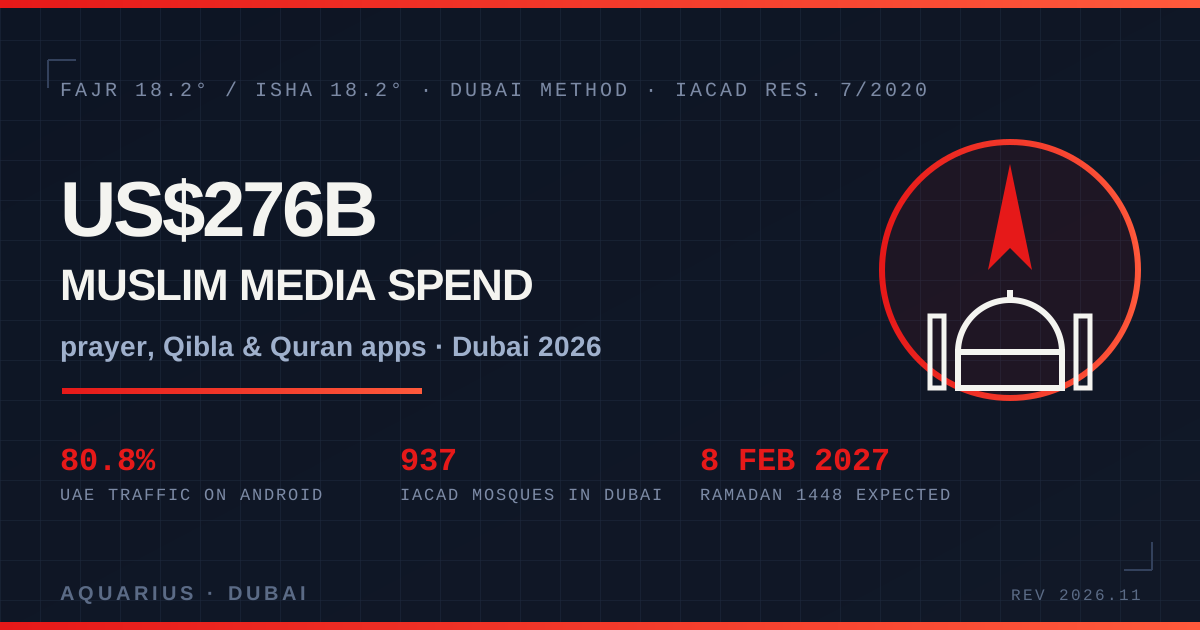
Short answer: An Islamic lifestyle app for the UAE market is not a thin wrapper around a prayer-time library. Two things decide whether it ships: picking the right calculation convention (Dubai’s own method uses Fajr 18.2° and Isha 18.2°, not Umm al-Qura’s 18.5° plus 90 minutes), and accepting that Google Play will not hand your adhan alarms the unrevocable exact-alarm permission. Budget AED 55,000 to 180,000 for a production app, and start now if you want it live before Ramadan 1448 AH.
Why the UAE is the hardest and best market for this
The money is real and growing. The State of the Global Islamic Economy 2025/26 report puts Muslim spend on media and recreation at US$276 billion in 2024, up 6.4% from US$260 billion, and projects US$364 billion by 2029 on a 5.7% CAGR — part of a US$2.6 trillion total Muslim consumer economy heading for US$3.56 trillion. Muslim Pro, the category leader, says it passed 190 million downloads by Ramadan 2026. That is the benchmark your store listing gets compared against, not some local competitor.
Dubai itself is the densest possible test bed. The Dubai Statistics Center put the emirate’s population at 4.58 million at the end of 2025, a jump of roughly 332,000 people or 7.5% in a single year. Dubai’s Islamic Affairs and Charitable Activities Department (IACAD) coordinates across 937 mosques and keeps adding capacity — 13 new mosques for over AED 162 million, seating up to 10,400 worshippers. Your users are physically surrounded by ground truth: if your Fajr time is three minutes off the mosque down the road, they notice on day one and uninstall on day two.
Most Dubai product teams get this wrong in exactly the same way. They treat prayer times as a solved API call, then discover somewhere between the first TestFlight build and App Review that the hard parts are jurisprudence, permissions and regulation.
Myth one: “just use the default calculation method”
There is no default. A prayer-time engine takes a latitude, a longitude, a date and a set of twilight angles — and the angles are a scholarly choice, not a technical one. Dubai has its own convention, and it is not the Saudi one most tutorials copy. In the widely used adhan library, the Dubai parameters are 18.2° for Fajr and 18.2° for Isha, with method adjustments of minus 3 minutes on sunrise and plus 3 minutes on Dhuhr, Asr and Maghrib. The AlAdhan API exposes the same thing as method ID 16.
Here is what you are actually choosing between for a UAE audience:
| Method | Fajr angle | Isha rule | AlAdhan ID | When to use it in the UAE |
|---|---|---|---|---|
| Dubai | 18.2° | 18.2° | 16 | Default for a Dubai-first app; closest to local timetables |
| Gulf Region | 19.5° | 90 min after Maghrib | 8 | Users who follow regional GCC timetables |
| Umm al-Qura | 18.5° | 90 min after Maghrib | 4 | Saudi residents, Hajj and Umrah modes |
| Kuwait | 18° | 17.5° | 9 | Kuwaiti expatriate users |
| Qatar | 18° | 90 min after Maghrib | 10 | Qatari expatriate users |
| Muslim World League | 18° | 17° | 3 | Large European and mixed diaspora segments |
| Karachi | 18° | 18° | 1 | Pakistani and Indian users, a huge share of UAE residents |
| ISNA | 15° | 15° | 2 | North American users of a UAE-built app |
Two engineering consequences. First, the method must be a user setting with a sane geo-based default, not a hardcoded constant — in a city where the large majority of residents are expatriates, one convention will be wrong for a large minority. Second, pick an Asr madhab default (Standard vs Hanafi) and expose the other; it shifts the afternoon prayer by a meaningful margin and it is the single most common one-star review in this category. Compute locally with a library so the app works offline, and treat any REST API as a cross-check rather than the source of truth.
Myth two: “adhan notifications are just exact alarms”
This is where UAE apps actually die, and it is an Android problem first. StatCounter put Android at 80.8% of UAE mobile traffic in October 2026 against 19.18% for iOS, so Android is not the second platform here — it is the platform.
Since Android 12, scheduling an exact alarm needs special access or you get a SecurityException. From API 33 there are two routes. USE_EXACT_ALARM is granted automatically and cannot be revoked by the user — but Google Play’s Permissions policy restricts it to apps whose “core, user facing functionality requires precisely-timed actions, such as: The app is an alarm or timer app. The app is a calendar app that shows event notifications.” A prayer-time app is a plausible argument, not a guaranteed one, and betting a release on how a reviewer reads your category is bad planning. The safe build uses SCHEDULE_EXACT_ALARM, which the user grants under “Alarms & reminders”, is revocable, is not pre-granted on fresh installs, and is denied after a backup-restore onto Android 14.
So a correct adhan scheduler has to: check canScheduleExactAlarms() before every schedule; onboard the user into granting the permission with an honest explanation of why five daily notifications need it; listen for ACTION_SCHEDULE_EXACT_ALARM_PERMISSION_STATE_CHANGED to reschedule when the permission flips; re-arm everything on ACTION_BOOT_COMPLETED; use setExactAndAllowWhileIdle() or setAlarmClock() so Doze does not defer the call to prayer; and never use repeating alarms, which have been inexact since API 19. Prayer times move daily anyway, so the right model is a rolling window of individually scheduled one-shot alarms.
One more date for the roadmap: Google Play’s Location Permissions policy takes effect 27 January 2027, and apps targeting Android 17 (API 37+) must use the Android location button for one-time or infrequent location requests. Qibla and prayer times are the textbook infrequent case. Ask for coarse location, foreground only, with a manual city fallback — and keep the data handling PDPL-aware, as covered in our UAE PDPL compliance checklist for websites and apps.
On iOS the risk is different: rejection for sameness. App Review Guideline 4.3(b) says Apple will not accept apps “indistinguishable from what’s already widely available” unless they offer “a meaningfully different or improved experience”, and 4.3(a) explicitly calls out shipping one Bundle ID per city. A generic prayer-times app with your logo on it is a 4.3 rejection. A Dubai app with mosque-level jamaah timings, IACAD-aligned content and Arabic-first RTL design is not.
The compliance question nobody asks until it is late
If your app ships Quranic text, audio recitation or religious instruction, Dubai has a licensing regime that predates app stores and does not obviously exclude them. Administrative Resolution No. (7) of 2020 Concerning Regulating Quran Copies and Religious Publications in Dubai, issued 6 January 2020, defines “Religious Publications” as “any scientific, literary, or artistic material related to the religion of Islam, whether in print, audio, or visual format”, and defines “Circulation” as “the sale, distribution, display, or publication of the Quran Copies or Religious Publications, or any other act that makes them accessible to a number of individuals”. Article 6 requires three sample copies, the intended quantity and the proposed distribution locations, with IACAD deciding within 30 days.
Layer on Federal Decree-Law No. 55 of 2023, which covers media activity in “audio, video or digital format”, carrying administrative fines of AED 1,000 to AED 1,000,000, doubled on repeat offences up to AED 2,000,000 under the Cabinet Resolution No. 42 of 2025 penalty schedule. If you also monetise through in-app advertising, note that the UAE Media Council Advertiser Permit became mandatory on 1 February 2026 — free for three years, then AED 1,000 a year, with 1,800+ permits already issued.
None of that means you cannot ship. It means the religious-content review and the permit conversation belong in week one of the project, not week twelve, and that a short written opinion from UAE counsel is cheap insurance. Apple’s Guideline 5.1.1(ix) will also expect a real legal entity behind a regulated-feeling app, and 1.1.1 covers religious content that could be read as defamatory — so source every translation and tafsir from a named, reputable authority and show the attribution in the UI.
What it costs in Dubai (AED, 2026)
These are our real build ranges for a native-quality Islamic lifestyle app aimed at UAE users. The first two rows are the minimum viable product; most of the retention lives in rows four and five.
| Scope | AED range | Timeline |
|---|---|---|
| Prayer-time engine (8 methods, madhab toggle, offline, high-latitude rules) | 12,000 – 22,000 | 1 – 2 weeks |
| Adhan notification layer (exact-alarm flows, boot re-arm, per-prayer sounds, silent-mode logic) | 14,000 – 28,000 | 2 – 3 weeks |
| Qibla compass (magnetometer calibration, true vs magnetic north, AR overlay) | 9,000 – 18,000 | 1 – 2 weeks |
| Quran module (Uthmani text, verse-synced audio, bookmarks, Arabic-first RTL typography) | 26,000 – 60,000 | 4 – 7 weeks |
| Ramadan pack (imsak and iftar countdowns, fasting tracker, Dubai mosque finder, Zakat calculator) | 18,000 – 40,000 | 3 – 5 weeks |
| Full iOS + Android launch, store-review-hardened, device matrix tested | 55,000 – 180,000 | 8 – 14 weeks |
For how those numbers sit against other app categories, see our Dubai development pricing and the cross-platform trade-offs in Flutter vs React Native for Dubai apps — relevant here because the alarm scheduler and the compass both need platform-channel native code whatever framework wraps them.
How Aquarius ships it
We build the astronomy first and the UI last, because the astronomy is the only part users can falsify. Week one is a test harness: compute a full year of Dubai timetables across all eight methods and diff them against published local timetables, minute by minute, before a single screen exists. Week two is the notification layer on real devices — Samsung, Honor and Xiaomi handsets, permission revoked and re-granted, airplane mode, reboot, timezone changes — because an adhan that fires late is worse than no adhan at all. Then the Quran and Qibla modules, with Arabic-first layout from the first commit rather than an RTL retrofit; our notes on that live in Arabic website localization and RTL for Dubai.
Risk reversal: we scope the prayer engine as a fixed-price module with the accuracy target written into the contract — agreed Dubai timetable, agreed tolerance in minutes — and we do not invoice it if it misses on the agreed test year.
The conversion maths is seasonality. Ramadan 1448 AH is expected to begin on 8 February 2027 in the UAE, subject to official moon sighting — roughly 96 days from today. Install and engagement spikes in this category cluster in the fortnight before and the month of Ramadan itself; miss the window and your next real launch moment is a year away while a US$364 billion market compounds without you. A 10 to 14 week build started in November lands with slack for store-review surprises. Started in January, it does not.
If you are planning an Islamic app, a mosque app or a Ramadan campaign for the UAE, tell us the scope and we will send back the timetable diff plan, the permission flow and a fixed-price module breakdown before you commit to anything.
FAQ
Which prayer-time calculation method should a Dubai app use by default?
The Dubai method: Fajr 18.2°, Isha 18.2°, with the standard adjustments of minus 3 minutes on sunrise and plus 3 on Dhuhr, Asr and Maghrib. It is AlAdhan method 16 and a named preset in the adhan library. Keep Gulf Region, Umm al-Qura, Karachi and Muslim World League one tap away for expatriate users.
Can I rely on an API for prayer times, or should I compute them on the device?
Compute on device. Prayer times are deterministic from coordinates and date, so there is no reason for a user to lose their adhan because your server or their connection dropped inside a Dubai basement car park. Use an API to validate your output during QA, and cache nothing you can recompute.
Will Google Play approve USE_EXACT_ALARM for a prayer app?
Treat it as uncertain. Play’s Permissions policy limits that permission to apps whose core function requires precisely-timed actions, and names alarm, timer and calendar apps as the examples. Build on SCHEDULE_EXACT_ALARM with a proper onboarding and re-check flow so your release does not depend on how a reviewer reads your category.
Do I need an IACAD permit to publish a Quran app in Dubai?
Ask before you ship. Administrative Resolution No. (7) of 2020 defines religious publications to include audio and visual material, and defines circulation to include any act that makes it accessible to a number of individuals — which plainly can reach a distributed app. The process runs on a 30-day decision window, so start early and get a written UAE legal opinion rather than guessing.
How long before Ramadan should we start building?
At least four months. With Ramadan 1448 AH expected on 8 February 2027, a full two-platform build at 8 to 14 weeks plus store review and a soft-launch period makes November to early December 2026 the last comfortable start. A Ramadan-only feature pack bolted onto an existing app can be done in 3 to 5 weeks, if the base app already handles notifications correctly.