
Dubai SME IT and Digital Budget for 2027: What to Allocate for Web, App and AI
Credible 2026 benchmarks put IT at 4-7% of revenue and AI near a fifth of it by 2027, while UAE e-invoicing fines start at AED 5,000 a month. A line-by-line AED budget for Dubai SMEs.
- PUBLISHED
- 18 OCT 2026
- READ TIME
- 12 MIN
- AUTHOR
- AQUARIUS · DUBAI
- UNIT
- REV 2026.09
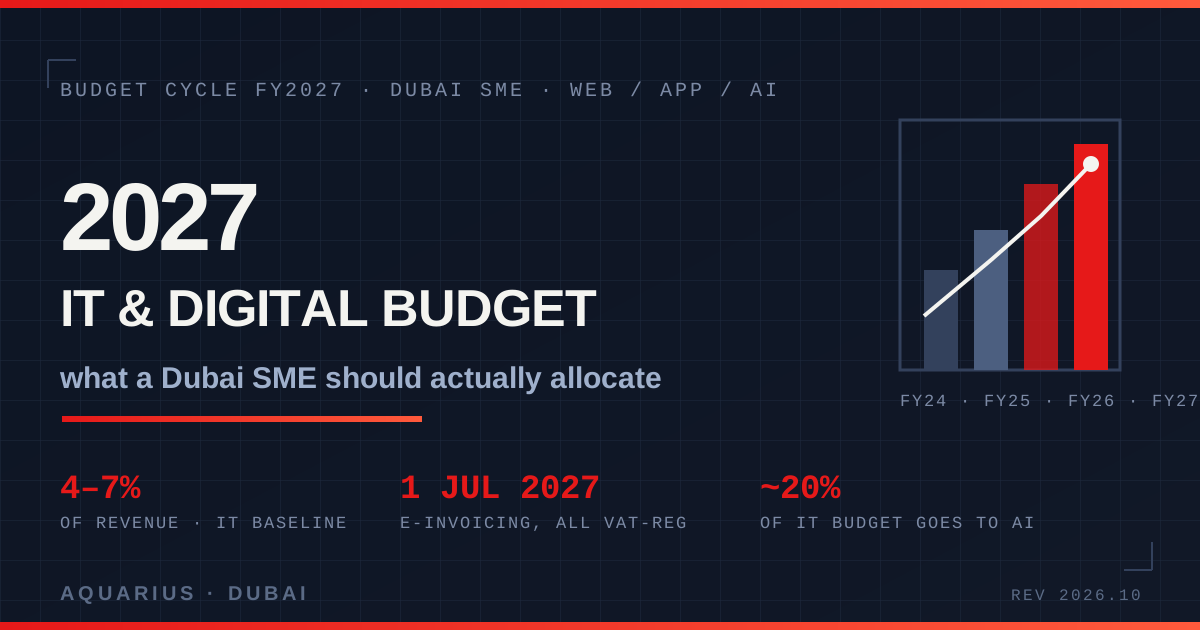
Short answer: Budget 4–7% of annual revenue for total IT if you are a normal Dubai SME, and 8–12% if you are regulated, e-commerce-led or growing fast. On AED 10 million of revenue that is AED 400,000–700,000 a year, of which roughly a fifth should be ring-fenced for AI by 2027 and a non-negotiable slice for the UAE e-invoicing mandate that hits every VAT-registered business on 1 July 2027. Everything else is a priority argument, not a budget argument.
It is October, which means finance is asking for next year’s numbers and someone has pasted last year’s IT line into a new spreadsheet with 10% added. That is the single most expensive thing a Dubai SME does in Q4, because 2027 is not a normal year: it carries a dated federal compliance deadline, a step-change in AI allocation, and a security cost curve that has moved faster here than almost anywhere else. This guide gives you the benchmarks, the dated obligations, and a line-by-line AED budget you can defend in a board meeting.
Key takeaways
- Credible 2026 benchmarks converge on 4–7% of revenue for IT, with sub-50-employee firms at the top of that band and regulated or high-growth companies at 8–12%. Cross-industry average: 5.49%.
- UAE IT spending is forecast at about USD 8.46 billion in 2026 (≈ AED 31.1 billion), up from USD 7.32 billion in 2025 — so your suppliers are pricing into a demand market, not a soft one.
- UAE organisations expect AI to be close to a fifth of total IT budgets by 2027, after increasing AI spend 105% year on year.
- E-invoicing is a hard date, not a project: appoint an Accredited Service Provider by 30 October 2026 if revenue is AED 50m or more, go live 1 January 2027; every other VAT-registered business goes live 1 July 2027. Fines reach AED 5,000 a month plus AED 1,000 a day for an unreported system failure.
- A Middle East data breach now averages USD 8 million (≈ AED 29.4 million), up from USD 7.29 million in 2025 and well above the USD 4.99 million global average.
The stakes: why a flat 2027 IT line is a cut in real terms
Three numbers frame the decision. UAE IT spending was USD 7.32 billion in 2025 and is expected to reach USD 8.46 billion in 2026 on the way to USD 12.43 billion by 2032. The broader ICT market moves from USD 52.22 billion in 2025 to USD 57.61 billion in 2026 and USD 94.02 billion by 2031, a 10.29% CAGR. Both are growing faster than most SME revenue lines, which means a flat IT budget buys you less capability every year.
SMEs are not a side story in this market. There are more than 558,000 SMEs in the UAE, over 94% of all registered businesses, contributing more than 63.5% of non-oil GDP. Their digital baseline has already moved: 91% accept contactless, mobile wallet or QR payments, 78% run cloud accounting or digital invoicing, and 64% have automated inventory or CRM. 82% of UAE small business owners expect steady or accelerated revenue over the next twelve months and over 75% plan to reinvest profit into technology, talent and expansion.
And on AI, the UAE is not a follower. 72% of UAE businesses now use AI, up from 53% a year earlier, and 70.1% of the working-age population actively uses AI tools as of Q1 2026 — first in the world on Microsoft’s AI Diffusion data. If your 2027 budget has no AI line, that is not prudence. It is being outspent by the company your customer is comparing you with.
Three dated obligations that are already in your 2027 budget
Compliance is the part of a budget you do not get to vote on, so price it first and argue about the rest afterwards.
1. E-invoicing: the deadline most Dubai SMEs have mis-scheduled
The UAE framework was set on 28 September 2025 by Ministerial Decision No. 243 of 2025 (the Electronic Invoicing System) and No. 244 of 2025 (its phased implementation). It is a Peppol-based five-corner model: structured e-invoices and credit notes exchanged through an Accredited Service Provider (ASP) with reporting to the Federal Tax Authority, covering B2B and B2G transactions.
| Milestone | Date | Who it hits |
|---|---|---|
| Voluntary / pilot phase live | July 2026 | Anyone who opts in — no fines during the test |
| ASP appointment deadline | 30 October 2026 | Revenue AED 50 million or more |
| Phase 1 mandatory go-live | 1 January 2027 | Revenue AED 50 million or more |
| Phase 2 mandatory go-live | 1 July 2027 | All other VAT-registered businesses |
| Government entities | 1 October 2027 | In-scope government entities |
Cabinet Decision No. 106 of 2025 sets the penalties, which bite from 1 January 2027 for Phase 1 and 1 July 2027 for everyone else: AED 5,000 for each month or part-month of delay in implementing e-invoicing or appointing an ASP, AED 100 per invoice not issued and transmitted on time (capped at AED 5,000 a calendar month), the same AED 100 per late credit note, and AED 1,000 for each day you fail to notify the Authority of a system failure.
Here is where most Dubai businesses get this wrong. They read “1 July 2027” and drop the cost into the H2 2027 budget. But an ERP or accounting-system integration, data cleanup, master-data fixes on supplier TRNs, plus ASP onboarding and testing, is a three to six month exercise for a mid-size SME. That spend lands in H1 2027 at the latest — and if you want the fine-free pilot window to de-risk it, in Q4 2026. Our deeper walkthrough of UAE e-invoicing ERP integration covers the technical shape of the work.
2. Security, because the regional loss number moved again
IBM puts the average cost of a data breach in the Middle East at USD 8 million in 2026 (≈ AED 29.4 million), up from USD 7.29 million in 2025 and far above the USD 4.99 million global average; UAE-specific reporting puts the local average at USD 6.93 million, roughly 69% above global. 26% of malicious breaches in the region now involve AI-enabled attack techniques, and the UAE Cyber Security Council reports blocking more than 200,000 cyberattacks a day. Of organisations that were breached, 59% planned to increase investment in security tools and governance afterwards — which is the most expensive possible moment to discover the line item.
3. Data protection and the rest of the compliance tail
PDPL obligations, consent and cookie handling, data-subject request workflows and breach notification are not one-off legal fees; they are recurring engineering work every time you ship a new form, app or analytics tool. Budget them as maintenance, not as a project. Our PDPL compliance checklist for websites and apps lists the specific controls.
How much: from benchmark percentage to real AED
Start with revenue, not with a wish list. The 2026 benchmarks (Deloitte and Flexera data, with Gartner for global totals) put the cross-industry average at 5.49% of revenue, with most credible ranges landing at 4–7%. Sector matters more than size: financial services runs 7–10% for smaller firms, healthcare and technology 6–9%, manufacturing 2–5%. Businesses under 50 employees trend to the top of their band, and regulated or high-growth organisations commonly run 8–12%.
| Annual revenue (AED) | Conservative (4%) | Typical (5.5%) | Growth / regulated (8%) |
|---|---|---|---|
| 3,000,000 | 120,000 | 165,000 | 240,000 |
| 10,000,000 | 400,000 | 550,000 | 800,000 |
| 30,000,000 | 1,200,000 | 1,650,000 | 2,400,000 |
| 50,000,000 | 2,000,000 | 2,750,000 | 4,000,000 |
That total covers everything technology: software licences, cloud, security, devices, connectivity, internal or outsourced IT, and the build and run of your customer-facing digital products. The mistake we see repeatedly in Dubai is a budget that contains only the build — a website or an app — with no line for the two years of running it.
The twelve lines of a Dubai digital budget, with 2026–2027 AED ranges
Ranges below reflect current Dubai market pricing for SMEs, excluding 5% VAT. They are the bands we quote against and see competitors quote against; your mix will be weighted by whether you sell online, operate in a regulated sector, or run a software product.
| Budget line | Annual AED range | Notes for a Dubai SME |
|---|---|---|
| Website build or rebuild | 18,000–150,000 one-off | Brochure site to multi-language, CMS-managed corporate build. Amortise over three years |
| Website care and content | 12,000–60,000 | Hosting, updates, security patching, SEO content, bilingual EN/AR upkeep |
| Mobile or web app build | 90,000–600,000 one-off | MVP to full product. Phase it; do not budget a single lump |
| App maintenance and OS churn | 15–25% of build cost | iOS and Android release cycles alone force work every year |
| E-invoicing and ERP compliance | 25,000–180,000 | ASP fees, integration, data cleanup, testing. Lands H1 2027 at the latest |
| Core business software | 500–3,500 per user | Accounting, CRM, HR and payroll with WPS. Per-user, so it scales with hiring |
| Cloud and hosting | 6,000–90,000 | Managed VPS to multi-environment cloud with UAE data residency |
| Security and compliance | 20,000–150,000 | Penetration testing, monitoring, backup and recovery, identity and access management |
| AI and automation | 15% to 20% of the IT total | Chatbots, document processing, agents, internal copilots. See below |
| Marketing technology and analytics | 10,000–80,000 | Analytics, consent, CRM automation, attribution. Separate from ad spend |
| Devices and endpoints | 3,500–9,000 per head | Three-year refresh cycle, so roughly a third of headcount each year |
| Contingency | 10–15% of total | The line that stops a mid-year emergency becoming a stalled roadmap |
If you want the build numbers in more detail, our Dubai website development cost breakdown and what website maintenance actually buys both go line by line, and our published pricing bands show where we sit.
The AI line: how much, and the ceiling to put on it
This is the line most likely to be either zero or reckless. The data says neither is right. UAE organisations increased AI spending 105% year on year and expect AI to account for close to a fifth of total IT budgets by 2027. In the Middle East, one in three organisations already spends more than 60% of its AI budget on generative AI.
But the binding constraint is not money, it is absorption: 48% of UAE businesses cite skills shortages as the barrier to expanding AI use and 31% say they lack the financial resources. The practical rule we hold clients to: cap year-one AI at 15% of the IT total, spend it on two or three processes with a measurable before-and-after, and only move to 20%+ once one of them has survived a quarter in production. The median annual AI spend per small business globally is about USD 2,200 — proof that the first useful step is not a platform purchase.
The tax layer: what your IT spend is actually worth after corporate tax
Two UAE-specific rules change the real cost of every number above.
Corporate tax. At 9% on taxable income above AED 375,000, deductible technology spend costs you 91 fils on the dirham. An AED 500,000 IT budget is an effective AED 455,000 after relief — which is the argument to make when finance wants to defer a build into next year. Capitalised software is relieved through depreciation rather than as an in-year expense, so the timing differs; your tax adviser decides the treatment, but budget the gross figure and show the net.
Small Business Relief. If revenue is AED 3 million or less in the current and all previous tax periods, you can elect Small Business Relief and be treated as having no taxable income. Ministerial Decision No. 131 of 2026 extended that window to tax periods ending on or before 31 December 2029, up from 31 December 2026, with the threshold and conditions unchanged. The budgeting consequence is blunt and almost always missed: inside Small Business Relief your IT spend carries no corporate tax shield at all, so judge it purely on cash payback. If you are about to cross AED 3 million, the deduction value arrives at the same moment the tax does. Our guide to corporate tax accounting software for Dubai SMEs covers the record-keeping side.
VAT. Technology invoices carry 5% VAT, recoverable as input tax to the extent you make taxable supplies. Budget net and treat VAT as cash flow, not cost — unless you are not VAT-registered, in which case every band above is 5% higher than it looks.
The cost of not deciding
Run the arithmetic on deferral for a VAT-registered Dubai SME at AED 10 million of revenue. Miss the e-invoicing go-live by three months and you are at AED 15,000 in implementation fines, plus up to AED 5,000 a month on untransmitted invoices and AED 1,000 a day if a system failure goes unreported — before a single customer notices you cannot issue a compliant invoice. Set against a USD 8 million regional breach average and an IT budget that should sit near AED 550,000, the expensive option is not spending. It is postponing, then buying under deadline pressure at whatever the market charges in June 2027.
How Aquarius builds a 2027 digital budget
We run this as a fixed-price exercise before anyone talks about a build. One session to map your current stack, revenue band and sector; one document that sets the percentage target, splits it across the twelve lines above in AED, maps each to the quarter the cash leaves, and flags the compliance dates against your own revenue threshold. If you then build with us, the discovery fee comes off the project. If you do not, the budget document is still yours and your incumbent supplier can quote against it — usually the fastest way to find out what you have been overpaying for.
FAQ
What percentage of revenue should a Dubai SME spend on IT in 2027?
4–7% is the defensible baseline, against a cross-industry average of 5.49%. Go to 8–12% if you are regulated, e-commerce-led, running a software product, or growing above 30% a year. Manufacturing and asset-heavy businesses can sit at 2–5%.
When exactly does UAE e-invoicing apply to my business?
If revenue is AED 50 million or more: appoint an ASP by 30 October 2026 and go live 1 January 2027. Every other VAT-registered business goes live 1 July 2027. In-scope government entities follow on 1 October 2027. The voluntary pilot opened in July 2026 and carries no fines during the test phase.
How much of the budget should go to AI specifically?
Cap year one at about 15% of the IT total and plan to reach the ~20% that UAE organisations expect by 2027 only after one deployment has proved itself in production for a quarter. Skills, not licences, are the binding constraint for 48% of UAE firms.
Is web and software development spend deductible against UAE corporate tax?
Ordinarily yes, as a business expense at the 9% rate above AED 375,000 of taxable income, though capitalised software is relieved through depreciation rather than in-year. If you have elected Small Business Relief under the AED 3 million threshold — now available for tax periods ending on or before 31 December 2029 — there is no deduction benefit, so judge the spend on cash payback alone. Confirm treatment with your tax adviser.
What is the most commonly missed line in a Dubai IT budget?
Run cost. Businesses budget the build and forget that app maintenance alone runs 15–25% of build cost every year, on top of hosting, security patching, content and the OS release cycle. The second most missed is contingency, which is why a mid-year emergency so often stalls a roadmap.
Building your 2027 numbers now? Send us your current stack and revenue band and we will map it against the twelve lines and the compliance dates above, free, before anyone proposes a project.