
Jewellery and Gold Trading Software in Dubai (2026): Real AED Build Costs and the Making-Charge VAT Trap
UAE precious-metals trade hit AED 625 billion and the reverse-charge rules changed on 15 February 2025. Real AED costs to build jewellery ERP and POS software in Dubai, plus the making-charge trap.
- PUBLISHED
- 08 OCT 2026
- READ TIME
- 12 MIN
- AUTHOR
- AQUARIUS · DUBAI
- UNIT
- REV 2026.09
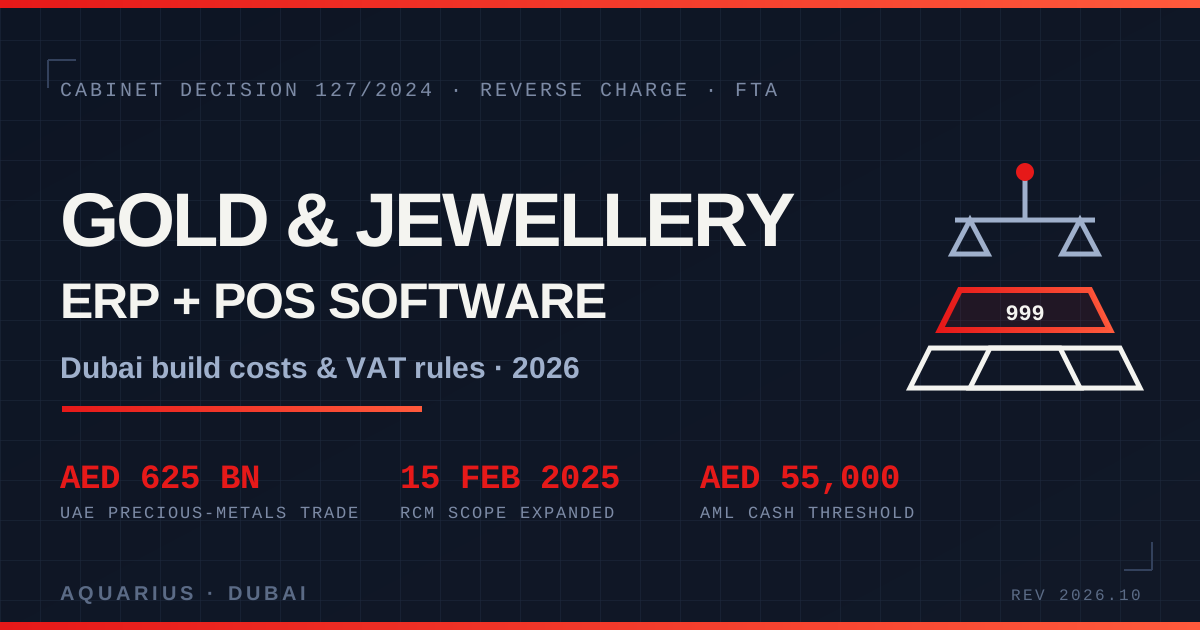
Short answer: A jewellery POS with gold-rate pricing and correct UAE VAT handling costs AED 55,000–120,000 to build in Dubai in 2026; a full retail-plus-wholesale ERP with karat-wise stock, making charges, hallmark traceability and goAML screening runs AED 120,000–280,000; a multi-showroom group platform with manufacturing, consignment and Peppol e-invoicing lands at AED 280,000–550,000+. The single most expensive mistake is not the software price — it is a till that still bills gold the pre-2025 way, because Cabinet Decision No. 127 of 2024 rewrote the reverse-charge rules on 15 February 2025 and most off-the-shelf jewellery systems were never updated for it.
Key takeaways
- The market is enormous: UAE foreign trade in precious metals reached about AED 625 billion (USD 170 billion), up 27% in a year and 79% in two, and 13–15% of all gold traded globally passes through Dubai.
- The VAT rule changed: Cabinet Decision 127/2024 repealed the 2018 gold-and-diamond decision and expanded the domestic reverse charge to silver, platinum, palladium, pearls, rubies, sapphires, emeralds and lab-grown diamonds from 15 February 2025.
- Making charges are the trap: bill them separately and the making charge carries 5% VAT while the gold sits under reverse charge; bundle them into one unseparated price and the whole line follows the gold. Your POS must model both.
- AML is enforced, not theoretical: DPMS obligations bite at AED 55,000 in single or linked cash transactions, and the Ministry of Economy has issued over AED 130 million in DNFBP fines since late 2022 — AED 42 million in H1 2025 alone.
- Two deadlines are already on the calendar: large businesses must appoint an accredited e-invoicing service provider by 30 October 2026 and go live 1 January 2027; everyone else by 31 March 2027 and 1 July 2027.
Dubai does not sell jewellery at the margin — it sells it at scale
Three numbers explain why a jewellery business in Dubai outgrows a generic retail till faster than almost any other trade:
- AED 625 billion (USD 170 billion) of precious metals moved through UAE foreign trade in a single year — a 27% annual jump and 79% growth across two years, putting the UAE neck-and-neck with London as a bullion hub and second only to Switzerland for physical gold.
- USD 41.7 billion of diamonds traded through Dubai in 2025 — an all-time record, up 16.2% from USD 35.8 billion in 2024, on 359.5 million carats (+42.5%), according to DMCC, whose free zone was on track to pass 26,000 member companies with roughly 2,500 of them in precious metals alone.
- 29.4 tonnes of gold jewellery was bought in the UAE in 2025, down 15% from 34.7 tonnes in 2024 as record prices pushed shoppers to lighter pieces — while bars and coins went the other way, up 24% to 14.8 tonnes.
That last pair of numbers is the operational story. Demand did not disappear; it changed shape. Grammage per invoice fell, investment-bar volume rose, and the mix inside a single showroom became harder to price, stock and report. At the AED 497.75 per gram that 24K was trading at in early October 2026 (22K at AED 460.75, 18K at AED 378.75), a one-gram error in a karat conversion is worth more than an hour of a salesperson's time — and a mis-coded VAT line on a wholesale bar invoice can be worth a car.
The retail base is deep too: the Dubai Jewellery Group counts 600-plus members across bullion, manufacturing, wholesale and retail, the Gold Souk alone holds several hundred shops, and the newly launched Dubai Gold District is built to consolidate more than 1,000 retailers. Nearly all of them run on either a spreadsheet, an imported Indian jewellery package, or a cloud POS that has never heard of a reverse charge.
Why off-the-shelf jewellery software breaks in the UAE
Jewellery software sold globally handles karat, weight and making charges well. What it almost never handles is the specific stack of UAE rules your auditor, the FTA and the Ministry of Economy will all test separately.
1. The reverse charge changed on 15 February 2025
Cabinet Decision No. 127 of 2024 repealed Cabinet Decision No. 25 of 2018 and took effect 15 February 2025. The domestic reverse-charge mechanism no longer covers only gold and diamonds: it now covers precious metals (gold, silver, platinum, palladium), precious stones (natural and lab-grown diamonds, pearls, rubies, sapphires, emeralds) and jewellery made from them, provided the value of the precious metal or stone exceeds the value of the other components.
Read that proviso again, because it is a software requirement, not a tax footnote. A silver-and-resin fashion piece and a silver-and-sapphire piece can leave the same workshop and land on opposite sides of the rule. If your system cannot store a component-level value split per SKU and decide the VAT treatment from it, somebody is deciding it by hand on every B2B invoice.
2. The making-charge trap most Dubai jewellers are still in
The FTA's public clarification on gold and diamond making charges (the earlier VATP032 has since been superseded by VATP043 for the reverse-charge mechanism) draws the line like this:
- One unseparated price, where the gold item is the principal component and the making charge is ancillary → a single composite supply, and the whole amount follows the gold under reverse charge.
- Making charge invoiced separately → the making charge is its own standard-rated supply at 5% VAT, while the gold component stays under reverse charge.
Most Dubai showrooms want to show customers a transparent gold-plus-making breakdown — and then wonder why their VAT return does not tie out. Those are two different tax outcomes driven by a formatting choice on the invoice. A system that cannot switch between composite and split billing per customer type, and post the resulting VAT lines correctly, is a monthly reconciliation tax on your accountant.
3. The written declaration nobody files
Applying the reverse charge is conditional. The supplier must hold a written declaration from the recipient confirming that the recipient is VAT-registered at the date of supply and will use the goods to produce or manufacture other gold items or to resell them. No declaration, no reverse charge — you owed the 5%.
In practice this is a document-lifecycle problem: capture at account opening, link to the TRN, validate against the date of each supply, expire and re-collect, and produce the lot on demand during an audit. That is exactly the sort of workflow a generic POS has no field for, and exactly the sort of thing a custom build makes a five-second lookup.
4. Hallmarking and purity are stock-identity data
Under Federal Law No. 11 of 2015, hallmarking in the UAE is mandatory, not a marketing nicety: wrought precious-metal articles must carry an official UAE hallmark from the Dubai Central Laboratory or a recognised foreign equivalent before legal sale, against the four recognised finenesses — 999 (24K), 916 (22K), 875 (21K) and 750 (18K). Reported penalties for trading in non-compliant articles run to AED 250,000–500,000 and can carry imprisonment.
Which means fineness, hallmark reference, assay certificate and supplier lot belong on the stock record itself — not in a drawer. When a customer returns a piece three years later, or a wholesale buyer demands provenance, that lookup is either instant or it is a morning lost.
5. AML starts at AED 55,000 and the fines are real
Dealers in precious metals and stones are DNFBPs under the UAE AML regime, now consolidated in Federal Decree-Law No. 10 of 2025 (in force 14 October 2025). Full obligations trigger on single or several linked cash transactions of AED 55,000 or more, registration on the FIU's goAML portal is compulsory, and administrative fines run from AED 10,000 to AED 5,000,000 per breach — with failure to register alone commonly cited at AED 50,000 to AED 1,000,000. The Ministry of Economy has levied more than AED 130 million on DNFBPs since late 2022, including about AED 42 million in the first half of 2025.
The software consequence: linked-transaction detection across tills, branches and days (not per-receipt), customer due-diligence records attached to the invoice, sanctions screening at the point of sale, and a clean export path to goAML reporting. If you are building the compliance layer anyway, our guide to AML and KYC compliance software in Dubai covers the screening and reporting plumbing in depth.
6. Tourist refunds and e-invoicing
Dubai retail jewellery is a tourist trade, so the Planet tax-free system is part of your checkout: minimum spend AED 250, roughly 19,000 registered stores by the end of 2025, and a refund net of a 13% administrative fee plus a fixed AED 3.60 per claim from 12 July 2026, with cash refunds capped at AED 35,000. Every one of those parameters has to be reflected at the till or your staff will quote refunds the tourist will not receive.
Then there is the structural change. Ministerial Decisions 243 and 244 of 2025 set the UAE e-invoicing path: a pilot and voluntary phase from July 2026, mandatory from 1 January 2027 for businesses with revenue of AED 50 million or more (accredited service provider appointed by 30 October 2026), and 1 July 2027 for the rest (ASP by 31 March 2027), with structured XML over the Peppol network. For a reverse-charge-heavy trade, that means your invoice data model must be clean long before the deadline — see our breakdown of UAE e-invoicing ERP integration.
Buy, bend or build: the honest comparison
Off-the-shelf jewellery POS is cheap to start and expensive to force into UAE shape. Global pricing in 2026 sits around USD 99–399 per month per location (cloud typically USD 99–299), with on-premise licences at USD 5,000–15,000+ plus annual maintenance — Lightspeed from USD 89/month, WJewel from USD 119/month, Pavilion POS USD 299–999/month depending on tier. Hardware, extra users, e-commerce modules and payment markups are all separate.
| Option | Year-1 cost (3 showrooms) | Handles RCM + making-charge split | Best for |
|---|---|---|---|
| Global cloud jewellery POS | AED 13,000–53,000/yr subscription | No — manual VAT coding | Single boutique, retail-only, low wholesale volume |
| Imported jewellery ERP + local customisation | AED 60,000–150,000 + annual maintenance | Partly — depends on the local partner | Traditional retail groups already on that vendor |
| Custom UAE-first build | AED 55,000–280,000 one-off, then care | Yes — modelled in the data | Retail plus wholesale, multi-branch, audit exposure |
| Spreadsheet plus generic accounting | "Free" | No | Nothing, past about AED 5m turnover |
The decision is rarely about features on a sheet. It is about where the regulated logic lives. If reverse charge, declarations, linked-cash thresholds and hallmark provenance live in your software, they happen every time. If they live in a senior accountant's head, they happen until that person takes leave.
What it costs to build in Dubai in 2026
Indicative AED ranges from scoped Dubai jewellery and bullion projects. Every band includes Arabic and English interfaces, because half your floor staff and most of your walk-in traffic will use one or the other.
| Scope | AED range | Typical timeline |
|---|---|---|
| Jewellery POS: live gold rate, karat-wise pricing, making charges, VAT modes, Planet refund flow | 55,000–120,000 | 6–10 weeks |
| Retail + wholesale ERP: karat-wise stock, barcode/RFID tagging, hallmark and assay records, purchase and scrap/exchange, goAML-ready CDD | 120,000–280,000 | 3–5 months |
| Group platform: multi-showroom, manufacturing and job-work, consignment, memo-out, Peppol e-invoicing, BI dashboards | 280,000–550,000+ | 5–9 months |
| Gold-rate engine + pricing rules (wastage, making, discount guardrails) as an add-on | 18,000–45,000 | 2–3 weeks |
| Tally/Odoo/SAP or e-commerce integration | 25,000–75,000 | 3–6 weeks |
| Care and compliance retainer (rule changes, FTA clarifications, support) | 4,000–16,000/month | Ongoing |
Compare those one-off numbers to the downside. A single AML registration failure is cited at AED 50,000–1,000,000. Trading non-hallmarked articles is reported at AED 250,000–500,000. Mis-applying the reverse charge on wholesale bar sales means you funded 5% of those invoices yourself — at AED 497.75 per gram, a kilo-scale month puts that number in six figures before anyone notices. The build is almost always the cheaper line.
How Aquarius builds it
We start with your invoice formats, not your wish list — one wholesale invoice, one retail bill, one exchange/scrap voucher and one memo-out tells us exactly which VAT, declaration and provenance rules your data model has to carry. Then we build the pricing and tax engine first, prove it against your last three months of real transactions, and only then put a till UI on top. You get the source code, your own cloud accounts, Arabic and English from day one, and a fixed AED quote per phase. If you are also selling online, the same catalogue and karat data should feed your storefront — our gold and jewellery e-commerce guide covers that side, and POS and inventory software development covers the general retail stack. Indicative bands live on our pricing page.
FAQ
Does my jewellery POS have to charge 5% VAT on gold in Dubai?
Not on qualifying B2B supplies. Since 15 February 2025, Cabinet Decision 127/2024 puts qualifying supplies of precious metals, precious stones and jewellery made from them under the domestic reverse charge between VAT-registered businesses — the supplier invoices without VAT and the buyer accounts for both output and input VAT. Retail sales to consumers remain standard-rated at 5%, and a separately invoiced making charge is standard-rated too.
How should making charges be shown on the invoice?
Decide deliberately, because the format sets the tax. One unseparated price with the gold as the principal component is a single composite supply that follows the gold; a separately stated making charge is its own supply at 5%. Your system should support both and label which rule it applied on every line.
What does a jewellery shop in Dubai need for AML compliance?
Registration on the goAML portal, a documented AML policy, customer due diligence, and detection of single or linked cash transactions at or above AED 55,000. Fines under Federal Decree-Law No. 10 of 2025 range from AED 10,000 to AED 5,000,000 per breach, and banks and free zones now check registration status.
Can I just use Tally or a global jewellery POS?
You can start there. It stops working when wholesale volume, reverse-charge declarations, hallmark provenance and multi-branch linked-cash detection arrive at once. Most groups we see keep their accounting package and build the jewellery-specific layer around it, integrated.
When do I need e-invoicing?
If your revenue is AED 50 million or more: appoint an accredited service provider by 30 October 2026 and issue structured XML invoices over Peppol from 1 January 2027. Below that threshold: ASP by 31 March 2027, live 1 July 2027. A voluntary pilot opens from July 2026 — worth joining, because reverse-charge invoices are exactly the kind that fail validation first.
Bottom line: Dubai moves AED 625 billion of precious metals and a record USD 41.7 billion of diamonds, and the rules governing how you invoice that trade changed on 15 February 2025. Budget AED 55,000–120,000 for a compliant POS, AED 120,000–280,000 for retail-plus-wholesale ERP, and AED 280,000+ for a group platform — then make sure the reverse charge, the making-charge split and the AED 55,000 threshold live in the software, not in somebody's memory. Talk to Aquarius for a fixed AED quote scoped on your own invoices.