
Software Testing & QA Services in Dubai (2026): Real Costs
What QA really costs in Dubai in 2026 — AED hourly and project bands, in-house vs offshore, what to automate first, and the 100x reason to test before you ship.
- PUBLISHED
- 19 SEPT 2026
- READ TIME
- 10 MIN
- AUTHOR
- AQUARIUS · DUBAI
- UNIT
- REV 2026.09
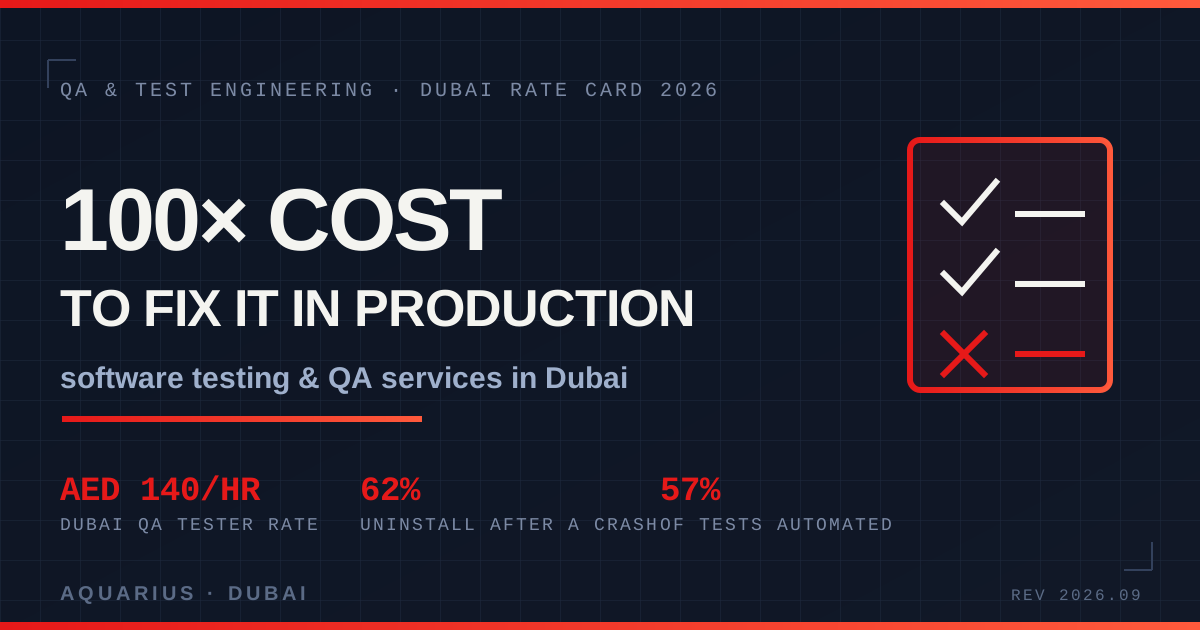
Short answer: Software testing and QA in Dubai costs roughly AED 130–180 per hour for a local contract tester, AED 65–150 per hour offshore, and AED 15,000–220,000 as a project workstream depending on scope. A full-time QA engineer in the UAE costs AED 197,000–251,000 a year. The number that should actually decide your budget is different: a defect caught in design costs 1× to fix, and the same defect found in production costs up to 100×.
Most Dubai businesses do not buy QA. They buy a developer, ship, and then pay for testing anyway — in hotfixes, refunds, one-star reviews and a support inbox. That is the expensive version.
Key takeaways
- 100× is the whole argument. The IBM Systems Sciences Institute benchmark — still the industry reference — puts a production fix at up to 100 times the cost of fixing the same defect at design, roughly 15× at the QA stage and 6× during implementation.
- 62% of users uninstall an app after a crash, freeze or error. In a market with about 10.8 million smartphone users, that is not a rounding error.
- Automation is not all-or-nothing. QA teams automate an average of 57% of their tests; the winning move is choosing which 57%.
- Dubai adds its own test matrix: Arabic RTL, UAE Pass, local payment gateways, Ramadan and Dubai Shopping Festival traffic peaks, and PDPL data handling.
Why QA turned into a budget line in Dubai
The awareness numbers explain the shift. Gartner expects IT spending across MENA to reach USD 169 billion in 2026, up 8.9% year on year, and the UAE is one of the fastest-moving parts of that. The federal Digital Economy Strategy is pushing the digital economy from roughly 12% of non-oil GDP toward 20% by 2030, against a non-oil sector that already makes up 79.4% of the national economy and grew 4.8% in Q1 2026.
More software, more users, more exposure. The UAE runs at 99% internet penetration with about 11.3 million users, roughly 10.8 million smartphone users, and 75.3% of all web traffic arriving on mobile. E-commerce alone is a USD 12.3 billion market in 2026, forecast to reach USD 21 billion by 2031.
Here is the part worth repeating in your next budget meeting: in that environment a bug is not a technical event, it is a revenue event. 62% of people who hit a crash, freeze or error uninstall the app. 76% name freezing as a major problem, 71% crashes, 59% slow responsiveness — and roughly 53% of all uninstalls trace back to technical issues rather than pricing or content. You do not get a second chance to load in three seconds.
Myth-bust: “our developers test their own work”
This is the single most common thing we hear from Dubai SMEs, and it is where most quality budgets quietly disappear. Developers do test — they test that the thing they just built does what they intended. QA tests something different: what happens when a real user does something the developer never intended.
The difference shows up in the boring cases that break production:
- An Arabic name with an unusual character breaks a PDF invoice.
- A customer taps “Pay” twice on a weak connection in a basement car park and gets charged twice.
- Session expiry logs the user out mid-checkout and the cart is empty when they come back.
- A price of AED 0.00 is accepted because the validation lives only in the browser.
- The app works perfectly on the developer’s iPhone and crashes on the mid-range Android device that most of the UAE market actually uses.
None of these are hard problems. All of them are invisible to the person who wrote the code, and all of them cost far more to fix once a paying customer finds them first.
What “QA” actually covers
When a Dubai agency quotes “testing included,” ask which of these is in scope. The gap between one line and six is usually the gap between two quotes.
- Functional testing — does each feature do what the spec says, including the unhappy paths.
- Regression testing — does last month’s working feature still work after this month’s release. This is the one that grows forever, and the first thing worth automating.
- Cross-device and cross-browser — real devices, not just an emulator. In the UAE that means a heavy Android skew alongside iOS.
- Performance and load — what happens at ten times normal traffic, which in Dubai means Ramadan, Dubai Shopping Festival, White Friday and the first hour of a campaign.
- Security testing — a separate discipline with a separate budget; see our penetration testing cost guide for Dubai.
- Localisation testing — Arabic RTL layout, mixed-direction strings, Hijri dates, AED formatting. More in our Arabic localisation guide.
- Accessibility and UX checks — increasingly requested in UAE government and semi-government tenders.
Software testing cost in Dubai (2026)
These are market bands from published 2026 UAE and global rate data, converted at roughly AED 3.67 to the dollar. Treat them as bands, not price tags — scope is what moves you inside the range.
| How you buy QA | Typical 2026 cost | Best for |
|---|---|---|
| In-house QA engineer (UAE, salary) | AED 197,000–251,000 / year | Product companies shipping weekly |
| Contract QA tester in Dubai | AED 130–180 / hour | Release crunches, on-site UAT support |
| Offshore QA team | AED 65–150 / hour | Volume regression, long test cycles |
| Onshore Western QA vendor | AED 260–440 / hour | Regulated enterprise programmes |
| QA as a project workstream | AED 15,000–220,000 | One build, fixed scope, 2–4 week cycles |
| Automated regression suite (first build, ~120 scenarios) | AED 17,000–28,000 | Any product with monthly releases |
| Load and performance test round | AED 12,000–35,000 | Pre-campaign, pre-DSF, pre-launch |
Two notes on that table. The AED 65–150 offshore band is why outsourced QA typically saves 30–50% against building the same capability in-house in Dubai — and it is also why cheap QA that reports vague symptoms instead of reproducible defects is worse than none. The automation row is arithmetic, not magic: roughly 120–200 engineering hours at the local AED 140 per hour benchmark.
What to automate first, and what to leave manual
QA teams now automate an average of 57% of their tests, yet only 26% report strong QA and DevOps integration. Translation: plenty of teams own automation that nobody runs. Order matters more than coverage.
- The money path. Signup, login, add to cart, checkout, payment success and payment failure. If exactly one flow is automated, this is it.
- Regression on stable APIs. Authoring cost is amortised across every run, so tests that fire on every commit return the most.
- Data-heavy forms. Emirates ID formats, UAE mobile numbers, TRN fields, Arabic text input — combinatorial by nature, miserable by hand.
- Cross-browser smoke tests. Cheap to run in parallel, and they catch the loud failures fast.
Leave manual: exploratory testing, first-release UX judgement, Arabic copy review, and anything whose UI changes weekly. Automating an unstable screen buys you a maintenance bill, not a safety net. Published benchmarks put test-automation ROI at around 4.5× over three years — but that assumes the suite actually runs in CI rather than on one engineer’s laptop.
The Dubai-specific test matrix nobody hands you
Generic QA checklists miss the things that break UAE products specifically:
- Arabic RTL and bilingual switching — mirrored layouts, Latin numerals inside Arabic sentences, truncation in Arabic, correct Hijri and Gregorian dates.
- Payment gateways — 3-D Secure step-ups, declines, partial refunds and buy-now-pay-later flows behave differently across UAE providers. Test the failure path, not just the receipt.
- UAE Pass — cancelled authentication, expired sessions, and the app-not-installed fallback on desktop.
- Peak load — iftar-hour ordering spikes in Ramadan, plus DSF and White Friday. Load testing before the campaign is far cheaper than scaling during it.
- Device reality — roughly 81% Android against 19% iOS in the UAE, so a mid-range Android on a mobile network is the default test device, not an afterthought.
- PDPL handling — consent capture, deletion requests, and confirming personal data is not leaking into logs or analytics payloads.
What skipping QA actually costs
The decision-stage maths is unkind. A serious QA workstream on a mid-size Dubai platform runs AED 40,000–90,000, and an automated regression suite adds AED 17,000–28,000 once. Against that:
- A defect that reaches production costs up to 100 times its design-stage fix — the same small change, plus incident handling, redeploy, support load and customer comms.
- 62% of affected users uninstall after a crash or freeze, and paid acquisition to replace them is not cheap in this market.
- A data-handling failure is a regulatory matter, not just a bug: the UAE Data Office can impose administrative fines from AED 50,000 up to AED 5 million, with the most serious tier reaching AED 20 million, and breaches must be notified within 72 hours.
One avoided production incident usually pays for the year.
How Aquarius handles QA
We build web and mobile products for Dubai businesses, and testing is part of delivery rather than a line item you can decline:
- Test cases written with the spec, not after the build — which is where the cheapest fixes live.
- A real UAE device matrix, Android-weighted, tested on mobile networks rather than office wifi.
- Automated regression on the money path, running on every release so last month’s feature stays fixed.
- Bilingual QA — Arabic RTL and English checked as one product, not as a translation pass.
- Load-tested before your campaign, against a concurrent-user target you sign off on.
Already live with a product that breaks every release? That is a fixable position, and it usually starts with automating the top ten flows. See our pricing and what we build, or read what ongoing upkeep costs in our Dubai app maintenance guide.
Frequently asked questions
How much does software testing cost in Dubai in 2026?
Contract QA testers in Dubai run about AED 130–180 per hour, offshore teams AED 65–150 per hour, and Western onshore vendors AED 260–440. As a project workstream, QA typically lands between AED 15,000 and AED 220,000 depending on scope. A full-time UAE QA engineer costs roughly AED 197,000–251,000 a year.
What share of a software budget should go to QA?
There is no single rule, but the defect-cost curve gives a practical answer: enough to catch issues before production, because a production fix costs up to 100 times a design-stage fix. For most Dubai SME projects that means a dedicated QA workstream inside the build rather than a few days bolted on at the end.
Should we outsource QA or hire in-house in Dubai?
Hire in-house if you release weekly and the product is your business — the salary is justified by continuity and product knowledge. Outsource if testing demand is spiky or you need volume regression, where offshore rates deliver 30–50% savings. Many Dubai teams run a hybrid: one local QA lead owning strategy and UAT, with an offshore team executing cycles.
Is manual testing still needed if we automate?
Yes. Teams automate about 57% of tests on average, and the remainder is where judgement lives: exploratory testing, Arabic copy and layout review, new-feature UX, and anything changing weekly. Automation protects what you already shipped; people evaluate what you are shipping next.
What is the difference between QA testing and penetration testing?
QA asks whether the product works correctly for legitimate users. Penetration testing asks whether an attacker can make it do something it should not — escalating privileges, reading another customer’s data, tampering with prices. They use different skills and different budgets, and a regulated UAE business needs both.
Shipping something in Dubai this quarter? Talk to Aquarius about a QA plan sized to your release cadence — before your customers become the test team.