
Medical Tourism Website Development in Dubai (2026): Turn 691,000 Health Tourists Into Booked Patients
Dubai drew 691,478 international health tourists and AED 1.03 billion in treatment spend. What an international-patient website costs in AED, and what DHA rules allow.
- PUBLISHED
- 15 SEPT 2026
- READ TIME
- 10 MIN
- AUTHOR
- AQUARIUS · DUBAI
- UNIT
- REV 2026.09
Short answer: A Dubai clinic or hospital that wants international patients should budget AED 25,000–55,000 for a multilingual international-patient website (English, Arabic and Russian, transparent package pages, enquiry routing to WhatsApp), AED 60,000–140,000 for a full acquisition platform with online package booking, payment, a patient CRM and a visa and travel concierge workflow, and AED 150,000–400,000+ for a hospital-grade portal with teleconsultation, medical record upload, NABIDH integration and multi-facility management (before 5% VAT). The reason to build is simple arithmetic: Dubai received 691,478 international health tourists in its last published year, who spent AED 1.034 billion on treatment alone — and almost every one of them chose a facility from a screen, in a country they had never visited.
This is the 2026 guide for clinic owners, hospital marketing directors, medical tourism facilitators and healthcare group CEOs in Dubai who are deciding what an international-patient website actually needs to contain, what the Dubai Health Authority allows them to say on it, and what it costs in dirhams. Updated September 2026.
Key takeaways
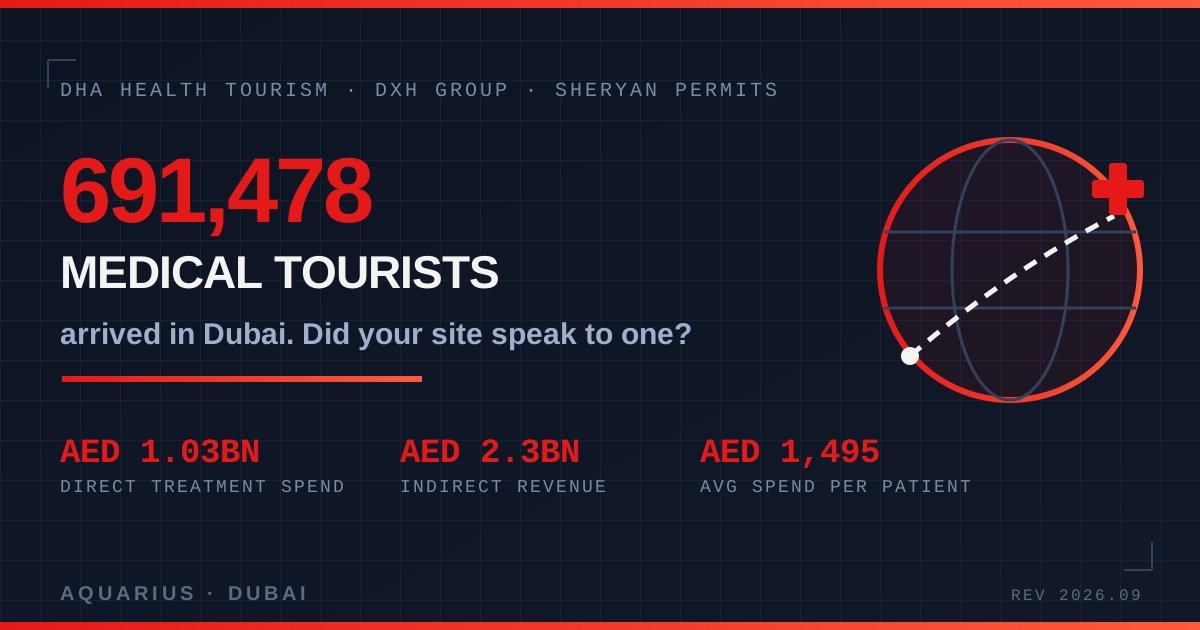
- Dubai welcomed 691,478 international health tourists, up from 674,000 the prior year, generating AED 1.034 billion in direct healthcare spend and AED 2.305 billion in indirect revenue across aviation, hotels and retail.
- That works out to roughly AED 1,495 of treatment spend per international patient on average — and dental, cosmetic and orthopaedic packages run far above the mean.
- The UAE medical tourism market was valued at USD 722.5 million in 2024 and is projected to reach USD 4.41 billion by 2033, a 19.84% CAGR (IMARC Group).
- Dubai drew a record 19.59 million international overnight visitors in 2025, up 5%, with hotel occupancy at 80.7%. Your future patients are already booking flights here for other reasons.
- Most Dubai clinic websites are built for the resident down the road. The health tourist needs price, proof, language, visa logistics and a same-day human reply — in that order.
Dubai's health tourism numbers, and why 2026 is the year to act
Start with the macro picture, because it sets the stakes for every marketing dirham you are about to spend.
In its last published annual figures the Dubai Health Authority recorded 691,478 international health tourists, spending more than AED 1.034 billion directly on healthcare services. The year before that it was 674,000 patients and AED 992 million. Indirect revenue — flights, hotels, retail, telecoms, the companion who came along — exceeded AED 2.305 billion, more than double the medical spend itself. That ratio is why health tourism sits inside Dubai's economic agenda rather than only its health policy.
Underneath the headline number, the demand is specific. DHA data shows the highest volumes of international patients seek dentistry, dermatology and gynaecology. Source markets split by specialty: dermatology patients came 33% from Asia, 28% from Arab and GCC countries and 23% from Europe, while dental patients skewed regional at 48% Arab and GCC, 20% Europe, 19% Asia. And 58% of international health tourists were women, against 42% men.
Read those three sentences again as a website brief. A dermatology clinic running an English-only site optimised for Dubai residents is ignoring the third of its addressable demand that searches in Hindi, Mandarin or Russian. A dental clinic without Arabic-first content is ignoring the 48% majority of its inbound market.
The wider market is compounding fast. The UAE medical tourism sector was valued at USD 722.5 million in 2024 and is forecast to reach USD 4.41 billion by 2033 at a 19.84% CAGR. Meanwhile Dubai posted a third consecutive record tourism year with 19.59 million international overnight visitors in 2025 (up 5%), 80.7% average hotel occupancy, over 4 million visitors from India alone and 4.1 million from Western Europe (21% of arrivals). The traffic is landing. The question is whose booking form it lands on.
The mistake most Dubai clinics are still making
Here is the myth worth busting: that a good clinic website and a good international-patient website are the same thing. They are not, and the gap costs Dubai facilities real revenue every week.
A resident chooses a clinic on proximity, insurance network and availability. They will call. An international patient cannot call — the time zone is wrong, the number is foreign and the tariff is unclear. They convert on a completely different sequence:
- Can I read this? Content in their own language, not a machine-translated afterthought with broken right-to-left layout.
- What does it cost? A real AED figure, or at minimum a published range. Silence on price is the single biggest drop-off point in the health tourism funnel, because the competing destination published theirs.
- Can I trust this? DHA licence numbers, named consultants with credentials, accreditation marks and genuine outcomes, presented within what the regulator permits.
- Can I actually get there? Visa route, length of stay, whether a companion can come, how long treatment and recovery take, which hotel is near the facility.
- Will someone answer me tonight? A WhatsApp thread with a human, in their language, within hours.
A brochure site answers one of those five. That is why so many Dubai facilities end up paying facilitators and aggregator platforms a commission on patients who were already searching for them — the same structural problem that pushes restaurants onto delivery apps and hotels onto OTAs, which we break down in our guide to direct booking versus OTA commission.
You are also competing with the government's own shop window. The official Dubai Health Experience portal (dxh.ae) lists over 100 licensed facilities and more than 400 medical packages, bundled with discounted Emirates fares, visa support, insurance, hotel stays and Marhaba airport service. Being listed there is close to mandatory. Relying on it alone means competing on a comparison grid with 99 other facilities where the only differentiator left is price.
What an international-patient platform actually needs
These are the modules that separate a site collecting enquiries from abroad from a site collecting local walk-ins.
| Module | Why it matters for health tourists | Typical build cost (AED) |
|---|---|---|
| Multilingual build (EN / AR / RU, often + Hindi or Mandarin) | Arab and GCC patients are 48% of dental demand; Asia is 33% of dermatology demand; Russia sent roughly 905,000 visitors to Dubai in 2025 | 8,000–30,000 per language pair |
| Treatment package pages with transparent AED pricing | Mirrors the 400+ packages on the DXH portal; price silence loses the comparison before you are ever contacted | 10,000–25,000 |
| Enquiry routing to WhatsApp Business API with time-zone aware response | Preferred channel across GCC, Asia and CIS markets; converts far better than a contact form left overnight | 9,000–30,000 |
| Visa and travel concierge workflow | The UAE medical treatment visa allows a 90-day stay, must be entered within 60 days of issue, and must be sponsored by a licensed UAE facility — that is your admin burden, not the patient's | 12,000–35,000 |
| Teleconsultation for pre-screening and post-op follow-up | Turns an enquiry into a committed traveller before a ticket is bought, and retains them after they fly home | 25,000–90,000 |
| Secure medical record and image upload | Scans and reports arrive before the patient does, so the quote is real; must be PDPL-safe, not an email attachment | 10,000–30,000 |
| DHA advertising compliance layer and content governance | Every page that mentions a procedure is a regulated health advertisement — see below | 5,000–15,000 |
| Medical schema markup and AI-search citability | Gets you quoted in AI Overviews and assistant answers, where health research increasingly starts | 4,000–12,000 |
The compliance layer nobody budgets for
This is where Dubai differs sharply from Bangkok or Istanbul, and where an agency without local experience gets you suspended.
Every DHA-licensed facility and practitioner is regulated on what it may advertise. Under the DHA's medical advertisement standards, any digital asset that mentions a medical service, procedure or professional — including clinic website landing pages, paid social ads, organic reels, influencer visits and WhatsApp broadcast templates — is classified as a regulated health advertisement and needs permitting through the DHA's Sheryan platform. Misleading claims, guaranteed outcomes and unpermitted before-and-after content are the classic violations. Enforcement is not theoretical: Dubai clinics have been suspended for promoting unapproved treatments on Instagram, and federal health advertising penalties now reach up to AED 1,000,000 for serious violations.
Two more constraints belong in the same sprint. Dubai facilities exchange patient data through NABIDH, the emirate's centralised health information exchange, so any portal handling records has to respect that architecture rather than build a parallel silo. And every cross-border patient you attract is a cross-border data transfer under the UAE Personal Data Protection Law — consent, retention, breach handling and transfer basis all need designing in, which we set out step by step in our UAE PDPL compliance checklist.
What it costs to build in Dubai
Real 2026 ranges from Dubai engagements, excluding 5% VAT and media spend.
| Tier | What you get | Cost (AED) | Timeline |
|---|---|---|---|
| International-patient website | EN/AR/RU content, 8–15 treatment package pages with published price ranges, consultant profiles, WhatsApp enquiry routing, medical schema, DHA-reviewed copy | 25,000–55,000 | 4–7 weeks |
| Patient acquisition platform | The above plus online package booking and deposit payment, patient CRM with source attribution, record upload, visa and travel concierge workflow, automated multilingual follow-up | 60,000–140,000 | 8–14 weeks |
| Hospital-grade portal | Teleconsultation, patient portal with results, NABIDH integration, insurance and TPA logic, multi-facility and multi-specialty management, BI dashboards by source market | 150,000–400,000+ | 4–8 months |
| Annual running cost | Hosting, translation upkeep, WhatsApp conversation fees, DHA permit renewals, content and support | 15,000–70,000 per year | Ongoing |
A note on the tiers. A single-specialty clinic chasing dental or aesthetics patients belongs in tier one and should stay there until international enquiries pass roughly 30 a month. Groups with multiple facilities, or anyone quoting surgical packages above AED 20,000, belong in tier two from day one, because the deposit and the concierge workflow are what stop a qualified patient going quiet after the quote. Our published pricing follows the same structure, and the booking mechanics overlap heavily with our guide to DHA-ready clinic websites and booking systems.
The decision, in one calculation
Do this with your own numbers rather than ours.
Dubai's published figures average out to roughly AED 1,495 of direct treatment spend per international health tourist. That is a blend of a walk-in dermatology consult and a full dental reconstruction, so use your own package economics: most Dubai facilities quoting cosmetic, dental or orthopaedic work to overseas patients are looking at AED 8,000–60,000 per case.
Take a clinic converting ten international patients a month at a conservative AED 8,000 blended package. That is AED 960,000 a year. A tier-two platform at AED 60,000–140,000 is paid back by the first six to eighteen patients it brings in. Now price the alternative: a facilitator or aggregator taking 15–25% of the same case value charges you AED 144,000–240,000 a year at that volume — every year, forever, while owning the patient relationship and the follow-up revenue. The build is a one-off cost that replaces a permanent tax.
The cost of inaction compounds. In a market growing at a projected 19.84% CAGR, the facilities that own their international funnel now will pay zero commission on a much larger book of business in 2030. The ones still renting demand will be paying a percentage of it.
How Aquarius builds these
We build healthcare platforms for Dubai facilities, using the same foundations behind our telemedicine app builds and clinic booking systems, extended for cross-border patient acquisition. A typical engagement: two weeks of discovery on your actual case mix and source markets, a compliant multilingual site live in six to seven weeks so enquiries start flowing, then booking, payments, concierge and teleconsult in phases. Copy is drafted for DHA permitting from the first draft rather than rewritten after rejection. Full source-code handover, your cloud accounts, your patient database, no lock-in. See what we build.
FAQ
How much does a medical tourism website cost in Dubai?
AED 25,000–55,000 for a multilingual international-patient website with package pages and WhatsApp enquiry routing, AED 60,000–140,000 for a full acquisition platform with booking, deposits, CRM and visa concierge, and AED 150,000–400,000+ for a hospital-grade portal with teleconsultation and NABIDH integration. Budget AED 15,000–70,000 a year for running costs. All figures exclude 5% VAT.
Which languages should a Dubai medical tourism site support?
English and Arabic are the baseline, with Arabic built right-to-left from the start rather than bolted on. Add Russian next in most cases, then Hindi or Mandarin depending on your specialty: Arab and GCC patients are 48% of dental demand while Asia is 33% of dermatology demand, and Dubai received over 4 million Indian visitors in 2025.
Do I need DHA approval for my clinic website content?
Yes. Under DHA medical advertisement standards, any digital asset that mentions a medical service, procedure or practitioner, website landing pages included, is treated as a regulated health advertisement and requires permitting through the Sheryan platform. Guaranteed outcomes, misleading claims and unpermitted before-and-after imagery are the common violations, and federal penalties for serious breaches reach AED 1,000,000.
Can we publish treatment prices publicly?
Published price ranges for packages are standard practice in Dubai health tourism and are precisely what the official DXH portal does across its 400-plus packages. Present them as indicative ranges subject to consultation, keep any promotional framing inside your permitted advertisement content, and never imply a clinical outcome alongside the price.
How does the UAE medical treatment visa work for our patients?
A treatment visa is sponsored by a licensed UAE facility, is valid for 90 or 180 days, must be entered within 60 days of issue, and permits a stay of up to 90 days. A companion can be sponsored on a linked permit, extendable once with a certified medical report. Handling that paperwork inside your own funnel, rather than telling the patient to figure it out, is one of the highest-leverage conversion features you can build.
How long does it take to launch?
Four to seven weeks for a compliant multilingual international-patient site, eight to fourteen weeks for a full acquisition platform. The long pole is rarely code — it is translated clinical copy and advertisement permitting, which is why both should start in week one.
The short version
Dubai has already solved the hard part: nearly 700,000 international patients a year arrive, AED 1.03 billion of treatment spend moves with them, and the market is compounding near 20% a year. What most facilities have not solved is the twelve inches of screen where a patient in Riyadh, Mumbai or Moscow decides between your clinic and a comparison grid. That is a build problem, and it costs less than one year of commission.
Running a clinic, hospital or healthcare group in Dubai? Tell us your case mix and top three source markets and we will map the funnel to a number before you spend anything.