
Mental Health and Therapy Clinic Software in Dubai (2026): DHA Rules, NABIDH Limits and Real AED Costs
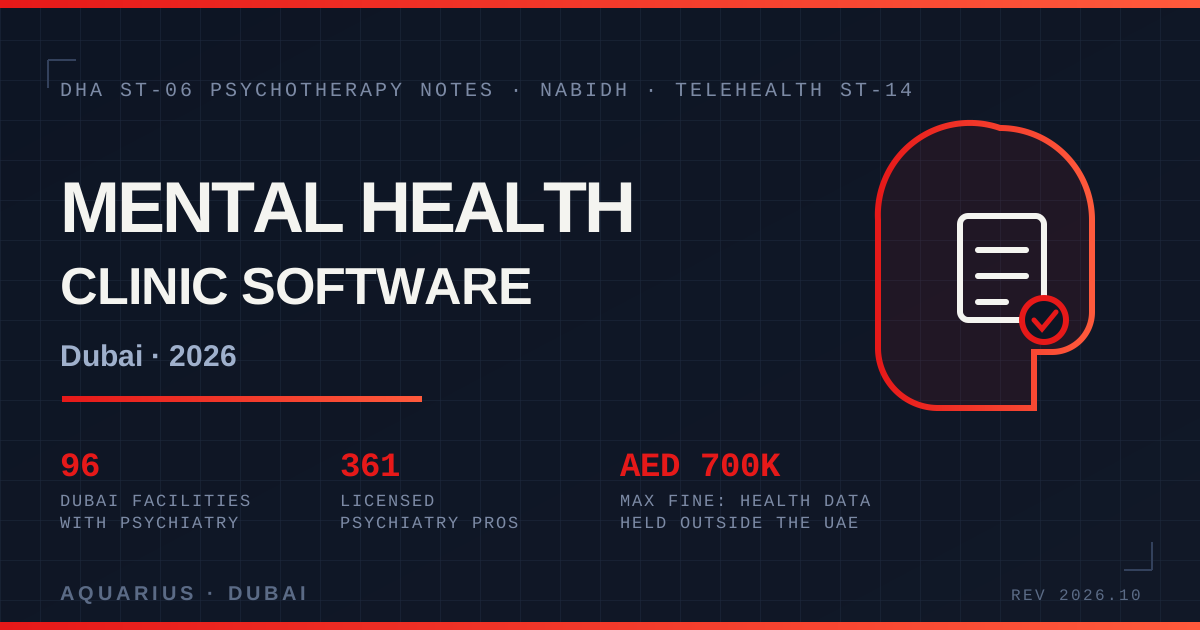
Dubai has 361 licensed psychiatry professionals across 96 facilities, and DHA keeps psychotherapy notes out of NABIDH. What therapy clinic software must do, plus real 2026 AED costs.
- PUBLISHED
- 22 OCT 2026
- READ TIME
- 12 MIN
- AUTHOR
- AQUARIUS · DUBAI
- UNIT
- REV 2026.09
Mental health clinic software in Dubai is not a normal EMR with the word "therapy" swapped in. Dubai regulates psychotherapy notes as a separate, more protected record class than the rest of the chart — they must be kept apart from the main medical record and must not be pushed to NABIDH — while every other encounter, diagnosis and prescription still has to flow into the exchange. Get that one distinction wrong and you are either in breach of the DHA record standard or in breach of the sharing mandate. There is no software setting that makes both problems disappear; you have to design for it.
Dubai's 2026 mental health numbers set the stakes
Three figures explain why this niche went from side-room to core service line.
First, supply. As of April 2026 Dubai has 361 licensed psychiatry professionals practising across 96 healthcare facilities — 205 on a full-time licence and 156 registered. That is a real, fragmented provider base: dozens of small two-to-six-clinician practices, each running its own booking, notes and claims stack.
Second, demand and money. The UAE mental health market was valued at USD 13.10 billion in 2024 and is forecast to reach USD 28.26 billion by 2033, a 8.92% CAGR. The digital slice is growing faster: UAE mental health apps were a USD 31 million market in 2023, projected at USD 88.68 million by 2030 (16.2% CAGR), inside a UAE digital health market sized at roughly USD 1.17 billion for 2026. Reported prevalence of mental disorders in the UAE sits around 14%, with depression estimates ranging from 12.5% to 28.6% depending on the cohort studied.
Third, and most commercially relevant: the payer side flipped. Federal Law No. 10 of 2023 on Psychiatric Health, in force since May 2024, prohibits blanket psychiatric exclusions in UAE health insurance. From January 2025 the DHA mandated that every Dubai plan include psychiatric and mental health services (alongside dental, dialysis and organ transplant cover up to AED 100,000). Enhanced plans now commonly fund 12–24 sessions a year with a AED 50–100 co-pay.
A practice that was 90% self-pay in 2023 is now processing insurance claims, pre-authorisations and session caps. That is a billing system problem, and most Dubai therapy clinics still solve it in a spreadsheet.
The rule most Dubai clinics get wrong: psychotherapy notes stay out of NABIDH
DHA issued Standards for Psychotherapy Notes Record Management in Healthcare Facilities (DHA/HISHD/ST-06) on 30 December 2024, effective 30 March 2025. Alongside it sits the Standards for Mental Health Services v1.0 (issued 31 December 2024, effective February 2025) and the DHA Standards for Health Information Consent and Access Control. Read together, they produce a two-tier record:
- Psychotherapy notes — the clinician's process notes from a counselling or therapy session — must be held separately from the rest of the patient record, and must not be shared with a Health Information Exchange such as NABIDH.
- Mental health records generally — diagnoses, medication, behavioural health reports — are classified as sensitive under the DHA health data classification policy, must be flagged as sensitive, and may be accessed only by the treating physician or treating mental health professional. They are still in scope for NABIDH.
Two practical consequences for software. One: a generic EMR that treats "clinical note" as a single table will either leak psychotherapy notes into the HIE payload or, if you disable the integration to be safe, break your NABIDH obligation for everything else. Two: "sensitive" is an access-control requirement, not a label. Your system needs role-based access that can hide a psychiatric episode from the receptionist, the physiotherapist down the corridor and the visiting locum, with an audit trail proving it did.
Consent adds a third wrinkle. Patient consent is not required to upload health information to NABIDH, but facilities must carry a NABIDH access-consent clause inside their general consent, and patients can opt out — with opt-out requests processed by DHA within five days. Your intake flow has to capture that clause and your record has to honour an opt-out that arrives after the fact. We cover the integration mechanics in detail in our guide to EMR software and NABIDH integration for Dubai clinics.
Teletherapy: a separate registration, not a Zoom link
Remote delivery of mental health services is legal in Dubai, and tightly specified. Under the DHA Telehealth Standard (ST-14, updated 26 November 2025), a DHA-licensed facility must register its telehealth service, operate approved care pathways, document every encounter in writing, and capture patient consent through secure electronic means. The January 2025 mental health standards reinforce that remote mental health care still has to run through DHA-licensed facilities and DHA-licensed practitioners, verified on Sheryan — and that adding the service to an existing facility licence is a Sheryan application, not an internal decision.
For a build, that converts into hard requirements: consent captured and timestamped in-app (not a verbal "is this okay?"), an encounter record created for every session including no-shows and cancellations, practitioner licence status surfaced in the system, and a video layer you can attest to. Clinics that bolt a consumer video tool onto a US scheduling app usually fail on two of those four.
Where the data is allowed to live
This is the point that kills the cheapest option. Federal Law No. 2 of 2019 on the use of ICT in health fields restricts health information connected to services provided in the UAE from being stored, processed, generated or transferred outside the country without health authority approval coordinated with MOHAP. The law applies across the UAE, including free zones. Penalties for storing or transferring health data offshore without approval run AED 500,000 to AED 700,000. Layer the UAE PDPL on top for consent, data-subject rights and breach handling — see our UAE PDPL compliance checklist.
So the popular off-the-shelf behavioural health platforms — priced at USD 29–99 per clinician per month for SimplePractice or Ensora/TheraNest tiers, with telehealth often a USD 12 per-therapist add-on — are the cheapest line item on the page and, hosted in US regions by default, the one you cannot legally point UAE patient records at without approval. A UAE-region deployment is not an optimisation. It is the entry ticket.
What the software actually has to do
Beyond a normal clinic stack, a Dubai mental health practice needs seven things most EMRs do not ship:
1. Two-tier notes with hard separation
Psychotherapy notes in their own store, excluded from HIE export by schema — not by a checkbox someone can untick.
2. Sensitivity flags with enforced access control
Per-record sensitivity, treating-clinician scoping, and an immutable access log. If you cannot produce "who opened this chart and when" on demand, you cannot evidence the standard.
3. Session-cap and pre-authorisation tracking
With plans funding 12–24 sessions a year, the system should warn at session 10, not surprise the patient at session 25. Pre-auth status belongs on the appointment, not in an inbox.
4. Structured risk assessment
The mental health standards expect risk assessment using internationally recognised tools and current disease classifications, with age-specific factors such as self-harm risk in adolescents. That means versioned instruments and scored, reportable outputs — PHQ-9 and GAD-7 as data, not PDFs.
5. Teletherapy with evidential consent
Secure electronic consent, per-encounter documentation, and a written record for every remote session.
6. No-show economics
At AED 400–900 a psychology hour, a 15% no-show rate on a four-clinician practice is a six-figure annual hole. Confirmations, waitlist backfill and a card-on-file cancellation policy are revenue features, not nice-to-haves.
7. Bilingual intake
Arabic and English intake, consent and screening copy — stigma research in the UAE consistently points to reluctance to seek help, and a form in the wrong language is one more reason to abandon it. Our notes on Dubai clinic websites and booking systems cover the front-door side.
Dubai mental health clinic costs in 2026 (AED)
Useful both for pricing a practice and for sizing what the software is protecting:
| Line item | 2026 range (AED) | Notes |
|---|---|---|
| Psychology / therapy session (50–60 min) | 400 – 900 | Market spread 500–1,500; ~800 typical in Dubai |
| Psychiatrist initial consultation | 600 – 1,200 | Follow-ups 300–700 |
| Couples therapy session | 600 – 1,200 | 60–90 minutes |
| Child psychologist session | 500 – 1,000 | Age-specific risk assessment required |
| Insured session co-pay | 50 – 100 | Enhanced plans: 12–24 sessions/year |
| DHA practitioner licence | 1,235 base fee | Two-year validity; PSV via DataFlow first |
| DHA facility licence (annual) | 20,000 – 50,000 | Mental health clinic / outpatient psychiatry classification |
| Offshore SaaS platform | ~110 – 365 per clinician/month | USD 29–99 equivalent; residency approval needed before use |
| Licensed UAE-hosted EMR | 15,000 – 60,000 per year | Plus 500–3,000 per integration endpoint |
| Custom build, single-site practice | 90,000 – 150,000 | Booking, two-tier notes, teletherapy, billing |
| Custom build, multi-site or group | 150,000 – 375,000 | NABIDH integration, insurance claims, analytics |
The cost-of-inaction maths is blunt. A single health-data residency breach is fined at AED 500,000–700,000 — more than the top of our custom build range, for one violation, before any licensing consequence. That is the number to weigh against a USD 49-a-month subscription hosted in Virginia.
How Aquarius builds mental health clinic software
We start with the record model, because that is the decision everything else inherits: psychotherapy notes in a separate store with HIE export impossible by design, sensitivity flags enforced at the query layer, and an append-only access log. Then scheduling, electronic consent and teletherapy sessions that write an encounter every time. Then billing — session caps, pre-authorisation state, co-pay collection. NABIDH last, with an explicitly scoped payload you can show an auditor.
Everything runs in a UAE region by default, with bilingual EN/AR intake and screening instruments as structured, scoreable data. Fixed scope, fixed price, a working build you can test before launch. Full ranges are on our pricing page, and a 30-minute scoping call will tell you whether your current stack is a configuration problem or a rebuild.
FAQ
Can I use SimplePractice or TheraNest for a Dubai therapy practice?
Not without resolving data residency. Federal Law No. 2 of 2019 restricts storing or processing UAE health data outside the country without health authority approval coordinated with MOHAP, with fines of AED 500,000–700,000. If the platform cannot host your records in a UAE region, you need that approval before you put a single patient in it.
Do psychotherapy notes go into NABIDH?
No. DHA's psychotherapy notes standard (DHA/HISHD/ST-06, effective 30 March 2025) requires them to be kept separate from the main medical record and not shared with a Health Information Exchange such as NABIDH. Other mental health records are still shared, but are classified sensitive and restricted to the treating physician or mental health professional.
Does a patient have to consent to NABIDH sharing?
Consent is not required for a facility to upload health information to NABIDH, but facilities must include a NABIDH access-consent clause in their general consent. Patients may opt out, and DHA processes opt-out requests within five days — so your system has to be able to apply an opt-out retroactively.
What do I need to offer teletherapy in Dubai?
A DHA-licensed facility, DHA-licensed practitioners verified on Sheryan, a registered telehealth service under Telehealth Standard ST-14 (updated 26 November 2025), approved care pathways, written documentation of every encounter, and patient consent captured by secure electronic means.
Is mental health covered by Dubai health insurance in 2026?
Yes, at least in part. Federal Law No. 10 of 2023 bans blanket psychiatric exclusions, and since January 2025 DHA requires all Dubai plans to include psychiatric and mental health services. Depth varies: psychiatry is usually covered more fully than psychology, outpatient therapy often needs pre-authorisation, and enhanced plans typically cap at 12–24 sessions a year with a AED 50–100 co-pay.
Next step
If your practice is still running therapy notes in the same table as the rest of the chart, that is the one thing worth fixing before you add clinicians, insurers or a second location. Tell us how your clinic runs today and we will map it against the DHA standards — and send the 2026 compliance checklist either way.