
Monorepo vs Multi-Repo for Dubai Product Teams in 2026: Real AED CI Costs, the 10 GB Cache Trap and the EN/AR Design-System Argument
GitHub caps Actions cache at 10 GB per repository — the real monorepo tax. Dubai CI rates in AED, ARM savings up to 55% in me-central-1, and when to split the repo.
- PUBLISHED
- 19 NOV 2026
- READ TIME
- 12 MIN
- AUTHOR
- AQUARIUS · DUBAI
- UNIT
- REV 2026.09
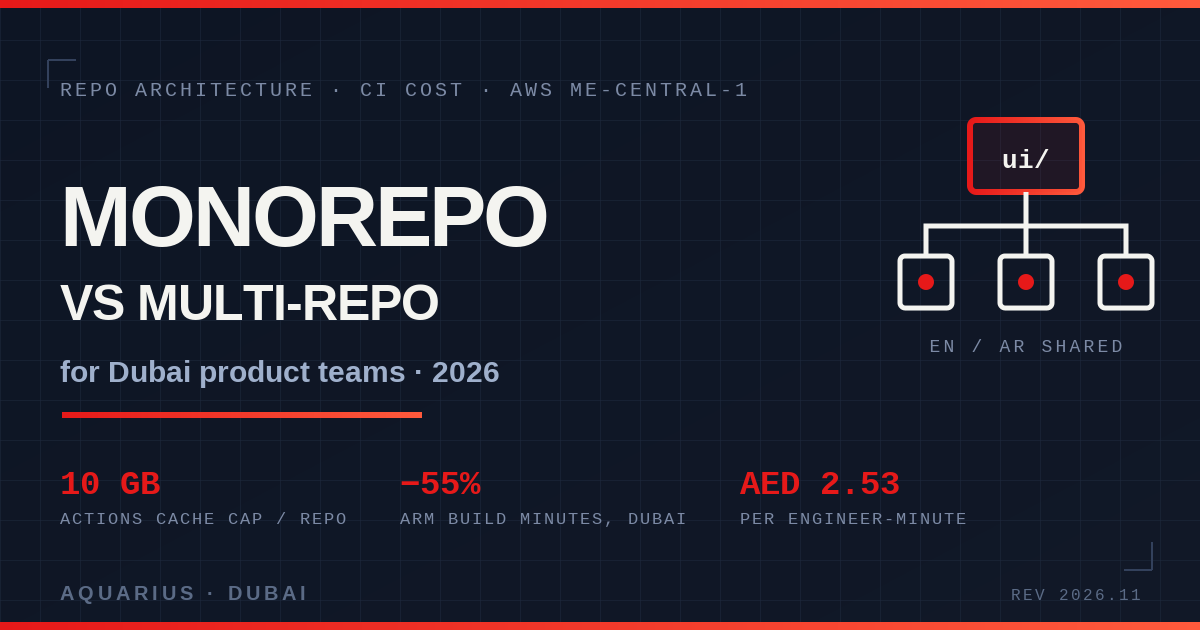
For a Dubai product team running three or more apps that share a design system, a single monorepo with affected-only CI is almost always cheaper — but not because of build minutes. GitHub caps Actions cache at 10 GB per repository, so an unmanaged monorepo thrashes its own cache and rebuilds everything. Fix that with a remote cache and the saving shows up where it matters: engineer attention, worth about AED 2.53 per minute at Dubai's median developer package.
Why repo architecture is a hiring problem in the UAE, not a taste problem
The UAE tech labour market in 2026 is tight in a very specific way: there is work, and not enough people. Market analysis for 2026 puts roughly 23,500 open tech positions in the UAE against a talent gap of about 10,500 unfilled roles — up from around 6,000 in 2025, a 75% widening in one year. Average time-to-fill moved from 42 days in 2025 to 48 days in 2026, and 80–85% of tech hires still come from international talent pools, which means visas, relocation and notice periods on top of those 48 days.
Meanwhile the budget is flattening. Cooper Fitch's UAE Salary Guide 2027, published on 16 November 2026 from a survey of 1,091 organisations representing more than 500,000 employees, found UAE employers planning an average pay rise of just 2.8% for 2027, with 42% expecting to expand headcount — down from 48% the year before — 32% holding flat and 26% expecting reductions.
Put those two facts together and the conclusion is blunt: most Dubai product teams will not get more engineers in 2027. Whatever throughput they gain has to come out of the way the code and the pipeline are organised. And engineer time here is not cheap — Levels.fyi data for Dubai, updated 18 November 2026 across 199 reported salaries, puts median software engineer total compensation at AED 316,000 a year (AED 26,337 a month), with the 25th percentile at AED 215,998 and the 75th at AED 420,057.
At the median, and at 2,080 working hours a year, one engineer-hour costs AED 151.92. One engineer-minute costs AED 2.53. Hold that number — it decides this entire argument.
The myth-bust: your monorepo is not slow, it is being evicted
Most Dubai teams who try a monorepo and hate it blame the monorepo. The actual culprit is usually a documented storage ceiling nobody read. GitHub's own reference states that the total size of all caches in a repository is limited to 10 GB by default, and that cache entries not accessed in over 7 days are removed.
That limit is per repository, not per app. Put six Next.js apps, a shared UI package and a pnpm store in one repo and the dependency cache, the build cache and the test cache for all of them compete for the same 10 GB. Once you cross it, GitHub starts evicting the least recently used entries — so the app nobody touched this week gets a cold, full, from-scratch build the moment someone does touch it. The pipeline looks randomly slow. Engineers conclude "monorepos don't scale". The repo never had a chance.
A monorepo without a remote cache is not a monorepo. It is several repos sharing one cache budget and one queue.
The fix is to stop using per-repo CI cache as your build cache and move to a content-addressed remote cache that is scoped by task hash rather than by repository. That is exactly what Turborepo and Nx do, and both have a free tier that is adequate for a typical UAE SME team.
What a monorepo actually buys you (and what it costs)
Three mechanics do the real work. None of them are automatic — this is where teams get it wrong.
1. Affected-only task graphs
Turborepo's --affected flag runs tasks only in packages that changed. It reads the GitHub Actions environment directly, comparing the pull request's base and head branches, and falls back to GITHUB_EVENT_PATH for plain pushes. Turborepo's own CI guidance notes this handles shallow clones more gracefully than a hand-rolled diff script, because it degrades to running everything when git history is unavailable rather than silently testing nothing. turbo query affected goes further and emits JSON so you can skip dependency installation entirely when nothing relevant changed. Nx offers the same idea through its project graph and nx affected.
A ten-app monorepo where every PR builds all ten apps is strictly worse than ten separate repos. A ten-app monorepo where a PR touching the admin panel builds one app and the one package it imports is strictly better. The flag is the whole difference.
2. Remote caching that survives the 10 GB wall
Vercel Remote Cache is free on all plans, including Hobby, under published fair-use limits: 100 GB of uploads per month and 100 artifact requests per minute on Hobby, 1 TB and 10,000 requests per minute on Pro, 4 TB on Enterprise. Artifacts expire automatically after 7 days. Two environment variables — TURBO_TOKEN and TURBO_TEAM — wire it into any external CI, so you can keep GitHub Actions, GitLab or CodeBuild and still get the cache.
Nx Cloud's free Hobby tier includes 50,000 credits a month, and Nx prices a credit at USD 0.00055 — so the free allowance is worth about USD 27.50, or AED 101 a month. Paid Nx Cloud Team starts at USD 29 a month (about AED 107), and the usage-based CI tier starts at USD 99 a month with 25 concurrent workers and a published cap of USD 0.50 per run for parallel execution and task packing.
One Dubai-specific footnote: GitHub, Vercel and Nx all invoice from outside the UAE. If you are VAT-registered here, those USD subscriptions are import-of-services and you account for 5% VAT under the reverse-charge mechanism on your own return. It is not extra cash out, but it has to appear in the filing.
3. One shared EN/AR design system instead of N copies
This is the argument that is specific to Dubai and that no imported blog post will make for you. A UAE product usually ships English and Arabic, which means right-to-left layout: mirrored padding, flipped icons, logical CSS properties, Arabic numeral handling, fonts with proper Arabic coverage, and date formats that differ per locale.
In a multi-repo setup, every RTL bug is fixed once per repository. A mirrored chevron in the marketing site, the customer portal and the admin panel is three pull requests, three reviews, three releases, three chances to miss one. In a monorepo with a shared packages/ui, it is one commit, and affected-only CI then rebuilds exactly the apps that consume it — with the shared-component test suite running once, not three times. Add a component workshop such as Storybook in the same repo and your Arabic review happens in one place, against one source of truth.
That is also the honest cost side: a shared package means a shared blast radius. One bad merge in packages/ui can break every app at once, which is why CODEOWNERS on the shared packages and a required review from whoever owns the design system stop being optional bureaucracy and start being the thing that keeps the model working.
The Dubai CI rate card: what a build minute really costs in AED
Here are current published rates, converted at USD 1 = AED 3.6725. GitHub-hosted runner prices are from GitHub's billing reference; the AWS CodeBuild figures come straight from the AWS public price list for me-central-1 (UAE), so they are the real Dubai-region numbers rather than a US rate.
| Runner / compute | Spec | USD per minute | AED per minute |
|---|---|---|---|
| GitHub-hosted Linux x64 | 2-core (standard) | 0.006 | 0.0220 |
| GitHub-hosted Linux arm64 | 2-core | 0.005 | 0.0184 |
| GitHub-hosted Linux x64 | 8-core (larger runner) | 0.022 | 0.0808 |
| GitHub-hosted Linux arm64 | 8-core (larger runner) | 0.014 | 0.0514 |
| GitHub-hosted Windows x64 | 2-core | 0.010 | 0.0367 |
| GitHub-hosted macOS | 3–4 core | 0.062 | 0.2277 |
| AWS CodeBuild, me-central-1 | Linux general1.small | 0.005 | 0.0184 |
| AWS CodeBuild, me-central-1 | Linux general1.large | 0.021 | 0.0771 |
| AWS CodeBuild, me-central-1 | ARM arm1.large | 0.016 | 0.0588 |
| AWS CodeBuild, me-central-1 | Linux general1.2xlarge | 0.215 | 0.7896 |
| AWS CodeBuild, me-central-1 | ARM arm1.2xlarge | 0.096 | 0.3526 |
Two things in that table are worth money. First, GitHub's included allowance is a dollar amount, not a minute count: USD 12 a month on Free, USD 18 on Pro and Team, USD 300 on Enterprise Cloud — and GitHub states that USD 300 covers 50,000 standard Linux minutes (about AED 1,102 of compute). Actions cache storage beyond the allowance is USD 0.07 per GB-month, while artifact and Packages storage is USD 0.25 per GB-month.
Second, on CodeBuild in Dubai the ARM discount is not flat — it widens with machine size: 20% cheaper at general1.small, 23.8% at large, 35.4% at xlarge and 55.3% at 2xlarge. If your monorepo's heavy job is a big parallel test shard on a 2xlarge, moving that one job to ARM halves its bill. CodeBuild also includes 100 free build minutes a month on general1.small. For the wider build-out budget, our DevOps and CI/CD setup cost guide for Dubai prices the pipeline itself, and the Kubernetes versus serverless cost comparison for me-central-1 covers where the resulting artefacts actually run.
The number that decides it: compute is 6%, attention is 94%
Model a realistic Dubai studio team: 8 engineers, about 40 CI runs a working day, and a pipeline that affected-only filtering plus a warm remote cache shortens by 10 minutes per run. Twenty-one working days a month, CodeBuild Linux general1.large at AED 0.0771 a minute, and engineer time at AED 2.53 a minute.
| Line | Per day | Per month | Per year |
|---|---|---|---|
| Build minutes saved (400 min/day) | AED 30.84 | AED 648 | AED 7,772 |
| Engineer wait saved (200 min/day, half the runs block someone) | AED 506.40 | AED 10,634 | AED 127,613 |
| Total | AED 537.24 | AED 11,282 | AED 135,385 |
The attention line is 16 times the compute line. The annual total is roughly 43% of one median Dubai engineer's package — recovered without a single new visa, in a year when only 42% of UAE employers plan to grow headcount at all. That is the business case, and it is why optimising CI minutes alone is the wrong fight: the minutes are a rounding error next to the people waiting on them.
When multi-repo is still the right answer
We consolidate repos for clients often, and we also talk clients out of it. Keep things separate when:
- The apps genuinely share nothing. Two products, two stacks, no shared components — a monorepo adds tooling and buys nothing.
- Different parties must not see the code. Separate clients, an outsourced vendor, or a white-label build where per-repo access control is the requirement. Path-based permissions inside one repo are weaker than a repo boundary.
- Release cadences are legally decoupled. A regulated component with its own audit trail is easier to evidence as its own repository with its own history.
- The team is one or two people on one app. There is nothing to coordinate yet. Start with pnpm or npm workspaces, add Turborepo or Nx when a second app appears.
Everything else — a marketing site, a customer portal, an admin panel, a mobile app and a shared EN/AR component library, built by one team — is the case a monorepo was designed for.
How we do it at Aquarius
Our standard UAE setup is pnpm workspaces plus Turborepo, affected-only pipelines, a remote cache on the free tier until usage justifies paying, CODEOWNERS on every shared package, and the Arabic/RTL review done once in a shared component workshop. For teams already on AWS we run the heavy jobs on CodeBuild ARM in me-central-1 so build data stays in the UAE and the bill drops 20–55% against the x64 equivalent.
A consolidation of three to six apps with a design-system extraction typically runs AED 18,000–45,000 of our time; ten or more apps with CI redesign and release-process changes runs AED 60,000–120,000. Against AED 135,385 a year of recovered capacity in the model above, the smaller engagement pays back in under five months. Our pricing page lists the engagement shapes, and if your pipeline is already the bottleneck, the database scaling guide covers the other half of the slow-release story.
FAQ
Is a monorepo cheaper to run than multiple repos in Dubai?
On compute, the difference is small either way — build minutes cost AED 0.0184 to AED 0.79 each depending on machine size. The saving comes from engineer time: at a median Dubai package of AED 316,000 a year, one engineer-minute is AED 2.53, so a 10-minute pipeline improvement across 40 daily runs is worth about AED 10,600 a month in recovered attention versus roughly AED 648 of compute.
What is the GitHub Actions cache limit, and why does it hurt monorepos?
GitHub limits the total size of all Actions caches to 10 GB per repository by default and evicts entries not accessed for more than 7 days. Because the limit is per repository rather than per app, a monorepo's apps compete for one budget, causing eviction and cold full builds. Moving to a task-hash-based remote cache (Turborepo or Nx) removes the ceiling.
Do I need Nx or Turborepo, or are pnpm workspaces enough?
Workspaces alone handle dependency linking but have no task graph and no cache, so CI still rebuilds everything. For one or two apps, workspaces are fine. From the third app, or the first shared UI package, add Turborepo or Nx for affected-only runs and remote caching — both have free tiers (Vercel Remote Cache is free on all plans; Nx Cloud Hobby includes 50,000 credits a month, about AED 101 of value).
Is it cheaper to run CI on AWS me-central-1 than on GitHub-hosted runners?
At small sizes they are near identical — CodeBuild Linux general1.small is USD 0.005 a minute against USD 0.006 for a GitHub-hosted 2-core Linux runner. At larger sizes CodeBuild ARM in me-central-1 pulls ahead, and arm1.2xlarge is 55.3% cheaper than the x64 equivalent in the same region. CodeBuild also keeps build data in the UAE, which matters if your pipeline touches personal data.
Does a monorepo help with Arabic and RTL support?
Significantly. RTL work is layout logic that every UAE app repeats: mirrored spacing, flipped icons, locale-aware dates and numerals. In one repo with a shared component package, each fix lands once and affected-only CI rebuilds only the apps that consume it. Across separate repos, the same fix is duplicated per repository and drifts.
How long does a monorepo migration take for a Dubai team?
For three to six apps, plan two to four weeks of mostly parallel work: workspace setup and dependency alignment first, then design-system extraction, then the affected-only pipeline and remote cache, with CODEOWNERS and branch rules last. The pipeline change is the fast part; agreeing who owns the shared packages is what actually sets the timeline.
Where to start this week
Open your CI billing page and your Actions cache usage. If cache size is near 10 GB, or if build times vary wildly for no code-related reason, you are paying the eviction tax today regardless of how your repos are arranged. Fix the cache, add affected-only filtering, and only then argue about repository boundaries.
If you would rather not spend a sprint discovering this the hard way, talk to Aquarius. We will audit your current pipeline against the AED numbers above and tell you plainly whether consolidating is worth it for your team — including when the answer is no.