
The New Dirham Symbol (U+20C3): Putting It on Your Dubai Website, App and Invoices in 2026
Unicode 18.0 encoded the dirham sign as U+20C3 on 16 September 2026, but no major OS font ships it yet. How to render it on Dubai websites, apps, POS receipts and invoices without breaking VAT data.
- PUBLISHED
- 25 OCT 2026
- READ TIME
- 11 MIN
- AUTHOR
- AQUARIUS · DUBAI
- UNIT
- REV 2026.09
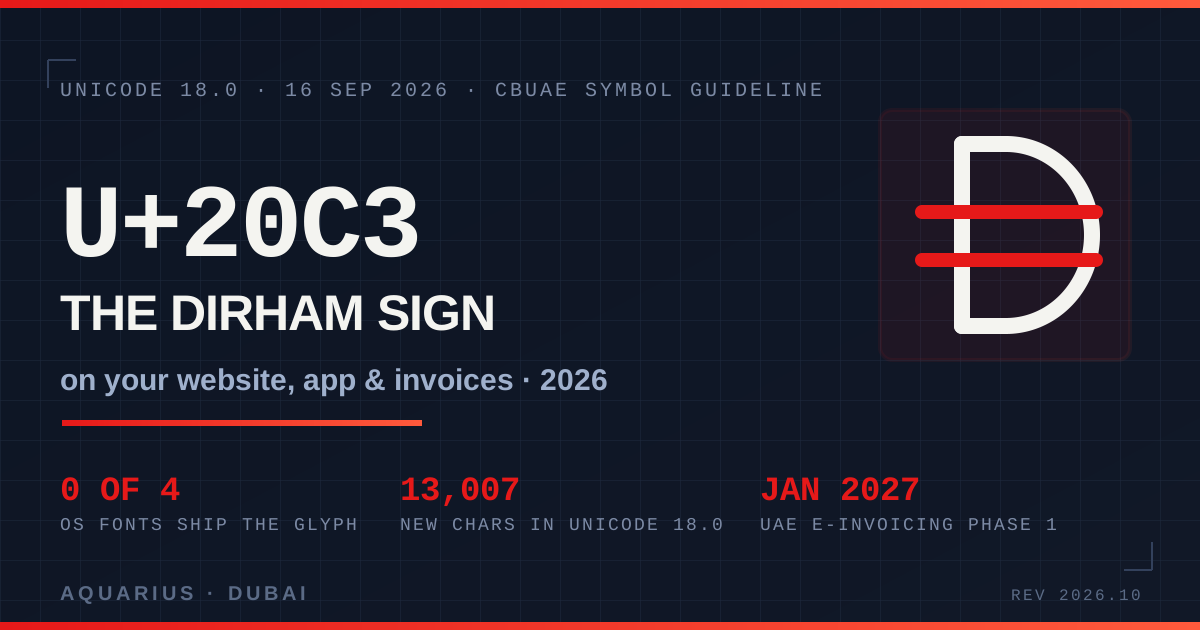
Short answer: the new dirham sign became a real character on 16 September 2026, when Unicode 18.0 encoded it at U+20C3. But encoding is not rendering: as of October 2026 none of Apple’s San Francisco, Google’s Noto or Roboto, or the shipping Windows fonts contain the glyph, so pasting it into your Dubai website or app shows most visitors an empty box. The fix is a two-line change: ship a subsetted web font scoped to that single codepoint for display, and keep the ISO 4217 code AED in your database and your tax invoices. Do both and you look current today without breaking a single VAT field.
The timeline most Dubai businesses missed
The Central Bank of the UAE unveiled the symbol — a Latin D crossed by two horizontal lines with curved ends, drawn from the UAE flag — on 27 March 2025. It published a formal usage guideline on 1 September 2025 covering placement, spacing, proportion and contrast. Then came the eighteen-month gap nobody plans for: a symbol can be official and still be invisible, because browsers and operating systems can only draw characters that the Unicode Standard has assigned a codepoint to.
That gap closed in September 2026. Unicode 18.0 shipped 13,007 new characters, bringing the total encoded repertoire to 172,808, and the dirham sign took U+20C3. It arrived alongside the Maldivian rufiyaa at U+20C2 and the Omani rial at U+20C4; the Saudi riyal had gone first, landing at U+20C1 in Unicode 17.0 a year earlier. The Unicode Consortium was blunt about why these took so long: each symbol “was authorised for public use by the respective monetary authority over a year ago, but usage has been hindered by lack of a standardised encoding.”
Here is the part that matters commercially. Unicode encodes; vendors implement. The Consortium’s own roadmap puts the lag from a Unicode release to broad vendor support at “typically, at least one year, and often longer” — and warns that older devices may never get it at all. In the UAE that is not an abstraction: StatCounter put the September 2026 UAE mobile split at 73.3% Android against 26.68% iOS, which is exactly the half of the market where handsets sit two or three OS versions behind. With 11.04 million UAE online shoppers and roughly 78.67% of UAE e-commerce orders placed on a smartphone, a currency symbol that fails on old Android is a currency symbol that fails on your highest-volume checkout surface.
Why it renders as an empty box (and what that box is called)
When a font has no glyph for a codepoint, the renderer substitutes .notdef — a hollow rectangle that typographers nicknamed “tofu.” Google’s Noto family is literally named for the goal of no more tofu, and Noto still does not carry U+20C3. Checked in October 2026: Apple’s system fonts on macOS 26.6 include the Saudi riyal sign U+20C1 but not the dirham; Google’s Noto and Roboto do not have it; Microsoft has not announced a shipping date; on Linux only GNU Unifont 18.0.01 carries it. Call it zero of the four font stacks that matter to a Dubai consumer product.
There is a second, quieter trap. Locale data lives in CLDR, and CLDR deliberately lists a brand-new currency symbol as an alternative rather than the default “to avoid the symbol being displayed in contexts in which available fonts might not yet support the new symbol.” Practical consequence for your developers: Intl.NumberFormat with currency: 'AED' will keep printing AED or د.إ and will never emit U+20C3 on its own. If a ticket says “just switch the formatter,” the ticket is wrong.
The symbol is a presentation concern. The currency is still AED everywhere a machine reads it. Teams that confuse the two end up with a broken tax invoice and a pretty price tag.
Four ways to render U+20C3 today
These are the only four options, and most Dubai sites should pick the first.
| Approach | How it works | Typical Dubai effort | Trade-off |
|---|---|---|---|
| Subsetted web font (recommended) | A tiny WOFF2 declared with unicode-range: U+20C3 and listed first in your font stack. The browser downloads it only when that one character appears. | AED 2,500 – 6,000 for one site, including price components and QA | Adds one small font request; needs the family listed first or another font claims the codepoint |
| Inline SVG component | A hand-drawn vector sign rendered next to the number — no font loading, works in email clients and PDFs | AED 1,500 – 4,000 per codebase | Not selectable or searchable text; must be given an accessible label |
| Raster image | A PNG of the sign dropped into templates | AED 500 – 1,500 | Blurs on retina, breaks in dark mode, invisible to screen readers and to AI crawlers reading your prices |
| Wait for the OS | Use plain AED until vendor fonts ship | AED 0 | Unicode’s own guidance says expect a year or more, and legacy Android may never update |
If you want a shortcut, the MIT-licensed dirham npm package already does the first two: four variants (sans, serif, mono and an Arabic-matched face) in WOFF2, WOFF and TTF scoped to unicode-range: U+20C3, plus React, React Native and Web Component wrappers and a formatDirham helper that inserts the sign followed by a no-break space, and flips it after the number for ar-AE. That last detail matters more in the UAE than anywhere else — see our note on Arabic and RTL localisation for Dubai sites, because a currency sign that sits correctly in English will sit on the wrong side in Arabic unless direction is handled explicitly.
The CBUAE rules you can actually fail an audit of taste on
The Central Bank’s guideline enumerates eight common mistakes. Six of them are pure CSS: the sign goes before the numeral, never after; its height matches the numeral’s height; it keeps its original geometric proportions — no stretching, skewing, superscripting or gradients; it needs clear space of about one-third of its height around it; it needs real contrast against the background; and it must align with the text direction. The other two are content rules, and they are the ones marketing teams break: never pair the symbol with “AED” or “Dh” in the same price, and never use it inside a company logo or an app icon. Keep a 12px on-screen minimum and you will stay on the right side of all eight.
Do not put the symbol in your data layer
This is the expensive mistake, and it is the one we are already cleaning up for clients. The glyph belongs in your templates. AED — the ISO 4217 code — belongs in your database columns, your API payloads, your accounting export and above all your tax documents.
The UAE’s e-invoicing regime makes that non-negotiable. The Ministry of Finance published the mandatory-fields specification on 23 February 2026 and updated the e-invoicing guidelines on 1 June 2026; the currency code is a mandatory field, and where a document is issued in another currency the gross payable total must still be carried in AED in the tax-accounting-currency field, converted at the Central Bank rate on the date of supply. Phase one bites for large businesses in January 2027 and for SMEs in July 2027. A decorative character smuggled into a currency field is a validation failure against a schema that will shortly be compulsory — which is why we cover it in our guide to UAE e-invoicing and ERP integration.
Two more data-layer notes. Cheques and many printed invoices still take AED and “Dirhams Only” as the accepted written format, so do not rip the words out of your cheque-printing templates. And for PDF invoices, the glyph only appears if the font is embedded in the document — a server-side PDF pipeline that relies on a system font will quietly print tofu on every invoice you send.
Where it has to work, surface by surface
- Website prices, cart and checkout — web font plus a
AEDtext fallback in the same element’saria-label. - iOS and Android apps — bundle the font with the binary; do not rely on the device. React Native needs the SVG route or an explicitly linked font.
- POS receipts and thermal printers — most ESC/POS printers have a fixed character ROM and cannot print U+20C3 at all. Print it as a bitmap, or stay with AED on the paper slip.
- PDF invoices and quotations — embed the font in the PDF, every time.
- Transactional email — many clients strip web fonts. Use the inline SVG or a small PNG with alt text of “AED”.
- SMS and WhatsApp templates — plain text only, rendered by the recipient’s handset. Use
AED; assume the glyph fails. - OG images, ads and signage — rendered server-side or by a designer, so this is the one place the symbol is always safe.
UAE brands are not waiting. By April 2026 the sign was already live in shopping apps and on store signage at names including Noon and Carrefour, and CBUAE has said it expects it on price displays, receipts, POS systems, ATMs and financial apps. The Central Bank also plans to put the symbol on the number-6 key in future UAE keyboard layouts — a reminder that the input side of this change is years out while the display side is a sprint you can finish this quarter.
What it costs to retrofit, and how we do it
For a typical Dubai SME site plus one mobile app, a complete rollout — font subsetting, a single reusable price component, Arabic and RTL placement, PDF font embedding, email fallback, POS decision and a regression pass across both — lands between AED 6,000 and AED 18,000. A multi-brand e-commerce estate with an ERP and a receipt printer fleet is realistically AED 25,000 to AED 60,000, almost all of it in finding every hard-coded price string rather than in the font work itself. See our pricing for how that is scoped.
Aquarius does it as one audited change: we grep every currency rendering path, replace them with a single component, put the ISO code back where machines read it, and leave you with a visual diff of every price surface before and after. We do not touch your schema, and we hand back the font subset so you own it. If the rollout does not pass our own 8-point CBUAE checklist on the first review, we fix it at no charge.
The cost of skipping it is small per impression and ugly in aggregate: a hollow box where a price should be, on the checkout screen of the 73.3% of UAE phones least likely to get a timely font update. That is a trust problem on the exact page where trust is priced. If your site is overdue for other work, bundle it — our Dubai website redesign cost guide covers how to sequence it.
FAQ
Can I type the new dirham symbol on my keyboard today?
Not natively on most devices. Unicode 18.0 only cleared the path; Apple, Google, Samsung and Microsoft each have to ship font and keyboard updates, and the Consortium’s roadmap puts that at a year or more after release. CBUAE has signalled a future UAE keyboard layout with the sign on the number-6 key. Until then, developers insert it as the escape ⃃ or copy it from a font that has the glyph.
Should I replace “AED” with the symbol everywhere?
No. Replace it in display copy only, and never show both in the same price — CBUAE prohibits pairing the symbol with AED or Dh. Keep AED in databases, APIs, accounting exports, e-invoices, cheques and SMS.
Is using the symbol mandatory for UAE businesses?
There is no published penalty for continuing to write AED, and AED with “Dirhams Only” remains an accepted format on cheques and invoices. The CBUAE guideline is a usage standard, not a fine schedule. Treat adoption as a brand-currency decision with a deadline set by your competitors, not by a regulator.
Will the symbol hurt my page speed or SEO?
A WOFF2 subset of one glyph is roughly a kilobyte and, scoped with unicode-range, downloads only on pages that actually print a price. Because it stays real selectable text rather than an image, search engines and AI answer engines can still read your prices — which an image-based price cannot offer.
What about the digital dirham?
Different project. The symbol is typography; the digital dirham is the Central Bank’s retail CBDC, and accepting it will mean POS terminal updates, a bank-side merchant wallet and a new checkout option — a payments integration, not a font change. Do the font work now; scope the CBDC work separately.
The one-line version: the dirham finally has a codepoint, almost nothing can draw it yet, and the businesses that look current in Q4 2026 are the ones shipping a 1 KB font subset instead of waiting on Apple and Google. Tell us your stack and we will scope the rollout in a day.