
Nursery and Childcare Management Software in Dubai (2026): KHDA Ratios, the Fee Freeze and Real AED Costs
KHDA caps nursery ratios at 1:3 for under-18-months and Dubai froze fees for 2026-27. Real AED costs for childcare software, the VAT split and build-vs-buy maths.
- PUBLISHED
- 24 SEPT 2026
- READ TIME
- 11 MIN
- AUTHOR
- AQUARIUS · DUBAI
- UNIT
- REV 2026.09
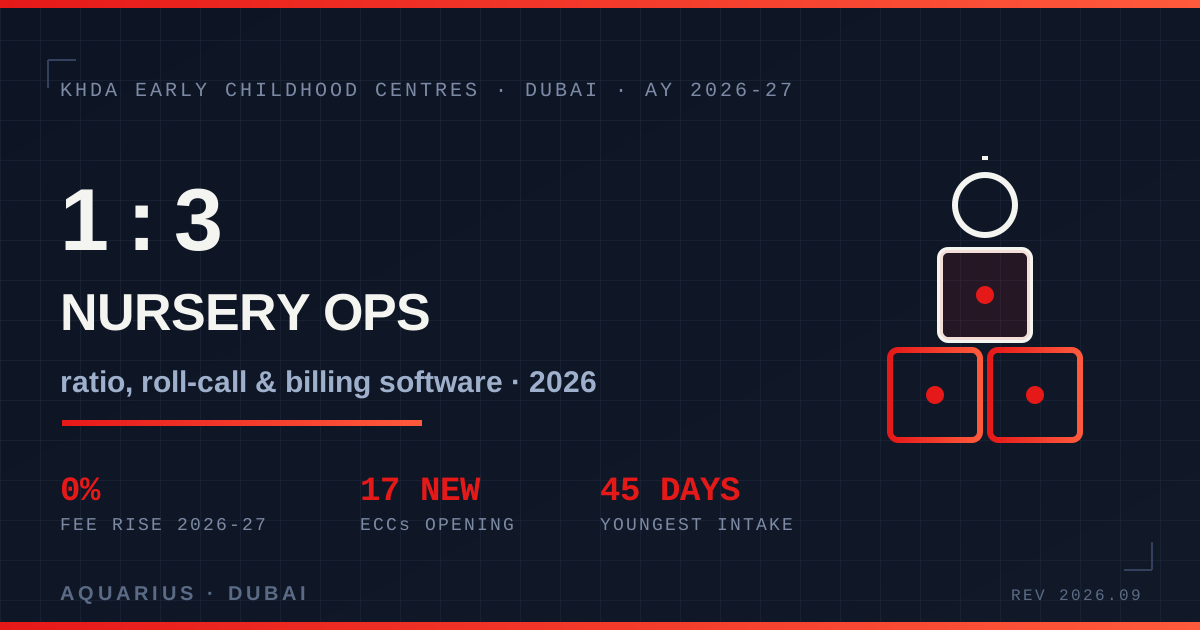
Short answer: A nursery in Dubai is not running a classroom, it is running a regulated ratio. KHDA caps supervision at one adult to three children aged 45 days to 17 months, 1:5 for 18–35 months, 1:8 for 36–47 months and 1:12 for 48–71 months — and for the 2026–27 academic year Dubai has frozen private education fees entirely. Off-the-shelf childcare platforms run roughly USD 29–250 per month per centre (about AED 105–920), while a custom KHDA-shaped nursery system in Dubai typically lands between AED 45,000 and AED 180,000 to build. When you cannot raise the fee, the only levers left are occupancy and cost per child — and both are software problems.
Here is what most Dubai nursery groups get wrong. They buy “nursery software” to send parents photos. Parent engagement is the easiest module to build and the least valuable one you own. The system that actually protects the business is the boring one underneath: a live ratio calculator tied to real check-ins, an enrolment pipeline that shows which age room will break even next term, and an invoice engine that knows which lines on a Dubai nursery bill are zero-rated for VAT and which are not.
The 2026–27 numbers that changed nursery economics
Dubai’s early years sector is expanding hard and pricing flat at the same time. That combination is the whole story.
- Fees are frozen. Under directives from HH Sheikh Hamdan bin Mohammed bin Rashid Al Maktoum, KHDA confirmed no private school fee increase for the 2026–27 academic year, alongside a support package for private schools and early childhood centres reported at Dh1.5 billion. For context, eligible for-profit providers could previously apply for increases of up to 2.35% under the Education Cost Index — the benchmark tied to salaries, rent and support services.
- Supply is surging. Dubai is opening 26 new private education institutions in 2026–27, of which 17 are early childhood centres delivering more than 1,700 new early-learning places.
- And it has been surging for a while. Over the past three years the emirate added 87 new early childhood centres, while ECC enrolment rose only 2.6%. Total private education grew 4.6% a year across the same period.
- The market is worth chasing. More than 200 licensed nurseries serve Dubai children from 45 days to six years, inside a UAE childcare market forecast to grow at roughly 7.5% a year to about USD 2.5 billion by 2030.
Read those two numbers together: 87 new centres opened against 2.6% enrolment growth. Capacity is growing far faster than demand, and the price lever is switched off for the year. In that market, margin comes from filling rooms and removing admin hours — nothing else.
The operating economics are tight enough that this matters immediately. A typical Dubai nursery runs 40–60 children at mid-range fees of around AED 3,000 per month — roughly AED 120,000 monthly revenue — at margins commonly cited between 15% and 25%, with well-run sites reaching 30%. Published Dubai nursery fees span about AED 3,000–8,000 per month, or AED 12,000–25,000 a year at the budget end, AED 25,000–45,000 mid-market and AED 45,000–60,000+ for premium international brands.
What KHDA actually requires your system to prove
Regulation is where nursery software stops resembling a CRM. KHDA is the sole licensing and inspection authority for early childhood centres in Dubai, including those inside free zones. Its requirements translate almost line-for-line into database fields.
The ratio table is the core data model
| Age band | Maximum children per adult | What the system must do |
|---|---|---|
| 45 days – 17 months | 1 : 3 | Block a check-in that would breach ratio; alert before staff break |
| 18 – 35 months | 1 : 5 | Recalculate live as children move rooms mid-session |
| 36 – 47 months | 1 : 8 | Flag staff absence against the day’s booked roll |
| 48 – 71 months | 1 : 12 | Hold an auditable timestamped record per room, per hour |
Note the trap in that table: ratio is a function of age in months on the day, not the room a child was enrolled into in September. A child who turns 18 months in February changes your compliant headcount mid-year. Spreadsheets never catch that. A system that stores date of birth and computes the band at check-in catches it automatically.
Staff records are a licensing condition, not HR housekeeping
KHDA sets qualification floors your staff module has to evidence on demand: centre managers need a bachelor’s degree or a level five vocational qualification in leading an early learning centre plus at least three years in early childhood settings, and must be recognised by KHDA before formal appointment. Teachers need a bachelor’s degree or a level three vocational qualification in early childhood education; teaching assistants need a degree, or a high school certificate plus relevant experience. Practitioners working with the 45-day to 35-month band are expected to hold specific baby and toddler expertise.
Add the paperwork clock: police clearance certificates typically take 4–8 weeks per person, which is the single most common reason a Dubai nursery opening slips. A staff module that tracks document expiry — visa, medical fitness, first aid, police clearance, KHDA recognition — with automated renewal alerts is worth more than any photo feed. Payroll obligations sit alongside it; see our guide to HR and payroll software with WPS compliance in Dubai.
CCTV, premises and the physical constraints
KHDA guidance expects camera coverage across all areas where children are cared for — classrooms, corridors, outdoor play areas and sleep rooms. Premises rules are equally literal: ground floor only, a minimum of about 2.3 sqm indoor space per child and 4 sqm of outdoor play area per child. Those numbers are your true capacity ceiling, and your enrolment system should enforce them rather than letting a waiting list promise a seat the floor plan cannot hold.
The VAT split most Dubai nursery invoices get wrong
Pre-school and nursery education supplied by a recognised institution in line with a recognised curriculum is zero-rated for UAE VAT, as are curriculum-linked school trips. Plenty of what a Dubai nursery bills alongside it is not. Ancillary supplies — transport, uniforms, canteen and food service, non-curricular activities and third-party extras — generally attract the standard 5% rate.
That means a single parent invoice can legitimately carry two VAT treatments on different lines. Get it wrong in one direction and you are under-collecting tax you still owe; get it wrong in the other and you are overcharging parents on a zero-rated service. Neither is a good look in an FTA review. Any billing engine you buy or build for a Dubai nursery needs per-line tax codes, not a single rate at the invoice header — the same discipline covered in our UAE VAT invoicing and e-invoicing guide.
Children’s data is the highest-risk data you will ever hold
A nursery system stores photographs, medical conditions, allergy records, sleep and nappy logs, emergency contacts and the location of minors. Under Federal Decree-Law No. 45 of 2021 (PDPL), processing the personal data of children under 16 requires parental consent, obtained in writing or electronically, in clear and accessible terms, with a documented way to withdraw it. The UAE’s Child Digital Safety framework goes further for digital platforms handling under-13s: consent must be explicit, documented and verifiable, with a fast, always-available withdrawal mechanism.
Practically, that rules out a few habits Dubai nurseries still have. Parent photo sharing over a WhatsApp group is not a consent record. A shared staff tablet with one login is not an audit trail. Storing the full cohort’s medical data in a spreadsheet on a personal laptop is not data minimisation. What you need instead: per-child consent flags with scope and timestamp, role-based access so a room assistant cannot read the whole centre’s medical file, and a documented retention policy. Our UAE PDPL compliance checklist for websites and apps covers the wider obligations.
Buy off-the-shelf or build: the honest comparison
Most single-site nurseries should buy. Most growing groups eventually build, or build a layer on top of what they bought. The line between them is usually multi-site reporting and the local compliance fields that global platforms do not carry.
| Option | Typical cost | Best for | Where it breaks |
|---|---|---|---|
| Global SaaS, small plan | USD 29–139/month (~AED 105–510) | One centre, 25–90 children | No KHDA ratio bands, no AED or per-line VAT logic, per-child pricing bites as you grow |
| Global SaaS, per-child plan | ~USD 139/month capped at 100–150 children | A full single site | A second branch doubles the bill; data sits in the vendor’s region |
| Enterprise multi-centre SaaS | ~USD 499/month (~AED 1,830) | Groups needing central CRM | Configuration limits; you adapt your process to the tool |
| Custom nursery platform (Dubai build) | AED 45,000–180,000 one-off + 15–20%/yr | Three or more sites, or a differentiated model | Upfront cost and a real 10–16 week timeline |
The build bands in practice: a focused attendance, ratio and billing core with a parent app typically runs AED 45,000–80,000. Add enrolment pipeline, waiting list, staff document expiry tracking and VAT-correct invoicing with a local gateway and you are at AED 80,000–130,000. Multi-branch consolidation, KHDA-shaped reporting packs, Arabic and English interfaces and CCTV or access-control integration push it to AED 130,000–180,000+. Plan for annual run costs of 15–20% of build. See our pricing for how those bands are scoped.
The modules that actually pay for themselves
- Live ratio dashboard. Room-by-room, age-banded, recalculated on every check-in and staff break. This is the module that protects the licence.
- Digital check-in with guardian verification. Timestamped, photo-verified pickup authority, with a same-day incident log.
- Enrolment pipeline and waiting list. Enquiry to tour to deposit to start date, by age band, so you know which room fills next term and which needs marketing now.
- Fee engine with the correct VAT split. Sibling discounts, term and annual plans, part-time sessions, late-pickup charges, AED payment links and automated reminders.
- Staff and document compliance. Qualification records, KHDA recognition, visa, medical and police clearance expiry alerts.
- Daily logs and parent app. Meals, naps, nappies, milestones, consented photos. Valuable — but built after the four above, not before.
Groups already running a school alongside the nursery should read this next to our Dubai school management ERP guide — the shared parent and finance layer is usually where the integration budget goes.
The cost of not fixing it
Run the arithmetic on a single empty seat. At mid-market Dubai fees of AED 3,000 a month, one unfilled place costs AED 36,000 over a year. Three empty places across three age rooms is AED 108,000 — inside the band of a full custom build, paid for by occupancy alone. Now add the administrator hours currently spent reconciling a paper register against a fee spreadsheet, and the fact that with fees frozen for 2026–27 none of that can be recovered by repricing.
On the risk side the maths is starker. Setting up a Dubai nursery already means clearing five authorities — DET, KHDA, MOE, Dubai Municipality and Civil Defence — with licensing fees reported around AED 15,000–20,000 (DET trade licence), AED 10,000–15,000 (KHDA), AED 10,000 (MOE permit), AED 3,000–5,000 (Municipality fit-out approval) and AED 2,000–4,000 (Civil Defence), inside a total year-one investment commonly quoted at AED 230,000–684,000 and an 8–14 week approval timeline. A ratio breach or a missing staff record puts all of that at risk. Software is the cheapest insurance on that balance sheet.
Frequently asked questions
Does a Dubai nursery legally need management software?
No specific regulation names a software product. But KHDA requires evidence of ratios, staff qualifications, safeguarding and records — and producing that evidence reliably from paper, at inspection, across a full term, is where centres fail. The requirement is the record, not the tool.
What is the staff-to-child ratio for nurseries in Dubai?
KHDA sets a maximum of one adult to three children aged 45 days to 17 months, 1:5 for 18 to 35 months, 1:8 for 36 to 47 months and 1:12 for 48 to 71 months. Ratios are calculated on the child’s age at the time, so they shift during the year as children move bands.
Are nursery fees in Dubai subject to VAT?
Pre-school and nursery education from a recognised institution following a recognised curriculum is zero-rated. Ancillary supplies such as transport, uniforms and canteen services are generally standard-rated at 5%, so a single invoice can carry both treatments on different lines.
How long does it take to build a custom nursery management system in Dubai?
A focused attendance, ratio and billing core with a parent app is typically 8–12 weeks. A multi-branch platform with Arabic and English interfaces, KHDA reporting packs and payment integration runs 12–16 weeks. Discovery and data migration from an existing spreadsheet or SaaS usually add two.
Can I use a global childcare app instead?
For one site with under 100 children, often yes — plans run roughly USD 29–139 a month. Check three things before you commit: whether it supports the KHDA age bands rather than US or UK ratios, whether it can split VAT treatment per invoice line in AED, and where children’s data is stored given PDPL parental-consent obligations.
Where Aquarius fits
We build operational systems for Dubai businesses that live under a regulator — clinics on NABIDH, schools on KHDA frameworks, brokers under RERA. For early years, that means starting with the ratio engine and the fee ledger, proving both against your actual roll for one term, then layering the parent experience on top. Fixed scope, fixed price, AED quoted, source code yours. Browse what we build, or send us your current roll and fee sheet and we will map the system against your rooms.
Fees are frozen for the year. Occupancy and admin cost are the only two numbers you still control — talk to us about making them visible.