
Payment Orchestration in Dubai (2026): Multi-Acquirer Routing, Real AED Savings and the CBUAE Deadline That Already Passed
MENA merchants lose 12-20% of transactions to avoidable declines and the CBUAE technology-provider transition closed on 16 September 2026. Real AED routing economics for Dubai checkouts.
- PUBLISHED
- 30 OCT 2026
- READ TIME
- 12 MIN
- AUTHOR
- AQUARIUS · DUBAI
- UNIT
- REV 2026.09
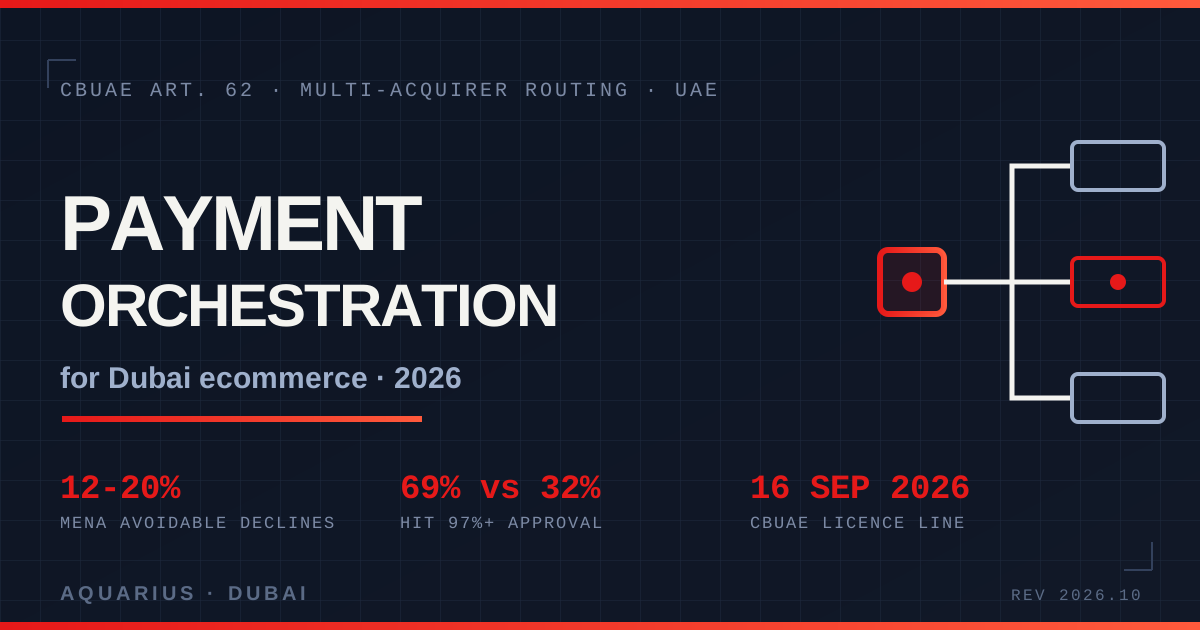
Short answer: payment orchestration is a routing layer that sits between your Dubai checkout and several acquirers at once, so a declined card gets retried on a different processor instead of becoming a lost sale. The reason it matters in 2026 is arithmetic: MENA merchants lose 12–20% of transactions to avoidable declines, and PYMNTS Intelligence found 69% of companies running the full orchestration stack clear 97% approval, against only 32% of those running one or two capabilities. The part almost nobody has priced in is regulatory: the new UAE Central Bank law pulled technology providers that facilitate payment services into the licensing perimeter, and the transition window closed on 16 September 2026.
What a Dubai checkout actually leaks
Start with the size of the pot. The UAE e-commerce market reached USD 12.30 billion in 2026 — roughly AED 45.1 billion — and is forecast to hit USD 21.01 billion by 2031 at an 11.29% CAGR. Around 80% of UAE payments are now digital, digital wallets carried 43.92% of e-commerce value in 2025 and over 53% of all transactions by early 2026, and 78.67% of orders arrive on mobile. Card share is quietly sliding: 87% of UAE online shoppers paid by credit or debit card in 2025, down from 93% in 2024.
Now the leak. Up to 15–20% of MENA transactions fail at 3-D Secure authentication, before an issuer ever makes a credit decision. On the consumer side, 56% of shoppers surveyed by PYMNTS in September 2026 had hit a false decline in the previous three months, and 42% abandon the cart after a failed payment. A false decline is not a fraud saving. It is a customer who now believes your store is broken, on a mobile phone, with a competitor one tab away.
Most Dubai merchants respond by shopping for a better gateway. That is the wrong unit of analysis. One gateway, however good, has one acquiring relationship, one fraud engine and one 3DS stack — which means one set of blind spots and a single point of failure on the biggest trading day of your year. We have covered what gateway integration costs in Dubai and how Telr, Network International and Checkout.com compare separately. Orchestration is the layer above that choice, and it assumes you will eventually hold more than one acquirer.
What orchestration is, and what it is not
An orchestration layer owns four things your current integration hard-codes: the card vault (credentials portable, not trapped inside one processor), the routing rules (which acquirer sees which transaction), the retry and failover logic (what happens on a soft decline or an outage), and the normalised API your developers build against once instead of once per provider.
It is not a payment gateway, it does not acquire funds, and — critically for the compliance section below — a well-designed one never settles money. It is also not a magic revenue machine. If you process AED 80,000 a month through a single hosted checkout, orchestration is overhead. The honest threshold in this market sits around AED 1.5–2 million a month in card volume, or any merchant selling cross-border into Saudi Arabia and Europe where a second acquirer is a hard requirement rather than a nice-to-have.
The five capabilities that separate 97% from 90%
PYMNTS Intelligence surveyed 110 companies with revenue above USD 10 million, fielding the study from 16–31 March 2026, and isolated five capabilities: automated routing, frequent routing updates, failover, token control, and the ability to add new payment rails without a redevelopment project. Firms with all five were more than twice as likely to clear 97% approval as firms with one or two. The gap between intent and execution is the interesting part: 89% said they had failover in place, yet only 47% sustained approval above 97% in a typical month, and 68% still switch providers by hand during an outage.
Routing and failover
Gains compound rather than arrive at once. Merchants typically report a 2–4% immediate lift in authorisation on moving to orchestration, reaching 5–12% as rules are tuned. Frictionless 3DS2 handling alone is worth 8–15% on approvals in this region, because exemption and challenge decisions stop being left to a single provider's defaults. BIN-level routing — local UAE-issued card to a local acquirer, international BIN to a cross-border one — is where cost falls, with reported savings of 20–40% on routed fees and processing costs down as much as 30% overall.
Network tokens and the account updater
This is the least glamorous and highest-return item on the list. Visa reports a 4.6% authorisation uplift on card-not-present transactions using network tokens; Mastercard reports 2.1%. In a 2026 report, Mastercard found Checkout.com merchants using network tokenisation achieved a 10.3 percentage-point improvement in authorisation rates and 7.2% revenue growth. Fraud moves the same direction: Visa puts the fraud rate on network-tokenised transactions at roughly 0.01% versus 0.12% for non-tokenised card-not-present — about 92% lower — and tokenised volume is projected to grow from 283 billion transactions in 2025 to 574 billion by 2029.
The schemes are no longer asking. From 2027 Mastercard applies a scheme fee in Europe to stored-card payments that are not network-tokenised. If you sell to European customers from Dubai, un-tokenised cards on file become a line item, not a preference.
Routing economics: where the AED actually moves
Average UAE merchant discount rates sit at 2.5–3.0% in 2026. High-volume merchants negotiate 1.5–2.5%; small merchants pay up to 4.0%; a newly onboarded business is typically quoted 2.2–2.9% plus about AED 1 per sale. Published tiers tell the same story — Telr at 2.69% + AED 1 (small) and 2.49% + AED 0.50 (medium) with monthly fees of AED 349 / 149 / 99 by tier; Tap at 2.75% + AED 1 on UAE cards, 3.50% + AED 1 regional, 3.75% + AED 1 global; Network International negotiated between 1.85% and 2.5%, with merchants above AED 5 million a month able to push below 2%.
| Lever | Reported effect | On AED 2m/month card volume |
|---|---|---|
| Multi-acquirer soft-decline retry | +2 to +4% authorisation | AED 40,000–80,000/month recovered |
| Tuned routing over 6–12 months | +5 to +12% authorisation | AED 100,000–240,000/month |
| Network tokens on cards-on-file | +2.1 to +4.6% CNP auth | AED 42,000–92,000/month |
| BIN routing to cheapest eligible acquirer | 20–40% off routed fees | AED 8,000–20,000/month saved |
| Frictionless 3DS2 tuning | +8 to +15% approvals | Largest single lever in MENA |
Read the right-hand column as arithmetic on the cited percentages, not as a promise — your mix of local versus international BINs decides which row actually pays. But note the asymmetry: a 30 basis point MDR saving on AED 24 million of annual volume is about AED 72,000 a year, while two points of recovered authorisation on the same volume is about AED 480,000 a year. Merchants negotiate hard on the first number and ignore the second. That is backwards.
Build, buy or self-host
Commercial orchestrators charge a platform fee plus USD 0.01–0.10 per transaction, or roughly 2–8 basis points of volume. Spreedly publishes an Independent Vault from USD 750 per month, with full orchestration from around USD 2,000 per month plus the per-transaction fee; Yuno quotes a fixed monthly platform fee plus per-transaction charges for payments, payouts, refunds and verifications, with add-ons for 3DS, fraud checks and chargeback alerts. At the other end, Hyperswitch is Apache-2.0 and self-hostable, with its maintainers estimating USD 100–1,500 per month of cloud infrastructure before any engineering time.
Timelines decide this more often than price. A direct PSP integration runs 8–12 weeks; a first integration through an orchestrator runs 1–4 weeks, and adding a further PSP afterwards takes 1–3 days instead of another quarter. Building the equivalent in-house has been costed at USD 150,000–300,000 against USD 10,000–50,000 to stand up an orchestration setup. There is one more hidden cost in the build column: the moment you store raw card numbers yourself, your PCI DSS obligation escalates from a short self-assessment to full scope, with the audit and remediation budget that implies. Letting a certified vault hold the credentials while you hold the routing logic is usually the cheaper half of the trade.
The CBUAE line almost nobody told you about
Federal Decree-Law No. 6 of 2025 was issued on 8 September 2025 and came into force on 16 September 2025, replacing the 2018 Central Bank law. Article 62 is the clause that matters here: it extends supervision to technology providers and platform operators, reaching any person who facilitates a Licensed Financial Activity — expressly “regardless of the medium, technology, or form used”. It does not invent new regulated activities; it confirms the existing ones apply however they are delivered, including through APIs and decentralised platforms.
There is a real carve-out, and it is narrower than vendors imply. Supplying software, infrastructure or technical solutions to a licensed financial institution does not, in that capacity alone, amount to facilitating a licensed activity. Pure technology supply sits outside. An entity that routes, enables or sits in the payment flow for unlicensed principals is a different conversation. Newly in-scope entities were given a one-year transition that expired on 16 September 2026, and operating without the required licence after that date is a criminal offence under the 2025 law, with fines reported up to AED 500 million.
The practical consequence for a Dubai merchant is a procurement question, asked in writing: does my orchestrator hold a CBUAE licence or exemption confirmation, or does it rely on being a technology supplier to my already-licensed acquirer? Both answers can be correct. No answer is not. The same diligence applies to anything touching domestic rails — read our note on Aani and Jaywan integration before you route domestic volume.
What this costs to do properly in Dubai
| Workstream | Scope | AED |
|---|---|---|
| Payment leakage audit | Auth-rate analysis by BIN, country and card type; decline taxonomy; routing business case | 12,000–28,000 |
| Orchestrator integration (single checkout) | Vault migration, one extra acquirer, failover rules, webhooks, reconciliation | 45,000–95,000 |
| Multi-acquirer build (web + app) | Three or more PSPs, BIN routing, network tokens, 3DS exemption logic, retry ladder | 95,000–190,000 |
| Self-hosted orchestration (Hyperswitch class) | Deployment, PCI scoping, observability, runbooks, load tests | 120,000–260,000 |
| Subscription and dunning rework | Account updater, smart retries, involuntary-churn recovery | 30,000–75,000 |
| Reconciliation and finance reporting | Multi-PSP settlement matching, VAT-ready exports | 25,000–60,000 |
| Ongoing routing optimisation | Monthly rule tuning, approval-rate reporting, incident response | 4,500–14,000/month |
Our published pricing covers the standard web and app engagements these sit inside. If you run recurring billing, pair this with subscription billing and recurring payments in the UAE — the account updater and retry ladder do more for retention there than any churn email ever written.
How Aquarius approaches it
We do not sell an orchestration platform, so we have no reason to recommend one. The sequence we run is deliberately boring. Measure your real authorisation rate first, by BIN and country, because most merchants quote a blended number that hides a 15-point spread between local and international cards. Then model the AED at stake per lever, pick vendor or self-host on that evidence, and ship the second acquirer behind a feature flag so routing can be rolled back in minutes rather than a sprint. Reconciliation gets designed in at the start, not bolted on after finance discovers two PSPs settle on different days.
Risk reversal is simple: if the audit cannot find authorisation and fee leakage worth materially more than the integration, we will tell you to keep the single gateway you have. That is a cheaper outcome for both of us than a routing layer nobody needed. With 42% of shoppers abandoning after one failed payment, the cost of doing nothing is not a rounding error on a fee line — it is repeat revenue you never see again.
FAQ
Is payment orchestration worth it for a small Dubai store?
Usually not. Below roughly AED 1.5–2 million a month in card volume, the platform fee and integration cost outrun the recovered revenue, and a single well-configured gateway plus network tokens captures most of the available lift. Orchestration earns its keep at scale, across borders, or where an outage costs more than the layer does.
Does an orchestration platform need a CBUAE licence?
It depends on function, not label. Under Article 62 of Federal Decree-Law No. 6 of 2025, anyone facilitating a Licensed Financial Activity is in scope regardless of the technology used, while supplying software or infrastructure to an already-licensed institution is not, in that capacity alone, caught. The transition period for newly in-scope entities ended on 16 September 2026, so ask for the licence or the exemption rationale in writing.
Will routing through two acquirers break my reconciliation?
It will break it if you add the second acquirer without touching finance reporting, which is the most common failure in these projects. Settlement timing, FX handling and refund flows differ per PSP, so the reconciliation layer has to normalise them before month-end, not after.
What is the fastest lift if I only do one thing?
Network tokens on your cards-on-file, then 3DS2 tuning. Reported uplifts are 2.1–4.6% on card-not-present authorisation for tokens, with one 2026 Mastercard report citing a 10.3 percentage-point improvement, and 8–15% on approvals from frictionless authentication in this region. Neither needs a second acquirer.
How long does a multi-acquirer setup take in practice?
Plan on 1–4 weeks for the first integration through an orchestrator and 1–3 days to add each further PSP, against 8–12 weeks for a direct integration. The audit and reconciliation work, not the API, sets the real timeline.
If you want the AED figure for your own checkout rather than the market averages above, send us three months of transaction data and we will come back with the leakage number and a routing plan. Talk to Aquarius — Dubai-based, and happy to tell you when the answer is to change nothing.