
Perfume and Oud Ecommerce in Dubai (2026): The UN1266 Shipping Rule and Real AED Build Costs
Perfume was Dubai Duty Free’s top category at AED 1.601 billion in 2025, yet alcohol-based fragrance is a Class 3 flammable liquid. What a compliant Dubai perfume store costs in AED.
- PUBLISHED
- 27 SEPT 2026
- READ TIME
- 11 MIN
- AUTHOR
- AQUARIUS · DUBAI
- UNIT
- REV 2026.09
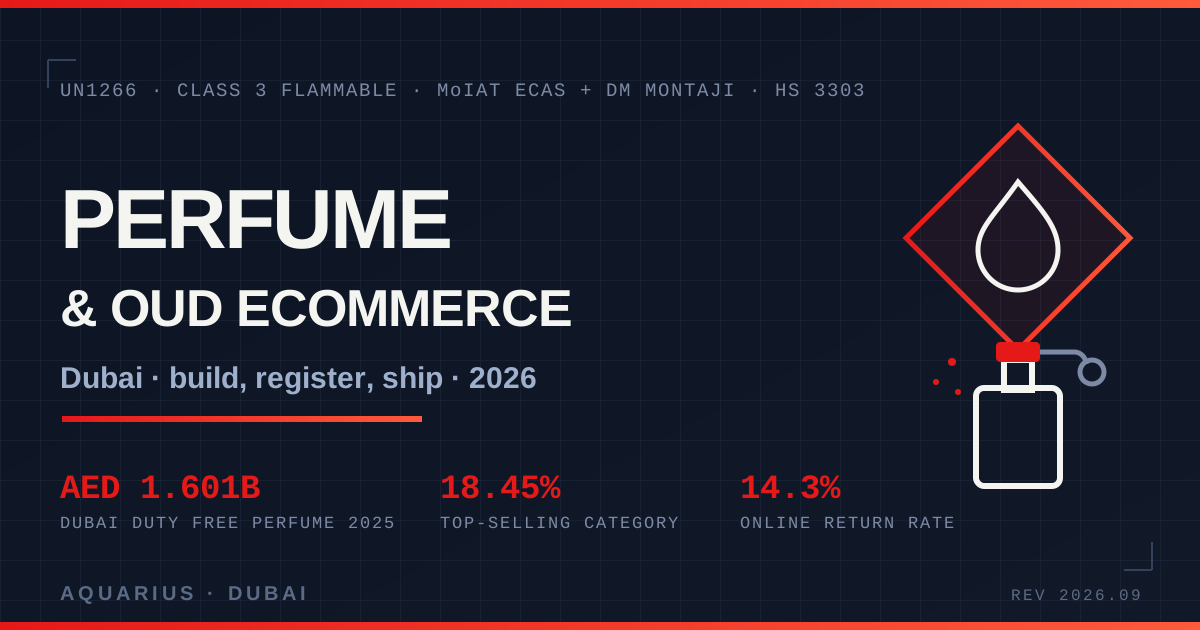
Short answer: A Dubai perfume or oud brand should budget AED 20,000–48,000 for a bilingual storefront with a compliance-ready catalogue, AED 55,000–140,000 for a full commerce build with a scent-profile finder, discovery-set logic and a dangerous-goods-aware shipping engine, and AED 175,000–420,000 for a multi-market GCC platform with refill subscriptions and ERP integration. The expensive surprise is not the design. It is that an alcohol-based fragrance is legally a flammable liquid — UN1266, Hazard Class 3 — so the checkout you just launched is quietly promising a delivery your courier is not allowed to make.
Dubai sells more perfume than almost anywhere, and most of it still sells offline
Three numbers set the stakes. Dubai Duty Free closed 2025 with record sales of AED 8.680 billion, and perfumes were the single biggest category at AED 1.601 billion, 18.45% of everything sold — ahead of liquor at AED 1.061 billion (12.22%). That is one retailer, in one airport, selling roughly AED 4.4 million of fragrance a day.
Second: the UAE perfume market was valued at about USD 748.9 million (AED 2.75 billion) in 2024 and is forecast to reach USD 1.72 billion (AED 6.3 billion) by 2033 — a 9.22% compound growth rate, per IMARC. Third: UAE ecommerce is running at roughly USD 12.3–12.4 billion in 2026, with beauty and personal care alone at USD 3.49 billion, heading to USD 4.68 billion by 2031. The UAE also exports around USD 2.1 billion of perfumes and cosmetics, much of it re-export through Dubai.
So demand is proven and the buyers are online. Yet the fragrance category converts worse online than almost any other: fragrance ecommerce sites typically run 2.5–3.0% conversion against a 2.66% global average, and Dubai Duty Free still reports that agarwood chips and Dahn Al Oud oils are bought in store while spray perfumes move online as repeat purchases. The gap is not traffic. It is that you cannot smell a screen — and that shipping a bottle is a regulated act.
The rule most Dubai perfume brands discover after launch
Fine fragrance is 60–95% ethanol or isopropanol. That makes it UN1266, “Perfumery products with flammable solvents”, Hazard Class 3, Packing Group II or III under IATA, IMDG and ADR. This is not a technicality that only freight forwarders care about — it changes what your website is allowed to offer.
Aramex lists flammable liquids, naming perfume explicitly, on its unacceptable-items list. DHL Express requires the shipper to be approved and audited by its Restricted Commodities team before any dangerous goods enter the network. Neither of those is something you fix at the packing bench on the day the order lands.
What compliant shipping actually requires: leakproof-tested inner glass, a UN-certified outer box (UN4G or equivalent) with absorbent cushioning that passes IATA PI 355 drop and pressure-differential tests, correct UN1266 marks and a Class 3 label, plus a Safety Data Sheet, a Dangerous Goods Declaration and the UN packaging test certificate. Add 2–3 days of handling lead time. On passenger aircraft, packages are often held under 1 litre.
The practical consequence for a Dubai store: road is your channel. Domestic UAE and overland GCC movement of small, properly packed quantities is workable; unrestricted air parcels are not. Oil-based attars and high-flash-point blends sit outside Class 3 entirely, which is why they are often the only SKUs a brand can ship the way it assumed everything would ship.
Registration: two layers, both mandatory, neither fast
Selling a fragrance in Dubai needs approval twice. Federal level: an ECAS conformity certificate from MoIAT against the GCC cosmetics standard GSO 1943, which is what clears import at the port. Emirate level: Dubai Municipality product registration through Montaji, which is what permits retail sale in Dubai. One without the other is not a route to market.
Each unique formulation registers separately — and that is the line item that scales with your catalogue, not with your revenue.
| Step | Typical cost (AED) | Typical timeline |
|---|---|---|
| ECAS certificate, MoIAT, per formulation | 2,000–4,500 | 10–15 working days |
| ECAS annual renewal | 1,500–3,000 | Annual |
| Dubai Municipality Montaji registration | Official fee from about 110–240 per variant; 500–1,500 with agent handling | Up to 22 working days |
| Laboratory testing against GSO 1943:2024 | 3,000–8,000 | Days to weeks, formulation dependent |
| Montaji end to end, complete file | — | 4–6 weeks; 6–10 weeks if extra lab work is triggered |
| Mainland DET trade licence | 1,570–2,500 per year | Days |
| Free-zone ecommerce licence | From about 5,750–6,500 (RAKEZ, SHAMS); DMCC around 35,484 | Days to weeks |
A distributor with a modest 10–20 SKU range should plan roughly AED 30,000–60,000 all-in in year one on registration and testing before a single order ships. On top: 5% customs duty on CIF value plus 5% VAT for imports under HS heading 3303, now declared against 12-digit GCC HS codes. Labels must be bilingual, with Arabic at least as prominent as English — the same trap that stops print runs in our Dubai packaging and box printing guide. Fragrance files also expect an IFRA certificate for the scent blend, an INCI ingredient list, a product safety assessment report and the manufacturer’s certificate of conformity.
Why this belongs in the software scope and not only in a lawyer’s folder: every SKU now carries an ECAS number, a Montaji number, a renewal date and an approved label artwork version. If that lives in a spreadsheet, a lapsed renewal becomes a product page still taking orders. Put the registry in the catalogue and let expiry block publishing.
What actually lifts fragrance conversion in the UAE
Four mechanics move the number, and all four are build decisions rather than marketing decisions.
1. Sampling, priced as a credit
Sample-to-full-size conversion is reported at 8.33% on tracked programmes and 16% post-trial on structured online sampling, with discovery sets that credit the set price against a full bottle hitting high double digits. In build terms: a sample SKU, a redeemable credit ledger tied to the customer record, and an expiry rule. Most template stores fake this with a coupon code and then cannot report on it.
2. A scent finder, not a filter
An AI-assisted fragrance matching quiz lifted conversion 30% during peak season for one European parfumerie, with a 97% completion rate. The Dubai version needs oriental structure — oud, amber, musk, bakhoor, attar concentration — not a Western top/heart/base taxonomy bolted on.
3. Return logic built for a 14.3% rate
Fragrance returns run about 14.3% online against a 4.7% beauty average. Unopened-seal rules, sample-first nudges and clear decant policies belong in the product data model, because a Class 3 return is also a regulated inbound movement, not a prepaid envelope.
4. Shipping rules as data, not a footnote
Your shipping engine needs a per-SKU hazard flag, a per-destination method matrix (UAE road, GCC road, restricted air) and quantity caps per parcel. Then checkout can refuse the impossible order before a customer pays for it — which is the difference between a clean cancellation rate and a stream of refunds and chargebacks through your Dubai payment gateway.
What it costs to build in Dubai in 2026
Honest bands, assuming bilingual Arabic and English, a UAE payment gateway, and the compliance fields above treated as first-class data.
| Scope | Cost (AED) | Best for |
|---|---|---|
| Bilingual storefront, compliance-ready catalogue, UAE gateway, road-only shipping rules | 20,000–48,000 | Under 40 SKUs, UAE delivery only |
| Full commerce build: scent finder, sampling and discovery-set credits, SKU registration registry, hazard-aware shipping engine, returns workflow | 55,000–140,000 | Growing niche or oud house selling nationally |
| Multi-market GCC platform: per-country compliance and duty logic, refill and subscription billing, wholesale tier, ERP and POS integration | 175,000–420,000 | Retail chains, exporters, multi-brand groups |
| Annual run: hosting, maintenance, registration renewals tracking | 12,000–60,000 per year | All of the above |
Put those against the maths of getting it wrong. At an average fragrance order value of roughly USD 75–100 (AED 275–367), a 14.3% return rate on 500 monthly orders is about AED 20,000–26,000 of monthly revenue reversed — before repacking and inbound freight. Cutting returns by a third through sampling and a working scent finder pays for the mid-band build inside a year. The other cost of inaction is quieter: while your store cannot ship, the AED 1.601 billion that walks through duty free keeps walking.
See our published price bands for how these scopes are quoted, and our Dubai gold and jewellery ecommerce guide for the same pattern in another Dubai category where the product, not the storefront, sets the architecture.
How Aquarius builds a Dubai fragrance store
We start with the shipping and registration matrix, not the homepage. Every SKU gets a hazard class, an ECAS and Montaji record with renewal dates, an approved-label version, and a list of permitted delivery methods per destination. Checkout reads that matrix. Sampling is a real credit ledger. The scent finder is built on oriental families because that is what UAE buyers search in. You get a fixed AED scope, a launch date, and the compliance registry handed over as documentation rather than tribal knowledge.
FAQ
Can I legally ship perfume from my Dubai store by courier?
Within the UAE, yes — small, properly packed quantities moved by road, with a carrier that accepts the commodity. Alcohol-based fragrance is UN1266 Class 3, so unrestricted air parcels are not available; Aramex lists perfume among prohibited flammable liquids, and DHL requires prior shipper approval and audit for dangerous goods. Oil-based attars with a high flash point are usually outside Class 3.
Do I need to register every fragrance separately?
Yes. Each unique formulation needs its own MoIAT ECAS certificate and its own Dubai Municipality Montaji registration. Budget AED 2,000–4,500 for ECAS per formulation, official Montaji fees from about AED 110–240 per variant, and lab testing at AED 3,000–8,000 where required.
How long before I can sell?
ECAS typically runs 10–15 working days and Montaji up to 22 working days; a complete Montaji file end to end is commonly 4–6 weeks, stretching to 6–10 weeks if additional lab testing is triggered. Start registration in parallel with the build, not after it.
What duty and tax applies to imported perfume?
Generally 5% customs duty on CIF value plus 5% VAT, declared under HS heading 3303 using 12-digit GCC HS codes. Free-zone treatment differs until goods enter the mainland.
Is an oud business different from a designer-fragrance store?
Commercially, yes. Oud chips and Dahn Al Oud oils still sell strongly in person, so the online job is repeat purchase, refills and gifting rather than discovery. Oil-based concentrations also ship more freely than alcohol sprays, which changes your catalogue strategy: lead online with what you can actually deliver.
Ready to sell fragrance online without the shipping surprise
If your store is live and half your catalogue cannot legally leave the warehouse by air, that is a fixable architecture problem, not a lost year. Send us your SKU count, your target markets and your current courier and we will come back with a fixed AED scope, a compliance registry plan and a launch date — usually within two working days.