
UAE Pillar Two DMTT in Dubai (2026): The 30 November Deadline and the Tax-Data Work Nobody Scoped
In-scope groups must register UAE entities for the 15% top-up tax by 30 November 2026. The free-zone myth, the AED 10,000 per-entity penalty, and the 480 data points your ERP cannot yet produce.
- PUBLISHED
- 27 OCT 2026
- READ TIME
- 12 MIN
- AUTHOR
- AQUARIUS · DUBAI
- UNIT
- REV 2026.09
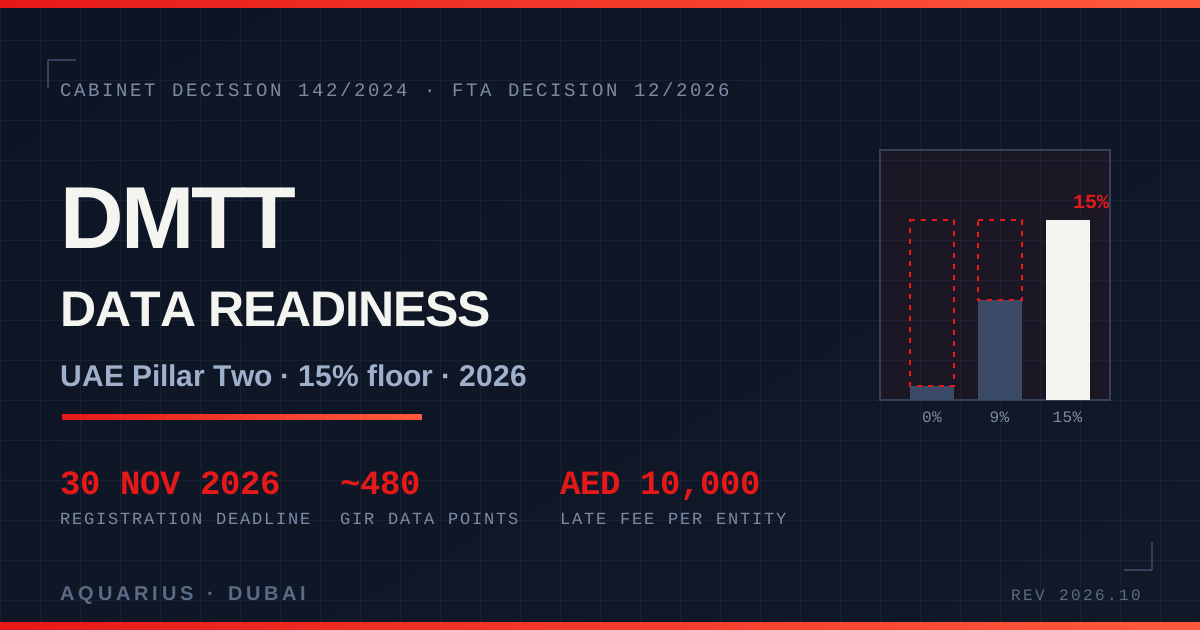
If your group’s worldwide consolidated revenue touched EUR 750 million in two of the last four years, your UAE entities must be registered for the Domestic Minimum Top-up Tax by 30 November 2026 — and a 0% free-zone status does not get you out of it. The tax itself is Cabinet Decision No. 142 of 2024, live for financial years starting on or after 1 January 2025, topping UAE profits up to a 15% effective rate. The deadline is the easy part. The hard part is that the GloBE Information Return asks for roughly 480 data points your UAE ERP has never been asked to produce, and no amount of tax advice invents data that was never captured.
Three numbers that make this a Dubai problem specifically
Pillar Two is global. The reason it lands harder here than in most jurisdictions is that Dubai spent a decade winning exactly the kind of company it now catches.
- Dubai is the world’s number one destination for headquarters greenfield FDI — for the fourth consecutive year. The emirate recorded 1,253 announced greenfield FDI projects in 2025, up 10.5% on 2024, taking a record 7% share of all global greenfield projects, with AED 32.43 billion (USD 8.83 billion) of capital inflows and 38,918 jobs created. Those headquarters are, almost by definition, constituent entities of large multinational groups.
- The UAE pulled in USD 48.2 billion of FDI in 2025, up 5.7% from USD 45.6 billion in 2024 and ninth globally, per UNCTAD’s World Investment Report 2026. Dubai’s own GDP reached AED 937 billion, growing 5.4%.
- The gap you have to close is 6 to 15 percentage points. UAE headline corporate tax is 9%. Qualifying Free Zone Person income is 0%. The Pillar Two floor is 15%. The GloBE rules do not recognise free-zone incentives when computing a jurisdictional effective tax rate, so for an in-scope group the DMTT simply tops the difference up.
Put those together and you get the 2026 situation: a city built on low-tax, incentive-driven inbound investment, now hosting hundreds of entities that owe a return no finance system in the building was designed to feed.
The myth that will cost someone a lot of money
“We’re a free-zone company with QFZP status at 0%, so a 15% minimum tax can’t apply to us.”
This is the single most common misreading we hear in Dubai boardrooms, and it is wrong in two directions at once.
First, Qualifying Free Zone Person treatment is a UAE corporate tax outcome. The DMTT is a separate charge that measures your group’s UAE effective tax rate against 15% and collects the shortfall. A 0% QFZP inside an in-scope group produces the largest top-up, not the smallest.
Second, registration is not conditional on owing anything. The Federal Tax Authority opened Pillar Two registration on EmaraTax and clarified the scope in its announcement of 7 October 2026: if an entity falls within the charging provisions, zero tax does not remove the registration obligation. The late-registration penalty is AED 10,000 per entity — and where a group appoints a Domestic Designated Filing Entity but misses the date, that penalty applies to each UAE constituent entity, not just the filer. A group with eleven UAE entities and a missed date has an AED 110,000 problem created entirely by an administrative oversight.
The in-scope test itself is simple enough to run this afternoon: consolidated revenue of the Ultimate Parent Entity of EUR 750 million or more in at least two of the four preceding fiscal years. Not the UAE subsidiary’s revenue — the group’s. Purely domestic UAE groups, governmental bodies, non-profits, pension funds and qualifying investment entities sit outside.
Every date you are now working against
FTA Decision No. 12 of 2026, issued 16 July 2026 and published 4 August 2026, set the transitional calendar. For a group with a 31 December 2025 year end, this is what the next eighteen months look like.
| Obligation | Rule | Calendar-year group (FY2025) |
|---|---|---|
| Top-up tax registration | 7 months after the end of the first in-scope fiscal year; transitional deadline for year ends before 30 April 2026 | 30 November 2026 |
| First Top-up Tax Return and Pillar Two Information Return | 15 months after fiscal year end, extended to 18 months for the transitional year | 30 June 2027 |
| Out-of-scope notification | 6 months after the end of the tested fiscal year; valid for that year plus four more | 30 June 2026 onwards, annually tested |
| Deregistration | 6 months from cessation or exit from the group; transitional date for entities that ceased before 30 June 2026 | 31 December 2026 |
| Penalty relief window | No penalties for fiscal years beginning on or before 31 December 2026 where the group took reasonable measures to apply the rules correctly — relief does not extend past fiscal years ending after 30 June 2028, and never covers late payment of actual tax | Closes for FY2027 onwards |
Read the last row twice. The transitional “reasonable measures” relief is the only forgiving thing in this regime, it is conditioned on you having genuinely tried, and it evaporates for financial years beginning in 2027. Groups treating 2026 as a year to do nothing are spending their one grace period on inactivity.
Where the real work is: the return is a data problem, not a tax problem
Here is what most UAE finance functions have not internalised. The GloBE Information Return is not a form you fill in from a trial balance. KPMG’s analysis of the OECD return puts it at 28 pages and around 480 data points covering the full GloBE rule set, and the number expands with every jurisdiction in the group. Business Roundtable’s submission to the OECD consultation estimated 150 to 200 data points per entity. Parts of the return are completed jurisdiction by jurisdiction and parts entity by entity, so a group with 100 constituent entities can face tens of thousands of individual data points.
The OECD’s GIR XML schema, published January 2025, structures this into five parts — jurisdictional top-up tax, constituent entity information, allocation rules, elections and adjustments, and a summary reconciliation — plus a filing metadata block. It is machine-validated: currency amounts must be integers, jurisdiction codes must be ISO 3166-1 alpha-2, and each jurisdiction may appear exactly once in Part A. A spreadsheet that “looks right” to a reviewer fails a schema validator without mercy, which is the same lesson UAE businesses are learning from structured e-invoicing on PINT-AE: the era of PDF-shaped compliance is over.
The five data gaps we find in almost every UAE group
- Entity-level payroll, split by jurisdiction of the employee. The substance-based income exclusion carves out a percentage of eligible payroll and tangible assets before top-up tax applies. For fiscal years beginning in 2025 the payroll percentage is 9.6%; for 2026 it is 9.4%, stepping down on a published schedule toward 5% by 2033. Most Dubai groups run payroll at the entity level but cannot attribute cost to the jurisdiction where the employee actually works — and secondments, free-zone visa sponsorship and shared service staff make that non-trivial.
- A tangible-asset register that ties to the GloBE carve-out basis, not just to the fixed-asset note in the statutory accounts. Right-of-use assets, assets held for sale and investment property all behave differently here.
- A Qualified Country-by-Country Report. The Cabinet Decision adopts the OECD safe harbours, including the Transitional CbCR Safe Harbour for fiscal years beginning before 1 January 2027 and not ending after 30 June 2028, plus the permanent Simplified Calculations Safe Harbour. The simplified tests — de minimis, effective tax rate and routine profit — can reduce your UAE top-up tax to nil. But every one of them requires a Qualified CbCR, meaning one built from qualified financial statements on a consistent basis. Groups that have been assembling CbCR by hand each year have no safe harbour to stand on.
- Deferred tax recast at 15%. GloBE covered taxes include deferred tax movements, recomputed at the minimum rate and subject to a five-year recapture rule on certain items. UAE entities that never had to maintain real deferred tax balances — because 9% from 2023 and 0% before that made it immaterial — now need an IAS 12 position with a Pillar Two overlay. This is where how you recognise revenue under IFRS 15 stops being an accounting-policy footnote and starts moving a tax number.
- A clean legal-entity master. TIN, jurisdiction, entity type and ownership chain for every constituent entity, reconciled to the consolidation system. It sounds trivial. In practice we routinely find UAE groups where the entity list in the consolidation tool, the list in the HR system and the list the tax team works from disagree with each other by five or six entities.
None of those five are tax questions. They are data-engineering questions: extraction from the ERP and consolidation tool, mapping, lineage, validation and an auditable push to an XML output. That is the work, and it is why the tax advisory fee is rarely the biggest line on this project.
What this costs, and what it costs to ignore
Software alone does not solve it. Dedicated Pillar Two engines exist — Orbitax Global Minimum Tax lists from USD 800 per user per year, Wolters Kluwer’s CCH Integrator module ingests from ERP, ledgers and provisioning tools, and Tax Systems launched a SaaS Pillar2 product in January 2025 — but every one of them is only as good as the feed you build into it. The ZEW discussion paper published in October 2025 put total one-off Pillar Two compliance costs for EU-headquartered groups at EUR 1.2 billion, up to EUR 2.0 billion, with recurring costs of EUR 517 million a year, up to EUR 865 million. That is the market price of under-built data pipelines.
Here is what the UAE data layer typically runs as a project, assuming the group has already picked its calculation engine or advisor.
| Scope | What is built | Typical AED | Timeline |
|---|---|---|---|
| Readiness assessment | Entity-by-entity in-scope test, gap analysis against the ~480 GIR data points, field-level ERP mapping, remediation plan | AED 28,000 – 55,000 | 2 – 3 weeks |
| Data extraction layer (3 – 10 UAE entities) | Automated pulls from ERP and consolidation, legal-entity master reconciliation, payroll and tangible-asset attribution, validation rules, audit log | AED 90,000 – 185,000 | 6 – 10 weeks |
| Multi-entity or multi-ERP group (10+ entities) | The above plus a staging warehouse, per-source adapters, variance dashboards and sign-off workflow per entity | AED 185,000 – 420,000 | 10 – 16 weeks |
| GIR XML generation and schema validation | Mapping to the OECD GIR schema, integer and ISO-code enforcement, Part A uniqueness checks, dry-run validation and error reporting | AED 45,000 – 95,000 | 3 – 5 weeks |
| Annual run and maintenance | Schema version updates, new-entity onboarding, OECD guidance changes, filing-window support | AED 3,500 – 11,000 / month | Ongoing |
Against that, the conversion maths. Late registration is AED 10,000 per entity before you have computed a single effective tax rate. A missed safe harbour because the CbCR was not qualified converts a nil top-up into a real 15% charge on UAE profit — on AED 50 million of UAE profit taxed at 9%, that gap is roughly AED 3 million a year. And the upside runs the other way too: the UAE’s new R&D tax credit, under Cabinet Decision No. 215 of 2025 and Ministerial Decision No. 24 of 2026, applies to tax periods beginning on or after 1 January 2026 at 15% on the first AED 1 million of qualifying spend (minimum 2 R&D staff), 35% on AED 1–2 million (minimum 6 staff) and 50% on AED 2–5 million (minimum 14 staff), with a minimum AED 500,000 of qualifying expenditure per project per year. Those credits must first offset corporate tax and top-up tax liability. In other words, the same data discipline that produces a defensible GIR is what lets you claim the credit that reduces it.
How Aquarius approaches it
We are not your tax advisor and we will not pretend to be — your firm owns the positions, the elections and the filing. We build the plumbing underneath: the extraction jobs, the entity master, the attribution logic, the validation gates and the XML output, documented so an auditor can trace any number on the return back to the ledger row it came from. Every pipeline ships with a reconciliation report, because “the system says so” is not an answer when the FTA asks. UAE data residency is the default, and we work alongside whichever calculation engine or Big Four workbook you have already committed to — we have no engine to sell you.
Fixed-scope readiness assessment, fixed price, two to three weeks, and you end it knowing exactly which of the five gaps above you have. See transparent pricing, review our engineering services, or book a 30-minute scoping call. If the assessment concludes you are out of scope, we will tell you that and bill the assessment only.
Frequently asked questions
Does the UAE DMTT apply to a free-zone company with 0% QFZP status?
Yes, if it is a constituent entity of a group with EUR 750 million or more in consolidated revenue in at least two of the four preceding fiscal years. The GloBE rules do not recognise free-zone incentives when computing the jurisdictional effective tax rate, so 0% QFZP income inside an in-scope group produces the largest top-up to 15%, not an exemption. Purely domestic UAE groups are outside the regime entirely.
When exactly must UAE entities register for Pillar Two top-up tax?
Under FTA Decision No. 12 of 2026, within seven months of the end of the first in-scope fiscal year — with a transitional deadline of 30 November 2026 for entities whose first in-scope fiscal year ended before 30 April 2026. Registration is through EmaraTax, either entity by entity or via a Domestic Designated Filing Entity. Confirm the date entity by entity, because fiscal years can differ inside one group.
What is the penalty for missing the DMTT registration deadline?
AED 10,000 per entity. If the group appointed a Domestic Designated Filing Entity and registration was not completed on time, the penalty applies to each UAE constituent entity rather than to the filing entity alone. Separately, the transitional “reasonable measures” relief that waives penalties for fiscal years beginning on or before 31 December 2026 never covers late payment of actual tax due.
When is the first UAE top-up tax return due?
Fifteen months after the fiscal year end, extended to eighteen months for the transitional year. A group with a 31 December 2025 year end files by 30 June 2027.
Can we just do this in Excel for the first year?
For a single UAE entity claiming a safe harbour, possibly. Beyond that it breaks down fast: the return runs to roughly 480 data points, 150 to 200 per entity, and the output is a schema-validated XML file, not a workbook. The deeper problem is repeatability — this is an annual filing with changing OECD guidance, and a hand-built spreadsheet has to be rebuilt and re-reviewed every year with no audit trail between versions.
Does the UAE R&D tax credit reduce top-up tax?
Qualifying credits under Cabinet Decision No. 215 of 2025 and Ministerial Decision No. 24 of 2026 must first be used to offset corporate tax and top-up tax liability before any carry-forward or transfer within a tax group. They apply to tax periods beginning on or after 1 January 2026, are tiered 15% / 35% / 50% by expenditure band with minimum R&D headcount at each tier, and require a minimum AED 500,000 of qualifying expenditure per project per year. Records must be retained for seven years — which is, again, a data problem.
Sources: UAE Cabinet Decision No. 142 of 2024; Ministerial Decision No. 88 of 2025; FTA Decision No. 12 of 2026 (issued 16 July 2026, published 4 August 2026) and FTA announcement of 7 October 2026; Cabinet Decision No. 215 of 2025 and Ministerial Decision No. 24 of 2026 (Deloitte Middle East analysis); OECD GloBE Information Return XML Schema, January 2025; KPMG analysis of the GloBE Information Return; Business Roundtable OECD consultation submission; ZEW discussion paper on Pillar Two compliance costs (October 2025); Dubai Media Office, 2025 FDI results (23 June 2026); UNCTAD World Investment Report 2026; PwC Middle East Pillar Two alerts. This article is engineering guidance, not tax advice — confirm every position with your UAE tax advisor.