
We Read the Referrer Policy of 569 .ae Homepages: 24 Leak Full URLs
We read the Referrer-Policy of the 569 live .ae homepages on 28 Nov 2026. 60.8% set none, 37.3% send the header, and 24 hand the full URL with its tokens and queries to every third party on the page.
- PUBLISHED
- 28 NOV 2026
- READ TIME
- 11 MIN
- AUTHOR
- AQUARIUS · DUBAI
- UNIT
- REV 2026.09
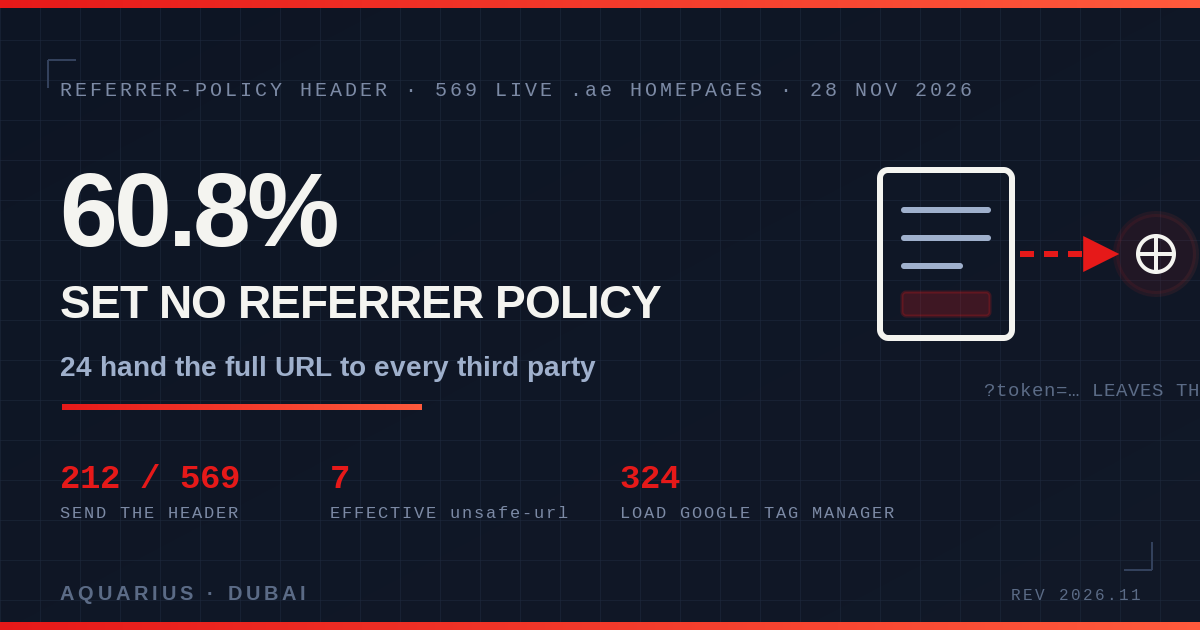
We read the referrer policy of the 569 live .ae homepages on 28 November 2026. 212 of them (37.3%) send a Referrer-Policy header, 346 (60.8%) send no policy at all, and 24 sites hand the full URL — path, query string, tracking tokens and all — to every third party their pages touch. Seven of those are effectively running unsafe-url, the single most leaky value the spec allows.
The referrer is the one header your site sends on someone else’s behalf: every script, font, pixel and outbound link gets told which of your URLs the visitor was on. Too loose and you post private URLs to Google, Meta and a dozen CDNs. Too tight and you delete your own marketing attribution. Almost nobody chooses deliberately.
What the Referer header actually gives away
When a browser requests anything — an image, a script, a link click — it may attach a Referer header naming the page that triggered the request. Unmanaged, that can be the whole URL. If your URLs look like /reset-password?token=8f21c…, /invoice/44182?email=…, /search?q=villa+in+jumeirah+budget+4m or /apply?emirates-id=…, then the full string travels to whichever third party is loaded on that page. Nothing is hacked. The browser is doing exactly what it was told.
Since the November 2020 revision of the W3C Referrer Policy spec, browsers that are told nothing default to strict-origin-when-cross-origin: cross-site requests get only your origin (https://example.ae), never the path. That default is why doing nothing is now safer than it was in 2019 — and why a site that overrides it with an older value is actively opting back into leakage.
The scan: 787 hosts, 569 real homepages
We probed the 787 most-visited .ae hosts from the Tranco list with a mobile Chrome user agent and Accept-Language: en-AE, followed every redirect, and recorded the final document’s Referrer-Policy header, every <meta name="referrer"> tag, any CSP referrer directive, and every cross-site link and subresource. 104 hosts failed to connect; 569 returned a live HTML homepage. Three numbers set the stakes for the UAE:
- 212 homepages (37.3%) send a
Referrer-Policyresponse header. For scale, the HTTP Archive’s Web Almanac measured the header on 17% of mobile pages globally in 2024, up from 14% in 2022. The.aetop end is running at more than double the global rate. - 346 homepages (60.8%) send nothing at all — no header, no meta tag, no CSP directive — and therefore inherit the safe browser default by accident rather than by decision.
- Only 15 sites (2.6%) use a
<meta name="referrer">tag, almost exactly the 2.52% the Web Almanac found globally in 2025. Nobody reaches for markup when a header is available.
Zero sites in the whole set use the deprecated CSP referrer directive, which is the one piece of good news about legacy code in this dataset.
Who is actually leaking, and what they set
Adoption is the easy metric. The interesting question is what the 223 sites with a policy actually chose. We computed the effective policy per site — walking the header’s comma-separated fallback list, then applying any meta tag, because the spec is explicit that unknown values are ignored and the latest value wins.
| Effective policy | .ae sites | What leaves your site cross-origin |
|---|---|---|
| None set (browser default) | 346 | Origin only — safe by accident |
strict-origin-when-cross-origin | 110 | Origin only — correct and deliberate |
same-origin | 59 | Nothing. Zero outbound attribution |
no-referrer-when-downgrade | 17 | Full URL to any HTTPS third party |
no-referrer | 12 | Nothing, ever |
strict-origin | 10 | Origin only, even same-site |
unsafe-url | 7 | Full URL to everyone, including plain HTTP |
origin / origin-when-cross-origin | 8 | Origin, also on insecure downgrades |
The 24 sites in the two bold rows are the finding. no-referrer-when-downgrade was the pre-2020 browser default, and it only withholds the referrer when HTTPS drops to HTTP — which in 2026 practically never happens. In every ordinary HTTPS-to-HTTPS case it sends the entire URL. Sites still running it, verified identically on apex and www, include propertyfinder.ae, rakbank.ae, cbd.ae, istyle.ae, masdarcity.ae, et.ae, palazzoversace.ae and the Dubai Development Authority at dda.gov.ae. For a property portal or a bank, the leaked path is the search the visitor ran or the product they were looking at.
Then there are the seven effective unsafe-url sites: abudhabi.ae (which redirects to the TAMM government services portal and sends Referrer-Policy: unsafe-url outright), drjobs.ae, autoline24.ae, machineryline.ae, homify.ae, sarabic.ae and sputnikarabic.ae. unsafe-url is the value the spec itself labels unsafe: full URL, to every destination, including downgrades to plain HTTP where anyone on the network can read it.
Two self-inflicted wounds we did not expect to find
1. The legacy keyword that quietly means unsafe-url. Three sites — homify.ae, sarabic.ae and sputnikarabic.ae — ship <meta name="referrer" content="always">. always is not a modern policy value, but it is not ignored either: the HTML Standard maps the legacy keywords explicitly, and always maps to unsafe-url. Worse, homify.ae sends a perfectly good strict-origin-when-cross-origin header and then overrides itself with that meta tag, because the meta is parsed later and the latest value wins. A 2014-era copy-paste is undoing a correct 2026 header.
2. Two headers that disagree. Seven sites send Referrer-Policy twice. Four send the same value twice, which is harmless noise (spaa.ae, printonline.ae, epc.ae, ajmanpolice.gov.ae). Three send two different values, and in each case the browser takes the last one: royalwatches.ae sends strict-origin-when-cross-origin then no-referrer-when-downgrade, so it lands on the leaky one. branex.ae sends the same first value then no-referrer, so it lands on total silence. Neither of those is what somebody intended; both are a CDN rule and an app rule fighting each other.
Who receives your referrer, in practice
A policy is abstract until you see the guest list. Across the 569 homepages, 324 load www.googletagmanager.com, 195 load Google Fonts, 140 load Cloudflare Insights, 131 load jsDelivr, 70 load www.facebook.com and 17 load the Meta pixel. Every one of those requests carries a Referer determined by your policy. On the 24 leaking sites, that list of companies is being handed your full URLs.
Outbound links tell the mirror-image story. The 569 homepages carry 8,641 cross-site links, of which 2,191 (25.4%) use rel="noreferrer", spread over 173 sites. The most-linked destinations are Facebook (322 sites), Instagram (300), YouTube (228), LinkedIn (209), X/Twitter (245 across both domains) and wa.me (98). Here is the trap: rel="noreferrer" strips the referrer outbound. When a Dubai agency links to a client or a marketplace links to a partner, that click arrives with no referrer and lands in GA4 as direct traffic. One in four cross-site links on the .ae top end does this, usually because a plugin added it alongside noopener — a protection modern browsers already apply to target="_blank" for free.
The Dubai context: Chrome, Safari and the PDPL
Browser share decides how much your policy matters. StatCounter puts Chrome at 76.98% of UAE browsing in October 2026 and Safari at 12.05%. Chrome obeys your policy as written, so unsafe-url leaks to roughly three in four UAE visitors. Safari does not: WebKit’s tracking prevention downgrades all third-party referrers to their origin regardless of what you set, and ITP 2.3 trims document.referrer to the referrer’s eTLD+1 when a link is decorated and the visitor came from a classified domain. So a loose policy is a privacy problem in Chrome and an attribution problem in Safari, at the same time.
On the compliance side, the UAE’s Personal Data Protection Law (Federal Decree-Law No. 45 of 2021) requires that personal data be adequate and limited to the purpose. A URL that carries an Emirates ID, an email, a booking reference or a password-reset token is personal data, and Referrer-Policy: unsafe-url transmits it to processors you never named in a data-processing agreement. The Executive Regulations were still unpublished as of late November 2026, which is precisely why you do not want to be the first enforcement case. See our UAE PDPL compliance checklist for websites and apps for the wider picture, and our cookie-consent scan of the same 787 hosts for the tracking half of the problem.
The government cut, and who sets it right
Of 58 reachable .gov.ae homepages, 22 (37.9%) send the header and none use a meta tag. Six choose strict-origin, the strictest sensible value — a deliberate, security-conscious pick you rarely see in the private sector. Two go the other way: dda.gov.ae on no-referrer-when-downgrade and afz.gov.ae on origin-when-cross-origin. And two federal hosts, moi.gov.ae and federalerp.gov.ae, set a policy on a redirect hop but not on the final document the visitor lands on — the header was applied to the wrong server block.
The adoption pattern shows who is doing the work. Behind Cloudflare, 43.4% of .ae homepages send the header; on bare nginx it is 23.7%, Apache 20.7%, LiteSpeed 17.6% and IIS 15.8%. A CDN dashboard is setting this, not developers — fine until the CDN’s value and the app’s value disagree, which is exactly the royalwatches.ae failure mode above.
What to set, what it costs, and how we do it
The correct answer for almost every Dubai business is one line. Send Referrer-Policy: strict-origin-when-cross-origin explicitly — it matches the modern default, so it changes nothing for current browsers while protecting you from an old CDN rule or a stray meta tag silently loosening it. If any URL on your site can contain a token, an ID or a person, go to same-origin and lose nothing but third-party analytics path data. Then, if you genuinely need to pass a full URL to one partner, do it per element with referrerpolicy="unsafe-url" on that single link or pixel — only 41 of 569 .ae sites use element-level control at all, and it is the tool that lets you be strict globally and loose exactly once.
Two things a header alone will not fix: stop putting secrets in query strings at all, and audit every rel="noreferrer" your CMS added to outbound links — that is revenue attribution you are deleting. With global ad spend passing USD 1.06 trillion in 2026 and digital taking 68.7% of it according to Dentsu, misattributed clicks are not a rounding error on a Dubai media budget.
We fix this as a focused security-header and attribution audit: every URL pattern classified for personal data, the policy set once at the edge with no conflicting app rule, element-level exceptions where a partner needs one, and a before/after check on what your third parties actually receive. AED 2,500–6,000 one-off for a single site, less folded into a build or retainer. The fix is under an hour of work; finding out you needed it is the expensive part.
If your site has a login, a checkout, a booking flow or a password reset, this is a five-minute check. See how our web and security team works, compare transparent AED pricing, or send us your domain and we will show you the raw headers and exactly which third parties receive your URLs today.
This scan is part of an ongoing first-hand audit of the UAE web. See also our companion measurement of which .ae sites restrict camera, microphone and geolocation access.
FAQ
What is the best Referrer-Policy value for a UAE business website?
strict-origin-when-cross-origin for most sites: third parties receive only your origin, same-site requests still get the full URL, and nothing downgrades to HTTP. If any URL can contain personal data or a token, use same-origin instead. Set it as a response header at your CDN or server, not as a meta tag, so it applies to every response including redirects and assets.
Does Referrer-Policy affect my Google Analytics or GA4 attribution?
Not for your own site’s analytics — GA4 reads the referrer from the browser on your page, and strict-origin-when-cross-origin still passes the referring origin. What does break attribution is no-referrer, same-origin, or rel="noreferrer" on outbound links: the destination then sees no referrer and records the visit as direct. 25.4% of cross-site links on the top .ae homepages currently do this.
Is no-referrer-when-downgrade safe since everything is HTTPS now?
It is the opposite of safe. It only withholds the referrer on an HTTPS-to-HTTP downgrade, which almost never happens in 2026 — so in every normal cross-site request it sends your full URL, path and query included. It was the browser default before November 2020; keeping it today means you are explicitly opting out of the protection newer browsers give you for free.
How can I check what my own site sends?
Run curl -sI https://yourdomain.ae/ | grep -i referrer-policy on both the apex and www, and search your HTML for name="referrer". Check for the header appearing twice — the last value wins, and a CDN rule plus an app rule is the commonest way to end up with a policy nobody chose. Or send us the domain and we will run the full check.