
We Scanned 698 UAE Homepages: 85.5% Track You With No Consent Tool
First-hand scan of 698 live .ae homepages, November 2026: 59.5% set a cookie before you click, 85.5% of tracker-running sites have no consent tool, and zero use the __Host- cookie prefix.
- PUBLISHED
- 25 NOV 2026
- READ TIME
- 09 MIN
- AUTHOR
- AQUARIUS · DUBAI
- UNIT
- REV 2026.09
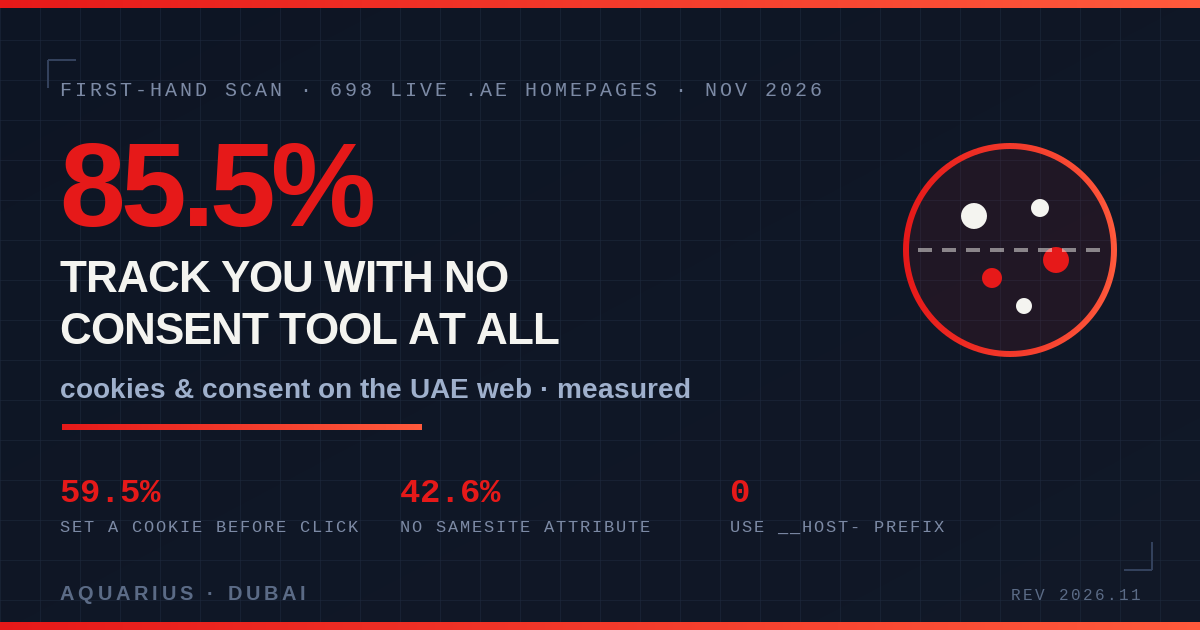
We scanned 698 live .ae homepages in November 2026 and found that 85.5% of the ones running a tracking tag have no consent tool of any kind. 59.5% set at least one cookie before you click anything, 42.6% of those cookies ship with no SameSite attribute, and exactly zero use the __Host- prefix. The UAE has no cookie-banner law — which is precisely why nobody noticed the security side rotting.
This is not a how-to. It is a measurement. We pulled every .ae host in the Tranco top-1M list, made one unauthenticated GET to each homepage as a fresh visitor with no history, and recorded every Set-Cookie header — including cookies set during redirects — plus every consent platform and tracker in the delivered HTML. 787 hosts, 698 that answered, 1,502 cookies.
What the UAE web does to you before you click
Three numbers set the stakes:
- 415 of 698 hosts (59.5%) set at least one cookie on first contact, with no interaction and no consent.
- 512 of 697 hosts (73.5%) load a tracking tag — gtag/GA4 on 477, Google Tag Manager on 249, Meta Pixel on 79, Microsoft Clarity on 32, TikTok on 18.
- 74 hosts (10.6%) run a consent management platform. That is the whole market: 48 generic plugins, 19 OneTrust, 6 Cookiebot, 5 CookieYes, 3 Usercentrics, 2 Iubenda, 2 Complianz, 1 Didomi, 1 Moove.
Cross those last two and you get the headline. Of the 512 hosts running a tracker, 438 — 85.5% — have no consent layer at all. Not a broken banner, not a pre-ticked box: nothing. Zero hosts in the sample run a CMP without also running a tracker, so the consent tooling that does exist is all defensive, bolted on after the tags.
Google Consent Mode is worse. 501 hosts load a Google tag. Only 41 (8.2%) emit any Consent Mode signal — ad_storage, analytics_storage, wait_for_update or a gcs= parameter. 428 hosts send hits to Google with no consent state attached whatsoever.
Only 139 of 698 homepages (19.9%) gave us a clean first contact: no cookie, no tracker. One in five.
The myth-bust: there is no UAE cookie-banner law
Dubai agencies sell cookie banners with borrowed European fear. The facts, as of 25 November 2026:
- The UAE has no ePrivacy-style cookie rule. Nothing in federal law says "get consent before dropping a cookie."
- The PDPL (Federal Decree-Law No. 45 of 2021) does prohibit processing personal data without the subject's consent — but it carries eleven exceptions, and its Executive Regulations are still unpublished. There is no published federal penalty schedule for PDPL breaches, and controllers get six months' grace once the regulations do land.
- The Federal Authority for Artificial Intelligence and Data, created on 14 June 2026, inherits the enforcement role. It has not yet issued cookie guidance.
- What is enforceable today: Cyber Crime Law Article 13 — AED 50,000 to AED 500,000 for unlawful interception or disclosure of data. And if you operate in the DIFC, DIFC Data Protection Law Schedule 2 (amended 8 July 2025) sets USD 50,000 for processing without a lawful basis, USD 75,000 for failing to cease processing, USD 100,000 as the general maximum, and unlimited fines for serious contraventions.
The banner is not your legal risk. The cookie you set withoutSecure,HttpOnlyorSameSiteis — because that is the one an attacker steals, and "unlawful disclosure" has a number attached to it today.
If you want the compliance mechanics rather than the measurement, we wrote the how-to separately: cookie consent banners and UAE PDPL.
The attribute audit: how UAE cookies are actually flagged
We looked at the 1,456 cookies set over HTTPS, where every security attribute is available and free. The browser rules are not ambiguous: Secure stops the cookie travelling over plain HTTP, HttpOnly hides it from JavaScript (and therefore from XSS), and SameSite controls cross-site sending — browsers default to Lax when it is absent, and SameSite=None is rejected outright unless Secure is also set.
| Attribute state | Cookies | Share of HTTPS cookies |
|---|---|---|
Secure present | 928 | 63.7% |
HttpOnly present | 728 | 50.0% |
SameSite missing entirely | 620 | 42.6% |
SameSite=None (cross-site, deliberate) | 346 | 23.8% |
SameSite=Strict | 58 | 4.0% |
| All three flags set | 447 | 30.7% |
| None of the three | 333 | 22.9% |
Half of UAE cookies are readable by any script on the page. Nearly a quarter are naked — no Secure, no HttpOnly, no SameSite. At host level it is starker: of 406 hosts setting HTTPS cookies, only 89 (21.9%) get all three flags right on every cookie they set.
The __Host- and __Secure- name prefixes let a server tell the browser to refuse a cookie that does not meet its own security rules — a one-word fix with no library and no config. Zero hosts in the UAE sample use __Host-. Five use __Secure-, on nine cookies total. One host ships SameSite=None without Secure on four cookies, which means the browser silently discards them and whatever feature they powered is already broken.
The one that actually bites: session cookies
Not all cookies matter equally. We isolated the 166 cookies whose names mark them as session identifiers — PHPSESSID (35 hosts), ASP.NET_SessionId (44), JSESSIONID (24), XSRF-TOKEN (25) and friends. These are the credentials. Steal one, you are logged in as that user.
86 of the 134 hosts that set a session cookie — 64.2% — ship at least one session cookie missing Secure or HttpOnly. 34.3% of session cookies have no HttpOnly; 37.3% have no Secure. That is the finding that should move budget, and it has nothing to do with banners.
Lifetimes, bloat, and who is really setting the cookies
Of 754 cookies with an expiry, the median life is 182 days. 115 (15.3%) outlive a year; 59 outlive two. The record holder is a cache key on a UAE group's homepage with Expires=Fri, 31-Dec-9999 — roughly 7,970 years. Median total Set-Cookie header weight is 443 bytes per homepage; the heaviest, a federal ERP portal, ships 8,913 bytes of cookie headers on every single request from that visitor thereafter.
One honest caveat, because it changes the number: of the 415 cookie-setting hosts, 87 set only infrastructure cookies — Cloudflare's __cf_bm (88 hosts), AWS load balancer stickiness, Azure's ARRAffinity. Those are platform-injected, not developer decisions. Strip them out and 328 hosts (47.0%) are running application or marketing cookies on first contact. Cloudflare fronts 341 hosts (48.9%) of the sample, so this distinction matters more in the UAE than most markets. 37 hosts are Shopify stores shipping the standard _shopify_* set.
Busiest single homepage: 25 distinct cookies on one unauthenticated GET. Median is 2.
Two segments that break the assumptions
Government is the outlier. 71 .gov.ae hosts answered. 64 set cookies, 46 run tracking tags — and exactly one has a consent platform. 45 UAE government homepages run analytics or advertising tags with no consent layer. Hand-checking a sample confirmed it: tax, immigration, health, police, education and telecom-regulator portals all load a Google tag with nothing in front of it.
WordPress is not the problem. The standard agency line is that WordPress sites are the compliance laggards. We measured it: 98 WordPress hosts, 11.2% with a CMP, versus 10.5% across everything else. Statistically identical. The platform is not the variable — the decision to install anything at all is.
This also explains why so much UAE measurement broke quietly in 2026 when third-party cookies and Privacy Sandbox both changed course — we covered that shift in what Privacy Sandbox's retirement means for Dubai advertisers. If you had no consent signal to begin with, you had no way to adapt.
What fixing this costs in Dubai
UAE digital ad spend is running at roughly USD 2.64 billion in 2026, up 15.2% year on year. Every dirham of that depends on measurement that is now consent-gated by the ad platforms themselves, whatever local law says. A site with no consent signal does not just carry legal exposure — it loses conversion data, and in our scan 85.5% of tracker-running sites are in that position.
Here is what the work actually costs, as we scope it:
| Scope | What you get | Typical AED | Timeline |
|---|---|---|---|
| Cookie & consent audit | Full header inventory, attribute report, tag/CMP map, PDPL + DIFC exposure note | 4,500 – 9,000 | 3 – 5 days |
| Attribute hardening | Secure/HttpOnly/SameSite set correctly, __Host- prefixes on session cookies, dead cookies removed | 3,500 – 7,000 | 2 – 4 days |
| CMP + Consent Mode v2 | Banner, geo rules, GTM consent triggers, wait_for_update, QA across browsers | 9,000 – 22,000 | 1 – 2 weeks |
| Server-side tagging | First-party endpoint, reduced client cookies, longer-lived attribution | 18,000 – 45,000 | 2 – 4 weeks |
The cheapest line on that table is the one with the real security payoff. Setting three attributes correctly costs a few thousand dirhams and removes the exposure that Cyber Crime Law Article 13 actually prices at AED 50,000–500,000. Most Dubai businesses do the expensive banner first and never touch the flags.
How Aquarius does it
We start with the same measurement you just read, run against your domain: every Set-Cookie header on every entry path, every tag, every consent signal, before and after. You get the raw evidence, not a traffic-light PDF. We fix the attribute layer first because it is cheap and it is the part that bites, then build the consent layer so your measurement survives. We also check the adjacent surface most audits miss — see our scan of Permissions-Policy on .ae websites.
Fixed scope, fixed price, and a re-scan at the end that either shows the numbers moved or we keep working. Full ranges are on our pricing page.
FAQ
Does the UAE legally require a cookie consent banner in 2026?
No. There is no ePrivacy-equivalent cookie rule in UAE federal law, and the PDPL's Executive Regulations remain unpublished as of November 2026. The PDPL does require consent for processing personal data, with eleven exceptions, and DIFC-based entities sit under DIFC Data Protection Law with published fines up to USD 100,000 and unlimited for serious contraventions. Google and Meta enforce consent signalling commercially regardless of local law.
What percentage of UAE websites have a cookie consent tool?
10.6% in our November 2026 scan of 698 live .ae homepages — 74 hosts. Among the 512 hosts that actually run a tracking tag, 85.5% have none.
Which cookie attribute should a Dubai business fix first?
HttpOnly and Secure on session cookies. 64.2% of UAE hosts that set a session cookie are missing one of them on at least one cookie. It is a server-config change, not a project, and it is the difference between an XSS bug and a stolen session.
Do Cloudflare and AWS cookies count against me?
They are set by the platform, not your code, and we separate them for exactly that reason. 87 of 415 cookie-setting hosts had infrastructure cookies only. But they still reach the user's browser, so they belong in your cookie disclosure — they just are not a security finding against your developers.
How did you measure this?
Every .ae host in the Tranco top-1M list (787), one unauthenticated HTTPS GET per homepage with a desktop Chrome user agent, redirects followed and cookies from redirect hops counted. 698 responded. Set-Cookie headers parsed for attributes; delivered HTML pattern-matched for nine consent platforms and eleven tracker families. Run 24–25 November 2026.
The short version
One in five UAE homepages gives a visitor a clean first contact. Three in four run tracking tags. One in ten has a consent tool. Half of UAE cookies are readable by JavaScript, nobody uses __Host-, and two-thirds of session-cookie-setting hosts have at least one flag missing on a credential cookie. The regulation that will eventually force the banner is not here yet. The security debt is.
Want your own numbers? Send us your domain and we will run the scan.