
F-Gas and HFC Rules for Dubai HVAC-R Companies (2026): MOCCAE Permits, the Closing Baseline and EU Export Bans
2026 is the final year of the UAE Kigali HFC baseline, and the EU bans GWP-150 chillers from 1 January 2027. Real MOCCAE permit duties, EU leak-check thresholds and AED build costs for Dubai HVAC-R firms.
- PUBLISHED
- 29 OCT 2026
- READ TIME
- 12 MIN
- AUTHOR
- AQUARIUS · DUBAI
- UNIT
- REV 2026.09
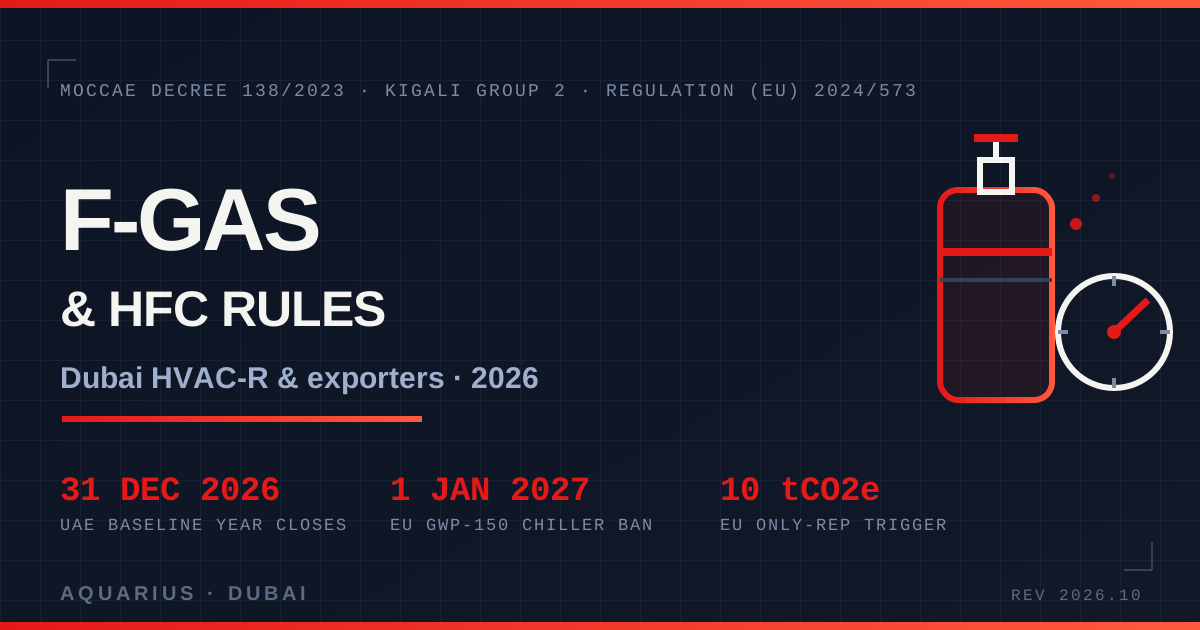
Short answer: two refrigerant clocks are running on Dubai HVAC-R businesses at once, and neither one is really about gas — both are about records. Domestically, MOCCAE Ministerial Decree No. 138 of 2023 already requires an HFC permit plus quarterly returns of what you sold, used and still hold, and 2026 is the last year of the UAE Kigali baseline (the average of 2024–2026 consumption plus 65% of 2009–2010 HCFC use), so the numbers you file this quarter help fix the national quota the country lives with to 2047. For export, Regulation (EU) 2024/573 bans GWP-150-and-above chillers and self-contained air conditioning up to 12 kW from 1 January 2027 and makes an EU "only representative" compulsory for any non-EU shipper of pre-charged equipment above 10 tonnes CO2 equivalent a year.
Dubai runs on refrigerant, and almost nobody logs it properly
Start with the scale of the thing. Roughly 70% of Dubai electricity goes to air conditioning — cooling is not a facilities line item here, it is the grid. District cooling, the efficient alternative, still serves under 20% of Dubai cooling demand against a national ambition of around 40% by 2030, so the gap is filled by tens of thousands of discrete DX systems, chillers, VRF cassettes and cold rooms, each with its own charge of fluorinated gas.
The equipment market behind that is growing fast. The UAE district cooling systems market was valued at USD 3.70 billion in 2025 and is projected to reach USD 6.26 billion by 2033 at a 6.28% CAGR — about AED 13.6 billion rising to AED 23.0 billion. The UAE air conditioner market alone was USD 1.07 billion in 2025 (about AED 3.92 billion), heading to USD 1.95 billion by 2035 at 6.20%. The UAE holds roughly 20% of the regional refrigeration and air-conditioning equipment market, second only to Saudi Arabia at 29%.
And the UAE is not just a buyer. In 2024 the UAE was the largest exporter of refrigerating and freezing equipment and heat pumps in the GCC, generating 69% of all GCC exports in that category, inside national industrial exports of AED 262 billion in 2025. That combination — an enormous installed base at home, serious export volume outward — is exactly why two separate regulatory regimes now land on the same Dubai companies.
Most Dubai HVAC-R firms treat refrigerant compliance as a gas-procurement question. It is a data question. The gas is legal; the missing cylinder ledger, the uncertified technician and the quarter you did not file are what cost you.
The UAE clock: Decree 138 of 2023 and the baseline that closes on 31 December
The UAE ratified the Kigali Amendment to the Montreal Protocol on 19 April 2024 — the 157th country to do so and the first in the GCC. That puts the UAE in Group 2 of the Article 5 developing-country track: freeze HFC production in 2028, then cut HFC consumption 85% by 2047.
The percentage is the headline. The denominator is the thing worth money. The UAE baseline is the average of its 2024, 2025 and 2026 HFC consumption, plus 65% of its 2009–2010 HCFC consumption. 2026 is the third and final year of that window. Whatever the national return says in a few weeks becomes the fixed reference point for every quota step that follows.
The reporting machinery already exists. Ministerial Decree No. 138 of 2023, issued by the Ministry of Climate Change and Environment in May 2023, applies across the whole UAE including every free zone, and requires regulated establishments to:
- register with MOCCAE and hold a permit to manufacture, import, export, re-export or transit HFCs — and the same applies to reclaimed and recycled material derived from HFCs;
- disclose yearly HFC import volumes for the preceding three years;
- file quarterly reports of quantities sold, used and remaining in stock;
- avoid releasing HFCs to atmosphere; and
- comply with the Basel Convention where transboundary movement of the material is involved.
The myth that is quietly expensive
Here is where most Dubai businesses get it wrong: they assume a thin return is a safe return. Under-declaring in 2026 does not reduce your exposure, it reduces the national baseline — which means a smaller pool to allocate from in every later year, for you and every competitor. A trading company that cannot evidence its real 2024–2026 throughput is arguing for its own future quota to be cut. Equally, stock you cannot reconcile cylinder by cylinder is not an asset in that filing; it is an audit finding waiting to happen.
The EU clock: Regulation (EU) 2024/573 and the 2027 cliff
Regulation (EU) 2024/573 has been in force since 11 March 2024 and tightens the screw from both ends. On supply, the HFC quota sits at 42.9 Mt CO2e for 2025–2026 — roughly 48% below the 2023 level — then drops to about 21.7 Mt for 2027–2029, around 9 Mt from 2030, and zero by 2050. Since the 2026 allocation round, quota also carries a fee of EUR 3 per tonne of CO2 equivalent, about AED 12.42 per tonne. On demand, a ladder of placing-on-market bans removes whole product categories by GWP and capacity.
| Equipment category | GWP threshold | Banned from | What it means for a UAE shipper |
|---|---|---|---|
| Self-contained refrigeration (except chillers) | GWP 150 and above | 1 Jan 2025 | Already closed — plug-in cabinets must be on R-290 or CO2 |
| Domestic refrigerators and freezers | All fluorinated gases | 1 Jan 2026 | Closed this year, no GWP threshold to argue about |
| Chillers up to 12 kW | GWP 150 and above | 1 Jan 2027 | Fourteen months of production left on R-410A and R-32 units |
| Chillers above 12 kW | GWP 750 and above | 1 Jan 2027 | R-410A (GWP 2,088) out; R-32 (675) survives this step |
| Self-contained AC and heat pumps up to 12 kW | GWP 150 and above | 1 Jan 2027 | Portable and monobloc lines need redesign now, not in 2027 |
| Split air-to-water up to 12 kW | GWP 150 and above | 1 Jan 2027 | Small hydronic heat pumps move to R-290 |
| Split air-to-air up to 12 kW | GWP 150 and above | 1 Jan 2029 | Two extra years for the highest-volume residential category |
| Other stationary refrigeration | GWP 150 and above | 1 Jan 2030 | Cold rooms and condensing units |
| Split systems up to 12 kW | All fluorinated gases | 1 Jan 2035 | Terminal date — nothing fluorinated at all |
Servicing bans bite earlier than equipment bans
Article 13 restricts what you can put into existing plant, and that schedule is already ahead of the equipment ladder. F-gases with GWP of 2,500 or more were barred from refrigeration servicing in 2025 (with a reclaimed-and-recycled exception running to 2030), and from air-conditioning and heat-pump servicing in 2026 (exception to 2032). From 2032, gases at GWP 750 or above are restricted for stationary refrigeration servicing, chillers excluded.
Translate that into cylinders: R-404A at GWP 3,922 and its siblings are effectively finished for virgin service fills, R-410A at GWP 2,088 can still service existing systems but cannot go into new small equipment after 2026, and R-32 at 675 buys you the 2027 chiller step but walks into the 2032 service restriction. If your spares catalogue and your service-contract SLAs still assume a 2,500-plus gas will be available, the contract is mispriced.
What a non-EU shipper must hold before customs will clear a pallet
This is the part that surprises Dubai exporters, because it is paperwork a freight forwarder cannot create for you. An importer of pre-charged refrigeration, air-conditioning or heat-pump equipment needs all of the following before the goods clear:
- F-gas Portal registration as an importer of HFCs pre-charged in equipment;
- HFC quota authorisation covering the pre-charge in the consignment;
- a declaration of conformity per consignment stating the contained HFCs are accounted for inside the quota system, retained for five years;
- independent third-party verification by an auditor accredited under the EU ETS or by a national verifier.
If you have no EU establishment, you also need an only representative. Article 19(5) requires one for bulk HFC imports outright; Article 19(6) requires one for pre-charged RAC and heat-pump equipment from 10 tonnes CO2e per year. Critically, the only representative is not a shared umbrella: each represented non-EU undertaking is subject to a separate F-gas report and holds quota or quota authorisation independently. Three UAE group companies shipping through one representative means three sets of books, not one.
The quota fee math is easy to underestimate. An authorisation covering 10,000 tCO2e — roughly 4,800 kg of R-410A — costs EUR 30,000, about AED 124,200, in fee alone, before a single unit ships. Price that into the quote or it comes out of margin.
Leak records are the part that fails the audit
The EU thresholds are in CO2 equivalent, not kilograms, which catches operators out. Leak checks start at 5 tonnes CO2e of an Annex I F-gas; a leakage detection system is mandatory from 500 tonnes CO2e; intervals are 12, 6 or 3 months depending on charge, and a fitted detection system doubles the permitted interval. For pure HFOs the trigger is mass-based, from 1 kg. Operators of mobile equipment get a grace period — the leak-check obligations do not apply to them until 12 March 2027.
Article 7(1) then specifies exactly what the record for each piece of equipment must contain, and it is a database schema in all but name: gas type and quantities, every addition with its date, recovered quantities, the origin of the added gas, who performed the work with their certificate number, the results of leak checks and repairs, and decommissioning details. A spreadsheet per site does not survive a verifier asking for the chain of custody on one cylinder across two years.
For comparison, the US went the other way and set a mass trigger: from 1 January 2026 EPA leak-repair requirements apply to appliances holding 15 lb or more of an HFC with GWP above 53, with a 20% annualised leak rate trigger for commercial refrigeration. Two regimes, two unit systems, one asset register — which is precisely why this cannot be done by hand if you operate in both.
The commercial case does not depend on fines at all. US industry data puts the average supermarket refrigeration system at a 25% annual leak rate on a charge of about 3,500 lb — roughly 875 lb of gas lost per store per year. At 2023 refrigerant prices of USD 12 to 80 per lb, that is USD 12,000–80,000 per store annually, or AED 44,000–294,000. Scale that to a 40-store Dubai grocery estate and you are looking at AED 1.8 million to 11.8 million a year leaking out of pipework nobody is instrumented to notice. The leak log is not a compliance cost; it is the only way to find that money.
If your plant is already instrumented for temperature, most of the sensing work is done — see our note on cold chain temperature monitoring software in Dubai for how that data layer is usually built. And if you report emissions anyway, refrigerant is one of the data sources covered in our ESG and carbon reporting software breakdown.
What we build, and what it costs in Dubai
We treat this as three deliverables, not one platform, because the first one pays for itself and the other two are driven by whether you export. The ranges below are our own 2026 quote bands for UAE clients.
| Phase | What it covers | Aquarius 2026 range (AED) | Typical duration |
|---|---|---|---|
| 1. Asset and leak register | Equipment register with charge in kg and tCO2e, offline-first technician app for leak checks and top-ups, photo evidence, technician certificate expiry tracking, automatic interval scheduling at the 5 and 500 tCO2e thresholds | 55,000 – 95,000 | 5 – 8 weeks |
| 2. MOCCAE quarterly engine | Cylinder-level stock ledger, sold / used / in-stock reconciliation, three-year import history view, permit and renewal calendar, export-ready quarterly return | 35,000 – 60,000 | 3 – 5 weeks |
| 3. EU export pack | Quota authorisation ledger, per-consignment declaration-of-conformity generator with five-year retention, verifier evidence bundle, per-entity F-gas reporting split for only-representative setups | 45,000 – 80,000 | 4 – 6 weeks |
| All three | Single asset spine, one login, role-based access for technicians, stores and compliance | 135,000 – 235,000 | 10 – 16 weeks |
| Ongoing | Hosting, regulatory updates as thresholds step down, support | 15 – 20% of build per year | — |
How we do it, specifically: the technician app works offline because plant rooms and cold stores have no signal, and syncs with conflict resolution rather than overwriting; charge is stored in kilograms with GWP as versioned reference data, so a GWP revision or a new refrigerant does not force a migration; and every record carries the Article 7(1) fields from day one even for UAE-only clients, because the cheapest time to add the EU fields is before you have two years of history without them.
Risk reversal, plainly: we scope in a fixed-price discovery sprint so the number above stops being a range before you commit, you own the code and the data outright, and the database sits in a UAE region. See our pricing for how the phases are structured, or compare the approach we took on EU product-safety compliance for UAE exporters — same pattern, different regulation.
FAQ
Does a UAE company need a licence to import refrigerant gas in 2026?
Yes. Ministerial Decree No. 138 of 2023 requires a MOCCAE permit to manufacture, import, export, re-export or transit HFCs, including reclaimed and recycled material derived from HFCs. It applies across the UAE, free zones included, and comes with quarterly reporting of quantities sold, used and held in stock.
Why does 2026 matter so much for the UAE HFC baseline?
Because the UAE Kigali baseline is the average of its 2024, 2025 and 2026 HFC consumption plus 65% of 2009–2010 HCFC consumption, and 2026 is the final year in that window. Every later reduction step — the 2028 production freeze and the 85% consumption cut by 2047 — is measured against that number.
Which refrigerants can still go into the EU in 2027?
From 1 January 2027, new chillers up to 12 kW and self-contained AC and heat pumps up to 12 kW cannot use gases with GWP of 150 or above, and chillers above 12 kW cannot use GWP of 750 or above. That leaves R-290, CO2 and HFO options for the small categories; R-32 (GWP 675) still clears the above-12 kW chiller step, and R-410A (GWP 2,088) clears neither.
Do I need an EU only representative to export pre-charged air conditioners?
If you have no establishment in the EU, yes — from 10 tonnes CO2 equivalent a year of pre-charged RAC or heat-pump equipment, under Article 19(6) of Regulation (EU) 2024/573. Bulk HFC imports require one regardless of volume under Article 19(5). Each represented company files its own F-gas report and holds quota independently.
How often are EU leak checks required?
Every 12, 6 or 3 months depending on the charge in tonnes of CO2 equivalent, starting at a 5 tCO2e threshold for Annex I F-gases and 1 kg for pure HFOs. A fitted leakage detection system — itself mandatory from 500 tCO2e — doubles the allowed interval.
What does refrigerant compliance software cost to build in Dubai?
Our 2026 bands are AED 55,000–95,000 for an asset and leak register, AED 35,000–60,000 for the MOCCAE quarterly engine and AED 45,000–80,000 for the EU export pack — AED 135,000–235,000 for all three, plus 15–20% a year ongoing.
The short version
The gas is not the problem; the ledger is. The UAE baseline window shuts on 31 December 2026, the EU GWP-150 bans land on 1 January 2027, and both regimes are satisfied by the same underlying record: every unit, its charge, its GWP, its leak history, and the certified name next to each intervention. Build that once and the quarterly return, the declaration of conformity and the leak-cost report all fall out of it.
If you are a Dubai HVAC-R contractor, refrigerant trader or equipment exporter trying to get this off spreadsheets before the quarter closes, tell us what you operate and we will map your asset register against both schedules in a week.