
Remittance and Money Transfer App Development in Dubai (2026): The Licence Costs More Than the App
UAE exchange houses pushed out AED 188.8 billion in 2025 and only about 30% of it moved digitally. What a remittance app really costs in Dubai, and the CBUAE licence that decides everything.
- PUBLISHED
- 23 SEPT 2026
- READ TIME
- 12 MIN
- AUTHOR
- AQUARIUS · DUBAI
- UNIT
- REV 2026.09
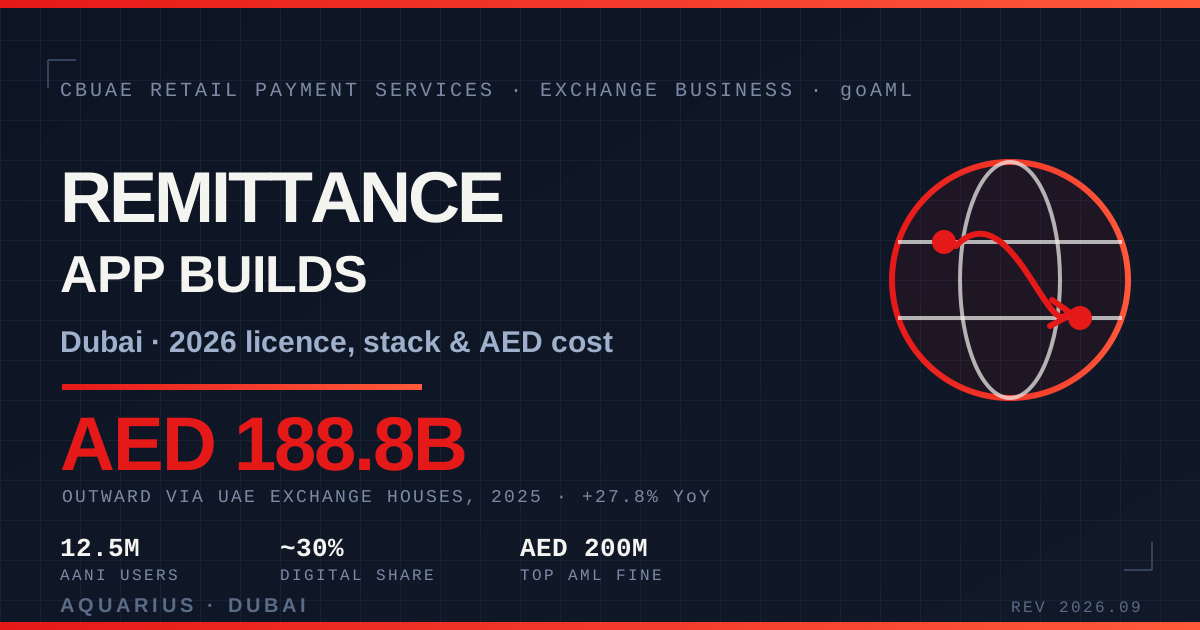
Short answer: A remittance app in Dubai costs AED 90,000–220,000 if you ride a licensed partner's rails, AED 250,000–600,000 for a custom single-corridor MVP, and AED 700,000–2.5M+ for a multi-corridor platform with its own ledger and compliance operations. None of those numbers matter until you answer the licensing question, because a CBUAE Retail Payment Services licence carries AED 1M–3M in initial capital and a 6–12 month approval cycle — and the Central Bank has already fined a single exchange house AED 200 million for AML failures. Pick the licence route first. Scope the app to it second.
Most Dubai founders do this backwards. They commission an app, get a polished onboarding flow and a corridor rate screen, then discover that the entity allowed to touch customer money does not exist yet, will take the better part of a year to create, and demands a compliance stack nobody budgeted for. The app is the cheap part. That is the single most useful sentence in this article.
Key takeaways
- The market is enormous and still analogue. UAE exchange houses sent out AED 188.8 billion in 2025, up 27.8% year on year — and digital channels were only around 30% of that flow at the largest operator.
- The licence, not the code, is the gate. CBUAE Retail Payment Services capital starts at AED 1 million and rises to AED 3 million once monthly transaction value crosses AED 10 million. Exchange business licences run AED 1M–5M depending on branch network.
- The rails already exist. Aani has 12.5 million registered users, 74 connected financial institutions and roughly 3-second settlement. You are not building a payment network, you are plugging into one.
- Compliance failure is priced in nine figures. CBUAE sanctions on exchange houses have reached AED 200 million and AED 100 million, and in June 2026 the regulator fined a compliance officer AED 300,000 personally.
The opportunity: AED 188.8 billion, and most of it still moves at a counter
The Central Bank's Financial Stability Report 2025, published on 26 August 2026, put outward remittances through UAE exchange houses at AED 188.8 billion, a 27.8% jump year on year. Personal transfers made up AED 115.7 billion of that, trade remittances AED 63.3 billion, other categories AED 8.5 billion and investment-related flows about AED 1 billion. Inward remittances through the same channel rose 53.6% to AED 36 billion.
Now the interesting part. Despite that volume, the sector's own reporting shows digital transactions running at around 30% of flow at the UAE's largest exchange operator, and market trackers put digital channels at roughly 37% of UAE remittance transactions in 2025, projected to reach about 72% by 2031. In a country where expatriates are close to 90% of the population and India, Pakistan and the Philippines together account for roughly half of outbound exchange-house volume, that gap between demand and digital supply is the entire business case.
The sector is profitable too, which matters when you pitch investors: UAE exchange businesses reported net profits of AED 625.6 million in 2025, up 8.2%, on capital of roughly AED 4 billion.
Most Dubai businesses get this wrong: they assume remittance is saturated because Al Ansari and Lulu Exchange are on every corner. Saturation of branches is not saturation of apps. Around seven dirhams in ten still move through a channel that needs a human being, a queue and a printed receipt.
What you are actually building
"A money transfer app" is four systems wearing one logo. Scope all four or your estimate is fiction.
- Onboarding and KYC. Emirates ID capture, UAE PASS where available, liveness check, document verification, and a customer risk score written at account creation — not bolted on later.
- Screening and monitoring. Real-time sanctions screening against the UAE Local List, UN consolidated lists and OFAC, PEP checks, and automated transaction monitoring with suspicious transaction report filing wired into goAML.
- The ledger and corridor engine. Double-entry accounting for every fils, FX rate sourcing and margin logic, payout partner APIs per corridor, and reconciliation that closes daily. This is where cheap builds fail.
- Apps plus back office. iOS and Android, and behind them a compliance console for case management, holds, refunds, regulatory reporting and an immutable audit log with 5-year retention and AES-256-grade encryption at rest.
The rails themselves are the easy part in 2026. Aani, the Al Etihad Payments instant payment platform, has crossed 12.5 million registered users, connects 74 licensed financial institutions and about 774,000 merchants, and settles in roughly three seconds. We break the integration work down in our guide to Aani and Jaywan payment integration in Dubai, and the AML tooling in our goAML compliance software guide.
The licence decides the architecture
There are three broad routes to market in the UAE, and each one changes what your engineering team builds.
| Route | Initial capital | Typical timeline | What you build |
|---|---|---|---|
| Agent / partner model on a licensed operator | Commercial terms only | 6–12 weeks | Front end, onboarding UX, partner API integration |
| CBUAE Retail Payment Services (Cat III) | AED 1M, rising to AED 2M above AED 10M monthly volume | 6–12 months | Full stack, your own compliance console and reporting |
| CBUAE Retail Payment Services (Cat IV) | AED 1.5M, rising to AED 3M above AED 10M monthly volume | 6–12 months | Broader service scope, heavier governance obligations |
| Exchange business licence (mainland) | AED 1M single branch to AED 5M multi-branch network | 6–12 months | Branch systems plus digital channel, cash handling |
| DIFC (DFSA) or ADGM (FSRA) | From ~USD 250,000 (ADGM) / ~USD 500,000 (DIFC) | 3–6 months | Same stack, different rulebook and client scope |
Two things founders miss. First, the capital thresholds are volume-triggered: exceeding an AED 10 million monthly average transaction value sustains a higher capital obligation, so your growth plan and your balance sheet are the same document. Second, if your roadmap quietly assumes customers can hold a balance in the app, that is stored value and it is a different licence entirely — a CBUAE Stored Value Facility, with AED 15 million paid-up capital. We cover that route in the e-wallet and CBUAE SVF licence guide.
The licensing door is genuinely open right now, which is the timing argument. Wise secured final CBUAE approval for Stored Value Facilities and Retail Payment Services Category 2, and Revolut received both licences in June 2026 after a nine-month regulatory cycle from in-principle approval. Global players are entering because the regulator built a path. So can you — but the nine-month clock is real, and it starts the day you file, not the day you incorporate.
Where the money actually is: fees and FX
Remittance economics are two-sided and most business plans only model one side. The visible side is the transfer fee: UAE exchange houses typically charge a flat AED 10–25 on high-volume corridors, with India-corridor pricing commonly between AED 25 and AED 50 and Philippines transfers around AED 20. Banks are far more expensive at AED 75–100 per transfer.
The invisible side is the FX spread, and it is usually the larger revenue line. Exchange-house rates typically sit 1–3% off the mid-market rate; banks commonly add 3–5%. A product that wins on a headline "zero fee" and loses on spread is not cheaper, and UAE customers have become very good at spotting that. Decide early which side of that trade you compete on, because it determines your rate-sourcing architecture, your treasury pre-funding model and your margin engine.
What it costs to build in Dubai (real AED bands)
These are our 2026 delivery bands for UAE remittance products. They assume bilingual Arabic and English apps, UAE-hosted infrastructure and a compliance console from day one — not as a phase two.
| Build tier | AED cost | Timeline | Best for |
|---|---|---|---|
| Partner-rails app (front end + integration) | AED 90,000–220,000 | 6–10 weeks | Testing a corridor before committing capital |
| Custom single-corridor MVP | AED 250,000–600,000 | 4–7 months | Owning the ledger, one payout partner, one diaspora |
| Multi-corridor platform + compliance ops | AED 700,000–2,500,000+ | 8–18 months | A licensed operator building its own rails |
| Annual run cost (hosting, monitoring, screening feeds, support) | 15–20% of build per year | Ongoing | Everyone — budget it or the platform decays |
Three cost drivers dominate that spread: the number of corridors (each payout partner is a distinct integration, reconciliation model and failure mode), whether you operate your own compliance console or rent a vendor's, and how much of the FX and treasury logic you own. Our engagement models are on the pricing page.
The cost of getting compliance wrong
This is the number to put in front of your board. The Central Bank of the UAE has imposed a financial sanction of AED 200 million on a single exchange house for significant AML violations, and AED 100 million on another for repeat breaches including failure to implement remediation plans from earlier inspections. A further AED 4.1 million was levied across three exchange houses for AML and counter-terrorist-financing lapses.
Enforcement has also become personal. On 24 June 2026, the CBUAE fined a foreign bank branch AED 20 million for repeated AML, CFT and sanctions-compliance failures — and separately fined its Head of Compliance and Money Laundering Reporting Officer AED 300,000 individually. Your MLRO is now personally exposed to the quality of the monitoring system you ship. That reframes the build: transaction monitoring, screening and audit logging are not features to cut in a scope negotiation. They are the reason the company survives its first inspection.
How Aquarius builds remittance products
We build the compliance console in parallel with the customer app, not after it, because the regulator inspects the console and the customers only see the app. Practically that means a double-entry ledger from commit one, screening and monitoring wired to goAML from the first test transaction, immutable audit logs with 5-year retention, Arabic and English parity across both apps, and UAE-resident infrastructure so data residency questions have a one-line answer. You get full source handover and your own cloud accounts — no lock-in, because an entity under a CBUAE licence cannot afford a vendor holding its ledger hostage.
We also do the unglamorous part: mapping your licence route to your architecture before a line of code is written, so you do not build stored-value features you are not licensed to operate. See our web and app development services for how a fintech engagement is structured.
FAQ
Do I need a CBUAE licence to launch a remittance app in Dubai?
To handle customer funds yourself, yes. Mainland money transfer and exchange activity is governed by the Central Bank, and Retail Payment Services capital starts at AED 1 million, rising with transaction volume. You can go to market faster as an agent or technology partner of an already-licensed operator, which is why many teams launch that way and apply for their own licence once volume justifies it.
How long does CBUAE licensing take?
Budget 6 to 12 months from initial submission for a CBUAE licence. DIFC and ADGM routes typically run 3 to 6 months for straightforward applications. Revolut's UAE licences were granted in June 2026, roughly nine months after in-principle approval — a useful real-world benchmark.
What does a remittance app cost to build in Dubai?
AED 90,000–220,000 on partner rails, AED 250,000–600,000 for a custom single-corridor MVP, and AED 700,000–2.5M+ for a multi-corridor platform with its own compliance operations. Add 15–20% of build cost annually for hosting, screening feeds, monitoring and support.
Is the UAE remittance market already too crowded?
Crowded at the counter, not in the app. Outward flows through exchange houses hit AED 188.8 billion in 2025 with digital at roughly 30% of volume at the largest operator. Digital share is forecast to reach about 72% of transactions by 2031, which is a decade-long migration still in its early years.
What compliance systems are mandatory?
Real-time sanctions screening against the UAE Local List, UN and OFAC lists; automated transaction monitoring with STR filing integrated to goAML; KYC onboarding with Emirates ID verification; strong encryption at rest; and immutable audit logs retained for 5 years.
The bottom line
The UAE moved AED 188.8 billion out through exchange houses in 2025 and roughly seven dirhams in ten still travelled through a branch. That is the opportunity. The constraint is that the Central Bank prices compliance failure in the hundreds of millions and now fines compliance officers personally, so the winning build is the one where the ledger, the screening and the audit trail were designed first and the interface second. Settle the licence route, scope the app to it, and budget the run cost honestly. Talk to Aquarius and we will map your licence route to an architecture and an AED number in one session.