
S3 Storage Classes in Dubai (2026): The AED Maths of a 7-Year FTA Record Archive
AWS charges AED 94.02 per TB a month for S3 Standard in me-central-1 and AED 15.23 for Glacier. Here is the lifecycle policy that cuts a 7-year FTA archive by 78%, and the three fees that undo it.
- PUBLISHED
- 18 NOV 2026
- READ TIME
- 12 MIN
- AUTHOR
- AQUARIUS · DUBAI
- UNIT
- REV 2026.09
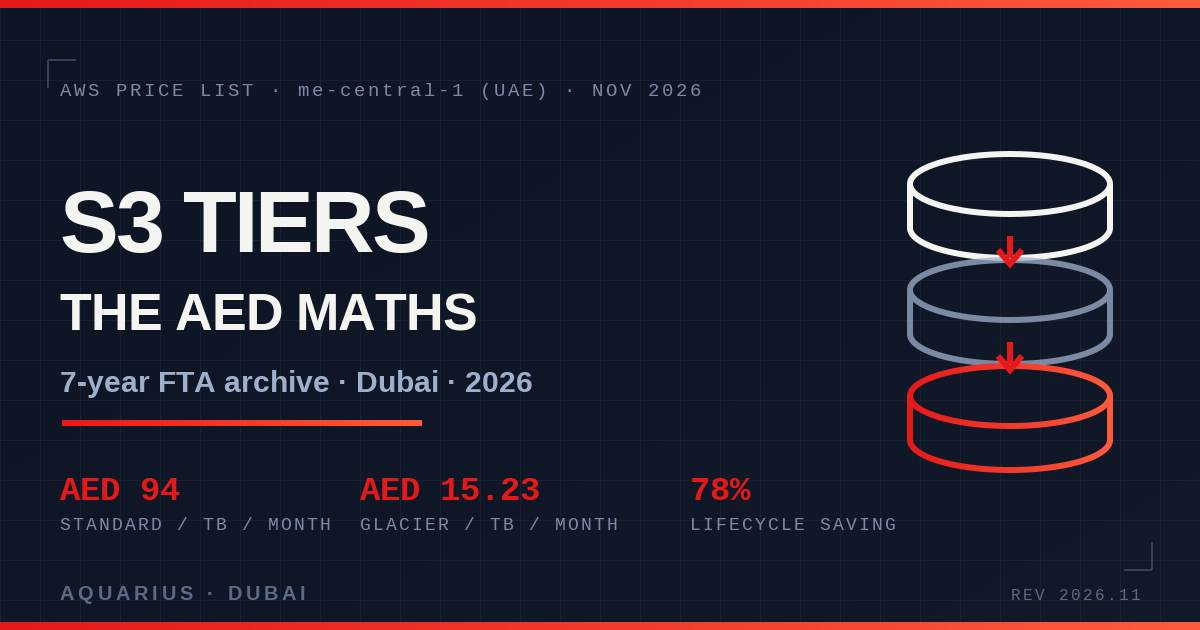
In AWS me-central-1 (UAE), S3 Standard costs AED 94.02 per TB per month while S3 Glacier Flexible Retrieval costs AED 15.23 — the same eleven-nines durability, 84% less money. A Dubai company holding 20 TB of records for the seven years Article 56 of the Corporate Tax Law demands pays AED 157,947 on Standard, or AED 34,799 with a three-rule lifecycle policy. The saving is 78%, and the only reason most UAE businesses do not take it is that three small fees — transition requests, minimum storage duration, and the Intelligent-Tiering monitoring charge — quietly reverse the maths on small files.
Dubai businesses are paying hot-storage rates for data nobody opens
The evidence here is now hard to argue with. CTERA's Cold Data Storage Report, published 15 September 2026, scanned 16 petabytes of live production data across 856 enterprise file-share scans and found that only 4.4% of stored capacity is actively used. Just 9.9% of stored data was touched in any given 90-day window. 83.1% of total capacity sits in files that have not been modified in over a year, and 88% of individual files had not been read in over a year.
That matters more in the UAE than in most markets, because the retention clock here is long and statutory:
- Seven years — corporate tax records, counted from the end of the relevant tax period (Article 56, Federal Decree-Law No. 47 of 2022). The article opens with “Notwithstanding the provisions of the Tax Procedures Law”, so seven is not an interpretation, it is a statutory override.
- Five years — VAT records, from the end of the tax period they relate to.
- Fifteen years — real estate records, which catches a large slice of Dubai's economy.
And the volume is about to jump. The UAE's Peppol-based e-invoicing framework opened for voluntary use on 1 July 2026 and becomes mandatory on 1 January 2027 for businesses with revenue of AED 50 million or more, 1 July 2027 below that threshold, and 1 October 2027 for government entities. Every invoice becomes a structured document that must be stored and produced on request. Separately, FTA Decision No. 4 of 2026, effective 30 July 2026, set the standard for electronic records: full document scanning rather than selected pages, copies that match the original, legibility on screen, and FTA access to the accounting system — including passwords or encryption keys where required.
Against that, the market is growing faster than most storage budgets. The UAE cloud storage market was valued at USD 1.5 billion in 2024 and is forecast to reach USD 6.6 billion by 2032, a 20.9% CAGR. Installed UAE data centre IT load reached 537.15 MW in 2026 and is projected to hit 711.3 MW by 2031. Capacity is not the constraint in Dubai. Tiering discipline is.
What S3 actually costs in me-central-1
These rates come straight from the AWS public price list for me-central-1 (November 2026), converted at USD/AED 3.6725. One TB here means 1,024 GB, the way AWS bills it.
| Storage class | AED / TB / month | Retrieval fee (AED/GB) | Minimum duration | First-byte latency |
|---|---|---|---|---|
| S3 Standard | 94.02 | None | None | Milliseconds |
| Standard-Infrequent Access | 51.90 | 0.0367 | 30 days | Milliseconds |
| One Zone-IA | 41.52 | 0.0367 | 30 days | Milliseconds |
| Glacier Instant Retrieval | 18.80 | 0.1102 | 90 days | Milliseconds |
| Glacier Flexible Retrieval | 15.23 | 0 bulk / 0.0404 standard / 0.1212 expedited | 90 days | 5–12 h bulk, 3–5 h standard, 1–5 min expedited |
| Intelligent-Tiering, Deep Archive Access tier | 6.77 | 0.0121 bulk / 0.0808 standard | 180 days | Up to 12 h standard, 48 h bulk |
Two rows there deserve a second read. First, bulk retrieval from Glacier Flexible Retrieval is free in me-central-1 — AED 0.00 per GB, with a 5 to 12 hour window. Second, the gap between Standard and Glacier Flexible is 6.2x, which means the cheapest compliant archive available in the UAE is also the one with no retrieval fee at all, provided you can wait half a day.
One caveat worth stating plainly: the me-central-1 price list prices Deep Archive retrievals, Deep Archive lifecycle transitions, and the Intelligent-Tiering Deep Archive Access tier at AED 6.77 per TB, but it carries no standalone timed-storage line for the standalone Deep Archive class. If your plan depends on direct Deep Archive in Dubai rather than reaching it through Intelligent-Tiering, confirm availability against your own bill before you build the policy around it.
The lifecycle policy that cuts a 7-year archive by 78%
Take a mid-size Dubai firm holding 20 TB of finance, contract and invoice records it must keep for seven years. Apply the CTERA access profile to it — 4.4% genuinely active, another 5.5% read within 90 days, the remaining 90.1% cold.
| Approach | Monthly | Over 7 years (84 months) |
|---|---|---|
| Everything on S3 Standard | AED 1,880.32 | AED 157,946.88 |
| Standard 0.9 TB + Standard-IA 1.1 TB + Glacier Flexible 18 TB | AED 414.28 | AED 34,799.17 |
| Difference | AED 1,466.04 | AED 123,147.71 |
The policy behind that second row is three lifecycle rules, not a migration project: transition to Standard-IA at 30 days, to Glacier Flexible Retrieval at 120 days, expire at 2,555 days. Nothing moves to a different bucket, no application code changes, and object keys stay identical.
Here is the belief we have to correct in almost every Dubai client workshop: teams avoid Standard-IA because of its retrieval fee. Run the numbers. Standard-IA saves AED 0.0411 per GB per month and charges AED 0.0367 per GB retrieved, so Standard-IA stays cheaper than Standard unless you read more than 112% of the data every month. For compliance records, that never happens. Glacier Instant Retrieval stays cheaper than Standard unless you read more than 67% of it monthly — with the same millisecond access. Retrieval fees are not what makes tiering expensive.
The three fees that quietly undo the saving
1. Transition requests are charged per object, not per GB
Every object a lifecycle rule moves is a billable request. In me-central-1, moving 10 million objects once costs:
- AED 367.25 into Standard-IA, One Zone-IA or Intelligent-Tiering (USD 0.01 per 1,000)
- AED 734.50 into Glacier Instant Retrieval (USD 0.02 per 1,000)
- AED 1,333.12 into Glacier Flexible Retrieval (USD 0.0363 per 1,000)
- AED 2,221.86 into Deep Archive (USD 0.0605 per 1,000)
Now the number that should change your policy. If those 10 million objects average 100 KB — typical for scanned invoices, receipts and PDF attachments — they total 953.67 GB. Archiving them to Deep Archive saves AED 81.25 a month against a one-off AED 2,221.86 transition fee, so the payback period is 27.3 months. Into Glacier Flexible it is 18.2 months. Archive 10 million small files in the final year of a 7-year retention window and you lose money. The fix is boring and effective: aggregate small records into monthly or quarterly archive objects before they reach the lifecycle rule.
2. Minimum storage duration is billed even after the object is gone
Standard-IA and One Zone-IA bill a minimum of 30 days, Glacier Instant Retrieval and Glacier Flexible 90 days, Deep Archive 180 days. Delete or overwrite early and AWS charges the remainder pro rata at that class's rate. This bites hardest on data that gets corrected — restated ledgers, reissued invoices, re-scanned documents. Never transition anything into an archive class before the window in which it can still change has closed.
3. The Intelligent-Tiering monitoring fee has a break-even object size
Intelligent-Tiering charges USD 0.0025 per 1,000 objects per month to monitor access patterns. Measured against the Standard-to-Infrequent-Access saving, that fee only pays for itself on objects larger than roughly 234 KB. AWS does not transition objects under 128 KB, which helps — but it leaves a band between about 128 KB and 234 KB where objects are monitored, do get moved, and still cost more than they save. If your bucket is mostly thumbnails, JSON documents or small PDFs, an explicit lifecycle rule beats Intelligent-Tiering. If it is mostly large files with unpredictable access, Intelligent-Tiering wins and needs no tuning. The wider pattern is in our guide to cloud cost optimisation for Dubai businesses.
One Zone-IA: the AED 10 saving that cost UAE companies their data
One Zone-IA looks like free money — AED 41.52 per TB against AED 51.90 for Standard-IA. That is a saving of AED 10.38 per TB per month, and what it buys you is a single Availability Zone instead of three.
Availability Zone risk is not hypothetical in the UAE. After the March 2026 disruption to AWS UAE facilities took two of the three me-central-1 zones offline, AWS confirmed in September 2026 that resources held exclusively in mec1-az2 with no external copy were unrecoverable. One Zone-IA is precisely that configuration, by design.
For statutory records in Dubai, One Zone-IA is the wrong instrument at any price: AED 10 per TB per month does not compensate for a record set the FTA can demand for seven years. Use it only for derived data you can regenerate — thumbnails, transcodes, build caches. Our Dubai disaster recovery and backup guide works through the RPO and RTO side of the same decision.
What an FTA record request actually costs to serve
This is the part most cost models get backwards. Say the FTA asks for two years of supporting documents and you need to restore 2 TB from the archive. The retrieval line is trivial:
- Glacier Flexible, bulk (5–12 h): AED 0.00
- Glacier Flexible, standard (3–5 h): AED 82.73
- Glacier Flexible, expedited (1–5 min): AED 248.20
- Deep Archive Access, bulk (up to 48 h): AED 24.82
Now download those 2 TB out of AWS to a laptop or an auditor's portal, and me-central-1 data transfer out at USD 0.110 per GB adds AED 827.34 — ten times the standard retrieval fee, and infinitely more than the free bulk one. The cheapest compliant answer is to restore inside the region and let reviewers work against a UAE-hosted viewer, which also keeps the records resident while an FTA officer inspects them. Keep the review inside me-central-1 and the whole exercise costs under AED 100; export it and you are paying AED 400 per TB to move your own records.
The real cost of getting this wrong is not a storage line at all. Under Cabinet Decision No. 75 of 2023, failure to keep required records carries an administrative penalty of AED 10,000 per violation, rising to AED 20,000 for a repeat within 24 months. A full 7-year Glacier archive for 20 TB costs AED 34,799 in total. One repeated recordkeeping penalty costs AED 20,000 and buys you nothing. If your audit readiness is thin, start with our FTA tax audit readiness guide.
How Aquarius sets this up
We treat retention as an engineering artefact, not a policy document. A typical engagement for a Dubai SME runs AED 6,000 to AED 14,000 one-off: an S3 Storage Lens and Analytics read of what you actually hold, a retention map from record type to statutory period, lifecycle rules written as infrastructure-as-code, Object Lock in compliance mode on the record bucket so nothing can be deleted inside its retention window, small-object aggregation wherever the payback maths demands it, and a documented restore runbook with a timed test restore. Larger estates with multiple accounts and cross-region copies sit higher; our pricing page shows how we scope it.
The risk reversal is simple. If the timed test restore does not produce legible, complete records inside the window we committed to, we rework the configuration at no charge. We do not resell storage, so the tier recommendation is not a margin decision — the same discipline runs through our me-central-1 database cost analysis.
Frequently asked questions
How long must a Dubai company keep accounting records?
Seven years after the end of the relevant tax period for corporate tax records under Article 56 of Federal Decree-Law No. 47 of 2022, five years for VAT records, and fifteen years for real estate records. Exempt persons must also keep records for seven years from the end of the period in which the exemption is claimed.
Which S3 storage class is cheapest for UAE compliance archives?
Glacier Flexible Retrieval at AED 15.23 per TB per month, because bulk retrieval in me-central-1 is free and a 5 to 12 hour restore window is compatible with a document request. The Intelligent-Tiering Deep Archive Access tier is cheaper still at AED 6.77 per TB, but its 180-day minimum duration and up-to-48-hour bulk restore make it suitable only for records you are confident will not change.
Does a lifecycle policy breach FTA Decision No. 4 of 2026?
No. The decision governs legibility, completeness and FTA access to the accounting system, not which storage tier the bytes sit on. What it does require is that you can actually produce complete, readable records on request — so whichever class you choose has to come with a restore runbook and a tested restore time, not just a low monthly rate.
Is S3 Intelligent-Tiering worth it in Dubai?
Only above roughly 234 KB average object size. Below that, the USD 0.0025 per 1,000 objects monthly monitoring fee exceeds the saving from dropping to the Infrequent Access tier. Buckets full of small scanned documents do better on explicit lifecycle rules.
Can we store UAE records outside the UAE to save money?
Cheaper regions exist, but the FTA has to be able to access your records, and sector rules plus the UAE Personal Data Protection Law constrain cross-border transfers of personal data. For record sets containing customer or employee data, keeping the archive in me-central-1 is the defensible position — and with Glacier at AED 15.23 per TB, regional storage is no longer the expensive option it once was.
If you are holding more than a few terabytes of UAE records on S3 Standard, the gap between what you pay and what you need to pay is almost certainly five figures across the retention window. Send us your S3 Storage Lens summary and we will come back with the three lifecycle rules and the AED number they save.