
Salla vs Zid vs Shopify vs Custom: The Right Store Platform for a Dubai Business (2026)
Salla and Zid are Saudi-first platforms, and Shopify charges UAE stores up to 2% extra on third-party gateways. How to pick a store platform in Dubai in 2026, with real AED numbers.
- PUBLISHED
- 05 NOV 2026
- READ TIME
- 13 MIN
- AUTHOR
- AQUARIUS · DUBAI
- UNIT
- REV 2026.09
Short answer: Salla and Zid are Saudi-first platforms. They are built around the riyal, mada cards and ZATCA e-invoicing, so they are the right call when most of your revenue comes from Saudi Arabia. For a UAE-registered store selling mainly in the Emirates, Shopify is the pragmatic default, and a custom or headless build earns its keep once operations — not the storefront — are the bottleneck. The expensive mistake is choosing on subscription price: at AED 1,000,000 of annual online sales, Shopify’s 2% third-party gateway fee on the Basic plan costs AED 20,000 a year on top of what your UAE gateway already charges.
That single line decides more Dubai store projects than any feature matrix. Here is the 2026 picture with real numbers.
Why the platform question got harder in 2026
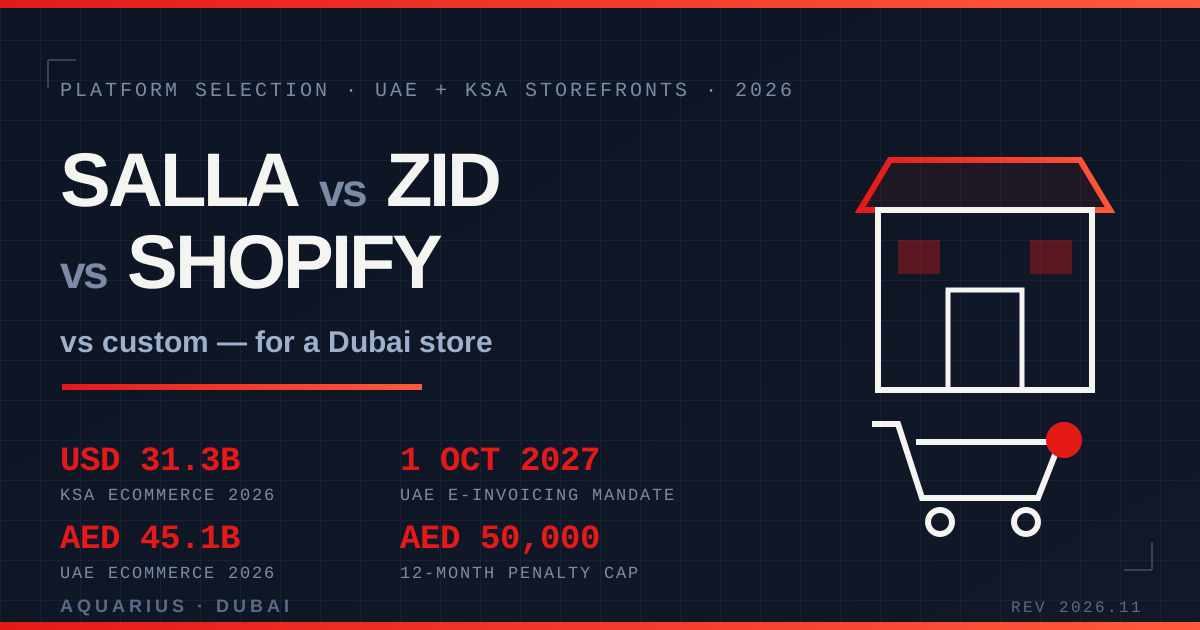
The Gulf is now two very different e-commerce markets, and the gap is widening. Mordor Intelligence sizes Saudi e-commerce at USD 31.29 billion in 2026, up from USD 27.96 billion in 2025 on an 11.92% CAGR, while the UAE sits at USD 12.30 billion — roughly AED 45.1 billion — growing at 11.29% toward USD 21.01 billion by 2031. Saudi Arabia is about 2.5 times the size of the UAE market, which is exactly why Saudi-born platforms exist at the scale they do, and exactly why Dubai founders keep being pitched them.
EZDubai’s annual report with Euromonitor International puts the UAE at AED 42.2 billion (USD 11.5 billion) in 2025, heading to AED 67.2 billion by 2030 on a 9.9% CAGR. With DataReportal counting 11.3 million UAE internet users at 99.0% penetration, growth here is not about getting more people online. It is about margin, repeat purchase and operations — and those are platform decisions.
On the Saudi side, payment localisation is the whole story. E-commerce spending on mada cards reached SAR 197.42 billion in 2024, up 25.82% year on year. A checkout that does not speak mada does not convert in Riyadh, and that is something Salla and Zid do natively while a default Shopify setup does not.
Most Dubai businesses get this wrong in one direction: they copy a Saudi competitor’s stack. A platform tuned for SAR, mada and ZATCA Fatoora becomes a tax-and-payments headache when your trade licence says Dubai and your invoices need a UAE TRN.
The four real options, compared
Ignore feature counts. The variables that decide a UAE build are home market, payment rails, tax plumbing, Arabic quality and the ceiling you hit when you grow.
| Option | Home market and currency | Payments out of the box | Published subscription | Best fit |
|---|---|---|---|---|
| Salla (Saudi, founded 2016) | SAR-first, 15+ currencies supported, Arabic-native admin | mada, Visa, Mastercard, American Express, Apple Pay and Tabby via Salla Pay | Basic free; Plus SAR 99/mo (SAR 990/yr); Pro SAR 299/mo (SAR 2,990/yr); enterprise custom | Arabic-first brands where Saudi is the main market and the UAE is a second shipping lane |
| Zid (Saudi, founded 2017) | SAR-first, Arabic-native, more operations-heavy | Zid Pay and Zid Ship bundled; Zid Finance connects merchants to SAMA-licensed lenders | Starter free; Rise SAR 99/mo; Growth SAR 299/mo; Professional custom | Established Saudi retailers who want working capital and logistics bundled with the storefront |
| Shopify | Global, native multi-currency, AED storefronts, strong EN/AR themes | Shopify Payments plus every major UAE gateway as an app | Basic USD 39/mo, Grow USD 105/mo, Advanced USD 399/mo list (about 25% less billed annually); Plus from roughly AED 2,300/mo | Most UAE stores under about AED 20m GMV with standard fulfilment |
| Custom / headless | Whatever you define — AED, SAR, multi-entity | Direct gateway integration, no platform override on the transaction | No licence fee; build cost plus hosting from roughly AED 400/mo | Complex catalogues, B2B pricing tiers, ERP-coupled stock, or unit economics that cannot absorb platform fees |
Salla, honestly
Salla is the volume leader in the Gulf SMB segment: more than 68,000 active stores, and its Salla 4.0 release shipped over 120 new merchant tools, 160+ shipping-carrier options on the Pro plan, and the ability to publish a branded mobile app in about 72 hours. For an Arabic-first brand, having the admin, the themes and the support all Arabic-native is a genuine productivity gain no international platform matches. It supports 15+ currencies and has been extending UAE and Egypt payment coverage through 2024–2026.
The constraint is gravity. The app ecosystem, the shipping integrations, the invoicing logic and the support all assume Saudi defaults. If your orders are 80% Dubai and Abu Dhabi, you spend your time fighting those defaults instead of using them.
Zid, honestly
Zid is the operations-led competitor. Founded in Riyadh in 2017, it raised a USD 50 million Series B led by IMPACT46 with participation from Aramco’s Wa’ed Ventures and Endeavor Catalyst — about USD 59 million across three rounds — and reported 659 employees as of 30 June 2026. Zid Pay, Zid Ship and Zid Finance mean a merchant can take storefront, payments, fulfilment and inventory credit from one vendor. That bundle is the reason to choose it.
It is also the most Saudi-anchored of the three. If you are a UAE SME with no Saudi entity, most of what makes Zid interesting is unavailable to you.
Shopify in the UAE: watch the second fee
Shopify is where most Dubai stores should start, with one number to understand before you sign. Shopify’s UAE pricing lists card rates of 2.9% + AED 1.00 on Basic, falling to 2.8% on Grow, 2.7% on Advanced and 2.5% on Plus. If you process through a third-party gateway instead — which many UAE merchants do, for local acquiring, AED settlement, or Tabby and Tamara support — Shopify adds its own third-party transaction fee of 2% on Basic, 1% on Grow, 0.6% on Advanced and 0.2% on Plus, on top of whatever the gateway charges.
Run that at realistic Dubai volumes:
| Annual online sales | Plan | Shopify third-party fee | What that money buys instead |
|---|---|---|---|
| AED 500,000 | Basic (2%) | AED 10,000/yr | Roughly a year of managed hosting and maintenance on a custom build |
| AED 1,000,000 | Basic (2%) | AED 20,000/yr | A meaningful slice of a custom storefront build |
| AED 3,000,000 | Grow (1%) | AED 30,000/yr | Upgrade maths flips: Advanced at 0.6% saves about AED 12,000/yr |
| AED 10,000,000 | Advanced (0.6%) | AED 60,000/yr | A full headless rebuild pays for itself inside two years |
None of this makes Shopify the wrong answer. It makes the crossover point calculable — and that calculation is the one nobody runs before choosing. We go deeper on where the line sits in Shopify vs custom e-commerce in Dubai, and on which acquirer to pair it with in Tap vs PayTabs vs Stripe for UAE payments.
The UAE constraint nobody budgets for: e-invoicing
This is the detail that should stop a Dubai merchant from casually adopting a Saudi platform. Saudi Arabia’s ZATCA Fatoora regime is mature, and Salla and Zid handle it as a native feature. The UAE regime is separate, newer, and routed through accredited service providers — so Saudi-native invoicing compliance does nothing for your Federal Tax Authority obligations.
The UAE timeline is now firm. The pilot and voluntary adoption phase opened in July 2026, with full implementation planned for 1 October 2027. On 1 November 2026 the Ministry of Finance issued updated penalty rules: AED 5,000 for an initial violation, a further AED 5,000 for each month of continued non-compliance, capped at AED 50,000 over twelve months. The amendments also removed administrative penalties for failing to notify the authority of a system failure, and they apply to both invoice issuers and recipients — so a B2B store that merely receives structured invoices is in scope too.
Practical read: whichever platform you choose, your 2027 requirement is a clean path from order to a structured invoice your accredited provider can transmit, carrying a valid TRN and correct 5% VAT treatment. Shopify and a custom build both reach that through your accounting stack or a direct integration. A Saudi-native platform gives you ZATCA compliance you do not need and leaves the UAE requirement to solve separately. Full breakdown in VAT-compliant e-commerce invoicing for the UAE.
Three more UAE realities that change the answer
- Mobile is 67.8% of UAE traffic (Statcounter, October 2026). Theme quality on a mid-range Android handset over a local mobile connection matters more than any desktop feature list.
- Cash on delivery and local last-mile are still material in the Emirates. Your platform needs COD reconciliation and a courier integration that actually exists here, not a plugin written for Riyadh.
- Arabic is not a translation toggle. RTL layout, Arabic product data, Arabic-language search and an Arabic-capable support inbox are build decisions. Salla and Zid win this by default; Shopify and custom builds need the work done deliberately.
What each route costs to launch in Dubai
Subscription is the small number. These are the ranges we actually quote in the UAE, for a store meant to sell rather than merely exist.
| Route | Scope | Indicative AED | Ongoing |
|---|---|---|---|
| Shopify launch, done properly | Theme customisation, EN/AR storefront, UAE gateway plus Tabby/Tamara, COD flow, courier integration, VAT setup, analytics | 18,000 – 45,000 | Plan fee plus 0.6–2% third-party fee plus apps |
| Salla or Zid setup for a KSA-led brand | Store configuration, theme work, Arabic merchandising, payment and shipping wiring, data migration | 12,000 – 30,000 | SAR 99–299/mo plus Salla Pay or Zid Pay transaction rates |
| Custom storefront on Next.js | Bespoke catalogue and checkout, direct gateway integration, CMS, EN/AR, Core Web Vitals tuned | 45,000 – 120,000 | Hosting from about AED 400/mo plus maintenance |
| Headless commerce with ERP integration | Headless backend, B2B pricing tiers, stock and invoice sync to ERP, multi-entity UAE + KSA | 120,000 – 350,000 | Infrastructure plus retained engineering |
| Replatform and migration | Catalogue and order-history migration, URL mapping, SEO preservation, parallel run | 20,000 – 60,000 | Depends on destination |
The decision stat for the bottom of the funnel: a UAE store doing AED 10 million a year pays about AED 60,000 annually in Shopify third-party transaction fees alone on the Advanced plan, before the plan fee and before the gateway’s own cut. At that volume a headless rebuild is not a vanity project, it is a payback calculation with a two-year horizon. Below roughly AED 2 million, the same maths says stay on Shopify and spend the money on traffic instead.
How Aquarius decides it with you
We start from your numbers, not our preferences. One call covers four inputs: current or forecast GMV, the UAE/KSA revenue split, SKU count and catalogue complexity, and whether stock lives in an ERP. That determines the route — and we will tell you to stay on Shopify when Shopify is the right answer, which it frequently is. Where Saudi is genuinely the larger market, we build on Salla or Zid and wire the UAE side around it rather than force one platform to pretend. Where the fee ladder or the operations have outgrown a hosted platform, we build custom or headless on Next.js with direct gateway integration, AED and SAR pricing, EN/AR from day one, and a structured-invoice path ready for October 2027. If a second market is the real plan, read expanding a Dubai store into Saudi Arabia before you choose anything. Fixed scope, fixed price — see pricing, or send us your GMV and gateway rate and we will run the crossover maths for you.
FAQ
Can a UAE company use Salla or Zid?
Yes, and some do. Salla supports 15+ currencies and has been expanding UAE and Egypt payment coverage, so a UAE-registered merchant can run an Arabic storefront and regional shipping on it. The real question is whether you should: every default, integration and support assumption is Saudi-first, and neither platform solves your UAE Federal Tax Authority e-invoicing obligation, which is a separate regime from ZATCA Fatoora. If Saudi is not your largest market, you are paying in friction for localisation you do not use.
Is Shopify or Salla cheaper for a Dubai store?
On subscription, Salla. Plus at SAR 99 a month and Pro at SAR 299 undercut Shopify’s USD 39 Basic and USD 105 Grow plans. On total cost, it depends on how you take payment. Shopify adds a third-party transaction fee of 2% on Basic down to 0.2% on Plus when you do not use Shopify Payments, which at AED 1 million of sales is AED 20,000 a year on Basic. Model that fee against your real volume before comparing plan prices.
What is the difference between Salla and Zid?
Salla is the broader SMB platform — 68,000+ stores, the larger app and theme ecosystem, 160+ carrier options on Pro, and faster self-service launch including a mobile app in roughly 72 hours. Zid is more operations- and finance-led: Zid Pay, Zid Ship and Zid Finance, which connects merchants to lenders licensed by the Saudi Central Bank, aimed at established retailers rather than first-time sellers. Salla for reach and speed, Zid for bundled operations and working capital.
When should a Dubai store go custom instead of hosted?
Three triggers, any one of which is enough: platform transaction fees exceed what maintenance would cost, roughly past AED 2–3 million in annual sales depending on your plan; your catalogue needs B2B pricing tiers, contract pricing or live ERP stock that hosted platforms model badly; or performance and Arabic experience are costing you conversions that theme tweaks cannot recover. Below those thresholds, custom is usually a distraction.
Does the new UAE e-invoicing mandate affect my online store?
Yes, if you are VAT-registered. Voluntary adoption opened in July 2026 and full implementation is planned for 1 October 2027. Penalty rules issued on 1 November 2026 set AED 5,000 for an initial violation plus AED 5,000 for each further month, capped at AED 50,000 over twelve months, and they apply to invoice recipients as well as issuers. Your store does not have to transmit invoices itself, but order data has to reach an accredited service provider as a complete structured invoice with a valid TRN — which is a platform and accounting-integration question worth settling in 2026 rather than mid-2027.
Sources: Mordor Intelligence UAE and Saudi Arabia e-commerce market reports, 2026; EZDubai and Euromonitor International UAE e-commerce report (AED 42.2bn 2025, AED 67.2bn 2030); Saudi Central Bank mada e-commerce data, 2024; Salla 4.0 announcement and published plans; Zid published plans and Series B funding announcements (IMPACT46, Wa’ed Ventures, Endeavor Catalyst); Shopify UAE pricing page, November 2026; UAE Ministry of Finance e-invoicing penalty amendments, 1 November 2026; DataReportal UAE; Statcounter UAE, October 2026.