
Secrets and Key Management in Dubai (2026): The Top Breach-Cost Driver in the Middle East
IBM names mismanaged secrets and keys the leading cost amplifier in Middle East breaches, now averaging USD 8 million. What vaults, KMS and HSMs cost Dubai teams in AED, plus a 30-day rotation plan.
- PUBLISHED
- 22 OCT 2026
- READ TIME
- 12 MIN
- AUTHOR
- AQUARIUS · DUBAI
- UNIT
- REV 2026.09
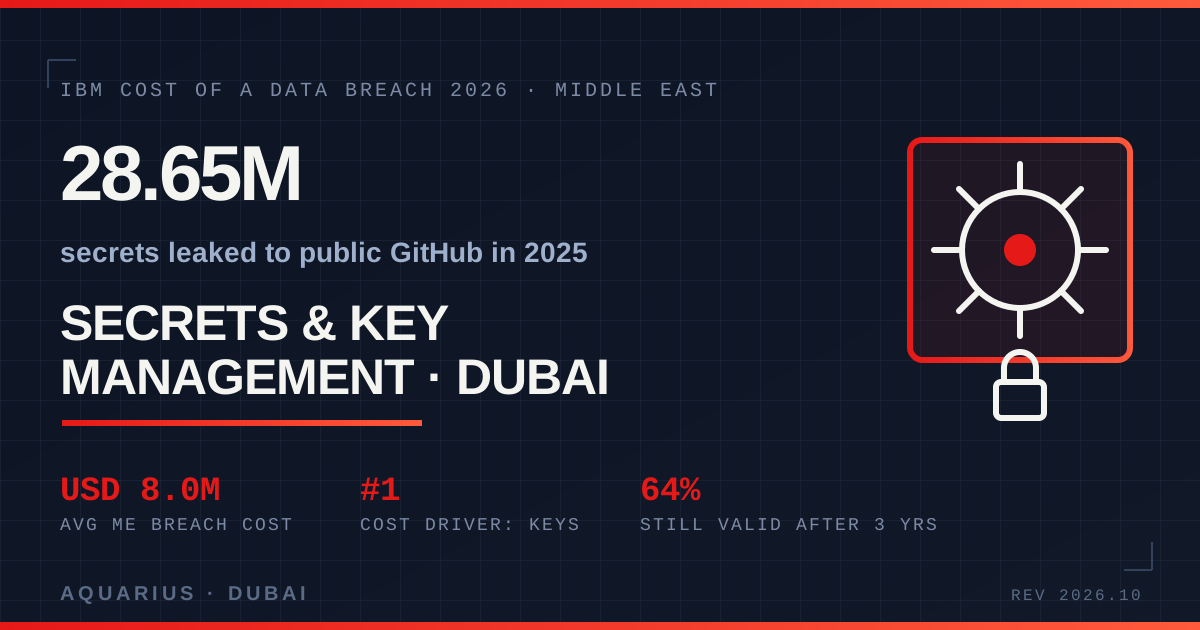
IBM’s 2026 Cost of a Data Breach report names mismanaged secrets and keys the single biggest cost amplifier for Middle East organisations — ahead of excessive privileges and poor threat prioritisation. The average breach in the region now costs USD 8 million (about AED 29.4 million), rising to USD 10.67 million (AED 39.2 million) in the financial and technology sectors. The fix is not a bigger firewall. It is knowing where every API key, database password and encryption key in your stack lives, who can read it, and when it was last rotated.
The number Dubai boards keep missing
Most UAE security budgets are built around perimeter and endpoint. The 2026 data says the expensive failures happen behind the perimeter, with credentials that were already valid.
- USD 8 million — average Middle East breach cost in 2026, split into USD 3.57m lost business, USD 2.17m post-breach response, USD 1.9m detection and escalation, and USD 360,000 notification.
- Mismanaged secrets and keys rank first among the three leading factors that push those costs higher, in IBM’s own ranking for the region.
- 26% of malicious breaches were AI-enabled, with a further 11% of respondents unable to say either way.
- Phishing caused 18% of incidents at an average of USD 10.41 million — and phishing is primarily a credential-theft mechanism, not a malware one.
- Nationally, the UAE Cyber Security Council reports blocking roughly 600,000 cyberattacks a day, around 416 every second, with one recent operational period counting close to 750,000 attempted attacks against aviation, energy and education targets.
Read the first two bullets together. The region’s most expensive breaches are not exotic. They are an attacker signing in with something that should have been revoked.
Where the secrets actually leak
GitGuardian’s State of Secrets Sprawl 2026 scanned public GitHub and found 28.65 million new hardcoded secrets added during 2025 alone — up 34% year on year. Three findings in that report should worry every Dubai engineering lead:
- 64% of secrets confirmed valid in 2022 were still valid in January 2026. Leaked credentials are not a moment of exposure. They are an open door that stays open for years because nobody owns rotation.
- Internal repositories are roughly 6x more likely to contain hardcoded secrets than public ones. The “it’s a private repo” reassurance is exactly backwards — privacy is why the hygiene rotted.
- AI-service credentials surged 81%, to 1,275,105 leaked AI keys, and 24,008 unique secrets were found in MCP configuration files, of which 2,117 were live. AI-assisted commits leaked secrets at 3.2% versus a 1.5% baseline.
That last point lands hard in Dubai, where AI adoption is running ahead of AI governance. Every team wiring an LLM into a workflow is minting new high-value credentials — OpenAI, Anthropic, Azure OpenAI, vector-store and MCP server keys — and most are pasting them into a .env file that is one careless commit from public. If you are building agentic systems, pair this with our notes on AI agent security and prompt injection.
And roughly 28% of leak incidents originate outside repositories entirely — in Slack, Jira and ticket comments — where they are 13 percentage points more likely to be rated critical. Scanning only your Git history catches less than three quarters of the problem.
Most Dubai businesses think secrets management is a developer convenience. IBM’s regional data says it is the highest-leverage line item in your security budget.
Secrets and keys are two different problems
Teams conflate them, buy one tool, and leave half the risk uncovered.
Secrets are credentials your application presents to something else: database passwords, API tokens, webhook signing keys, SSH keys, service-account JSON. They are read constantly, shared across environments, and they belong in a secrets manager with versioning, per-environment scoping, audit logs and automatic rotation.
Cryptographic keys are the material that makes your encryption meaningful: data-encryption keys, key-encrypting keys, TLS private keys, signing keys, payment keys. They should never be readable by an application at all. They belong in a KMS or HSM, where the application sends data to the key rather than fetching the key to the data.
The practical test: if a developer can print the value to a log, it is a secret and it is in the wrong place if it is a cryptographic key. Getting this boundary right is also what makes your eventual post-quantum cryptography migration tractable — you cannot swap algorithms you cannot locate.
What UAE regulation now actually requires
Key management stopped being a best practice in the UAE in late 2025.
- UAE National Encryption Policy (approved 27 November 2025, with executive regulation). It explicitly defines requirements for the secure management of cryptographic keys across their full lifecycle — creation, distribution, storage, availability and disposal — including documented recovery strategies for key loss or corruption. It also mandates automated crypto-discovery tooling so entities hold a real-time record of cryptographic assets.
- UAE PDPL (Federal Decree-Law No. 45 of 2021) requires appropriate technical measures to protect personal data, with breach notification duties that get materially harder to satisfy when you cannot prove which keys protected which dataset. See our PDPL compliance checklist for websites and apps.
- PCI DSS v4.0.1 Requirement 12.3.3 became mandatory on 31 March 2025. Any Dubai merchant or processor in scope must maintain a documented inventory of cipher suites and protocols in use, review it at least every 12 months, and hold a written strategy for responding to cryptographic weakening. Requirements 3.6 and 3.7 add key-lifecycle controls on top.
- Dubai Electronic Security Centre ISR carries its own cryptographic and access-control domains for Dubai government-linked entities and their suppliers — costed out in our DESC ISR compliance guide.
The common thread across all four: an inventory you can produce on demand. Not a vault. An answer to “list every key and secret, its owner, its purpose, and its last rotation date.” Most Dubai SMEs cannot produce that document in under a week. The regulator expects it in an audit window.
What the tooling costs in AED
This is the part that surprises people. The controls that top IBM’s regional cost-driver list are among the cheapest line items in a cloud bill. Prices below are list rates as of 2026, converted at USD 1 = AED 3.67.
| Tool | What it holds | List price | Monthly AED (typical SME) |
|---|---|---|---|
| AWS KMS | Managed encryption keys | USD 1 / key / month + USD 0.03 / 10k requests (20k free) | AED 40–180 for 10–40 keys |
| AWS Secrets Manager | App secrets, auto-rotation | USD 0.40 / secret / month + USD 0.05 / 10k calls | AED 75–300 for 50–200 secrets |
| Azure Key Vault (Premium) | HSM-protected keys | USD 1–5 / key / month + USD 0.03 / 10k ops | AED 60–400 |
| Infisical Pro | Secrets, self-hostable | USD 20 / identity / month (annual) | AED 730 for 10 identities |
| Doppler Team | Secrets sync across envs | USD 21 / user / month | AED 770 for 10 users |
| HCP Vault Dedicated (small) | Enterprise secrets + PKI | ≈ USD 2,250 / month all-in | ≈ AED 8,260 |
| AWS CloudHSM | Single-tenant FIPS HSM | ≈ USD 1.60 / HSM / hour | ≈ AED 4,300 per HSM (x2 for HA) |
A typical Dubai SME running a web app, a mobile backend and a payment integration lands at AED 150–1,200 a month for managed KMS plus a secrets manager. An HSM-backed setup — which you generally only need for card issuing, PKI, or a CBUAE-regulated workload — adds AED 8,000–9,000 a month for a highly available pair, before staff time. Against an AED 29.4 million average breach, the managed tier is a rounding error.
The real cost is engineering time, not licence fees: expect AED 18,000–45,000 of one-off work to inventory existing secrets, migrate them out of environment files and CI variables, wire rotation, and add pre-commit plus CI scanning. See our pricing page for how that sits inside a wider build.
A 30-day plan that actually closes the gap
You do not need a year-long programme. You need four weeks and a named owner.
Week 1 — find everything
Scan full Git history, not just the current HEAD, across every repository including archived ones. Scan Slack, Jira, Confluence and shared drives. Export CI/CD variables, Kubernetes secrets, serverless environment configs and third-party integration settings. Produce one spreadsheet: secret, system, owner, environment, last rotated, blast radius if leaked.
Week 2 — revoke and rotate
Assume every secret that has ever touched a repository, a chat message or a ticket is compromised. Given the 64%-still-valid figure, that assumption is closer to true than not. Rotate in blast-radius order: production database and payment credentials first, then cloud provider keys, then third-party APIs, then internal services.
Week 3 — centralise
Move everything into one secrets manager with per-environment scoping and audit logging. Move true cryptographic keys into KMS with envelope encryption, so the application never handles raw key material. Bind access to workload identity — IAM roles, OIDC federation, Kubernetes service accounts — not to long-lived static tokens.
Week 4 — make regression impossible
Add pre-commit hooks and a CI job that fails the build on a detected secret. Set automatic rotation at 30 days for application secrets and 90–365 days for encryption keys. Schedule the annual cipher-suite review that PCI DSS 12.3.3 requires. Put the inventory on a quarterly calendar reminder with a named owner, because an inventory nobody owns is stale in eight weeks.
How Aquarius builds this in
We treat secrets management as part of the delivery pipeline, not a post-launch security project. Every build we ship from Dubai starts with workload-identity authentication rather than static keys, envelope encryption through a managed KMS, environment-scoped secrets with audit trails, and CI secret scanning that blocks the merge rather than filing a ticket. For existing systems we run the week-1 inventory as a fixed-scope engagement and hand over the spreadsheet whether or not you continue with us — the document has value on its own, and it is the artefact your auditor will ask for.
The conversion maths is blunt. IBM found that Middle East organisations making extensive use of security AI and automation recorded breach costs more than USD 3 million (AED 11 million) lower than those that did not. Automated rotation and automated scanning are the cheapest entry point into that category. A control costing AED 300 a month sits between your business and the region’s most expensive failure mode.
Frequently asked questions
Is an .env file in a private repository actually a problem?
Yes, and statistically it is a worse problem than a public one — internal repositories are about 6x more likely to contain hardcoded secrets. Private repositories get cloned to laptops, forked into archives, exported during acquisitions and read by every contractor you have onboarded. Privacy is access control, not secret management.
Do UAE SMEs legally need an HSM?
Usually not. A managed KMS such as AWS KMS or Azure Key Vault Premium satisfies the UAE National Encryption Policy lifecycle expectations and PCI DSS key-management requirements for most merchants. Dedicated HSMs become necessary for card issuing, PIN processing, certificate authority operations, or where a CBUAE-regulated mandate or a specific contract names FIPS 140-3 single-tenant hardware.
How often should we rotate secrets and keys?
Application secrets and API tokens: every 30 to 90 days, automated. Data-encryption keys: annually, or immediately on suspicion. TLS certificates: automated renewal well inside their validity window. Any credential involved in an incident: immediately, and treat the rotation as incomplete until you have confirmed the old value is rejected.
What does the UAE National Encryption Policy require from a private company?
The policy is framed around national and government entities, with the explicit transition-plan mandate applying to government bodies. For private companies it sets the de facto standard the market and regulators will reference: documented key lifecycle management covering creation, distribution, storage, availability and disposal, recovery procedures for key loss, and automated discovery so your cryptographic inventory is current rather than annual.
We use AI coding tools. Does that change anything?
It raises the rate. AI-assisted commits leaked secrets at 3.2% against a 1.5% baseline, and AI-service credential leaks grew 81% in a year. Keep the AI tooling — it is a productivity win — but make CI secret scanning mandatory rather than advisory, and never let an agent read raw key material when it can call a KMS endpoint instead.
Where to start
Run the inventory. Not the tool selection, not the vendor comparison — the inventory. Almost every Dubai team that does it discovers at least one live production credential sitting in a place it should never have been, and that single finding usually justifies the whole exercise.
If you want that done properly, talk to Aquarius. We are a Dubai studio; we will scope the audit, hand you the inventory, and only quote remediation for what the scan actually finds.