
Security Guard and Patrol Management Software in Dubai (2026): SIRA Cards, WPS Payroll and the Margin Maths
What guard management software really costs in Dubai: AED build ranges, SIRA card and training rules, 31-day CCTV retention, WPS payroll penalties and the SaaS vs custom crossover.
- PUBLISHED
- 20 SEPT 2026
- READ TIME
- 12 MIN
- AUTHOR
- AQUARIUS · DUBAI
- UNIT
- REV 2026.09
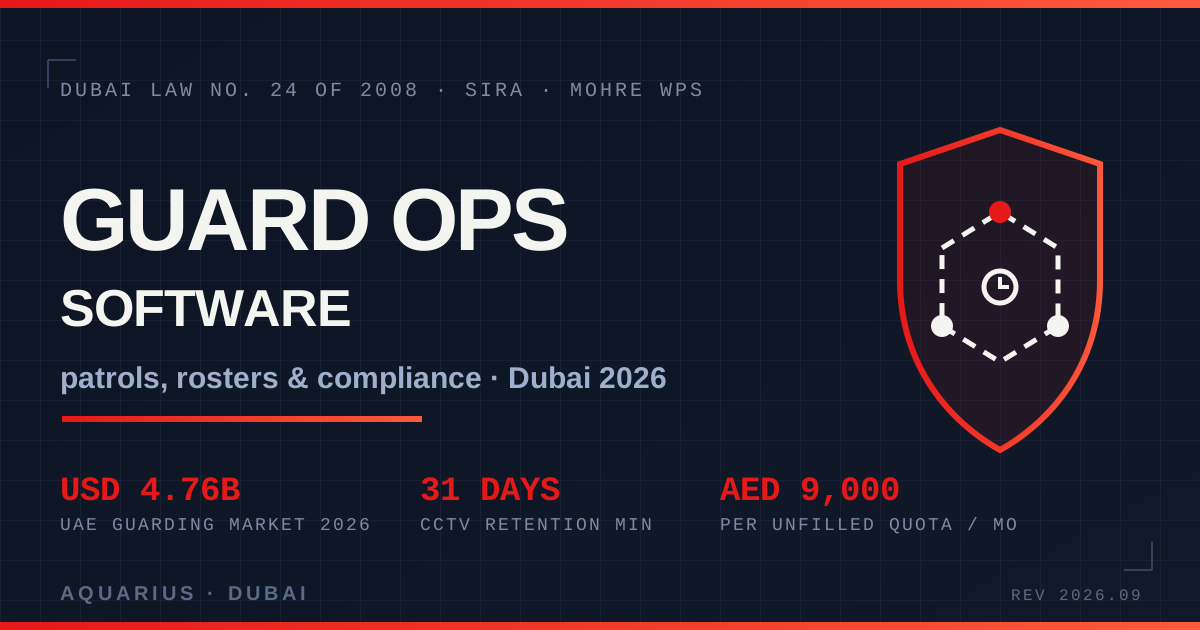
Short answer: Security guard and patrol management software in Dubai costs roughly AED 55,000–140,000 for a single-company system (guard app, checkpoint scanning, rosters, incident reports), AED 150,000–380,000 once you add SIRA-ready compliance records, WPS-clean payroll exports and a client portal, and AED 400,000+ for a multi-emirate operation with control-room dashboards and CCTV integration. Off-the-shelf guard tour apps run about USD 25–150 per guard per month (roughly AED 90–550), which is why a 300-guard company usually crosses over to a custom build inside two years. Updated September 2026.
Here is the part most Dubai security companies get wrong: they buy patrol software to prove guards did their rounds. That is the cheapest problem they have. The expensive problems are a guard card that expired last Tuesday, a 12-hour shift that was never converted into correctly calculated overtime, a WPS file that goes in late, and an Emiratisation shortfall nobody is tracking. Patrol scanning is a feature. Compliance is the product.
Key takeaways
- The market is big and getting bigger. The UAE manned guarding market is projected at USD 4.76 billion in 2026, rising to USD 7.10 billion by 2032 — a 6.89% CAGR.
- SIRA is a licensing regime, not a badge. Guard cards cost roughly AED 500–1,625 each, require 40 hours of basic training (60 for supervisors), and are valid for one year. Multiply by headcount and the renewal calendar becomes an operations problem.
- Your CCTV clients have a retention clock. Dubai commercial premises must keep footage for a minimum of 31 days, with higher-risk categories pushed to 90.
- Payroll is now watched in near real time. MOHRE upgraded WPS monitoring in December 2025; salaries more than 30 days late can attract AED 50,000 penalties per affected worker plus a work-permit freeze.
- Emiratisation shortfalls bill monthly. AED 9,000 per unfilled Emirati role per month — about AED 108,000 a year for one empty seat.
Why 2026 is the year guard ops outgrew the paper occurrence book
Three numbers set the stakes.
First, volume. The UAE manned guarding services market is projected to grow from USD 4.76 billion in 2026 to USD 7.10 billion by 2032, a 6.89% CAGR. That growth is not abstract — it is buildings. Dubai's residential market delivered roughly 46,700 housing units in 2025 across communities such as Dubai South, Business Bay and MBR City, and every handover adds lobbies, gatehouses, basement car parks and a client who wants a monthly patrol report.
Second, the cost of standing still. Setting up a licensed security company in Dubai runs roughly AED 80,000–200,000 in the first year before a single salary is paid: DED commercial licence AED 10,000–18,000, SIRA company licence AED 5,000–15,000 annually, application processing AED 2,000–4,000, public liability insurance AED 8,000–25,000, plus a bank guarantee that can reach AED 50,000. The licensing path itself takes 6–12 weeks, and getting fully operational with certified staff typically takes 3–5 months. Nobody spends that and then runs the resulting business on a WhatsApp group.
Third, margin. A Dubai guard on a 12-hour pattern is commonly structured around a basic of about AED 1,440 per month for 26 days at 8 hours, with the remaining four hours a day landing as overtime; market pay lands around AED 2,200–2,800 per month once entry and experienced guards are blended, with new SIRA-licensed guards nearer AED 1,800–2,500. On a contract billed at a fixed monthly rate per post, your entire margin lives inside two variables: hours actually worked and hours actually billed. Both of those are software questions.
What SIRA compliance actually demands from your system
Dubai Law No. 24 of 2008 governs security service providers and users, and SIRA — operating under the Ministry of Interior umbrella — licenses the companies, certifies the individuals and regulates the training centres. Any business supplying manned guarding, CCTV installation, alarm monitoring, security consulting or armed transport needs SIRA approval on top of its DET trade licence.
Translated into software requirements, that means four things your guard tour app probably does not do.
1. A live certification register, not a spreadsheet
Every deployed guard must hold a valid SIRA card — around AED 1,000–1,625 for a guard, AED 1,500–2,900 for a supervisor, near AED 5,000 for a security manager, and about AED 550 for event security. Cards run for one year and renewals cost roughly half of the original. With 400 guards, that is 400 expiry dates and a mandatory 40-hour basic training record (60 hours for supervisors) behind each one. The system should block rostering an expired guard onto a post — not email a reminder after the fact.
2. Post orders and checkpoints tied to a specific site
Patrol evidence is only worth something if it is geofenced, timestamped and immutable. NFC or QR checkpoints with offline capture matter in Dubai basements and plant rooms where signal drops. Every missed round should raise an exception, not a silent gap.
3. Incident reporting that survives a client dispute
Photos, timestamps, guard ID, site ID, supervisor sign-off, and an export a facilities manager or a police report can consume. One badly documented incident on a high-value tower contract costs more than a year of software.
4. CCTV retention awareness if you also sell systems
Dubai commercial premises need SIRA-approved CCTV with footage retained for a minimum of 31 days — and up to 90 days for higher-risk categories — installed and certified by a SIRA-licensed company. If your firm carries the installation side, retention status and certification expiry belong on the same dashboard as your guard cards.
The module map: what to build, in what order
| Module | What it kills | Typical build (AED) | Phase |
|---|---|---|---|
| Guard app: check-in/out, NFC/QR checkpoints, offline queue | Paper occurrence books, disputed patrols | 25,000 – 55,000 | 1 |
| Rostering and shift engine (12-hour patterns, reliefs, no-shows) | Uncovered posts, unplanned overtime | 30,000 – 70,000 | 1 |
| SIRA compliance register (cards, training, expiry blocks) | Deploying an uncertified guard | 20,000 – 45,000 | 1–2 |
| Incident and visitor logging with photo evidence | Client disputes, insurance arguments | 18,000 – 40,000 | 2 |
| Timesheet to WPS-ready payroll export | Late salaries, overtime errors | 35,000 – 85,000 | 2 |
| Client portal with monthly patrol and SLA reports | Manual reporting hours, renewal churn | 30,000 – 75,000 | 2–3 |
| Control-room dashboard, alarm/CCTV integration, lone-worker SOS | Blind response times | 60,000 – 150,000 | 3 |
Phase 1 alone — app, roster, compliance register — is where most Dubai firms recover the cost. Phases 2 and 3 are where they win tower and mall contracts against bigger competitors, because a client portal with real data beats a PDF assembled on the last Thursday of the month.
The payroll trap that quietly eats guarding margin
This is the section most patrol software vendors skip, and it is the one with real money in it.
UAE labour law sets an 8-hour standard day, while the guarding industry runs on 12-hour shifts. Those extra four hours are overtime, every day, per guard. Get the calculation wrong across 300 guards and you are either underpaying staff — a MOHRE complaint waiting to happen — or overpaying by a margin you never priced into the contract.
Then there is timing. Under the Wage Protection System, salaries must reach employee accounts within 15 days of the due date. At 15 days or more past the contracted date, MOHRE issues a warning and freezes new work-permit applications immediately. At 30 days or more, the penalty escalates to AED 50,000 per affected employee alongside the continued permit freeze, with fine structures commonly starting at AED 5,000 per worker and capped around AED 50,000 per incident depending on the breach. And it is no longer a slow process: in December 2025, MOHRE moved WPS to near real-time monitoring with Aani instant payments and Jaywan card integration, so late salaries appear on ministry dashboards within days rather than weeks.
For a labour-heavy business, the permit freeze is the real weapon. A security company that cannot issue new work permits cannot onboard for the contract it just won. Any timesheet-to-payroll pipeline you build should be designed backwards from the WPS file and the payment date — the same principle we apply in HR and payroll software builds for Dubai.
Emiratisation: the line item that bills monthly whether you act or not
Mainland private-sector companies with 50 or more skilled employees must reach a 10% Emiratisation rate in skilled roles by the end of 2026, structured as a 1% uplift by 30 June 2026 and a further 1% by 31 December 2026. Miss it and the shortfall costs AED 9,000 per unfilled position per month — roughly AED 108,000 a year for a single seat — enforced by MOHRE with digital monitoring and audits.
Security companies are exactly the profile that gets caught: large headcount, a skilled-role category that includes supervisors, managers and control-room operators, and an HR function that is usually one person with a spreadsheet. An operations platform that classifies roles correctly and shows the quota position monthly turns a surprise penalty into a hiring plan.
Build or buy: the crossover maths in AED
Off-the-shelf guard tour platforms price per guard per month. Published ranges sit between USD 3.20 and USD 11.10 at the budget end and USD 25–150 per guard per month for full workforce platforms — call it AED 90–550 per guard per month for anything with rostering, reporting and support attached. Enterprise names quote custom, typically from USD 25–50 per guard.
Run that across a real Dubai headcount.
| Guards | SaaS at AED 120/guard/month | 3-year SaaS total | Custom build + 3yr hosting/support |
|---|---|---|---|
| 50 | AED 6,000/mo | AED 216,000 | AED 55,000–140,000 + ~AED 90,000 |
| 150 | AED 18,000/mo | AED 648,000 | AED 150,000–380,000 + ~AED 120,000 |
| 400 | AED 48,000/mo | AED 1,728,000 | AED 400,000+ plus ~AED 180,000 |
The honest read: under about 60 guards, buy the SaaS and spend your money on contracts. Between 60 and 150, buy it but insist on API access so your compliance and payroll data stays yours. Above roughly 150 guards — or the moment SIRA card tracking, WPS exports and client portals become the reason you win or lose tenders — a custom platform pays for itself inside 18–24 months and stops charging you for growth.
One more number for the decision: at AED 2,500 average monthly pay, 400 guards is AED 12 million a year in wages. A 2% leak from unbilled overtime, uncovered posts and manual timesheet errors is AED 240,000 a year — more than the entire build.
How Aquarius builds guard operations platforms in Dubai
We build these the way the business actually runs, not the way a feature list reads. Phase 1 ships in 8–12 weeks: guard app with offline checkpoint capture, rostering, and the SIRA compliance register that refuses to schedule an expired card. Phase 2 adds timesheet-to-WPS payroll export and the client portal. Phase 3 is control room, CCTV and alarm integration.
Everything is bilingual English/Arabic with RTL handled properly, hosted with UAE data-residency options, and built against the same PDPL discipline we describe in our UAE PDPL compliance checklist — guard biometrics, incident photos and visitor records are all personal data. If you also run facilities contracts, the same data model extends into CAFM and facility management workflows rather than becoming a second silo.
Fixed-scope phases, fixed prices, source code handed over. See transparent pricing or book a 30-minute scoping call and we will map your guard count, contract mix and compliance calendar into a build plan with AED numbers attached.
FAQ
Does guard patrol software need SIRA approval itself?
SIRA licenses security companies, individuals and training providers, and certifies CCTV systems and installers. Management software is not separately licensed, but it must hold and produce the records the regime expects — valid guard cards, training completion, incident documentation and, where you supply CCTV, retention and certification status.
How long does it take to build a custom guard management system in Dubai?
A usable Phase 1 — guard app, checkpoints, rostering, compliance register — takes 8–12 weeks. Payroll export and a client portal add 6–10 weeks. Control-room and CCTV integration depends entirely on the hardware you already own.
What does a SIRA guard card cost and how often is it renewed?
Roughly AED 1,000–1,625 for a security guard, AED 1,500–2,900 for a supervisor and around AED 5,000 for a security manager, with event security guards near AED 550. Cards are valid for one year and renewal is typically about half the original cost, with mandatory training of AED 1,500–5,000 per person depending on role.
How long must Dubai businesses keep CCTV footage?
A minimum of 31 days for commercial premises, extending to 90 days for higher-risk categories, on SIRA-approved systems installed and certified by a SIRA-licensed company.
Can one platform handle guarding, cleaning and facilities crews?
Yes, and it usually should. Rostering, geofenced check-in, incident logging and WPS payroll export are the same spine. What changes is the compliance layer on top — SIRA cards for guards, different certifications for technicians. Build the spine once.
The uncomfortable summary: plenty of Dubai security companies run an AED 12 million wage bill on tools that track where a guard walked and nothing that tracks whether that guard was legally deployable, correctly paid and profitably billed. Fix the second list and the first one takes care of itself.