
Supply Chain Resilience Software in Dubai (2026): Re-Routing When Jebel Ali Drops 90%
Jebel Ali handled 374,000 TEU in Q2 2026, down 90.1%, yet cargo outside it grew 5.4%. What multimodal re-routing software costs in AED and which hard-coded fields block the pivot.
- PUBLISHED
- 02 NOV 2026
- READ TIME
- 12 MIN
- AUTHOR
- AQUARIUS · DUBAI
- UNIT
- REV 2026.09
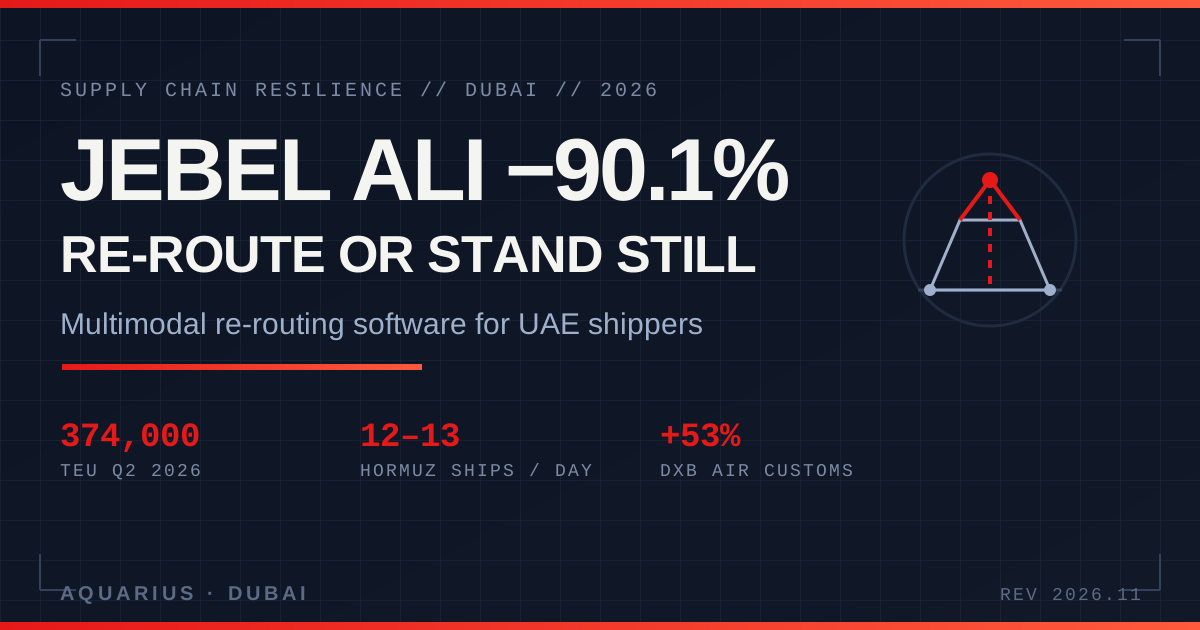
Short answer: Jebel Ali handled just 374,000 TEU in Q2 2026 — down 90.1% year on year from roughly 3.8 million — while Dubai’s air-cargo customs transactions rose 53% and Gulf cargo rerouted through alternative ports and Saudi land corridors. The port never closed and suffered no physical damage; the routing around it broke. Dubai importers who survived that quarter were the ones whose systems could switch port, mode and paperwork in days, not months. That capability is software, and it costs AED 90,000–450,000 to build.
This is not a geopolitics article. It is about the specific, boring fields in your ERP, TMS and checkout that assume one port of discharge, one Incoterm, one lead time and one landed-cost formula — and what it costs to make them plural.
What actually broke in 2026 (and what did not)
The Strait of Hormuz has been effectively closed to commercial traffic since 28 February 2026 — a de facto closure enforced by war-risk pricing rather than any declaration. The numbers are blunt:
- Hormuz transits fell to about 12–13 ships a day by early September 2026, from roughly 100 before the crisis.
- Additional war-risk premium reached 3%–10% of hull value for a Hormuz transit, against 0.02%–0.25% before February 2026. On a USD 100 million vessel that is USD 3–10 million a voyage versus about USD 250,000.
- Jebel Ali: 374,000 TEU in Q2 2026, a 90.1% fall year on year; 3.1 million TEU for H1, down 59.5%. DP World put the cost at around USD 100 million a month, and Dubai dropped out of the global top 30 container ports.
Now the part most coverage skips. DP World’s H1 2026 revenue still grew 13.1% to USD 12.7 billion, and gross throughput excluding Jebel Ali rose 5.4% to 39.6 million TEU. Group throughput fell only 5.7% overall. Cargo did not stop. It moved — to Khor Fakkan, Fujairah, Sohar and Duqm, onto Saudi land bridges, and into the air.
The box volume did not vanish. It relocated. The companies that lost money were the ones whose software could not relocate with it.
Dubai Customs confirms the air-side surge: 18.2 million air-cargo customs transactions in H1 2026 against 11.9 million in H1 2025, up 53%, with tonnage up 47% to 1.3 million tonnes. May 2026 alone cleared 48.26 million kg against 26.56 million kg in January — an 82% jump inside four months. Xeneta also lifted its 2026 forecast, expecting long-term air-freight rates to rise 5%–15% on the year.
Most Dubai businesses get this wrong
The common reaction was to hire a consultant and write a contingency plan. A PDF does not re-route a container. Four things in your stack decide whether you can actually pivot:
- Port of discharge is hard-coded. One POD per SKU, per supplier, per route. Switching to Khor Fakkan means re-keying masters by hand.
- Landed cost is a spreadsheet. When the freight leg changes mode, the duty base, war-risk surcharge and inland trucking all move. If landed cost lives in Excel, your pricing is wrong for weeks.
- Lead times are single values. Safety stock and reorder points computed off a 22-day sea lane are meaningless on a 4-day air lane or a 9-day land bridge.
- Documents assume the sea path. Switching mode means a different transport document, different origin evidence and a re-declaration. Our guide to freight forwarding and customs clearance software in Dubai covers the Mirsal 2 and 12-digit HS mechanics behind that.
What multimodal re-routing software actually does
1. Plural route masters
Every lane gets two or three configured alternatives — sea via Jebel Ali, sea via Khor Fakkan with bonded truck to Dubai, air via DXB, land bridge via Saudi — each with its own transit time, cost model, document set and customs path. Switching a shipment becomes a dropdown, not a project.
2. Live landed-cost engine
Freight, war-risk surcharge, inland haulage, customs duty and the 5% import VAT recalculated per route option, per shipment. This is the module that protects margin, because it tells you the real cost of the air option before you book it rather than after.
3. Scenario and exposure dashboard
Which SKUs, purchase orders and customer orders sit behind each chokepoint, in AED, right now. During 2026 the firms that answered that question in minutes were the ones that pre-booked air capacity at sane rates.
4. Dual-document automation
Generate the sea and the air or land document packs from the same shipment record, with HS codes, origin and valuation carried across so a mode switch does not trigger a manual re-declaration.
5. Dynamic promise dates
Your storefront and B2B portal quote the lead time of the route actually assigned, not a static “3–5 working days”. Fewer refunds, fewer support tickets, less goodwill burned.
What this costs in Dubai, in AED
Real ranges for UAE-market builds. Most Dubai importers and distributors start at the first or second row and add modules as the exposure becomes clear.
| Service | What you get | AED | Timeline |
|---|---|---|---|
| Resilience audit | Lane-by-lane chokepoint map, exposure in AED, inventory of hard-coded assumptions across ERP, TMS and storefront | 12,000–28,000 | 1–2 weeks |
| Plural route masters + landed cost | Multi-POD route config and a per-route cost engine including duty, VAT and surcharges | 90,000–180,000 | 5–8 weeks |
| Full re-routing platform | Above plus exposure dashboard, dual-document automation, dynamic promise dates, carrier and forwarder API feeds | 220,000–450,000 | 10–16 weeks |
| ERP/TMS integration layer | Two-way sync with SAP, NetSuite, Odoo, Dynamics or a bespoke stack, plus Mirsal 2 declaration handoff | 45,000–140,000 | 3–6 weeks |
| Ongoing tuning | New lanes, rate-card updates, tariff and customs-notice changes, monitoring | 4,500–14,000/mo | Ongoing |
For context on the surrounding stack, our Dubai logistics and fleet software cost guide prices the dispatch and e-POD side, and full commercial ranges sit on our pricing page.
How Aquarius does this
We start with the audit, not the build, because in most UAE stacks the fix is smaller than the fear. Half of what blocks a re-route is configuration and master data, not missing software — and we will tell you that before you spend AED 200,000.
Then we build in the order that protects cash: plural route masters and landed cost first, because those two stop margin leaking the day a lane moves. Exposure dashboards and document automation follow. We integrate with the ERP you already run rather than replacing it, and we hand over the route configuration so your own operations team can add a lane without calling us.
Risk reversal: fixed-price scope per module, a written AED quote before any code, and the audit deliverable is yours to take to any vendor. If the audit says you do not need a build, we say so and invoice only the audit.
The conversion maths is unforgiving. A mid-size Dubai distributor that loses eight weeks of pricing accuracy on a re-route can burn more margin than the entire AED 220,000–450,000 platform costs — and DP World’s own numbers show the volume relocated rather than disappeared, growing 5.4% everywhere outside Jebel Ali. The cargo is still moving. The question is whether your systems can follow it.
FAQ
Is this only relevant while Hormuz is disrupted?
No. Every assumption fixed here — plural PODs, recalculating landed cost, mode-agnostic documents — also pays off on a Red Sea diversion, a Suez queue, a tariff change or a single supplier going dark. 2026 was the stress test, not the use case.
Can our existing ERP do this already?
Partly. SAP, NetSuite and Dynamics all support multiple routes and cost elements; the gap is usually that nobody configured them, the landed-cost formula was rebuilt in Excel, and the storefront quotes a hard-coded lead time. The audit separates a missing feature from a feature nobody ever set up.
Does changing port or mode create a customs problem in Dubai?
It creates a documentation problem, not a legal one. A different port of discharge or mode means a different transport document and a fresh declaration through Mirsal 2, with HS classification and origin evidence carried over correctly. Automating that handoff is exactly what the dual-document module is for.
How long before it is actually usable?
The audit lands in one to two weeks. Plural route masters with a working landed-cost engine typically go live in five to eight weeks — fast enough to matter inside a single disruption cycle.
What does the 5% import VAT change on a re-route?
The rate does not change, but the base often does: freight, insurance and surcharges feed the customs value, so an air or land-bridge leg carrying a war-risk surcharge raises the VAT and duty you actually pay. That is why the cost engine has to be live rather than a quarterly spreadsheet.
Not sure which of your lanes is single-threaded? Talk to us — send your top five import lanes and your ERP name, and we will come back with the chokepoint map and an honest answer on whether you need a build or a week of configuration.