
UAE Sugar Tax 2026: The POS, ERP and Pricing Changes Dubai F&B Still Gets Wrong
A Dh10 drink with 6g of sugar now carries AED 0.79 of excise instead of AED 5. What the per-litre model broke in Dubai POS, ERP and ecommerce pricing.
- PUBLISHED
- 30 OCT 2026
- READ TIME
- 13 MIN
- AUTHOR
- AQUARIUS · DUBAI
- UNIT
- REV 2026.09
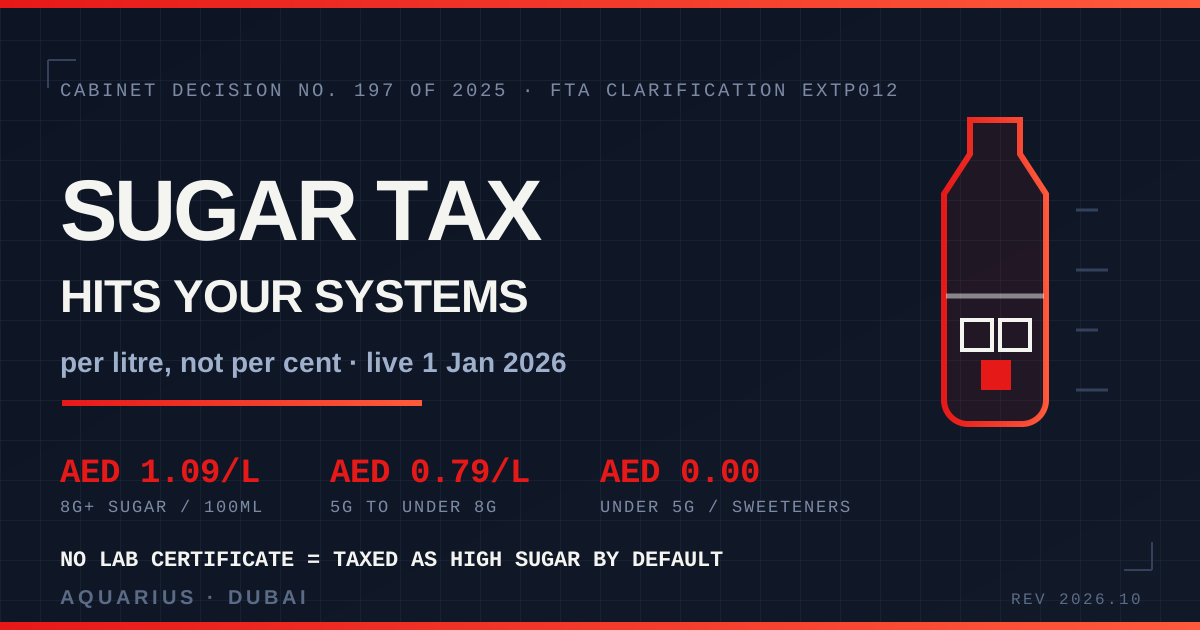
Short answer: since 1 January 2026 the UAE charges excise on sweetened drinks per litre by sugar content instead of as a flat 50% of price: AED 1.09 per litre at 8g or more of sugar per 100ml, AED 0.79 per litre at 5g to under 8g, and zero below 5g or where the drink is sweetened only with artificial sweeteners. Any beverage without an approved conformity certificate on file is taxed at the high-sugar rate by default. The part almost nobody budgeted for: a POS, ERP or online store that stores excise as a percentage field now calculates the wrong number on every single sale, and no amount of price-list editing fixes it.
The number that should have made every Dubai F&B finance team look up
Start with the scale. The UAE soft drinks market is projected at USD 9.7 billion in 2026, heading to USD 13.5 billion by 2031 on a 6.8% CAGR (StrategyHelix). Every litre of that now passes through a tax rule that changed shape, not just rate.
Then the worked example that circulated when the decision landed and still has not reached most product masters. Take a drink retailing at Dh 10 with 6g of sugar per 100ml. Under the old regime it carried roughly AED 5 of excise. Under the tiered volumetric model it carries AED 0.79 per litre — a fraction of the old charge (Andersen UAE, via Gulf News). Flip it around and you get the risk: a low-sugar drink that should pay nothing pays AED 1.09 a litre indefinitely if its paperwork is not in the Federal Tax Authority's system.
The legal basis is Cabinet Decision No. 197 of 2025, which replaced Cabinet Decision No. 52 of 2019 under Federal Decree-Law No. 7 of 2017 on Excise Tax as amended. The FTA published its reading in public clarification EXTP012. The Ministry of Finance framed it as a public-health measure — promoting public health and reducing the financial burdens associated with diseases linked to excessive sugar consumption.
Most Dubai businesses treated this as a pricing announcement. It is a data-model change. Excise stopped being a percentage of the price and became a function of two attributes your product catalogue probably never stored: net volume in litres, and grams of sugar per 100ml.
Ten months in, the market has already moved. Retailers report high-sugar lines slowing while zero- and low-sugar lines accelerate, and multinationals are reformulating into cheaper bands — PepsiCo is reshaping its GCC portfolio so roughly two-thirds of sales come from beverages with 100 calories or less from added sugars per serving. If your systems cannot reprice a reformulated SKU into a new tier without a developer, you are now structurally slower than your suppliers.
What actually changed in the law
| Category | Total sugar per 100ml | Excise from 1 Jan 2026 | Was (to 31 Dec 2025) |
|---|---|---|---|
| High sugar | 8g or more | AED 1.09 per litre | 50% of excise price |
| Moderate sugar | 5g to under 8g | AED 0.79 per litre | 50% of excise price |
| Low sugar | Under 5g | AED 0.00 per litre | 50% of excise price |
| Artificially sweetened only | No sugar, sweeteners only | AED 0.00 per litre | 50% of excise price |
| Carbonated drinks | Judged on sugar content | No longer a separate category — taxed as a sweetened drink | 50% standalone category |
| Energy drinks | n/a | 100% of excise price — unchanged | 100% |
| Tobacco, e-liquids, vaping devices | n/a | 100% of excise price | 100% |
Three consequences worth underlining. First, the carbonated drinks category was abolished as a standalone head of charge — a cola is now simply a sweetened drink assessed on its sugar. Second, energy drinks stayed at 100% of excise price, so your tax engine must run two completely different calculation types side by side in the same basket. Third, from 1 September 2026 a minimum excise price of AED 1 per millilitre applies to liquids used in electronic smoking devices — a floor for calculating tax, not a minimum retail price. Any system that assumed excise equals a percentage cannot express any of this.
The four fields your product master is missing
| Field | Where it comes from | What breaks without it |
|---|---|---|
| Total sugar, g per 100ml | Accredited laboratory test, carried on the conformity certificate | Tier cannot be derived; the FTA defaults the SKU to high sugar |
| Net volume in litres | Product label, per pack configuration | Per-litre tax cannot be computed at all — a 330ml can and a 1.5L bottle of the same drink are different tax amounts |
| Certificate reference and date | Ministry of Industry and Advanced Technology (MoIAT) | No audit trail; reformulations silently keep the old tier |
| Dilution ratio | Manufacturer preparation instructions | Concentrates, powders and syrups get taxed on the wrong volume |
Note the second row carefully, because it is the one that quietly corrupts reporting. Under an ad-valorem rate, excise scaled with price, so pack size looked after itself. Under a volumetric rate, excise scales with litres. Every pack configuration, multipack, case and promotional bundle needs an accurate net-volume value, and a multipack has to resolve to the sum of its units. Catalogues that stored 500ml as a free-text marketing string rather than a numeric litre value cannot be taxed correctly by any downstream system.
Concentrates, powders and gels are where the maths gets strange
The model covers sweetened products in any form — ready-to-drink, concentrates, powders, gels and extracts. For those, tax is assessed on the volume of the final prepared drink, derived from the manufacturer's dilution ratio. Where no usable preparation instruction exists, KPMG's analysis of the rules describes a fallback: total sugar and other sweeteners in grams multiplied by 20. A cordial, a powdered mix and a coffee syrup therefore each need a stored dilution ratio, and liquid concentrates need laboratory evidence supporting their classification. If your inventory system treats a 1L syrup bottle as one litre of taxable drink, it is understating by whatever the dilution factor is — the kind of error that compounds monthly until an audit finds it.
What is genuinely out of scope
- Beverages containing at least 75% milk or 75% milk substitutes.
- Baby formula, follow-on formula, and beverages for special dietary or medical use.
- Drinks prepared fresh on the premises and served in open containers — the barista-made iced latte, the juice pressed to order.
That third exclusion is the single most useful line in the decision for Dubai cafes and restaurants, and the most commonly misapplied. The flat white your barista pours is out of scope. The bottled ready-to-drink version of the same thing sitting in your display fridge is in scope. One venue, two tax treatments, and your POS has to know which product line is which — precisely the kind of rule that belongs in the product master rather than in a staff member's head. If you are rebuilding the ordering layer anyway, our notes on QR menu and table ordering systems in Dubai and on POS and inventory software builds cover where the tax logic should sit.
The evidence requirement: one certificate per SKU
The FTA has been explicit. Sugar content must be evidenced by an Emirates Conformity Certificate for Sugar and Sweeteners Content in Beverages (for Excise Tax purposes), obtained from the Ministry of Industry and Advanced Technology after laboratory testing. Testing must be done at a laboratory listed by the National Accreditation Department or the Emirates International Accreditation Centre. The certificate is then submitted when registering or updating the beverage on EmaraTax. Without it, the beverage is classified in the high sugar category until a laboratory report is provided.
That is per product, not per company. A distributor with 400 beverage SKUs needs 400 defensible sugar values, each tied to a certificate reference, each re-tested when a supplier reformulates. There is no realistic way to run that on a spreadsheet for long.
Where it breaks, system by system
| System | What has to change | Symptom if you skip it |
|---|---|---|
| POS / till | Tax engine must support amount-per-litre alongside percentage rates; tier derived from the SKU, not keyed by staff | Receipts and daily Z-reports overstate or understate excise; margin leak nobody can trace |
| Product master / PIM | New numeric fields: sugar g/100ml, net litres, tier code, certificate reference and date, dilution ratio | The correct rate cannot be derived anywhere downstream, including on the tax return |
| Ecommerce / app | Recompute tax-inclusive display prices; handle multipacks and mixed baskets of tiered and 100% goods | Checkout total disagrees with the tax invoice; refunds reverse the wrong amount |
| ERP / inventory | Excise accrual per litre at receipt and release; Designated Zone movements; stock valuation | Inventory carries the wrong landed cost, so gross margin reporting is wrong by SKU |
| Accounting and returns | Monthly excise return and payment on EmaraTax; litres by tier, reconciled to sales | Incorrect declarations, manual rework every month, penalty exposure |
| Supplier onboarding | Capture the certificate and sugar value at the point a new SKU is listed | Untested SKUs enter the catalogue and default to the top tier |
Excise first, then VAT — in that order
One sequencing trap worth stating plainly, because it is easy to get backwards in code. UAE 5% VAT is calculated on the value including excise tax, not alongside it. So the chain is: establish the tier, apply the per-litre excise to the net volume, add that to the taxable value, then apply 5% VAT to the excise-inclusive amount. An engine that applies both to the same base undercharges VAT on every line of every beverage invoice. For how that flows into invoice structure ahead of the e-invoicing mandate, see UAE e-invoicing and ERP integration.
Registration and filing cadence
Excise has no registration threshold — importing, producing, stockpiling in specified cases, or releasing excise goods from a Designated Zone triggers it, and a single import is enough. Registration is due within 30 days of the end of the month in which the activity first occurs. The tax period is monthly, with the return and the payment both due by the 15th day of the following month via EmaraTax. That cadence is the real argument for automation: twelve filings a year, each needing litres by tier reconciled to actual sales.
If you are still holding mis-tiered stock, the cheap fix has expired
There was transitional relief. On KPMG's reading of the rules, between 1 January and 30 June 2026 a business that had declared goods as high sugar and then obtained a lab report placing them in a lower band could claim a deduction — provided the goods had not been sold, and supported by the laboratory report, the original excise declaration and proof of unsold inventory. That window has now closed. Businesses in this position should take specific advice on the general deduction provisions, which are narrower. The lesson worth keeping for the next change: the paperwork window was six months, and the systems work needed to exploit it took longer than that at most companies.
What the fix costs in AED
These are our own Dubai delivery ranges for excise-related system work, not survey averages:
| Scope | What it covers | Cost (AED) | Timeline |
|---|---|---|---|
| Tax engine patch | Add an amount-per-unit tax type beside percentage rates, tier lookup from SKU attributes, receipt and invoice formatting | 18,000–45,000 | 2–4 weeks |
| Product master upgrade | Sugar, litre, tier, certificate and dilution fields; validation rules; bulk import of 100–1,000 SKUs; certificate expiry alerts | 35,000–80,000 | 3–6 weeks |
| Ecommerce and app repricing | Tax-inclusive display prices, multipack volume maths, mixed-basket handling, excise-then-VAT sequencing, refund reversal | 25,000–70,000 | 3–5 weeks |
| End-to-end compliance build | POS plus ERP plus online store on one tax service, monthly return pack generated from sales data, audit trail per SKU | 90,000–220,000 | 8–14 weeks |
| Ongoing | Rate and rule changes, new SKU onboarding, reformulation re-tiering, support | 1,500–6,000 / month | Ongoing |
Now the cost of doing nothing, using nothing but the published rate and arithmetic. Take a distributor moving one million litres a year of a drink that genuinely sits at 4.5g of sugar per 100ml — a zero-rated product. With no conformity certificate on file, the default classification applies and it is taxed as high sugar: AED 1.09 × 1,000,000 = AED 1,090,000 of excise a year the business does not actually owe. Even at a tenth of that volume the number dwarfs every line in the table above. On the compliance side, an incorrect tax return carries an administrative penalty of AED 1,000 the first time and AED 2,000 for a repeat within 24 months under Cabinet Decision No. 49 of 2021 — small beside the overpayment, but it arrives with the audit that finds it.
How Aquarius handles this
We start with a catalogue audit, not a code change. One pass over your beverage SKUs to find which have a certificate, which have a defensible sugar value, which have no usable net-volume figure, and which are concentrates hiding a dilution ratio nobody recorded. That list is usually the shock. Then the tax calculation moves to a single service that POS, ERP and the online store all call, so a reformulated product changes tier in one place and every channel follows. Certificate references and expiry dates live on the product record with alerts, the monthly return pack is generated from sales data rather than assembled by hand, and every calculation keeps an audit trail per SKU and per litre.
Fixed scope, fixed price in AED, full source handover. See our pricing for how builds are quoted, or send us your beverage SKU list and we will tell you how many of them your current system is taxing incorrectly today.
FAQ
What is the UAE sugar tax rate in 2026?
Excise on sweetened drinks is charged per litre by total sugar per 100ml: AED 1.09 per litre at 8g or more, AED 0.79 per litre at 5g to under 8g, and AED 0.00 below 5g or where the drink is sweetened only with artificial sweeteners. The rates took effect on 1 January 2026 under Cabinet Decision No. 197 of 2025 and replaced the previous flat 50% of excise price.
Does the sugar tax apply to fresh juice and coffee made in my cafe?
No. Drinks prepared fresh on the premises and served in open containers are excluded, as are beverages containing at least 75% milk or milk substitutes, baby formula, and beverages for special dietary or medical use. The bottled ready-to-drink version of the same product sold from your fridge is in scope, so a single venue can carry both treatments and your POS needs to distinguish them at the product level.
Do carbonated drinks and energy drinks still pay 50% and 100%?
Carbonated drinks are no longer a separate excise category. They are now assessed as sweetened drinks on their sugar content, which is why zero-sugar colas became the cheapest option in the aisle. Energy drinks remain at 100% of excise price, and tobacco, e-liquids and vaping devices also remain at 100%. Your tax engine has to run percentage and per-litre calculations side by side.
What happens if I do not have a lab report for a drink?
It is classified in the high-sugar category at AED 1.09 per litre until an approved laboratory report is provided. You need an Emirates Conformity Certificate for Sugar and Sweeteners Content in Beverages, issued by the Ministry of Industry and Advanced Technology following testing at a laboratory listed by the National Accreditation Department or the Emirates International Accreditation Centre, submitted when you register or update the product on EmaraTax.
How is excise calculated on concentrates, powders and syrups?
On the volume of the final prepared drink, using the manufacturer's dilution ratio rather than the volume in the container. Where no usable preparation instruction exists, KPMG describes a fallback of total sugar and sweeteners in grams multiplied by 20. Liquid concentrates also need laboratory evidence supporting their classification, so every syrup and cordial SKU needs a stored dilution ratio in your product master.
Does VAT apply on top of the excise tax?
Yes, and the order matters. UAE 5% VAT is calculated on the value including excise tax, so you apply the per-litre excise first, add it to the taxable value, then calculate VAT on the excise-inclusive amount. Systems that apply both to the same base undercharge VAT on every beverage line.
Who has to register for UAE excise tax?
Anyone importing, producing, stockpiling in specified cases, or releasing excise goods from a Designated Zone. There is no registration threshold, so a single import triggers the obligation, and registration is due within 30 days of the end of the month in which the activity first occurs. Returns and payment are monthly, due by the 15th of the following month on EmaraTax.