
Deconsolidation in Dubai: What Changes the Day You Lose Control of a Subsidiary
MENA closed 884 deals worth US$106.1 billion in 2025, most of them partial stake sales. What IFRS 10 deconsolidation, UAE tax group exit and the system cut-off actually require, in AED.
- PUBLISHED
- 16 NOV 2026
- READ TIME
- 14 MIN
- AUTHOR
- AQUARIUS · DUBAI
- UNIT
- REV 2026.09
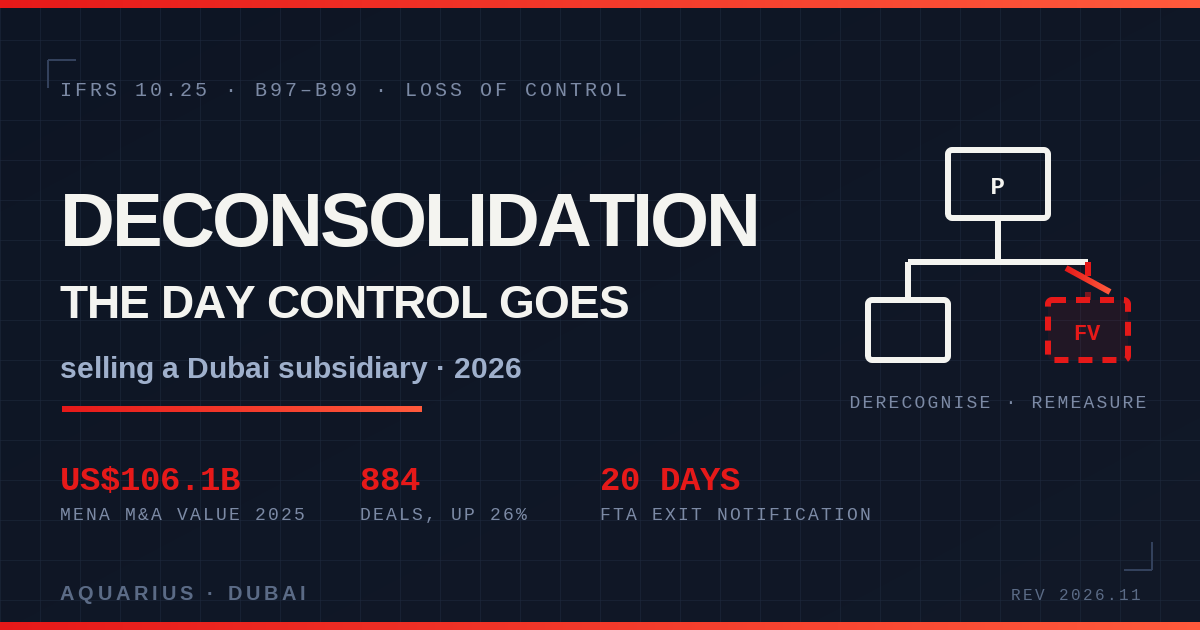
Short answer: under IFRS 10 you deconsolidate a subsidiary on the date you lose control — not the date you drop below 50%, and not the date the lawyers sign. On that date you derecognise every asset, liability and goodwill balance of the subsidiary, derecognise any non-controlling interest, remeasure whatever stake you keep to fair value, recycle the reserves that recycle, and take the whole difference to profit or loss in one line (IFRS 10.25, B97–B99). For a Dubai group that is three problems at once: an accounting entry, a UAE corporate tax event, and a reporting system that still thinks the subsidiary is yours.
Why this keeps happening in the UAE right now
MENA recorded 884 M&A deals worth US$106.1 billion in 2025, against 701 deals and US$92.3 billion in 2024 — volume up 26%, value up 15%, according to EY’s MENA M&A Insights. The GCC alone accounted for 685 of those deals and US$102.1 billion. The UAE sat at the centre of it: 49% of MENA’s inbound deal volume and 92% of inbound deal value, plus 131 domestic deals of its own.
Now look at the shape of the three largest transactions: a 64% stake in Borouge to OMV and Borealis for US$16.5 billion, an 84.76% stake in Modon Holding for US$13.8 billion, and Emirates NBD’s US$4.4 billion deal with RBL Bank. None of them are tidy 100% exits. Partial stake sales, joint ventures and reshuffles inside holding structures are the dominant form the UAE market takes — and every one of them forces the same question onto a finance team: did we just lose control, or not?
That question has a binary answer with wildly different consequences. Get it wrong and your group accounts either carry a subsidiary that is no longer yours, or book a multi-million-dirham gain that should never have touched profit or loss.
Control is the trigger. Percentage is only evidence.
IFRS 10 draws a hard line, and most Dubai finance teams put it in the wrong place.
If you sell down but still control the entity — say 100% to 70% — IFRS 10.23 treats that as a transaction between owners. You adjust the non-controlling interest, push the difference straight to equity, and no gain or loss goes to profit or loss at all. No remeasurement. Nothing in the income statement.
If you lose control, IFRS 10.25 applies and you recognise everything at once. The cliff edge between those two outcomes can be a single percentage point — or no percentage change whatsoever. Control can be lost through a shareholders’ agreement that hands veto rights over relevant activities to the incoming investor, through a board composition change, through a put or call structure, or through dilution when you simply decline to follow a capital increase. Keeping 51% on the share register does not keep control if someone else now directs the activities that drive returns.
Two dates then matter, and they are frequently not the same: the date of legal completion, and the date the parent actually ceases to direct the subsidiary’s relevant activities. IFRS 10 requires the second. If a Dubai SPA signs on 12 March with conditions precedent and the buyer takes board control on 30 April, the deconsolidation entry is dated 30 April, and the subsidiary’s results consolidate for four months, not three. Which means your consolidation system needs to cut off mid-period — something most of them handle badly.
The entry, line by line
IFRS 10.B98 and B99 set out the mechanics. On the loss-of-control date the parent:
- Derecognises the assets and liabilities of the former subsidiary at their consolidated carrying amounts, including any goodwill allocated to it.
- Derecognises the carrying amount of any non-controlling interest, including accumulated NCI share of other comprehensive income.
- Recognises the fair value of consideration received, and any distribution of shares to owners if the exit takes that form.
- Remeasures any retained interest to fair value at that date. That fair value becomes the cost basis going forward — as an associate under IAS 28, a joint venture, or a financial asset under IFRS 9.
- Reclassifies amounts previously recognised in other comprehensive income on the same basis as a direct disposal of the underlying assets. Foreign currency translation and cash flow hedge reserves recycle to profit or loss; an IAS 16 revaluation surplus transfers to retained earnings instead and never touches the income statement.
Here is the arithmetic on an illustrative Dubai group selling 70% of a wholly owned subsidiary and retaining 30% as an associate. The AED figures are an illustration, not a benchmark — the point is which lines exist, and that the biggest one is usually not the cash.
| Line | IFRS 10 reference | AED |
|---|---|---|
| Fair value of consideration received for 70% | B98(b)(i) | 84,000,000 |
| Fair value of the retained 30% interest | B98(b)(iii) | 36,000,000 |
| Non-controlling interest derecognised (none — wholly owned) | B98(a)(ii) | 0 |
| Net assets derecognised, including allocated goodwill | B98(a)(i) | (60,000,000) |
| Translation reserve recycled to profit or loss | B99 | (3,000,000) |
| Gain on loss of control | IFRS 10.25 | 57,000,000 |
Note what AED 36 million of that gain is: a non-cash remeasurement of a stake nobody bought. The cash proceeds were AED 84 million against AED 60 million of net assets. The fair value step-up on the retained 30% adds a third of the reported gain, and your auditor will want that fair value supported — the same valuation discipline you would apply to a purchase price allocation on the way in, just pointed the other way.
One more timing trap: if the disposal was signalled early enough, the subsidiary may have already been classified as held for sale and presented as a discontinued operation under IFRS 5, with depreciation stopped from the classification date. That changes the carrying amounts going into the table above, so the two standards have to be sequenced, not run in parallel by different people.
And from 1 January 2027, IFRS 18 changes where this gain sits. All income and expenses must be classified into operating, investing, financing, income taxes or discontinued operations — and a gain on disposal of a subsidiary falls in the investing category, below the new mandatory operating profit subtotal. Dubai groups with December year-ends will present FY2027 under IFRS 18 with restated FY2026 comparatives, so a disposal booked today will be re-presented in a form your investor deck does not currently produce.
The UAE tax layer nobody schedules
The accounting gain is not the tax answer, and in the UAE the two can be very far apart.
Participation exemption. Article 23 of Federal Decree-Law No. 47 of 2022 exempts dividends and capital gains on a qualifying shareholding — broadly at least 5% held for at least 12 months, with a subject-to-tax test and an asset test for foreign participations. Gains on disposing shares in a UAE-resident subsidiary are exempt from corporate tax without the holding-period and subject-to-tax hoops. Sell a foreign subsidiary too early, or before the 12-month clock runs, and a gain that your accounts show as exempt economics is taxable at 9%.
Tax group exit. If the subsidiary was in a UAE tax group, losing control normally breaks the Article 40 conditions. The tax group must notify the FTA within 20 business days of the date the conditions stop being met. The group’s tax losses stay with the group — but that subsidiary’s unutilised pre-grouping tax losses leave with it. Nobody finds those numbers in a hurry if the group has been filing on a single aggregated ledger.
Audited statements. Ministerial Decision No. 84 of 2025, in force from 1 January 2025, requires audited financial statements from taxable persons with revenue above AED 50 million, from every Qualifying Free Zone Person, and from every tax group — which must prepare audited special purpose financial statements. A mid-year deconsolidation means those SPFS have to show a partial-period consolidation of the departing entity, supported by data most groups can only reconstruct by hand.
Worth knowing: if you are selling into your own joint venture or associate rather than to a third party, the IFRS 10 / IAS 28 amendments on sale or contribution of assets — which would have restricted gain recognition where the asset is not a business — were deferred indefinitely by the IASB in December 2015 and are still deferred. Practice continues under IFRS 10 as written. Do not let an adviser tell you otherwise without a reference.
Where the systems actually break
The accounting entry is a week of work for a competent technical accountant. The expensive part is that your estate was built on the assumption that this entity is yours forever.
- Mid-period cut-off. Most close and consolidation setups consolidate by entity for a full period. Consolidating four months of P&L, then nothing, then equity-accounting a 30% share, usually requires a manual journal that nobody can re-derive at audit.
- Intercompany unwinding. Balances that were eliminated on consolidation become real receivables and payables the moment control goes. If they were never settled or novated, you now have related-party debt with transfer pricing exposure.
- Shared systems and data. The ERP tenant, the CRM, the payroll instance, the BI layer, the domain and the cloud accounts. Separating them is a project in its own right — see the detail on IT carve-outs, TSAs and stranded cost — and PDPL obligations follow the personal data into the new entity.
- Historical evidence. You still need queryable access to pre-disposal transaction detail for FTA assessment windows and for the buyer’s post-completion claims, long after you have stopped paying for the system that holds it.
- Valuation support for the retained stake. That AED 36 million line needs a defensible model, refreshed at each reporting date under IAS 28 or IFRS 9.
What it costs to do this properly in Dubai
The reporting and systems workstream around a UAE deconsolidation typically lands in these ranges. The accounting opinion sits with your auditor; the data layer is where we work.
| Workstream | Typical AED | Duration |
|---|---|---|
| Entity separation and data readiness assessment | 18,000 – 38,000 | 1 – 2 weeks |
| Reporting cut-off and historical data extraction layer | 45,000 – 130,000 | 3 – 6 weeks |
| Consolidation and close reconfiguration post-exit | 60,000 – 180,000 | 4 – 8 weeks |
| TSA-period interim integrations (per interface) | 25,000 – 75,000 | 2 – 5 weeks |
| Tax-group evidence pack and pre-grouping loss reconstruction | 30,000 – 85,000 | 2 – 4 weeks |
Set that against the cost of improvising. Advisers tracking lower-mid-market transactions report that 30–40% of deals are retraded at least once, typically by 5–12% of headline price, and the trigger is almost always something the seller could not evidence on demand. On an AED 60 million Dubai exit, a 7% retrade is AED 4.2 million — more than every line in the table above, combined, several times over. The deconsolidation workstream is cheap insurance on the number you actually bank.
What Aquarius builds is the evidence layer: a reporting cut-off that an auditor can re-perform, exports that survive the system being switched off, interim integrations that keep both sides running through the TSA window, and a consolidation setup that is correct the day after control goes rather than three closes later. Scope and rates are on our pricing page, and if the structure is still being decided, the trade-offs in share deal versus asset deal are worth settling first — they determine whether you have a deconsolidation at all.
FAQ
Do we deconsolidate when we drop below 50%?
Not automatically. IFRS 10 keys off control, not ownership percentage. You can hold 51% and have lost control through veto rights or board composition, and you can hold 40% and retain control through contractual arrangements. Test the three elements of control — power over relevant activities, exposure to variable returns, and the ability to use power to affect those returns — at the specific date, and document the conclusion. Auditors challenge this more often than any other line in the disposal.
What date do we use if completion is conditional?
The date the parent actually ceases to direct the relevant activities, which may be before or after legal completion. If conditions precedent delay board control, consolidation continues until board control transfers. Pin this date in writing early, because it drives the cut-off in every system and the split between consolidated results and equity-accounted results.
Is the IFRS 10 gain taxable in the UAE?
It depends on whether the disposal qualifies under the Article 23 participation exemption, not on the accounting gain. Gains on shares in a UAE-resident subsidiary are exempt without the holding conditions; foreign participations must clear the 5% ownership, 12-month holding, subject-to-tax and asset tests. The remeasurement gain on a retained interest is an accounting figure and needs its own analysis — take advice from a UAE tax adviser on the specific structure.
Do we have to restate prior years?
No. A loss of control is accounted for prospectively from the date it occurs; prior periods are not restated. But if the disposal group met IFRS 5 held-for-sale criteria and qualifies as a discontinued operation, comparative income statement figures are re-presented to show it separately, which looks like a restatement to anyone reading the deck and should be explained before it lands.
When does IFRS 18 affect this?
Annual periods beginning on or after 1 January 2027. For a December year-end Dubai group that is FY2027, with FY2026 comparatives re-presented into the new categories. A disposal gain goes to the investing category, so it sits below operating profit rather than inside it — worth modelling now if your covenants or bonus plans reference an operating profit subtotal.
Losing control of a subsidiary is one date that hits your ledger, your tax position and five systems simultaneously. Most Dubai groups discover the systems half in the week after completion, when the data they need is already behind someone else’s login. Talk to Aquarius before the cut-off date is set, not after.