
Warehouse Management System Development in Dubai (2026): Real AED Costs, Build vs Buy & the Rent Squeeze
Dubai warehouse rents hit AED 58/sq ft with 95% Grade A occupancy — so the cheapest space you will ever buy is the space you already waste. Real 2026 WMS costs, build-vs-buy and ROI math.
- PUBLISHED
- 13 SEPT 2026
- READ TIME
- 10 MIN
- AUTHOR
- AQUARIUS · DUBAI
- UNIT
- REV 2026.09
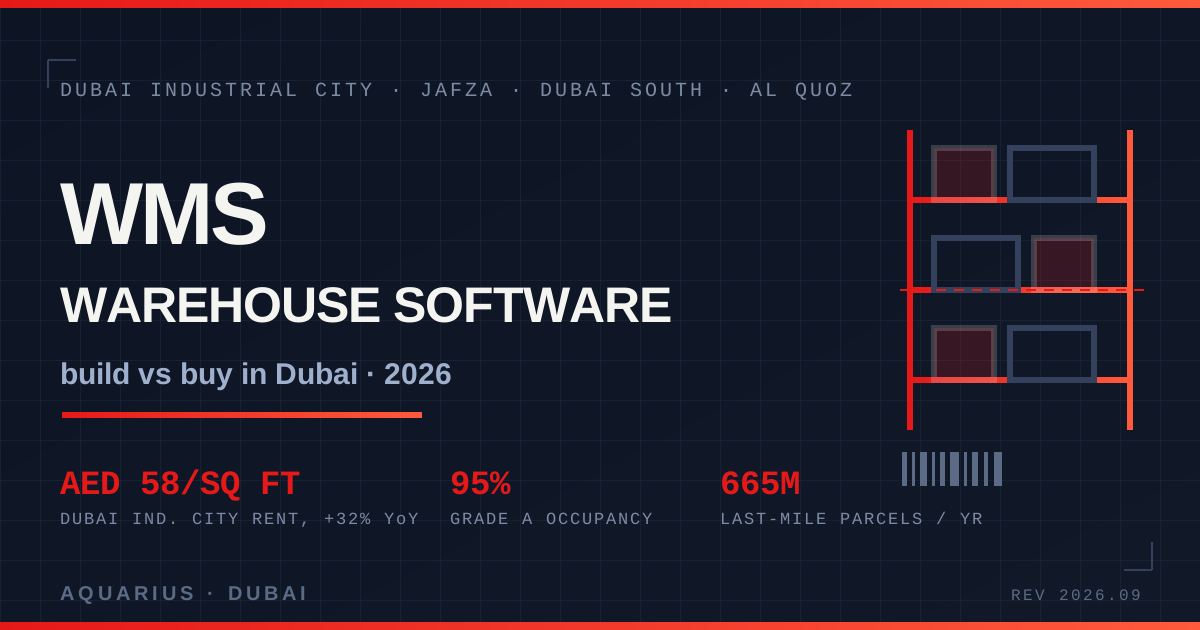
Short answer: In 2026 a Dubai operation can licence an off-the-shelf cloud WMS for roughly AED 7,300-18,400 per month (USD 2,000-5,000 at SME scale), or commission a custom one for AED 45,000-90,000 at entry scope and AED 120,000-280,000 for a multi-client 3PL platform. Buy when your flows are standard; build when your billing, customs paperwork or integrations are not. Either way the business case is the same one: with Dubai Industrial City rents at AED 58 per square foot after a 32% year-on-year jump and Grade A occupancy near 95%, the cheapest square foot you will ever buy is the one you are currently wasting on stock you cannot find.
Key takeaways
- Space is the new constraint, not labour. Knight Frank put Dubai Industrial City at AED 58/sq ft (+32% YoY), Dubai South at AED 45-55 (+25%), Jafza at AED 40-45 (+22%) and prime Al Quoz at AED 100/sq ft in its February 2026 update, with only 6.6 million sq ft of new supply landing in 2026 and 2.2 million in 2027.
- Volume is still climbing. UAE ecommerce is USD 12.30 billion in 2026 heading to USD 21.01 billion by 2031 (11.29% CAGR), the UAE 3PL market is USD 5.60 billion in 2026 heading to USD 8.82 billion by 2031, and annual last-mile parcel volumes are moving from 185 million to 665 million.
- Accuracy is where the money is. At 500,000 orders a year, the gap between 97% and 99.5% pick accuracy is 15,000 versus 2,500 mis-picked orders. Barcode-driven picking typically runs ~30% faster with up to 67% fewer data-entry errors, and cuts new-hire ramp-up from 40+ hours to under 8.
- Returns are a Dubai-specific line item. Global returns average 16.9% of orders (apparel ~26%), and UAE consumer protection law gives online buyers a seven-day return window — so reverse logistics is a core WMS flow here, not an afterthought.
- A compliance clock is running. E-invoicing goes voluntary on 1 July 2026; businesses above AED 50 million revenue must appoint an Accredited Service Provider by 30 October 2026 and go live 1 January 2027, on 51 mandatory fields. Your WMS feeds those fields.
TOFU: Dubai ran out of cheap warehouse space — that is the real story
For a decade the Dubai answer to growing volume was to lease more space. That answer stopped working. Knight Frank's February 2026 market update recorded Dubai Industrial City rents at AED 58 per square foot, up 32% year-on-year; Dubai South at AED 45-55 (+25%); Jafza at AED 40-45 (+22%); and prime Al Quoz at AED 100 per square foot. Grade A occupancy sits at roughly 95%. Supply is not rescuing anyone soon: about 6.6 million sq ft completes in 2026, then just 2.2 million sq ft in 2027.
Meanwhile, demand keeps compounding. UAE ecommerce is worth USD 12.30 billion in 2026 and is forecast to reach USD 21.01 billion by 2031 at an 11.29% CAGR, with Dubai taking roughly 60% of the national market and hosting 100+ fulfilment centres from Dubai CommerCity out to Al Quoz. The UAE third-party logistics market is USD 5.60 billion in 2026, growing to USD 8.82 billion by 2031 (9.52% CAGR). Digital retail's share of UAE transactions is climbing from 8.2% in 2021 to 26.5% in 2026, taking annual last-mile volumes from 185 million to 665 million parcels.
Put those two trends side by side and you get the defining Dubai warehouse problem of 2026: more units, more SKUs, more returns — in square footage that costs a third more than it did last year, and cannot simply be expanded. Mid-sized units of 10,000-50,000 sq ft accounted for 58% of 2025 leasing demand, which is exactly the band where most Dubai traders, D2C brands and small 3PLs operate. They are all bidding for the same shrinking pool.
Most Dubai operations get this wrong: they treat a WMS as an inventory ledger, a slightly better Excel. It is not. It is a density and throughput tool. Directed put-away, bin-level locations, ABC slotting and cycle counting are how you get 20-30% more goods through the same lease — and in a market at AED 58 per square foot, that is the highest-return software you can buy.
MOFU: what a real WMS does that your spreadsheet does not
Adoption has already crossed the tipping point — over 90% of warehouses are expected to use or plan a WMS by 2027, and 62% of 3PL providers already run mobile barcode scanning. The functional core breaks into six blocks, and the difference between a cheap system and a useful one is how many of them are genuinely wired together.
- Receiving & put-away — scan against the purchase order or ASN, capture batch/lot and expiry, and let the system direct the pallet to a bin instead of a person choosing "wherever there's room".
- Bin-level inventory — every unit has a location. This single change is what kills the "we have it somewhere" search that quietly eats an hour of every picker's shift.
- Picking — single, batch, zone and wave picking on a handheld or phone, with a scan-verify step at each touch. Barcode picking typically runs ~30% faster with up to 67% fewer errors than manual entry.
- Packing & dispatch — cartonisation, weight capture, courier label generation, and a manifest that matches what actually left the building.
- Returns (reverse logistics) — inspect, grade, restock or write off. With global returns at 16.9% of orders and apparel near 26%, plus a statutory seven-day online return window in the UAE, this flow decides whether returned stock re-sells within days or dies in a corner.
- Cycle counting & reporting — rolling counts instead of an annual shutdown, and dashboards on accuracy, dwell time, lines per hour and space utilisation.
The numbers behind the pitch are unusually concrete for enterprise software. On 500,000 orders a year, moving pick accuracy from 97% to 99.5% takes you from 15,000 mis-picked orders to 2,500 — in Dubai, where a re-delivery plus a collection is a courier charge, a picker's time and a customer's patience, that is a direct, countable saving. Training costs drop too: new hires who need 40+ hours on paper processes are typically productive in under 8 hours with scanning. Broader warehouse automation programmes report 25-30% reductions in labour cost.
Labour is worth sizing honestly, because it is the number most Dubai operators assume will dominate the ROI — and it usually does not. Indeed data puts the average Dubai warehouse worker at AED 2,183 per month (UAE-wide AED 2,579), with pickers and packers at AED 1,500-2,800 and storekeepers at AED 2,000-4,000, plus AED 400-700 in peak-season overtime. A 20-person floor is roughly AED 45,000-55,000 a month all-in. Trimming 25% of that is real money — but it is often smaller than what you save by not leasing another 5,000 sq ft at AED 58.
MOFU: build or buy in the UAE — and where off-the-shelf breaks
Buy first. That is the honest default, and any consultancy that tells you otherwise before asking about your flows is selling hours. A packaged cloud WMS handles standard receive-store-pick-pack-ship perfectly well, deploys in weeks, and someone else maintains it. Off-the-shelf starts failing in five specific UAE situations:
- Multi-client 3PL billing. If you store other people's goods, you bill on storage per pallet or per cubic metre, inbound handling, per-line picks, VAS and returns — per client, per contract, per tariff. Generic WMS billing modules are where most Dubai 3PLs end up back in Excel, which is exactly the leak that kills margin.
- Free zone and mainland under one roof. Bonded and duty-paid stock, customs declarations and inter-company transfers between a Jafza entity and a mainland one need segregation the product was never designed for.
- Arabic and bilingual floor use. Handheld screens, labels and picker instructions in Arabic and English, plus proper RTL on any web console — retrofitted badly by most imported systems.
- The integration spread. One stock pool has to reconcile against noon and Amazon.ae listings, a Shopify or custom storefront, an ERP, and three or four courier APIs. See our Dubai ERP cost guide for how the ERP side of that prices out.
- Tax and e-invoicing structure. Every dispatch eventually becomes a tax document. VAT is 5%, with registration mandatory above AED 375,000 in taxable supplies (voluntary from AED 187,500) — and e-invoicing turns voluntary on 1 July 2026, with AED 50 million+ businesses appointing an ASP by 30 October 2026 and going live 1 January 2027 against 51 mandatory fields on the Peppol PINT AE specification. Smaller businesses follow with an ASP by 31 March 2027 and go-live 1 July 2027. Detail in our UAE e-invoicing guide.
The pragmatic middle — and what we build most often — is a hybrid: keep a packaged WMS or your ERP's inventory module as the ledger, and build the thin custom layer where your business is actually different. Usually that is the 3PL billing engine, the customs/free-zone segregation, the courier and marketplace integrations, and the handheld picking app. You are not rebuilding a WMS; you are building the 20% no vendor ships.
BOFU: what it costs in Dubai in 2026, and the payback math
Here are the realistic 2026 numbers. Licence figures are converted from published vendor ranges at AED 3.67 to the dollar; build figures are our own Dubai delivery ranges.
| Option | Year-one cost (AED) | Timeline | Best for |
|---|---|---|---|
| Entry cloud WMS (licence) | From ~AED 1,650/month (USD 449) — roughly AED 20,000/year plus scanners | 2-6 weeks | Single site, standard flows, <2,000 SKUs |
| SME cloud WMS (licence + rollout) | AED 92,000-275,000 year one (USD 25k-75k: implementation, training, hardware, 12 months of subscription) | 6-14 weeks | Growing D2C or distributor, one or two sites |
| Enterprise / on-premise licence | AED 184,000-735,000 upfront (USD 50k-200k), or AED 29,000-55,000/month SaaS at enterprise tier | 4-9 months | Large multi-site operations with in-house IT |
| Custom WMS — entry scope | AED 45,000-90,000 | 6-10 weeks | Barcode receiving, bin locations, mobile picking, dispatch |
| Custom WMS — 3PL / multi-client | AED 120,000-280,000 | 12-20 weeks | Per-client tariffs and billing, free-zone segregation, portal |
| Custom platform — multi-site + ERP/marketplace integration | AED 300,000-600,000+ | 5-9 months | Several sites, deep ERP, courier and marketplace sync |
| Hardware (either route) | AED 1,800-4,500 per rugged handheld; label printers AED 2,500-9,000; site Wi-Fi survey & APs AED 15,000-60,000 | 2-4 weeks lead | Non-negotiable — scanning is the whole point |
Now the payback, using a mid-sized Dubai operation: 15,000 sq ft in Dubai Industrial City at AED 58/sq ft = AED 870,000 a year in rent, plus a 20-person floor at roughly AED 600,000 a year in wages. A WMS that lifts usable density by 20% defers a 3,000 sq ft expansion worth ~AED 174,000 a year, and a 25% labour efficiency gain is worth ~AED 150,000 a year — before counting fewer mis-picks, fewer re-deliveries, and faster returns processing. Against an AED 120,000-280,000 custom 3PL build or an AED 92,000-275,000 licensed rollout, payback lands inside 9-14 months, and the deferred lease alone repeats every year after. The cost of inaction is the mirror image: keep running on spreadsheets through a 665 million parcel market and you will pay the expansion, the overtime and the returns anyway — you just will not see the line item.
How Aquarius builds it: (1) a two-day floor walk and data audit before a line of code — half the time the first win is re-slotting, not software; (2) bin-level inventory with directed put-away and ABC slotting sized to your actual velocity data; (3) an offline-tolerant handheld picking app in Arabic and English, because Dubai warehouse Wi-Fi has dead aisles; (4) integrations that hold one stock truth across your storefront, noon/Amazon.ae, your ERP and your couriers — the same discipline we apply in our Dubai fleet and logistics builds; and (5) dispatch data structured for 5% VAT invoicing and the 51-field e-invoicing schema, so 2027 is a configuration change rather than a rebuild. Fixed-scope quotes in AED, source code and data you own, and a phased rollout that never dark-starts a live warehouse. See our pricing or send us your SKU count, order volume and site size and we will model build-versus-buy on your real numbers.
FAQ
How much does a warehouse management system cost in Dubai in 2026?
Licensed cloud WMS platforms start around AED 1,650 per month and run AED 7,300-18,400 per month for SME-scale deployments, with a realistic first-year total of AED 92,000-275,000 once implementation, training, hardware and subscription are counted. On-premise enterprise licences run AED 184,000-735,000 upfront. A custom build is AED 45,000-90,000 at entry scope, AED 120,000-280,000 for a multi-client 3PL platform, and AED 300,000-600,000+ for multi-site with deep ERP and marketplace integration.
Should a Dubai business buy an off-the-shelf WMS or build a custom one?
Buy if your flows are standard receive-store-pick-pack-ship on one or two sites. Build — or build a thin custom layer on top of a packaged ledger — when you bill multiple 3PL clients on per-contract tariffs, run bonded free-zone and mainland stock together, need Arabic handheld screens, or must reconcile one stock pool across marketplaces, a storefront, an ERP and several courier APIs. Those five cases are where packaged systems push Dubai operators back into Excel.
What ROI should we expect from a WMS in Dubai?
The two big levers are space and accuracy. At Dubai Industrial City's AED 58 per square foot, a 20% density gain on a 15,000 sq ft unit defers roughly AED 174,000 of annual rent, and warehouse automation programmes commonly report 25-30% labour cost reductions. Accuracy compounds on top: at 500,000 orders a year, going from 97% to 99.5% pick accuracy removes 12,500 mis-picked orders and their re-delivery costs. Typical payback is 9-14 months.
How long does a WMS implementation take?
A packaged cloud WMS on a single site is typically 2-6 weeks at entry scope and 6-14 weeks with real integration and training. A custom entry-scope build runs 6-10 weeks, a multi-client 3PL platform 12-20 weeks, and a multi-site platform with ERP and marketplace sync 5-9 months. Add 2-4 weeks lead time for handhelds, printers and a Wi-Fi survey, and always run parallel before cutover.
Does a WMS need to handle UAE VAT and e-invoicing?
It needs to feed them. VAT is 5%, with registration mandatory above AED 375,000 in taxable supplies and voluntary from AED 187,500. E-invoicing becomes voluntary on 1 July 2026; businesses with AED 50 million+ revenue must appoint an Accredited Service Provider by 30 October 2026 and go live on 1 January 2027, with everyone else appointing by 31 March 2027 for a 1 July 2027 start. The schema carries 51 mandatory fields on the Peppol PINT AE standard, and several are dispatch-level data your WMS owns — capture them at source rather than reconstructing them later.
How should a Dubai warehouse handle ecommerce returns?
As a first-class flow with its own bins, grading rules and SLA. Global returns average 16.9% of orders and apparel reaches about 26%, and UAE consumer protection law gives online buyers a seven-day return window — so a meaningful share of your inbound volume is returns. The measure that matters is time-to-restock: goods inspected and back in a pickable bin within 24-48 hours re-sell; goods sitting on a returns pallet for three weeks become dead stock occupying space you are paying AED 58 a square foot for.
Bottom line: Dubai's warehouse market is 95% full and 32% more expensive than a year ago, while parcel volumes head toward 665 million a year. You cannot lease your way out of that. Bin-level control, scan-verified picking and a returns flow that actually returns stock to sale are how Dubai operators get more throughput out of the lease they already signed. Talk to Aquarius about a WMS sized to your SKUs, sites and order volume — and we will tell you honestly if buying off the shelf is the better call.