
Smartwatch and Wearable App Development in Dubai (2026): AED Costs, Platforms and Health-Data Rules
42% of UAE residents use a fitness wearable. Real AED costs for watchOS and Wear OS builds, the Google Fit shutdown, Apple 5.1.3 limits and the UAE health-data localisation rules that decide your architecture.
- PUBLISHED
- 04 NOV 2026
- READ TIME
- 11 MIN
- AUTHOR
- AQUARIUS · DUBAI
- UNIT
- REV 2026.09
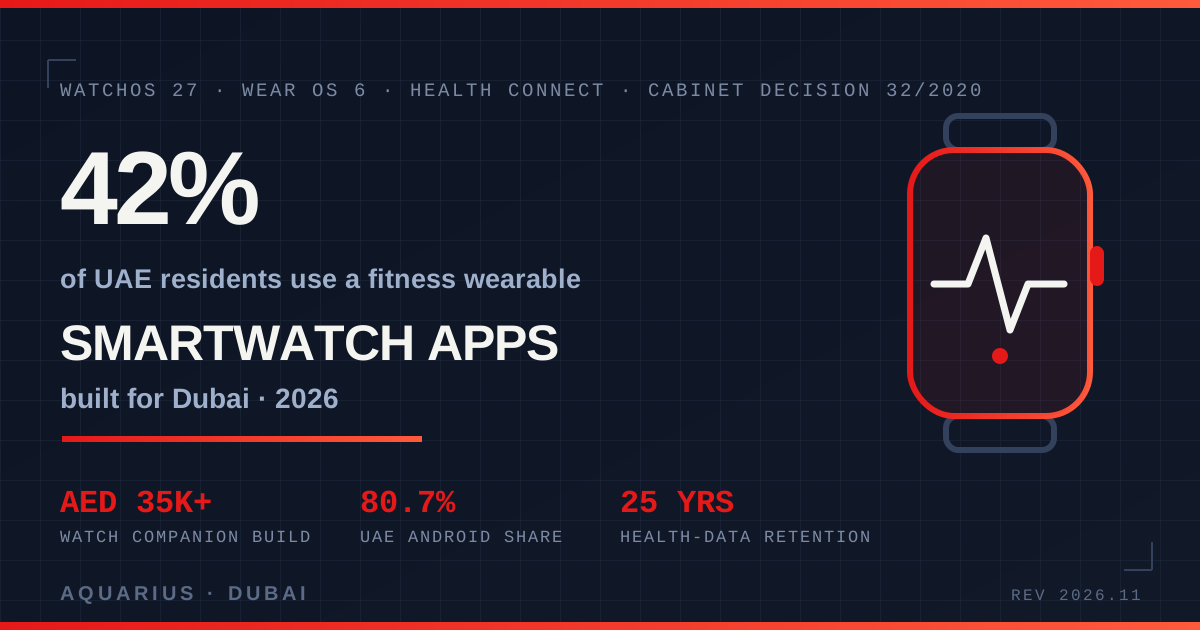
A smartwatch companion app in Dubai costs AED 35,000 to 70,000 when it hangs off an existing mobile app, AED 90,000 to 180,000 as a standalone watch plus phone build with HealthKit and Health Connect, and AED 220,000 to 500,000+ once clinicians, insurers or remote patient monitoring are in scope. The platform work is the cheap part. What blows budgets in the UAE is health-data law: health data generated inside the country generally cannot be stored or processed abroad without health-authority approval, and Apple rejects a whole category of wearable features outright.
Most Dubai businesses get this wrong in the same way. They scope a watch face and a step counter, then discover six weeks before launch that their cloud is in Frankfurt, their insurer partner wants the raw heart-rate stream, and the App Store will not allow either.
Why Dubai is a wearable-first market, not a wearable-curious one
The demand signal here is unusually strong. GymNation's UAE and KSA Health and Fitness Report 2026 — fielded December 2025 to January 2026 across 15,322 respondents, 7,355 of them in the UAE — found 42% of UAE residents regularly use fitness wearables, against 28% in Saudi Arabia. In the same study, 52% of Dubai residents exercise four or more times a week, the highest of any Gulf city measured, and 48% said they had increased their spending on fitness.
The hardware market tracks that behaviour. Grand View Research puts the UAE wearable technology market at USD 1,206.5 million in 2025, reaching USD 3,278.7 million by 2033 at a 13.4% CAGR — roughly AED 4.4 billion of devices on wrists today, growing past AED 12 billion. And the government keeps priming the pump: the 10th Dubai Fitness Challenge ran 31 October to 29 November 2026, with more than 16 million participants recorded across its first nine editions, three Fitness Villages and over 23 community fitness hubs.
Translation for a product owner: your users already own the sensor. You are not selling them a device. You are selling them a reason to keep your app on their wrist.
Platform split: why Dubai cannot be an Apple Watch-only project
This is the first place UAE projects diverge from playbooks written for the US or UK. StatCounter's UAE figures for October 2026 show Android at 80.69% and iOS at 19.29% of mobile OS share. An Apple Watch-first build reaches a high-value minority, not the market.
Globally the wrist is consolidating rather than exploding. IDC's Q2 2026 wearables data recorded 48.01 million wrist-worn units shipped, down 4.3% year on year — smartwatches at 37.08 million (down 4.2%) and basic bands at 10.92 million (down 4.7%), with Huawei, Xiaomi and Apple as the top three vendors. In the Gulf, Huawei and Xiaomi wrists are everywhere. If your app only speaks to Apple Health, you are invisible to most of the people wearing a tracker in Dubai Marina.
The Apple side: watchOS 27 and HealthKit
watchOS 27 shipped on 14 September 2026 and supports Apple Watch Series 9 and later, Ultra 2 and later, and SE 3 only — a narrower install base than most clients assume, and a real decision point if your audience holds older hardware. It adds on-watch access to Apple's Foundation Models framework (local inference, no round trip, no cloud health-data transfer, which matters enormously for UAE localisation) plus new HealthKit workout-zone APIs.
The constraint that surprises teams: HealthKit is not a convenient analytics pipe. Background delivery and continuous sync behave very differently on the watch than on the phone, and anything you want to analyse server-side has to clear both Apple's rules and UAE law before it leaves the device.
The Android side: Wear OS 6, Health Connect, and the Google Fit shutdown
Two breaking changes landed here, and both have cost implications.
- Permissions were rebuilt. Wear OS 6 on Android 16 (API 36) retires the old blanket BODY_SENSORS and BODY_SENSORS_BACKGROUND permissions in favour of granular
android.permission.health.*grants — READ_HEART_RATE, READ_SLEEP, READ_OXYGEN_SATURATION and so on, each requested individually. Wear OS 6.1 followed with Android 16 QPR2 around 1 April 2026. - Google Fit APIs are going away. Google's own migration documentation states the Fit APIs "will be deprecated in 2026", sign-ups closed on 1 May 2024, and — the line that breaks backends — "There is no alternative to the Fit REST API." Replacements are Health Connect (on-device, user-granted) or the account-centric Google Health API. Any Dubai app still reading Fit REST is on borrowed time.
Two Health Connect details quietly change your data model: reading anything older than 30 days requires the separate android.permission.health.READ_HEALTH_DATA_HISTORY permission, and reading while your app is in the background requires READ_HEALTH_DATA_IN_BACKGROUND. You also have to complete the health apps declaration in Play Console or your data access gets blocked at review. Teams who assumed they would "just backfill a year of sleep data" end up rewriting onboarding.
Myth-bust: the insurance-discount model most Dubai brokers ask for is not allowed
This one costs real money when it surfaces late. Apple's App Review Guideline 5.1.3(i) prohibits using HealthKit, Clinical Health Records or Motion and Fitness data for advertising, marketing or use-based data mining. Offering a direct user benefit such as a reduced insurance premium is permitted only if the app is submitted by the entity actually providing the benefit, and the data is not shared with any third party. The standard Dubai arrangement — a broker or agency builds the app, an insurer funds the discount, data flows between them — fails both halves of that test.
Guideline 5.1.3(ii) adds that you must not write false or inaccurate data to HealthKit and may not store personal health information in iCloud. And 1.4.1 rules out an entire feature class: apps claiming to measure blood pressure, body temperature, blood glucose or blood oxygen using only the device's own sensors are not permitted. Accuracy claims need disclosed methodology, and medical apps draw heavier review scrutiny.
Scope these rules at the wireframe stage, not at submission. A rejection on 5.1.3 is not a resubmission, it is an architecture change.
What it actually costs in Dubai
| Build tier | What you get | Cost (AED) |
|---|---|---|
| Watch companion | watchOS or Wear OS companion on an existing app: complications/tiles, notifications, step and heart-rate read, one primary action, single platform | 35,000 – 70,000 |
| Standalone wearable product | Both platforms, HealthKit + Health Connect integration, on-watch workout sessions, offline sync, consented cloud backend, Arabic and English, Play Console health declaration | 90,000 – 180,000 |
| Clinical / regulated | + remote patient monitoring, clinician dashboard, HL7 FHIR R4 interchange, UAE-resident infrastructure, insurer or health-authority integration, audit logging and 25-year retention | 220,000 – 500,000+ |
Typical timelines: 5 to 7 weeks for a companion, 12 to 18 weeks for a standalone two-platform product, and six months or more for anything touching clinicians, where the long pole is approvals rather than code. Budget 15 to 25% of build cost per year for OS upgrades; watchOS and Wear OS both ship breaking changes annually, as 2026 demonstrated twice. For the phone-side economics in more depth, see our Dubai gym and fitness app cost guide.
The UAE health-data rules that decide your architecture
Here is the clause that relocates your servers. Federal Law No. 2 of 2019 on the Use of ICT in Health Fields, read with Cabinet Decision No. 32 of 2020, requires that health data generated inside the UAE not be stored, processed, generated or transferred outside the country without approval from the relevant health authority, coordinated with MOHAP. The same framework sets a minimum 25-year retention period for health records — longer than most startups plan to exist.
Ministerial Resolution No. 51 of 2021 then opened ten exceptions. The one wearable teams care about is exception 6, medical devices and tools, covering simple medical devices and tools used by members of the public in a non-supervised capacity — the blood-pressure cuffs and glucose monitors people buy for themselves. Others cover overseas treatment, laboratory testing, scientific research, insurance coverage and claims, pharmacovigilance, telemedicine, and formal patient requests.
Two practical consequences:
- A consumer fitness tracker and a clinical monitor are different legal products. Steps, sleep and workout logs for personal wellness sit in a far lighter regime than data feeding a clinician's decision. Decide which one you are building, in writing, before architecture.
- If a clinician or hospital ever reads your data, you are in the health-system lane. That means UAE-resident infrastructure, HL7 FHIR R4 interchange for Dubai Health Authority connectivity via NABIDH, audit trails, and retention you cannot delete your way out of. Our Dubai telemedicine app guide covers that side in detail.
Layer the UAE PDPL on top: health data is sensitive personal data, so consent must be explicit, granular and withdrawable — which maps neatly onto Health Connect's per-type permission model if you design for it, and painfully if you do not.
How Aquarius builds wearable apps for Dubai
We start with a one-week data and jurisdiction map: every sensor reading the app touches, where it is processed, where it rests, who else sees it, and which rule applies — Apple 5.1.3, the Play health declaration, Federal Law 2/2019, PDPL. That document is what prevents the AED 200,000 rewrite later.
Then we build on-device first. Health analytics that run locally, including on-watch inference via Foundation Models on supported Apple Watch hardware, never raise a cross-border transfer question, because the data never crosses a border. Cloud comes in only for what genuinely needs it, hosted on UAE-resident infrastructure.
Both platforms ship together, Arabic and English, and we hand over the Play Console health declaration and App Store privacy disclosures completed rather than leaving your team to guess.
The cost of not building this properly is visible in the demand itself. The IDF Diabetes Atlas, 11th edition (2025), puts UAE adult diabetes prevalence at 20.7% in 2024, or 1,274,200 adults, rising towards 1.9 million by 2050. That is the market for continuous monitoring, adherence and preventive-care wearables in this country, and today it is largely served by apps built for other jurisdictions' laws. A compliant local product does not merely avoid a rejection. It is the moat.
FAQ
Do I need a separate app for the Apple Watch?
Not separate, but separately built. A watchOS app is its own target with its own UI, lifecycle and review surface — you cannot ship iPhone screens to a wrist. Same on Wear OS, which uses its own Compose-based tiles and complications. Budget it as a platform, not a feature.
Can my app read a user's past year of health data?
On Android, only with the extra READ_HEALTH_DATA_HISTORY permission; without it Health Connect limits reads to the previous 30 days. On iOS, HealthKit grants are per data type and per direction, and users can revoke any of them at any time. Design onboarding so the app is useful on day one with no history at all.
Is Google Fit integration still a valid option in 2026?
No. Google's documentation confirms the Fit APIs are being deprecated in 2026, sign-ups closed in May 2024, and there is no direct replacement for the Fit REST API. New builds go to Health Connect for on-device data, or the Google Health API for account-centric access. Existing Fit integrations need a migration plan now.
Can we store UAE users' health data on AWS Frankfurt or Google Europe?
Not for data in the health-system scope. Federal Law 2/2019 and Cabinet Decision 32/2020 require health-authority approval, coordinated with MOHAP, before UAE-generated health data is stored or processed abroad, with Ministerial Resolution 51/2021 providing specific exceptions. The cheap route is to keep clinical data on UAE-resident infrastructure and process consumer wellness metrics on-device.
Can our app show an insurance discount based on activity?
Only if the entity providing the discount is the entity publishing the app, and the data is not shared with any third party. Apple's Guideline 5.1.3(i) is explicit about both conditions. The usual broker-builds-the-app, insurer-funds-the-reward structure does not qualify.
Where to start
If you are weighing a wearable build, the cheapest hour you will spend is the one that maps your data flows against Apple's rules and UAE health-data law before design starts. We run that as a fixed-scope engagement, and if the answer is that you should not build a watch app, we will say so.
See transparent AED pricing, or tell us what you want to measure and we will tell you what it costs and what it is allowed to do.