
Web Font Delivery on UAE Sites: We Scanned 632 .ae Homepages (2027)
First-hand scan of 632 UAE homepages: 48.4% of 14,502 @font-face rules ship no font-display, 57.6% risk invisible text, and median font payload is 130.7 KB.
- PUBLISHED
- 24 NOV 2026
- READ TIME
- 11 MIN
- AUTHOR
- AQUARIUS · DUBAI
- UNIT
- REV 2026.09
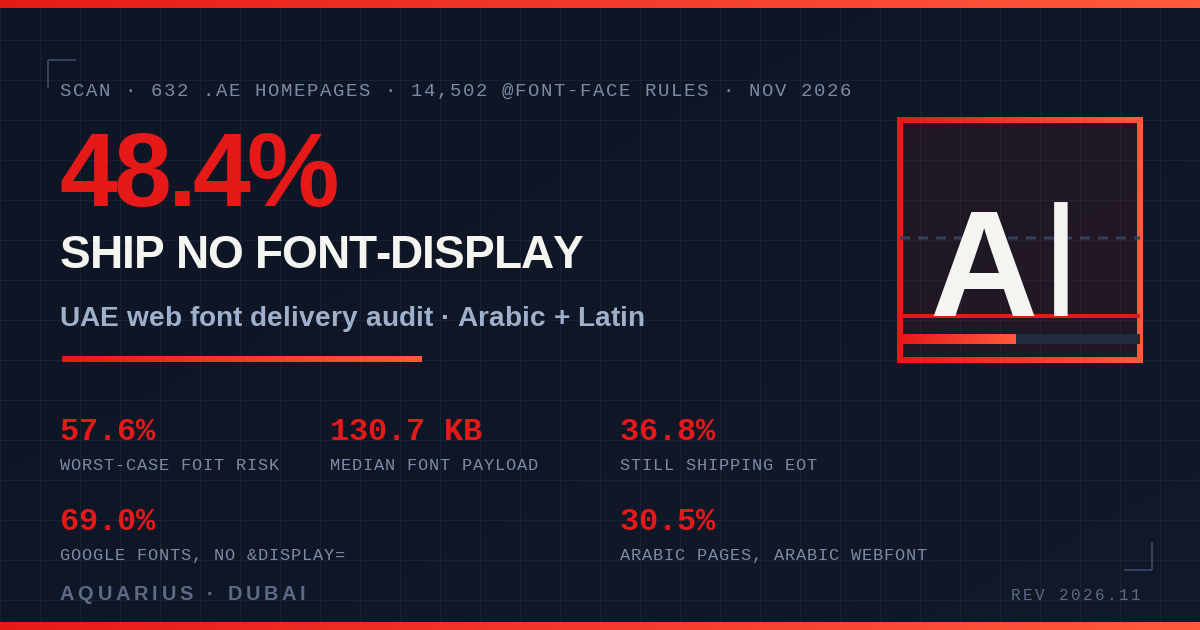
We downloaded and parsed the fonts on 632 live UAE homepages in November 2026. 7,016 of the 14,502 @font-face rules we found — 48.4% — ship no font-display at all, which means the browser gets to decide whether your Dubai visitor sees text or a blank space. 57.6% of the sites that use web fonts are in the worst-case bucket: at least one bare font face and no font preload. Chromium and Firefox block text rendering for up to 3 seconds waiting on that font; Safari blocks it indefinitely.
This is a first-hand scan, not a survey. Below is every number, how we got it, and the exact fix order — starting with the one-character change that removes most of the risk.
Why font delivery is the quiet tax on UAE sites
Three numbers set the stakes for a Dubai business.
- 67.8% of UAE web traffic is mobile (StatCounter, UAE, October 2026). Font bytes land on a phone, not a desk.
- The UAE averages 681.14 Mbps mobile download speed (Ookla) — so bandwidth is rarely the bottleneck. Render-blocking behaviour is. A fast pipe does not help you if the browser has decided to paint nothing.
- Google and Deloitte measured that a 0.1-second improvement in load time lifted retail conversion by 8.4%. Font blocking is routinely worth more than 0.1s.
And the fonts are not small. Across 1,759 successfully measured font files, the median file was 26.6 KB, the 90th percentile 102.2 KB, and the largest single file we pulled was 4,285.3 KB — one TrueType file on a single UAE homepage. Per host, the median font payload was 130.7 KB, p75 228.0 KB, p90 389.3 KB.
The myth most Dubai teams get wrong: Google Fonts does not default to swap
187 of the 632 homepages (29.6%) load fonts from fonts.googleapis.com. 129 of those 187 — 69.0% — request the stylesheet without &display=.
We tested the assumption rather than repeating it. Requesting css2?family=Roboto:wght@400 returns 5,529 bytes of CSS containing zero font-display declarations. Adding &display=swap to the same URL returns the same families with nine font-display: swap lines. There is no hidden default — and per MDN, the initial value of font-display is auto, which means "the font display strategy is defined by the user agent."
Pasting the Google Fonts embed code from a tutorial and leaving off &display=swap is the single most common font mistake on UAE homepages. It is a 14-character fix.
Among the 481 hosts that declare at least one font face, 355 (73.8%) have at least one face with no font-display. Only 85 (17.7%) set it on every single face. Where a value was present, the distribution was: swap 6,548 faces, block 592, optional 149, auto 144, fallback 53.
What we found, by failure mode
481 of 632 parsed homepages (76.1%) declare at least one @font-face. Here is how those 481 sites performed on each delivery control.
| Delivery control | Sites doing it right | Sites exposed | What goes wrong |
|---|---|---|---|
font-display on every face | 85 (17.7%) | 355 (73.8%) | Up to 3s of invisible text in Chrome/Firefox; indefinite in Safari |
| Preloads at least one font | 126 of 632 (19.9%) | 506 (80.1%) | Font discovered only after CSS parses — two round trips late |
Uses unicode-range subsetting | 271 (56.3%) | 210 (43.7%) | Median 49.3 KB per file vs 19.0 KB when subset — 2.6× |
| Ships WOFF2 only | 149 (31.0%) | 332 (69.0%) | Legacy formats bloat the CSS and invite wrong-format downloads |
| No EOT / SVG font fallbacks | — | EOT 177 (36.8%), SVG 168 (34.9%) | Formats for IE8 and iOS 4. Dead weight in 2026. |
| Variable fonts | 67 (13.9%) | 414 (86.1%) | Multiple static weights downloaded where one file would do |
| Worst case: bare face + no preload | — | 277 (57.6%) | Blocking font the browser cannot even find early |
WOFF2 support is near-universal in declarations — 447 hosts (92.9%) and 13,171 face declarations. The problem is what sits beside it: WOFF on 288 hosts (59.9%), TrueType on 245 (50.9%), Embedded OpenType on 177 (36.8%), SVG fonts on 168 (34.9%). The byte penalty is measurable in our own data: WOFF2 files had a median of 24.9 KB (p90 76.4), while TrueType files ran a median of 88.7 KB with a p90 of 217.4 KB.
Icon fonts are the real whale
The biggest payloads we measured were almost never body text. Font Awesome appears on 116 of 481 hosts (24.1%), IcoMoon or custom icon sets on 45 (9.4%), Glyphicons on 22 (4.6%), Material icon fonts on 20 (4.2%).
Concretely: one UAE news portal ships 36 font faces and 1,638.2 KB of fonts, of which three Font Awesome Pro files account for 421.7 + 417.6 + 382.5 KB. A university homepage spends 3,907.8 KB on a single Material Symbols file. A government e-commerce gateway ships 942.1 KB because it self-hosts two Segoe UI weights at 504.5 and 396.7 KB. Those are icon and system-font choices, not design requirements — the same visual result is a few KB of inline SVG.
Resource hints are mostly missing
Of all 632 homepages: 260 (41.1%) issue any preconnect, only 138 (21.8%) preconnect to fonts.gstatic.com (where the font bytes actually live), 178 (28.2%) use dns-prefetch, and 126 (19.9%) preload a font. Among the sites that do preload, the median is 2 fonts and the p90 is 6 — but 15 hosts preload 5 or more, which is its own problem: preload competes with everything else for early bandwidth.
We also found that 177 of the 178 Google-Fonts-using hosts with font faces also self-host WOFF2 files. Two font delivery paths, two connection setups, double the bytes at risk.
The Arabic gap nobody is measuring
295 of 632 homepages (46.7%) render real Arabic text. Of the 243 Arabic-rendering hosts that declare any font face, only 74 (30.5%) declare an Arabic-script web font at all. The other 69% hand Arabic rendering to whatever the device happens to have — which is why the same UAE site looks typographically correct in English and improvised in Arabic.
Where Arabic fonts are declared, the families are: Noto Kufi Arabic 17, Alexandria 17, Tajawal 13, Almarai 9, Cairo 8, Dubai 7, Noto Sans Arabic 6, IBM Plex Sans Arabic 4, Droid Arabic Kufi 4, 29LT Bukra 3. Dubai Font appears on 17 hosts in total, concentrated exactly where you would expect — Digital Dubai, DMCC, Dubai Culture, Dubai Health, Dubai Police, Dubai Taxi, DDA, Fazaa, HIPA.
Arabic fonts cost more: a median of 32.1 KB per file (p90 134.4) against 25.8 KB for everything else, because Arabic glyph sets are larger and contextual forms cannot be dropped. That makes unicode-range more important for bilingual UAE sites, not less — and 43.7% of sites with fonts use none. If you run a bilingual site, this pairs directly with our Arabic RTL readiness scan of .ae homepages.
Government sites are the worst performers
We isolated 55 .gov.ae hosts, 44 of which declare font faces. Missing font-display: 75.0%. Font preload: 6.8%, versus 19.9% overall. Median 14 font faces per host, median payload 171.6 KB, p90 443.1 KB.
Platform matters more than budget
| Platform | Hosts | Missing font-display | Preloads a font | Uses unicode-range | Median faces |
|---|---|---|---|---|---|
| Next.js | 55 | 83.6% | 40.0% | 52.7% | 14 |
| Drupal | 11 | 81.8% | 18.2% | 45.5% | 9 |
| Magento | 20 | 80.0% | 30.0% | 40.0% | 8 |
| WordPress | 91 | 74.7% | 23.1% | 72.5% | 35 |
| Shopify | 43 | 67.4% | 60.5% | 37.2% | 11 |
Shopify leads on preload (60.5%) because the platform does it for you. Next.js leads on missing font-display (83.6%) because teams hand-roll @font-face and forget it. WordPress leads on face count — a median of 35 faces per homepage, mostly theme and plugin fonts nobody chose.
The fix order, cheapest first
- Add
&display=swapto every Google Fonts URL, orfont-display: swapto every self-hosted face. Removes the 3-second block. Minutes of work. - Delete EOT, SVG font, and TTF fallbacks. WOFF2 is supported everywhere that matters. 36.8% of UAE sites with fonts still carry EOT.
- Audit icon fonts. If you use fewer than 30 icons, inline SVG and delete the font. This is where the 400 KB files live.
- Subset with
unicode-range. Measured 2.6× byte reduction in our own dataset — and essential for Arabic. - Preload only the one or two fonts used above the fold, and
preconnecttofonts.gstatic.comif you use Google Fonts. Not five fonts. - Collapse static weights into one variable font. Only 13.9% of UAE sites with fonts use them.
- Pick one delivery path. Self-hosted or Google — not both, which 177 of 178 hosts currently do.
Font bytes compound with everything else on the critical path, so fix them alongside the other two cheap wins we have measured on .ae sites: image delivery and AVIF adoption and text compression.
What this costs in Dubai
Font delivery is a small, bounded engagement — which is why it is the highest-ROI performance work available to most UAE businesses. Typical Dubai market ranges:
| Scope | AED range | Timeline | What you get |
|---|---|---|---|
| Font audit only | 2,500 – 5,000 | 2 – 3 days | Full inventory, byte measurement, prioritised fix list |
| Audit + implementation (single site) | 5,000 – 12,000 | 1 – 2 weeks | font-display, WOFF2-only, subsetting, preload, icon-font removal |
| Bilingual EN/AR typography rebuild | 12,000 – 30,000 | 3 – 5 weeks | Arabic web font selection, matched metrics, RTL type scale, subsetting |
| Full Core Web Vitals programme | 25,000 – 60,000 | 6 – 10 weeks | Fonts, images, compression, scripts, INP, monitoring |
The cost-of-inaction number worth holding onto: UAE e-commerce is projected to grow from USD 12.30 billion in 2026 to USD 21.01 billion by 2031 (Mordor Intelligence). At 8.4% conversion lift per 0.1s, a font fix that saves half a second on a mid-size Dubai store is not a technical nicety — it is a line item.
How Aquarius does it
We measure before we touch anything. Every engagement starts with the same scan we ran here: every @font-face enumerated, every font file downloaded and weighed, every declaration checked for font-display and unicode-range. You get the byte numbers for your site, not a Lighthouse screenshot.
Then we fix in the order above and re-measure. For bilingual clients we treat Arabic as a first-class typographic system — matched x-heights, subsetted Arabic ranges, and a real Arabic web font instead of a system fallback, which 69% of Arabic-rendering UAE sites are currently shipping.
Risk reversal: if the audit does not find a measurable reduction in blocking font bytes on your site, we do not invoice it. Our pricing page lists the fixed-fee tiers, and a 20-minute call is enough to tell you which bucket you are in — we will run the three key greps on your homepage live.
FAQ
Does font-display: swap hurt Core Web Vitals?
It trades invisible text for a layout shift when the real font arrives. web.dev's guidance is to "use font-display: swap but make sure to deliver the font early enough that it does not cause a layout shift" — i.e. pair it with preload and a metric-matched fallback. swap alone is still strictly better than the auto default that 48.4% of UAE font faces currently inherit.
Should a Dubai business self-host fonts or use Google Fonts?
Either, but not both — and 177 of the 178 Google-Fonts-using UAE homepages we scanned do both. In our data, gstatic-served files were smaller (median 20.7 KB vs 37.1 KB self-hosted), largely because Google serves subsetted WOFF2 with unicode-range by default. Self-hosting wins if you subset properly; Google Fonts wins if you will not.
Which Arabic web font should we use?
For Dubai government-adjacent work, Dubai Font is the obvious choice and appears on 17 of the hosts we scanned. For commercial sites, Noto Kufi Arabic, Alexandria, Tajawal, Almarai and Cairo are the families actually in production on .ae homepages. Choose on metric compatibility with your Latin font, then subset — Arabic files ran a median 32.1 KB in our measurement.
Is 130 KB of fonts actually a problem?
130.7 KB is the UAE median, and on its own it is survivable. The problem is the distribution: p90 is 389.3 KB and we measured hosts at 4,456.0 KB. Combined with no font-display, the bytes arrive late and block text while they do. Fix the blocking first, then the bytes.
How do I check my own site in five minutes?
View source, search for fonts.googleapis.com and confirm &display= is present. Then open DevTools → Network → Font, reload, and read the total transferred. If it is above 200 KB or you see .ttf/.eot files, you are in the exposed 69%.
Method and limits
We took the .ae hosts in the Tranco top-1M list (781), fetched homepages on 24 November 2026, and parsed 632 that returned usable HTML. For each we parsed inline <style> blocks plus up to 5 external stylesheets (2,216 CSS files across 548 hosts), extracted every @font-face rule (14,502 across 481 hosts), and then issued HEAD-style measured requests for up to 5 font files per host (1,808 requests, 1,759 returning 2xx).
Limits worth stating: homepage only, not whole sites. Caps of 5 CSS files and 5 font files per host mean per-host payloads are floors, not totals. We parsed static HTML and CSS only, so fonts injected by JavaScript are invisible to us. And our unit is the font face, not the page — so our 48.4% is not directly comparable to page-level industry figures. Every number above understates the problem rather than overstating it.
If you want the same scan run against your own Dubai site — your faces, your bytes, your fix list — send us the URL.