
Wedding & Venue Management Software in Dubai (2027): Costs, Features and the Ramadan Calendar Problem
Dubai logged 4,782 marriage contracts in nine months of 2025 and 766 fell in February alone. Ramadan 1448 starts around 8 February 2027 — here is what that does to your season, and your software.
- PUBLISHED
- 23 NOV 2026
- READ TIME
- 11 MIN
- AUTHOR
- AQUARIUS · DUBAI
- UNIT
- REV 2026.09
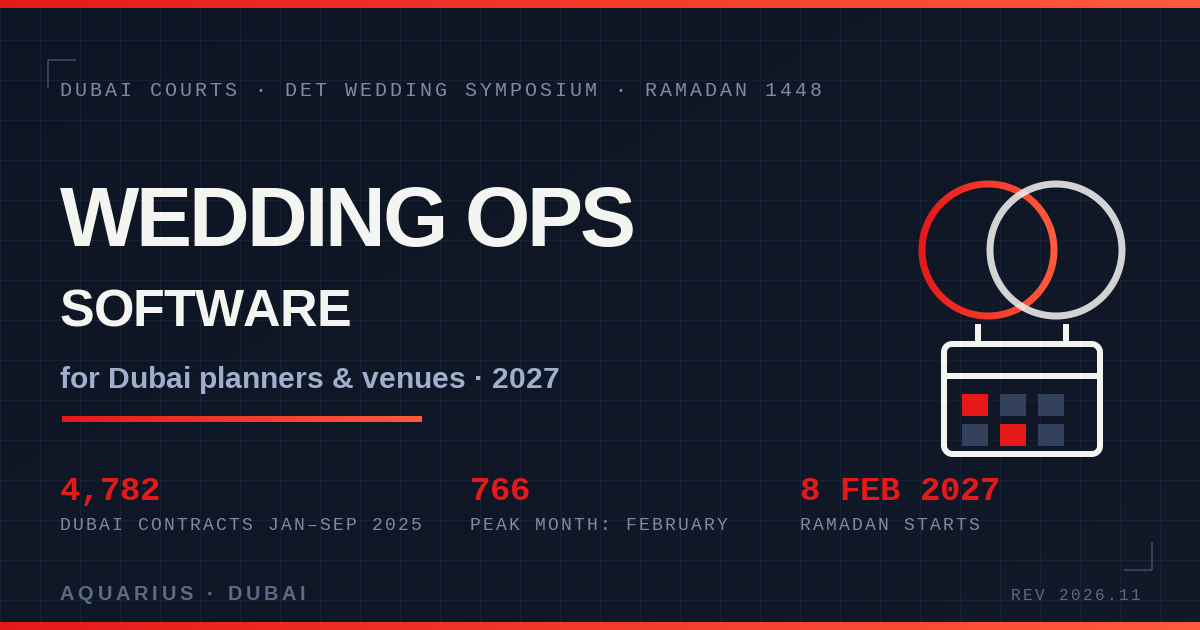
Short answer: Wedding and venue management software in Dubai is the system that runs the enquiry, the hold-and-release on a ballroom date, the staged AED deposits with 5% VAT, the bilingual guest list, and the vendor schedule on the day. Dubai Courts registered 4,782 marriage contracts in the first nine months of 2025 — about 17 a day, and February alone took 766 of them. A planner or venue running that on WhatsApp threads and a shared spreadsheet is not short of demand; it is short of a system.
Here is the part most Dubai operators have not priced in yet. Ramadan 1448 is forecast to begin on 8 February 2027. Your single biggest wedding month is about to sit inside the one month nobody books. The 2027 season does not shrink evenly — it compresses into roughly ten weeks between late October 2026 and early February 2027, and whoever cannot quote, hold and invoice inside a day will lose those dates to whoever can.
The numbers behind the Dubai wedding market in 2026–2027
Three sets of figures set the stakes, and none of them are soft.
1. Volume is real and it is documented. Dubai Data and Statistics Establishment, drawing on Dubai Courts records, counted 4,782 marriage contracts in Dubai from January to September 2025 — an average of about 17 marriages per day. The monthly split is where the operational story lives: February 766, May 711, January 665, April 614, June 562, August 559, July 556, March 341. (The published September figure of 8 is clearly a partial-month artefact, so we exclude it from the share maths below.) Across the eight complete months, that totals 4,774 contracts — and February is 16% of them on its own, 2.2 times the March volume. March 2025 contained Ramadan. That is the seasonality curve, visible in official data.
2. The Emirati segment is growing fast and is now institutionally organised. Marriage contracts between Emirati couples in Dubai climbed from 983 in 2022 to 1,450 in 2025 — a 47.5% rise over four years. The Dubai Weddings initiative, delivered by the Community Development Authority under the Sheikha Hind bint Maktoum Family Programme, accounted for 48% of all Emirati weddings held in Dubai in 2026, has helped establish roughly 1,500 families, and reports a 99.5% beneficiary satisfaction rate. Nearly half of one whole segment now arrives through a coordinated programme with service expectations attached.
3. The inbound destination-wedding channel is being actively built. Dubai Department of Economy and Tourism's Wedding Symposium drew more than 100 international wedding planners from 37 countries — a 19% increase in country spread year on year — alongside 67 Dubai-based stakeholder partners (double the previous edition), 25 hospitality venues, 40 suppliers, and a 226% surge in curated one-to-one meetings. Dubai has 830+ hotels and resorts to sell into that pipeline, and Research and Markets sizes the global destination-wedding market at USD 48 billion in 2025 rising to USD 137 billion by 2029.
The paperwork in the UAE is already fully digital. Abu Dhabi Judicial Department has attested 53,000 civil marriage contracts for foreigners since Civil Marriage Law No. 14 of 2021 took effect, including 4,320 in Q1 2026 alone — roughly 1,600 a month, 70 a day, 13 every hour. A couple can complete a ceremony remotely through the TAMM app for AED 800, over a secure video link, receiving a bilingual Arabic–English certificate signed with a UAE Pass digital signature rather than a physical stamp. The state digitised the legal step. Most of the vendor industry around it did not.
What Dubai actually needs that generic wedding software does not do
The global wedding planning software market is estimated at roughly USD 1.1 billion in 2026, heading to USD 2.55 billion by 2033 at about a 13% CAGR (estimates vary by scope — a second house puts it at USD 0.91 billion in 2025 growing 9.2% annually, so treat the direction as reliable and the absolute number as approximate). Almost all of that spend sits in American and European products built for a Saturday-afternoon, single-calendar, English-only wedding. Six things break when you point one of those at a Dubai operation.
1. The calendar is lunar, and it is not fixed
Ramadan and Eid dates depend on a moon sighting, not a formula. Ramadan 1448 is expected to start on 8 February 2027, with the UAE Moon Sighting Committee looking for the crescent after sunset on Sunday 7 February — if it is not sighted, the month starts on 9 February instead, and Eid al-Fitr lands around 9–10 March. Software that hard-codes blackout dates will be wrong by a day every single year. A Dubai system needs a dual Gregorian–Hijri calendar, blackout windows that an administrator can shift at 48 hours' notice, and a cascade that automatically re-flags every affected booking, deposit schedule and vendor confirmation when the date moves.
2. Bilingual is not a translation layer
Invitations, RSVP portals, guest instructions and contracts need genuine Arabic and English side by side, with correct right-to-left layout, mirrored navigation and Arabic numerals handled properly — not a Google-translated afterthought. Getting this wrong is the single most visible quality signal to an Emirati or Khaleeji client. See our notes on Arabic RTL design for UAE sites.
3. Seating plans are not one room
A large Emirati or Khaleeji wedding frequently runs separate men's and women's celebrations, sometimes in different halls, sometimes on different nights, with distinct guest lists, catering counts and service staff. A seating module built around one floor plan and one headcount cannot model that, and the error surfaces as a catering invoice dispute.
4. Money is staged, and VAT is on it
Dubai weddings are paid in tranches — hold deposit, venue confirmation, final headcount, on-the-day extras — and each tranche needs a proper tax invoice carrying your TRN with 5% VAT shown separately. VAT registration is mandatory above AED 375,000 of taxable supplies and voluntary above AED 187,500. If you are still issuing deposit receipts from a Word template, read our breakdown of UAE e-invoicing and VAT-compliant invoicing before the next phase lands.
5. Guest lists are regulated personal data
A destination wedding guest list holds names, phone numbers, dietary and medical notes, flight details and often passport scans for visa support. Under Federal Decree-Law No. 45 of 2021 (the UAE PDPL) that is personal data you are processing on a client's behalf, which means a lawful basis, retention limits, and deletion after the event — not a folder of PDFs in a shared inbox three years later. Our PDPL compliance checklist covers what that means for a booking system.
6. The ballroom has no signal
Most Dubai hotel ballrooms sit below ground. On the day, your coordinator is checking a run sheet, confirming vendor arrivals and marking guest tables in a basement with no usable mobile data. Anything cloud-only becomes a printed sheet by 6pm. Offline-first data capture that syncs when the device resurfaces is not a nice-to-have — it is the difference between a system people use and a system they abandon on the day it matters.
What it costs to build in Dubai (AED)
These are our own planning ranges for a custom build in Dubai, not vendor list prices. They assume bilingual EN/AR from day one, AED payments with VAT-correct invoicing, and hosting that keeps client data where your contracts say it is.
| What you are building | Core scope | Typical AED range |
|---|---|---|
| Planner's client & vendor CRM | Enquiry pipeline, proposals, contracts, staged payment schedule, vendor directory, moodboards — 12–18 screens | 28,000 – 55,000 |
| Venue enquiry-to-booking engine | Hall and date availability, timed hold-and-release, quote builder, deposit capture, VAT tax invoices, Hijri-aware blackout calendar | 45,000 – 95,000 |
| Guest-side portal & RSVP app | Bilingual RTL invitations, RSVP with dietary and accessibility fields, travel and visa document upload, dual-hall seating, QR check-in | 35,000 – 70,000 |
| Multi-property operations platform | Cross-venue calendar, F&B costing per cover, vendor marketplace with commissions, roles and approvals, revenue dashboards | 120,000 – 260,000 |
| Offline day-of coordinator module | Run sheet, vendor arrival log, table marking, incident notes — works with no signal, syncs on reconnect | 18,000 – 38,000 |
| Annual maintenance & hosting | Updates, Hijri calendar rollover, security patching, support | 15–25% of build per year |
Ranges are planning estimates for scoping conversations, not quotes. Scope, integrations and design depth move the number. Current figures are on our pricing page.
Most operators do not need the bottom row of that table first. The lazy, correct sequence is: booking engine before marketplace, deposits before dashboards, one language pair done properly before a third. A single-venue operator who fixes enquiry-to-deposit usually sees the return before the guest portal is even designed.
How Aquarius builds these
We build wedding and venue systems the same way we build the rest of our Dubai software work: the revenue path first, in one short phase, live and in use before anything else is scoped. For a venue that means availability, hold-and-release and a VAT-correct deposit invoice. For a planner it means enquiry capture, a proposal that can be accepted on a phone, and a payment schedule that chases itself.
The Dubai-specific pieces are not add-ons for us — the Hijri-aware calendar, the EN/AR right-to-left guest portal, PDPL-aware retention on guest data and offline day-of capture are in the first build, because retrofitting any of them costs more than including them. If your operation overlaps with food service or ticketed events, the same stack extends into catering and banquet management and event ticketing without a rebuild.
The cost of waiting, in one line. February carried 16% of Dubai's documented marriage contracts across the complete months of 2025. In 2027 that month is expected to be inside Ramadan. If your 2027 season is really ten weeks long, every week you spend quoting by WhatsApp is roughly 10% of the year's enquiries handled at the speed of your slowest reply. Fixing the enquiry-to-deposit path is a four-to-six week build. There is still time to have it live before the season opens — there will not be in June.
Tell us what your enquiry-to-deposit flow looks like today and we will map it against the 2027 calendar with you. No charge for the mapping, and no obligation to build it with us.
Frequently asked questions
How much does wedding planning software cost to build in Dubai?
A planner's client and vendor CRM typically lands at AED 28,000–55,000, and a venue enquiry-to-booking engine with availability, hold-and-release and VAT invoicing at AED 45,000–95,000. A full multi-property operations platform runs AED 120,000–260,000. Budget a further 15–25% of the build per year for maintenance, which includes the annual Hijri calendar rollover.
Why does Ramadan matter for 2027 wedding bookings in Dubai?
February is Dubai's busiest wedding month — 766 of the 4,774 contracts recorded across the complete months of January to August 2025, about 16% of the total. Ramadan 1448 is forecast to begin on 8 February 2027, subject to moon sighting on 7 February. That places the historical peak month inside Ramadan, compressing the 2027 season into roughly late October 2026 to early February 2027.
Can off-the-shelf international wedding software work for a Dubai venue?
Partly. It will handle a pipeline and a task list, but most products lack a dual Gregorian–Hijri calendar with adjustable moon-sighting-dependent blackout dates, genuine Arabic right-to-left guest-facing pages, dual-hall gender-segregated seating and headcounts, and UAE tax invoices showing 5% VAT against your TRN. Those are the four gaps that generate manual work, and manual work is what you were trying to remove.
Is a wedding guest list regulated personal data in the UAE?
Yes. Names, contact numbers, dietary and medical notes, travel documents and passport scans are personal data under Federal Decree-Law No. 45 of 2021, the UAE PDPL. If you hold it for a client you need a lawful basis, a stated retention period and a real deletion path after the event. Build the retention rule into the system rather than relying on someone remembering to empty a folder.
How many weddings happen in Dubai each year?
Dubai Courts registered 4,782 marriage contracts between January and September 2025, around 17 per day, according to Dubai Data and Statistics Establishment. Separately, Abu Dhabi Judicial Department has attested 53,000 civil marriage contracts for non-Muslim foreigners since 2021, including 4,320 in the first quarter of 2026 — roughly 70 a day. Neither figure counts the ceremony-only and destination events that bring couples to Dubai without registering the marriage here.
How long does it take to build a venue booking system?
A focused enquiry-to-deposit build — availability, hold-and-release, quote, VAT-correct deposit invoice — is realistically four to six weeks. Guest portals, seating and multi-venue reporting are better treated as a second phase once the revenue path is live and your team is actually using it.