
Workflow Automation Cost Dubai 2026: n8n vs Zapier vs Make
Real 2026 prices for n8n, Zapier and Make in AED, what a custom automation build costs in Dubai, self-hosting for PDPL, and the e-invoicing deadlines forcing the issue.
- PUBLISHED
- 29 SEPT 2026
- READ TIME
- 10 MIN
- AUTHOR
- AQUARIUS · DUBAI
- UNIT
- REV 2026.09
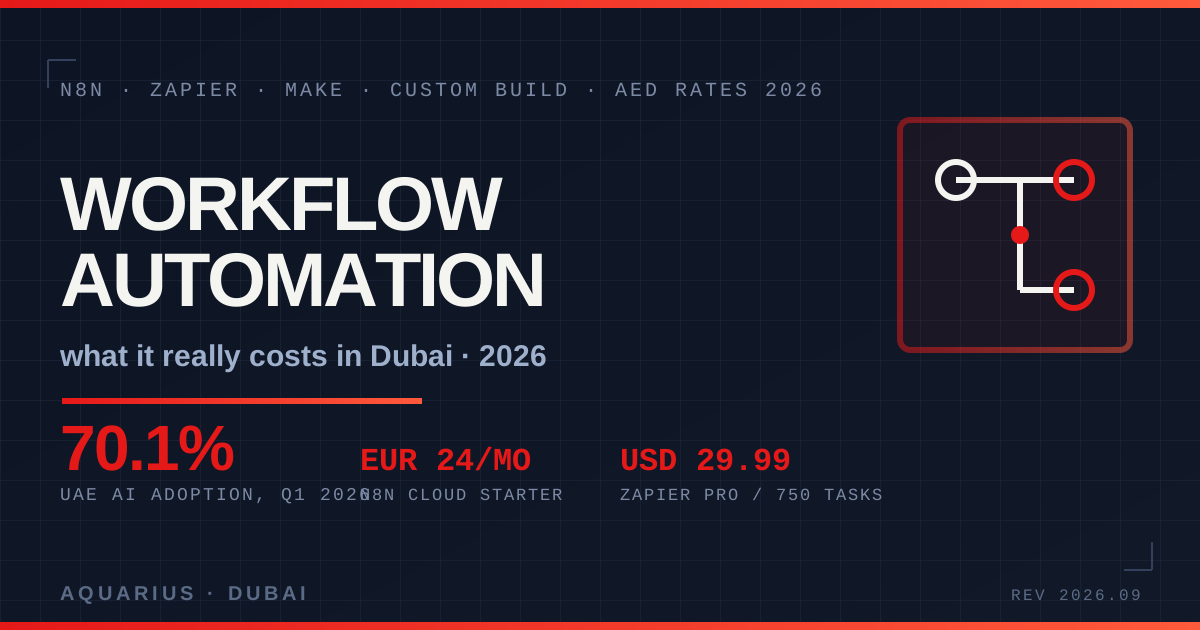
Short answer: in 2026 a Dubai business can run real workflow automation for AED 35 to AED 450 a month on an off-the-shelf tool — Make Core from USD 9 (about AED 33), n8n Cloud Starter at EUR 24 (about AED 103) and Zapier Professional at USD 29.99 (about AED 110) — or from AED 0 in licence fees by self-hosting n8n Community on a UAE server. A built-for-you automation layer, with the integrations, error handling and Arabic-ready documents that Dubai operations actually need, starts around AED 10,000 as a one-off. The expensive option is the one most SMEs are still on: a person doing it by hand.
Key takeaways
- The UAE is the world's most automation-ready market. AI adoption hit 70.1% in Q1 2026 against a global average of 17.8% — and 98% of Dubai's private sector is SMEs, the exact segment with no ops headcount to spare.
- Subscription pricing is not the real cost. Zapier bills per task, Make per credit, n8n per workflow execution. The same process can cost many times more on one platform than another.
- Self-hosted n8n Community is free with unlimited executions. Your only bill is the server — which also answers the data-residency question a PDPL review will ask.
- E-invoicing is the forcing function. The FTA pilot starts 1 July 2026; businesses under AED 50m revenue must appoint an accredited service provider by 31 March 2027 and go live 1 July 2027. Manual invoice handling has an expiry date.
- Payback is measured in months, not years. A Dubai administrator averages AED 3,953 a month. Recover 40% of one admin role and you cover a AED 110 monthly subscription roughly 14 times over.
Why Dubai businesses are automating in 2026
The UAE is not an early adopter any more — it is the benchmark. AI adoption across the working-age population reached 70.1% in Q1 2026 versus a global average of 17.8%, making the UAE the first country where more than seven in ten working-age people actively use AI. The KPMG UAE Tech Report 2026 found 97% of UAE tech leaders are embedding AI agents into workflows, products or services, against an 87% global average.
Underneath the headline, the SME picture is more practical than the hype suggests. Smaller operators are growing software adoption at 11.7% a year, and 72.6% of regional software demand is task-specific tools rather than sweeping platforms. That is the real Dubai playbook: automate one painful process properly, then the next one.
The volume pressure is genuine. 2,709 new companies joined Dubai Chamber of Commerce in March 2026 alone, and 98% of Dubai's private sector is made up of SMEs. Those companies win work faster than they hire, so the gap gets absorbed by someone re-typing WhatsApp enquiries into a spreadsheet at 11pm.
Then there is regulation. UAE e-invoicing moves from theory to timetable this year: the FTA pilot opens 1 July 2026, large taxpayers (revenue at or above AED 50 million) must appoint an Accredited Service Provider by 30 October 2026 and comply from 1 January 2027, and everyone below that threshold appoints by 31 March 2027 and complies from 1 July 2027. Every B2B and B2G invoice becomes a structured, machine-readable document exchanged through accredited channels. If your finance process is a folder of PDFs and a WhatsApp thread, automation stops being an efficiency project and becomes a compliance one. Our UAE e-invoicing ERP integration guide covers that side in detail.
n8n vs Zapier vs Make: 2026 prices in AED
All three tools do the same core job — trigger, fetch, transform, push — and all three price it differently. The table below uses September 2026 list prices. The dirham is pegged at AED 3.6725 to the US dollar; euro amounts are converted at roughly AED 4.3, so check the day's rate before you commit a budget.
| Plan | Billing unit | Included volume | List price | Approx. AED/month |
|---|---|---|---|---|
| Make Core | Credits (renamed from operations in 2026) | 10,000 credits | USD 9 annual / 10.59 monthly | 33 - 39 |
| Make Pro | Credits + priority execution | 10,000 credits | USD 16 annual / 18.82 monthly | 59 - 69 |
| Make Teams | Credits + roles, shared templates | 10,000 credits | USD 29 annual / 34.12 monthly | 107 - 125 |
| Zapier Professional | Tasks (every successful action step) | 750 tasks | USD 19.99 annual / 29.99 monthly | 73 - 110 |
| n8n Cloud Starter | Workflow executions (a whole run = 1) | 2,500 executions | EUR 20 annual / 24 monthly | 86 - 103 |
| n8n Cloud Pro | Executions + admin features | 10,000 executions | EUR 50 annual / 60 monthly | 215 - 258 |
| n8n Business | Executions + SSO | around 40,000 executions | about EUR 667 annual | around 2,870 |
| n8n Community (self-hosted) | None — unlimited executions | Unlimited | Free software + your server | Server only, 75 - 400 |
The billing unit is the whole game. A workflow that pulls a lead from a form, enriches it, writes it to your CRM, sends a WhatsApp message and posts to Slack is one execution on n8n but roughly four tasks on Zapier. Run it 500 times a month and n8n's 2,500-execution Starter plan has barely noticed, while Zapier's 750-task Professional tier is already over — and Zapier bills over-limit usage automatically at about 1.25x the base task rate rather than stopping your Zaps. Dubai businesses with spiky volumes (Ramadan, DSF, GITEX, quarter-end invoicing) tend to discover this on the invoice rather than on the pricing page.
Conversely, Make's credit model is generous at the bottom: 10,000 credits for USD 9 is the cheapest serious entry point in the market, and it is the right first step for a small Dubai trading or services company running a handful of scenarios. Core is also the first Make tier with unlimited active scenarios and one-minute scheduling, which matters the moment you want near-real-time lead response.
One local detail that catches finance teams out: all three vendors bill in USD or EUR from outside the UAE. Budget for the card FX spread, and check with your accountant how reverse-charge VAT applies against your TRN — it is not the same line on your return as a local supplier's 5% VAT invoice.
Self-hosting n8n in the UAE: free licence, real trade-offs
The n8n Community Edition is free software with unlimited executions, so a Dubai company running high volume can move from a four-figure cloud bill to the cost of a server. On a UAE-region cloud instance that is typically AED 75 to AED 400 a month for a small-to-mid VPS, plus backups.
The second reason to self-host has nothing to do with money. Automation workflows touch exactly the data a privacy review cares about: customer names, Emirates ID numbers, trade licence documents, payroll files, tenant or patient records. Under Federal Decree-Law No. 45 of 2021 (PDPL) you need to be able to say where personal data sits and who processes it. Self-hosting inside the UAE gives you a one-sentence answer instead of a vendor sub-processor list. See our UAE PDPL compliance checklist and our Dubai hosting and data residency guide.
The honest trade-off: free software is not free operations. Someone has to patch the server, watch for failed executions, rotate credentials and restore from backup at 2am when a queue silently stops. Budget either an internal owner or a support retainer — a self-hosted automation stack nobody monitors is worse than a subscription, because the failures are quiet.
When a custom build beats a subscription
Most Dubai automation projects should start on a no-code platform. Consider custom code when one of these is true:
- The integration does not exist. Local systems — UAE PASS, Mollak, utility portals, eClaimLink, a supplier's SOAP feed, an on-premise ERP or an old Tally install — rarely have a maintained connector. Someone has to write the API layer.
- Arabic and RTL documents are involved. Bilingual quotes, invoices and contracts break generic templating in ways a screenshot in a sales deck never shows.
- Volume has crossed the line. Above roughly 50,000 operations a month the per-task platforms get expensive quickly, and self-hosted or bespoke wins by a wide margin.
- The logic is your business. Pricing rules, commission splits, credit limits and approval matrices belong in code you own and can test, not in 40 chained no-code steps nobody can read six months later.
Our usual recommendation is a hybrid: self-hosted n8n as the orchestration layer, plus custom nodes and a small API service for the parts that are genuinely yours. That keeps 80% of the work visual and cheap to change, and puts the 20% that matters under version control.
What an automation project costs in Dubai (AED)
| Scope | What it includes | Typical AED | Timeline |
|---|---|---|---|
| Single workflow | One process, 2-4 apps, error alerts, handover doc | 2,500 - 6,000 | 3 - 7 days |
| Automation starter pack | 3-5 workflows, self-hosted n8n set up on your server | 10,000 - 20,000 | 2 - 4 weeks |
| Custom integration / API layer | Bespoke connector to a local or legacy system | 8,000 - 35,000 | 2 - 6 weeks |
| AI-assisted workflows | Document extraction, Arabic/English triage, drafting | 12,000 - 60,000 | 3 - 8 weeks |
| Monitoring & support retainer | Uptime, failed-run alerts, changes, patching | 750 - 3,500 / month | Ongoing |
All excluding 5% VAT. The ROI arithmetic is blunt, which is why this line item survives budget season: an administrator in Dubai averages AED 3,953 a month and a data-entry operator about AED 3,626, while an executive assistant sits between AED 12,722 and AED 20,654 a month. Take back 40% of one AED 3,953 admin role — roughly AED 1,580 of monthly capacity — and a AED 110 subscription plus a AED 12,000 build clears its cost in about eight months, then keeps paying every month after that. Automate something that touches revenue, like same-hour lead response, and the payback is shorter still.
How Aquarius does it. We publish our prices: a Starter Site from AED 500, a Business Site from AED 2,500 and a Custom App from AED 10,000, all before VAT — and automation work is scoped the same transparent way. We start with the one process costing you the most hours, ship it in days rather than quarters, host it in the UAE when your data calls for it, and hand over the credentials, the code and the documentation. You own it. If you want to take the whole thing in-house next year, nothing stops you. See our pricing or what each service includes.
The five automations Dubai SMEs should build first
- Lead capture to CRM to WhatsApp reply. Website form, Meta or TikTok lead ad straight into your CRM with an instant bilingual acknowledgement. Speed-to-lead is the cheapest conversion gain in the market — see our WhatsApp Business API cost guide.
- Quote and invoice generation. Deal marked won, bilingual quote or TRN-compliant tax invoice generated, numbered, filed and emailed. This doubles as your e-invoicing warm-up.
- Document and ID extraction. Trade licence, Emirates ID and passport pages read once into structured fields instead of being typed three times by three departments.
- Renewal and expiry alerts. Trade licence, visas, Ejari, insurance, vehicle registration — a calendar with escalation beats a fine every time.
- Daily operations digest. One morning message per owner or manager: yesterday's leads, sales, overdue invoices, stuck jobs. It is the automation that makes people trust the other four.
If you are weighing agents rather than plain workflows, our guide to AI agents for Dubai SMEs covers where they help and where they quietly burn budget. For the CRM that usually sits at the centre of these flows, see our Dubai CRM comparison.
What most Dubai businesses get wrong
They automate the process they hate instead of the process that costs the most. The loudest annoyance is usually a five-minute weekly task; the expensive one is the twelve-times-a-day, ninety-second habit nobody complains about because it feels like the job. Before you buy a plan, count events per month and multiply by minutes. The winner is almost never the one you would have guessed.
The second mistake is skipping failure handling. An automation that silently stops is worse than no automation, because everyone has already stopped checking. Every workflow you ship needs an alert on failure, a retry policy and a named human owner.
Frequently asked questions
Is n8n cheaper than Zapier for a Dubai SME?
Usually yes — because of the billing unit rather than the sticker price. n8n Cloud Starter is EUR 24 a month (about AED 103) for 2,500 whole-workflow executions, while Zapier Professional is USD 29.99 (about AED 110) for 750 tasks, and every action step in a Zap is a task. Self-hosted n8n Community is free software with unlimited executions, so at volume it is not a close contest.
What does Make.com cost in 2026?
Make renamed its billing unit from operations to credits in 2026. Core is USD 9 a month billed annually (USD 10.59 monthly), Pro USD 16 (USD 18.82 monthly) and Teams USD 29 (USD 34.12 monthly), each with 10,000 credits. Core is the first tier with unlimited active scenarios and one-minute scheduling.
Can I keep automation data inside the UAE?
Yes. Self-host n8n on a UAE-region server and your workflow data, credentials and execution logs stay in country — the cleanest answer to a PDPL data-residency question. Any third-party API you call (a global CRM, an overseas AI model) still moves data outside, so map those flows too.
Do I need automation before UAE e-invoicing?
You need a clean, structured invoicing process. The pilot opens 1 July 2026; businesses under AED 50 million revenue appoint an Accredited Service Provider by 31 March 2027 and comply from 1 July 2027. Companies whose invoices already come out of a system rather than a spreadsheet will find that a configuration job. Everyone else will find it a migration.
How long until an automation pays for itself?
For a typical Dubai SME, months rather than years. With administrator salaries averaging AED 3,953 a month, recovering 40% of one role is around AED 1,580 of monthly capacity, which clears a AED 10,000-12,000 build inside a year and a AED 110 subscription almost immediately.
Bottom line: start on Make or n8n for tens of dirhams a month, move to self-hosted n8n when volume or PDPL says so, and pay for custom code only where the integration or the logic is genuinely yours. Talk to Aquarius and we will map your top three processes and quote them in AED — no platform lock-in and no retainer you cannot exit.