
AI Machine Vision Quality Inspection in Dubai (2026): Real AED Costs and Payback
EGA went from hand-inspecting 2% of its carbon anodes to 100% with AI cameras. Human inspectors catch about 80% of defects. Real AED costs for a Dubai machine vision build.
- PUBLISHED
- 03 NOV 2026
- READ TIME
- 12 MIN
- AUTHOR
- AQUARIUS · DUBAI
- UNIT
- REV 2026.09
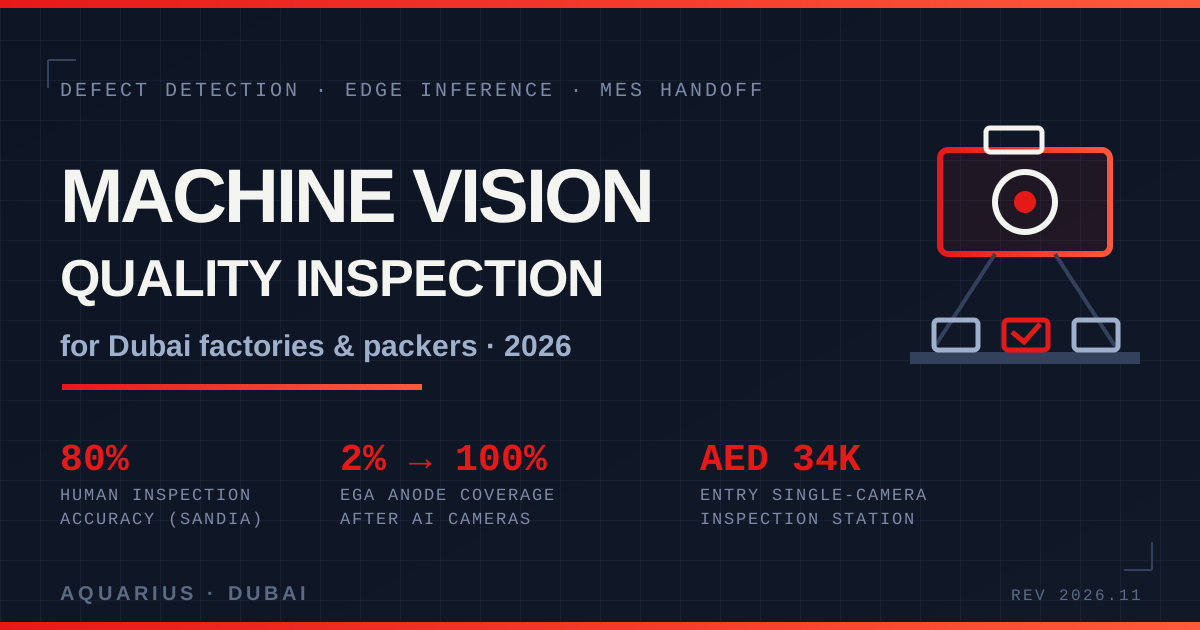
Short answer: An AI machine vision quality inspection station on a Dubai production line costs AED 25,000–75,000 for a simple single-camera presence, barcode or label check, AED 75,000–250,000 for multi-angle defect classification with a trained deep-learning model, and AED 250,000–740,000 for a multi-station, high-speed or 3D build (before 5% VAT). The camera is rarely more than a fifth of that. The cost sits in lighting, labelled defect images, and the handoff that actually ejects the bad part.
This is the 2026 guide for UAE manufacturers, food and beverage packers, pharma and cosmetics fillers, plastics and metals plants, and logistics operators who still sign off quality on a sample. Real AED figures, a verified Dubai deployment, and the payback maths. Updated November 2026.
Key takeaways
- Human visual inspectors catch roughly 80% of defects — 85% in the best measured case — according to the Sandia National Laboratories reliability work cited in peer-reviewed inspection research. One defect in five walks past a trained operator.
- Emirates Global Aluminium previously hand-inspected only 2% of the carbon anodes it produced. After installing AI cameras at the inspection station, a neural network now analyses nearly 4 million images a year and inspects 100% of anode surfaces in real time (EGA Chief Digital Officer, via CIO).
- Dubai’s manufacturing value added was AED 24.1bn in H1 2026 — up just 0.5% at current prices and down 0.9% in real terms (Dubai Economy). Flat output means margin has to come out of waste, not volume.
- The UAE AI vision inspection market was about USD 70m in 2025 and is forecast at USD 620m by 2035, a 24.5% CAGR (Next Move Strategy Consulting).
- Most Dubai factories get this wrong by buying a camera first. A camera with bad lighting and 40 labelled images is an expensive paperweight.
Why Dubai factories are buying vision in 2026, not 2029
Three numbers explain the timing.
First, output stopped growing. Dubai’s manufacturing sector added AED 24.1bn of value in the first half of 2026 — a 0.5% rise at current prices, but a 0.9% contraction in real terms, against an emirate-wide real GDP of AED 473bn. When the line cannot ship more units, the only margin left is the margin you are currently scrapping.
Second, the inspection method has not changed in thirty years, and it was never very good. The Sandia National Laboratories study repeatedly cited in quality engineering literature found that operators correctly rejected defective precision parts 85% of the time in the best case, with an industry average near 80%. The same body of research notes accuracy falls further as part complexity rises, and that operator error accounted for 23% of quality-control inaccuracy in one oil and gas study. Attention degrades within the first half hour of repetitive visual work — and Dubai lines run three shifts.
Third, the money is now flowing. Next Move Strategy Consulting sizes the UAE AI vision inspection market at roughly USD 70m in 2025, reaching USD 620m by 2035 at a 24.5% CAGR, against a global market of USD 7.35bn in 2026 heading to USD 34.8bn by 2035. Defect detection alone was 34% of global spend in 2025, and hardware was 54% — a share that falls every year as the software does more of the work.
The number most Dubai QC reports hide: your sample rate
Here is the myth worth busting. A quality report showing a 0.4% defect rate does not mean 99.6% of your output is good. It means 99.6% of the units you looked at were good — and on most Dubai lines you looked at a handful per pallet.
Emirates Global Aluminium published the honest version of this. Before AI vision, EGA inspected 2% of its carbon anodes manually. Everything else shipped on the strength of that sample. After cameras went in at the inspection station, a neural network began processing nearly 4 million images a year, covering 100% of anode surfaces, flagging defects in real time with better accuracy than the human eye. EGA’s wider digital factory programme has now delivered over USD 100m of impact across more than 80 use cases, and in July 2026 it took the AI Vision and Strategy Award at the US Manufacturing Leadership Awards. It was also the first industrial company in the UAE named a World Economic Forum Industry 4.0 Global Lighthouse.
That is the real shift. Machine vision does not mainly make inspection more accurate — it makes inspection complete. Going from a 2% sample to 100% coverage changes what you know about your own process, which is why the first month of data usually embarrasses someone.
What you are actually buying: five layers
1. Optics and lighting
The least glamorous and most decisive layer. Backlight, dome, dark-field, coaxial or structured light — the choice decides whether a defect is visible at all. Individual lighting components run from a few hundred dirhams to AED 250–15,000, and getting this wrong is the single most common reason a vision project fails after the camera is already bolted on.
2. Capture and edge compute
Area or line-scan cameras, a trigger from the PLC or an encoder, and an industrial PC or embedded GPU running inference at line speed. A smart camera with onboard deep learning can replace the PC entirely for a single check; anything multi-camera or above a few hundred parts per minute usually needs a proper edge box.
3. The model
Rule-based measurement for dimensions, barcodes, presence and absence. A trained convolutional or transformer model for cosmetic and texture defects you cannot express as a tolerance. This layer needs your images — typically a few hundred to a few thousand labelled examples per defect class, including the rare ones nobody photographed.
4. Decision and reject
A verdict is worthless until something moves. Pass or fail must reach an air blast, a diverter arm, a stop signal or an andon light with deterministic latency. This is engineering, not AI, and it is where integration hours go.
5. Traceability and MES handoff
Every verdict, image and timestamp written against a batch or serial, feeding your MES, ERP or dashboard so defect trends surface before they become a recall. ERP and MES integration alone budgets at AED 49,000–148,000 on a typical build. If you export to the EU, this layer is also how you evidence conformity — see our note on the EU Machinery Regulation for UAE exporters.
Rule-based, deep learning, or hybrid?
Vendors sell one of these as the answer to everything. In practice almost every Dubai line we build runs the third row.
| Approach | Best for | Images needed | Weakness |
|---|---|---|---|
| Rule-based / classical | Dimensions, barcode and OCR verification, presence and absence, fill level, cap seating, label skew | None — you define the tolerance | Blind to anything you did not anticipate; cosmetic defects defeat it |
| Deep learning | Scratches, contamination, texture, weld and print defects, anything a human calls “it just looks wrong” | Hundreds to thousands per defect class, including rare ones | Needs labelled data, retraining when the product changes, and explainability for auditors |
| Hybrid (recommended) | Real lines: classical for the measurable checks, a model for the cosmetic ones, one verdict out | Only for the cosmetic classes | More moving parts to maintain — which is exactly why it needs a real software owner |
Anomaly detection deserves a footnote: you can train on good parts only and flag outliers, which is attractive when you genuinely have no defect library. It catches the unknown unknowns, but it also flags every harmless variation, so expect a tuning period measured in weeks.
What machine vision inspection costs in Dubai (2026)
The figures below convert published integrator pricing at GBP 1 = AED 4.93 (3 November 2026) and assume UAE installation, commissioning and training. Add 5% VAT.
| Build | What it does | Hardware | Software & engineering | Total (AED) |
|---|---|---|---|---|
| Feasibility study | Your parts, your defects, your lighting — proof it can be seen before you spend | — | — | from 6,200 |
| Simple single-camera station | Barcode or label verification, presence and absence, one fixed check | 20,000–44,000 | 10,000–30,000 | 25,000–75,000 |
| Mid-complexity station | Multi-angle defect classification plus dimensional checks, trained model | 39,000–123,000 | 35,000–123,000 | 75,000–247,000 |
| Multi-camera label and print verification | Full pack inspection: artwork, variable data, placement, batch and expiry | ~89,000 | 59,000–89,000 | 173,000–222,000 |
| Complex station | High-speed, 3D, hyperspectral or multi-position inspection | 123,000–222,000 | 123,000–271,000 | 247,000–493,000 |
| Multi-station deep-learning cell | Several inspection points, shared model stack, full traceability | ~222,000 | 197,000–296,000 | 493,000–740,000 |
| ERP or MES integration | Verdicts, images and trends against batch or serial | — | — | 49,000–148,000 |
| Annual support | Model retraining, recalibration, spares cover | — | — | 10,000–25,000 |
Two honest caveats. Custom inspection software on its own — the layer we build — starts around AED 49,000–148,000 depending on how many defect classes and how awkward the reject mechanism is. And a model is not a one-time purchase: change your supplier, your substrate or your print head and it needs retraining. Budget for the second year, not just the first. Our pricing page lays out how we scope this.
The payback maths, done honestly
Start with what manual inspection actually costs in Dubai. A quality control inspector averages AED 3,950–4,500 a month in Dubai and about AED 4,129 across the UAE on current Indeed data. Covering one station across three shifts needs three people: roughly AED 142,000–162,000 a year in salary alone, before visas, medicals, gratuity and the supervisor time spent arbitrating disagreements between them.
A mid-complexity station at AED 150,000 therefore pays for itself against headcount inside about a year — and that is the weakest part of the case.
The strong part is the escape cost. Quality engineering’s 1-10-100 rule holds that a defect costs roughly 1 unit to prevent, 10 to catch internally, and 100 once the customer has it. Cost-of-quality benchmarks put the total cost of poor quality at 15–20% of sales revenue for typical manufacturers, against under 5% for best-in-class operations. On AED 50m of Dubai turnover, closing even three points of that gap is AED 1.5m a year — an order of magnitude above the capex.
Then there is the regulated downside. Dubai Municipality carried out 24,820 food establishment inspections in the first five months of 2026 across a sector of more than 26,500 businesses, and Dubai’s entry points receive over 1,000 food consignments a day. If you pack food, cosmetics or pharma here, a mislabelled allergen or an unreadable expiry date is not a scrap-rate problem. It is a withdrawal, a regulator conversation, and a retailer who does not re-list you.
Where this pays off fastest in Dubai
- Food and beverage packing — fill level, cap and seal integrity, allergen and Arabic label verification, batch and expiry legibility. Highest regulatory leverage in the emirate.
- Pharma, supplements and cosmetics — print and artwork verification, insert presence, tamper evidence, serialisation readability.
- Metals, extrusion and building materials — surface defects, profile dimensions, coating coverage. The EGA anode case is this category.
- Plastics and packaging converters — short shots, contamination, colour drift, web defects at speed.
- Electronics and assembly — component presence, polarity, solder and connector seating. Globally the largest vision inspection segment at 29% of 2025 spend.
- Logistics and fulfilment — damage capture at handover, label and dimension verification, pallet integrity. Pairs naturally with predictive maintenance on the same conveyors.
Five mistakes we see on Dubai lines
- Camera first, lighting last. If the defect is not visible in a still photograph taken under the proposed lighting, no model will find it. Settle optics before procurement.
- No defect library. Teams arrive with forty images, thirty-eight of them good parts. Start photographing rejects today, with the defect class written on each one — even if the project is a year away.
- Ignoring line speed and trigger latency. A model that infers in 400ms cannot gate a part moving at 600 units a minute. The reject mechanism, not the GPU, usually sets the ceiling.
- Treating a demo as a deployment. Vendor demos run on clean parts under lab lighting. Dubai reality is dust, 45°C ambient in summer, vibration and a changeover every Thursday.
- No owner for the model. Accuracy decays as products, suppliers and substrates change. Someone must own retraining, or the operators quietly switch the station into bypass — which is how most abandoned vision systems die.
How Aquarius builds it
We are a software team, not a camera reseller, so we start where the risk is. First a paid feasibility study on your parts: we photograph your real defects under candidate lighting and tell you honestly which classes are detectable and which are not — before anyone issues a purchase order. Then a fixed-price single-station pilot with an agreed accuracy target measured on your own held-back images, hybrid by default (classical checks plus a trained model only where it earns its place). Then rollout, MES or ERP integration, operator training in English and Arabic, and a support agreement that includes retraining, not just spares.
The same team builds the AI systems around it — the dashboards your plant manager actually opens, and the document and label pipelines described in our guide to Arabic OCR and AI document processing. If the feasibility study says vision will not solve your problem, we will say so and bill you only for the study. That is cheaper for both of us than a station in bypass mode.
FAQ
How much does an AI visual inspection system cost in Dubai?
Between AED 25,000 and AED 75,000 for a simple single-camera check, AED 75,000 to 247,000 for a mid-complexity station with a trained defect model, and AED 247,000 to 740,000 for complex or multi-station cells, plus AED 49,000–148,000 if it must talk to your ERP or MES. Add 5% VAT and AED 10,000–25,000 a year for support.
How accurate is machine vision compared with a human inspector?
Human inspectors average about 80% defect detection, 85% at best, per the Sandia reliability research. Published deep-learning inspection models reach the high 90s on well-defined defect classes — one peer-reviewed casting-inspection model reported 99.86% accuracy with zero false negatives on its test set. The honest answer for your line is whatever a feasibility study on your own images proves, not a vendor datasheet number.
How many defect images do I need before this works?
Typically a few hundred to a few thousand labelled examples per defect class. Rare defects are the hard part — which is why we tell Dubai clients to start photographing rejects months before the project starts. Anomaly-detection approaches can train on good parts only, at the cost of a longer tuning period and more false alarms.
Can I inspect 100% of output, or only a sample?
100% is the point. EGA went from hand-inspecting 2% of carbon anodes to 100% of anode surfaces with roughly 4 million images a year. Full coverage is a software and throughput question, not a staffing one — which is exactly why it is affordable now and was not a decade ago.
Does a vision system help with UAE and export compliance?
Indirectly but materially. It gives you a timestamped image and verdict per unit or batch, which is the evidence trail regulators and EU buyers ask for when a label, expiry date or dimension is disputed. It does not replace your HACCP plan, conformity assessment or technical file — it makes them defensible.
The one-line version
Your defect rate is a sampling artefact, human inspectors miss about one defect in five, and a station that fixes both costs less than the three inspectors it replaces. Dubai factories running flat real output in 2026 cannot find margin in volume — it is sitting in the scrap bin.
Tell us what your line makes and what keeps coming back, and we will tell you in one call whether vision can see it.