
B2B Wholesale Ecommerce Portal Development in Dubai (2026): The Cash Problem an Order Form Will Not Fix
Dubai wholesale and retail trade produced AED 50.9 billion in Q1 2026, yet 58% of UAE B2B credit sales are paid late. What a trade portal costs in AED, and where it actually pays back.
- PUBLISHED
- 15 SEPT 2026
- READ TIME
- 10 MIN
- AUTHOR
- AQUARIUS · DUBAI
- UNIT
- REV 2026.09
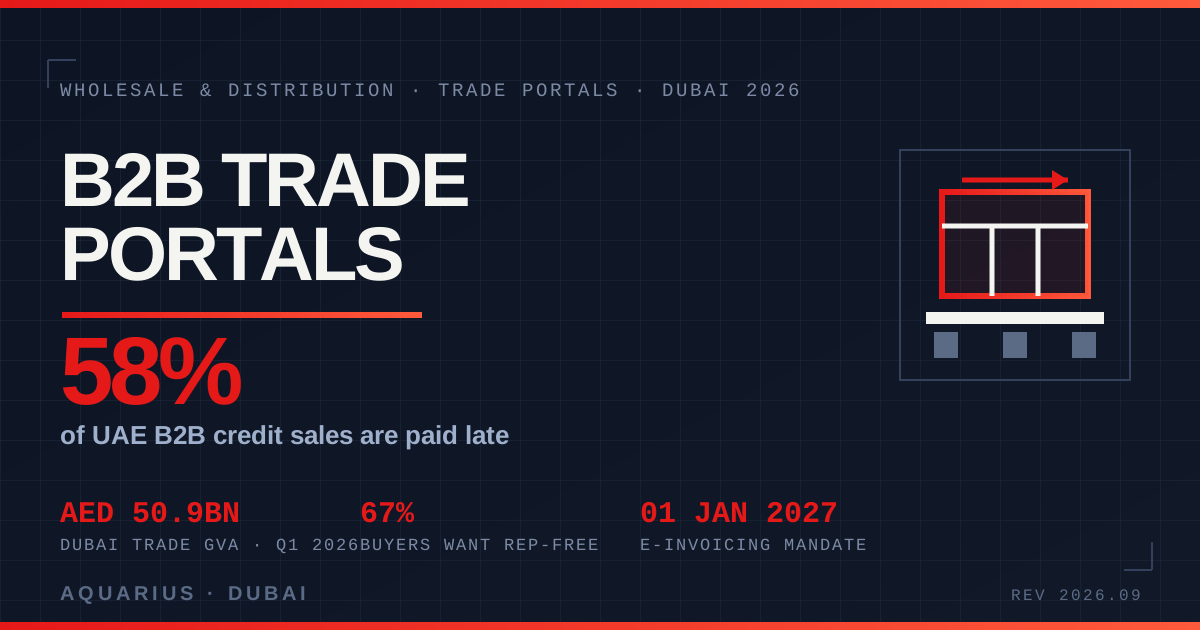
Short answer: A B2B wholesale ecommerce portal in Dubai costs AED 45,000–90,000 for a trade-customer ordering portal bolted onto your existing catalogue, AED 110,000–260,000 for a full trade platform with contract pricing, credit limits, ERP sync and FTA-ready e-invoicing, and AED 300,000–700,000+ for a multi-warehouse or multi-country distribution platform. But the number that decides whether it pays back is not order volume. It is collection speed — because 58% of UAE B2B credit sales are paid late, and a portal that fixes that earns more than one that simply takes orders.
Key takeaways
- Wholesale and retail trade is Dubai’s largest economic sector — AED 50.9 billion of real gross value added in Q1 2026, roughly 22% of the emirate’s AED 232 billion GDP. Most of it still moves on WhatsApp, PDF price lists and emailed LPOs.
- 67% of B2B buyers now prefer a rep-free buying experience (Gartner, March 2026, 646 buyers surveyed). Your trade customers already self-serve everywhere else.
- Half of UAE B2B sales are made on credit, on average 47-day terms — and 58% of those credit sales are paid late. Bad debt averages 8% of overdue invoices.
- E-invoicing is now a build requirement, not a finance project. Voluntary from 1 July 2026, mandatory from 1 January 2027 for businesses above the FTA revenue threshold, and extended to the remaining in-scope VAT-registered businesses from 1 July 2027.
- B2B is the fastest-growing slice of UAE ecommerce — forecast at a 17.43% CAGR to 2031, ahead of consumer ecommerce, inside a market moving from about USD 12.3 billion in 2026 to roughly USD 21 billion by 2031.
Dubai’s biggest sector is still trading on PDFs
Start with the size of the prize. Dubai’s GDP reached AED 232 billion in Q1 2026, up 2.4% year on year. Inside that, wholesale and retail trade produced AED 50.9 billion in real gross value added, up from AED 49.6 billion a year earlier — growth of 2.6%, a contribution of about 0.57 percentage points to the emirate’s overall growth, and roughly 22% of Dubai’s entire economy. No other sector is bigger. Dubai is, structurally, a trading city.
The trading community keeps thickening, too. Dubai Chamber of Commerce data shows 85,841 active Indian member companies as of June 2026, a 15% annual increase, with 7,579 new Indian companies joining in the first half of 2026 alone. 45% of those members sit in trade and services. That is one nationality inside one chamber. Scale it across the full membership and you get the real picture: tens of thousands of Dubai importers, distributors, stockists and re-exporters competing on the same catalogues.
Now the uncomfortable part. Ask a Dubai distributor how a typical order arrives and the honest answer is a WhatsApp voice note, a PDF price list from March, and an LPO emailed to a salesperson who is driving. Meanwhile Gartner’s March 2026 survey of 646 B2B buyers found 67% prefer a rep-free buying experience, and 45% used AI tools during a recent purchase. Buyers are researching, comparing and shortlisting before they ever speak to your rep. If your catalogue, stock position and contract price are not online, you are simply not in that evaluation.
The myth: a B2B portal is just an online order form
This is where most Dubai wholesalers get it wrong, and it is the single most expensive misunderstanding in the category. They scope a portal as a nicer way to take orders. Orders were never the bottleneck. Cash is.
The Atradius Payment Practices Barometer for the UAE found that about half of all B2B sales are made on credit, with payment terms averaging 47 days — and that 58% of those credit sales are paid late, mostly because of administrative bottlenecks or financial distress at the customer. Overdue invoices affect 55% of B2B transactions, and bad debt averages 8% of overdue invoices. Read that back in trading terms: you win the order, you fund the stock, you ship it, and then more than half the time you wait past terms to be paid, with roughly one dirham in twelve of the overdue pile never coming back at all.
“Administrative bottlenecks” is the operative phrase. A large share of UAE late payment is not the customer refusing to pay. It is an invoice sent to the wrong person, a missing TRN, a price that does not match the LPO, a delivery note nobody signed, a credit note stuck in an inbox. Every one of those is a software problem, and every one of them is fixable in a portal. A trade platform that shows the buyer their live statement, their overdue invoices, their approved credit limit and a button to pay is a collections tool wearing a catalogue’s clothing. That is where the return on investment lives.
What a Dubai B2B portal actually has to do
A B2B portal is not a consumer store with a login. Six capabilities separate a real trade platform from a shop in disguise.
1. Customer-specific pricing and contract terms
In wholesale there is no such thing as “the price”. There is this account’s price, at their tier, on their contract, with their volume break and their promotional allowance. Your portal needs price lists per customer group, per-SKU overrides, quantity breaks, and a rules engine that always agrees with what your ERP will invoice. A price that differs from the invoice by two fils generates a dispute, and disputes are exactly what turn 47-day terms into 90-day terms.
2. Credit limits, statements and self-serve payment
Show available credit before checkout, block or route orders that breach the limit, expose the live ledger, and let the buyer settle by card, bank transfer or the UAE national payment rails. Tie a small early-settlement discount to it. This is the module that pays for the build, and the one most agencies leave out of the quote.
3. FTA-ready invoicing and the 2027 e-invoicing mandate
Under Ministerial Decisions No. 243 and 244 of 2025, the UAE is rolling out an Electronic Invoicing System built on the PEPPOL five-corner model, covering B2B and B2G transactions. Voluntary adoption opened on 1 July 2026, mandatory compliance begins 1 January 2027 for businesses above the FTA revenue threshold, and extends to the remaining in-scope VAT-registered businesses from 1 July 2027. If you are commissioning a trade portal in 2026, structured invoice data and accredited service provider integration belong in scope now. Retrofitting them in 2027 costs more and lands during a compliance crunch. We covered the invoice-level detail in our guide to VAT-compliant ecommerce invoicing and the UAE e-invoicing mandate.
4. Real ERP and stock integration
A portal that shows stock it does not have destroys trust in one order cycle. You need live or near-live availability by warehouse, allocation on order, and a two-way sync with SAP, Oracle, Microsoft Dynamics, Odoo, Tally or whatever runs the business today. This is usually the largest single line item in the budget and the most common place a fixed-price quote goes wrong — see our breakdown of ERP implementation costs in Dubai.
5. Trade-shaped ordering mechanics
Multiple units of measure (piece, inner, carton, pallet), minimum order quantities, CSV upload and one-click reorder from history, saved order templates, split delivery across branch addresses, RFQ and quote-to-order flows for negotiated lines, and multi-user accounts where a buyer raises and a manager approves. McKinsey research finds 39% of B2B buyers are willing to spend over USD 500,000 per order through self-service or remote digital channels — but only where the mechanics match how they actually buy.
6. Arabic, RTL and a Dubai-shaped front door
Dubai trade is multilingual by default, and your buyers’ procurement staff are not all reading English. Proper Arabic and RTL support is a ranking, conversion and credibility issue rather than a nice-to-have, as we set out in our guide to Arabic website localization for Dubai.
Own portal or B2B marketplace?
Dubai distributors have a real alternative: list on a regional B2B marketplace and let someone else own the technology. Marketplaces solve discovery, and several now integrate with SAP and Oracle for reconciliation. The trade-off is the same one consumer sellers face with Noon and Amazon — you rent the customer relationship, you compete on price inside someone else’s search box, and you do not control credit terms.
| Dimension | B2B marketplace listing | Own trade portal |
|---|---|---|
| Upfront cost | Near zero | AED 45,000–260,000+ |
| Ongoing cost | Commission on every order | 15–20% of build per year |
| Contract pricing | Limited or none | Full, per customer |
| Credit terms and statements | Marketplace rules | Yours, enforced in software |
| Customer data | Shared or withheld | Entirely yours |
| Best for | New-buyer discovery, spot sales | Repeat trade accounts — where the margin is |
The pragmatic answer for most Dubai wholesalers is both: marketplace for acquisition, own portal for retention. You should never pay commission to serve a customer who already buys from you every month.
What it costs in Dubai, and when it pays back
Real AED ranges, based on how these builds actually scope in this market. Every tier assumes hosting, security and Arabic support are handled properly rather than bolted on later.
| Tier | What you get | Build cost (AED) | Timeline |
|---|---|---|---|
| Trade ordering portal | Login-gated catalogue, customer price lists, reorder, LPO upload, basic stock feed | 45,000–90,000 | 6–10 weeks |
| Full trade platform | Contract pricing engine, credit limits and statements, online settlement, RFQ, two-way ERP sync, PEPPOL-ready invoicing, EN/AR | 110,000–260,000 | 3–5 months |
| Distribution platform | Multi-warehouse allocation, multi-company or multi-country, sales-rep app, delivery and route integration, analytics | 300,000–700,000+ | 6–10 months |
| Annual run cost | Hosting, support, compliance updates, enhancements | 15–20% of build | Ongoing |
Now the payback, using published UAE numbers rather than optimism. Take a distributor turning over AED 40 million a year, with half of that on credit — AED 20 million of credit sales, in line with the UAE average. At the market rate, 58% of that is paid late, and bad debt runs at about 8% of the overdue pile. Recovering even a fraction changes the arithmetic. Cutting average days-to-pay by ten days on AED 20 million of credit sales frees roughly AED 550,000 of working capital, permanently. Clawing back a single percentage point of bad debt on the AED 11.6 million that sits past terms is worth about AED 116,000 a year. Against a AED 110,000–260,000 platform, the credit-control module alone can pay for the build inside the first year — before counting one incremental order, one hour of order-entry labour saved, or the disputes that never happen because the price on screen matched the invoice.
The cost of inaction has a date attached. Mandatory e-invoicing starts 1 January 2027 for businesses above the FTA threshold and 1 July 2027 for the rest. Everyone who waits will be commissioning the same integration work in the same quarter, from the same small pool of UAE implementation partners. Prices in that quarter will not be kind.
How Aquarius builds them
We build trade portals the way traders actually operate: pricing engine and credit rules first, catalogue second, visual design last. Discovery starts in your ERP, not in Figma, because the integration decides the timeline. You get a fixed scope with a named integration boundary, a staging environment your sales team can break before your customers do, and PEPPOL-ready invoice structures from day one so 2027 is a switch-on rather than a rebuild. Our pricing and full service list are both published — no “request a quote to see a number”.
FAQ
How much does a B2B ecommerce portal cost in Dubai?
Expect AED 45,000–90,000 for a trade ordering portal, AED 110,000–260,000 for a full platform with contract pricing, credit control and ERP sync, and AED 300,000–700,000+ for multi-warehouse or multi-country distribution. Budget a further 15–20% of the build cost per year for hosting, support and compliance updates.
Does a B2B portal have to support UAE e-invoicing?
If you are VAT-registered and selling B2B or B2G, yes — on a timetable. Under Ministerial Decisions 243 and 244 of 2025, voluntary adoption opened on 1 July 2026, it becomes mandatory on 1 January 2027 for businesses above the FTA revenue threshold, and extends to the remaining in-scope VAT-registered businesses on 1 July 2027. The system uses the PEPPOL five-corner model, so invoice data has to be structured, not a PDF attachment.
Can I just use an off-the-shelf store platform for wholesale?
For a simple price list behind a login, yes. The moment you need per-customer contract pricing, enforced credit limits, live multi-warehouse stock, RFQ flows and two-way ERP sync, plugin stacks get fragile and expensive to maintain. The honest test: if more than about a fifth of your order value involves negotiated pricing or credit terms, build the pricing and credit logic properly.
How long does it take to launch?
Six to ten weeks for a trade ordering portal, three to five months for a full platform. The variable is almost never the front end — it is how clean your ERP data is and how fast your team can agree the pricing rules. Distributors who arrive with a tidy SKU master and documented price tiers launch first.
Will my customers actually use it?
The evidence says yes, and faster than most owners expect. Gartner’s March 2026 survey found 67% of B2B buyers prefer a rep-free experience, and McKinsey finds 39% will place orders above USD 500,000 through self-service or remote digital channels. Adoption problems in this market are almost always caused by wrong prices, missing stock or a login flow nobody explained — not by reluctance to buy online.
The one-line version
Dubai’s largest economic sector runs on credit that gets paid late more often than it gets paid on time. Build the portal that fixes the cash, not the one that prettifies the catalogue — and build it before the 2027 e-invoicing queue forms.
Thinking about a trade portal for your Dubai distribution business? Tell us what your ERP is and how your pricing works, and we will come back with a scoped range and a realistic timeline — no obligation, no discovery fee.