
Beauty and Cosmetics E-commerce in Dubai (2026): Montaji Registration, Shade Data and Real AED Build Costs
UAE beauty is a USD 3.49bn market in 2026 and online is its fastest-growing channel at 9.11% CAGR. Real AED build costs for a Dubai cosmetics store, plus Montaji registration and the shade-data fix.
- PUBLISHED
- 08 OCT 2026
- READ TIME
- 12 MIN
- AUTHOR
- AQUARIUS · DUBAI
- UNIT
- REV 2026.09
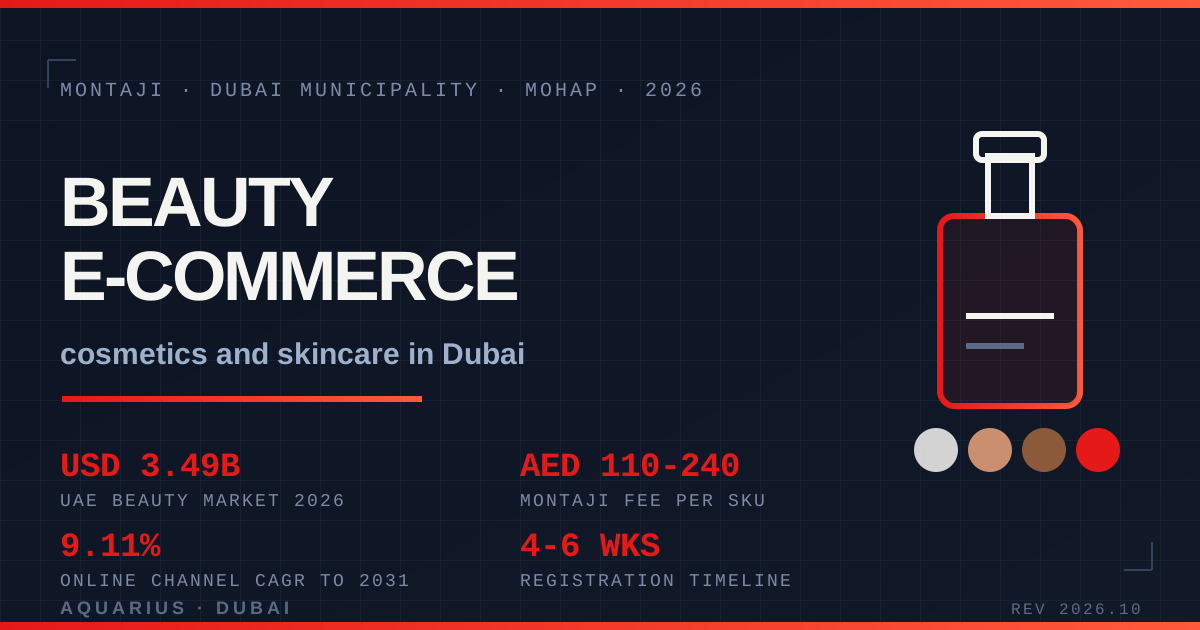
Short answer: a Dubai beauty and cosmetics store costs roughly AED 22,000–48,000 on Shopify with a bilingual catalogue, AED 60,000–145,000 for a custom build with a shade finder, routine quiz and refill subscriptions, and AED 165,000–390,000 for a headless GCC platform with live AR try-on and ERP integration. The expensive part is not the design. It is that every SKU you sell must carry a Dubai Municipality (Montaji) or MOHAP registration, a bilingual label and a batch-and-expiry record — and your product data model either holds that or your catalogue becomes unsellable the day an inspector asks.
Key takeaways
- UAE beauty and personal care is a USD 3.49 billion market in 2026 — about AED 12.8 billion — heading to USD 4.68 billion by 2031 at a 6.05% CAGR (Mordor Intelligence).
- Specialty retail still owns the category: health and beauty specialty stores held 42.20% of channel share in 2025, and 46.58% within cosmetics specifically. Online retail is the fastest-growing channel at 9.11% CAGR through 2031 — roughly double the pace of the category itself.
- Most Dubai beauty brands get this wrong: they copy the fashion e-commerce playbook and over-build returns logistics. Beauty has the lowest online return rate of any major category at 4–12% (median 8–9%). Your money is not leaking out of returns. It is leaking out of the shopper who leaves because she cannot tell whether the shade is hers.
- When beauty does come back, it is a colour problem: foundation hits about 23% on shade mismatch, and roughly 64% of beauty returns happen because the product looked different in person. Live AR try-on lifts conversion 20–30% on colour cosmetics and cuts returns 25–40%.
- Registration is cheap and slow, which is the worst combination to discover late: official Montaji fees run about AED 110–240 per product, but the clock is 4–6 weeks standard and 6–10 weeks for complex formulations. MOHAP routes take 30–60 days. Any reformulation or label change means re-registration.
- Enforcement is live. In its largest air cargo campaign since the start of 2025, Dubai Customs seized over 35 tonnes of smuggled, counterfeit and non-compliant goods including 37,110 non-compliant cosmetic products and 10,520 counterfeit branded items. Trademark offences under UAE law carry fines of AED 100,000 to AED 1 million.
- Since 1 February 2026, every influencer post promoting your brand from inside the UAE needs an Advertiser Permit under Federal Decree-Law 55 of 2023 and Cabinet Resolution 42 of 2025. Brands are liable for engaging creators who do not hold one, and content violations are fined from AED 5,000 up to AED 1 million.
Where Dubai beauty actually sells — and why online is the only growing shelf
The headline number is the market: USD 3.49 billion in 2026, growing 6.05% a year to USD 4.68 billion by 2031. Inside that, colour cosmetics alone is worth USD 411.79 million in 2026, with facial products taking 47.92% of category value and lip and nail the fastest-growing lines at 6.05% CAGR.
But the channel split is the part that should decide your budget. Specialty stores — the mall counters, the beauty retail chains, the pharmacy groups — still hold 46.58% of cosmetics sales in the UAE. Online retail holds much less, and grows at 9.11% CAGR: faster than any other route to the shopper, and faster than the market it sits inside. Against a national e-commerce market of roughly USD 12.3 billion in 2026 and about 11 million UAE online shoppers, the category is clearly under-indexed online, not saturated.
Two structural tailwinds sit underneath that growth, and Mordor quantifies both: inbound tourism contributes about 1.2 percentage points to the forecast CAGR, and social media influence about 0.9 points. Translated into build decisions, that means your store has to convert two very different people — a resident restocking a serum she already knows, and a visitor or a scroller who discovered you forty seconds ago in a Reel. Those are not the same product page.
The mix is also moving upmarket. Mass-market products held 67.65% of 2025 value, but premium is growing at 7.1%, and natural or organic formulations at 7.6% against 68.72% still held by conventional formulas. Premium and clean-beauty buyers read ingredient lists. A catalogue that cannot render a full INCI list, a sourcing claim and a batch date is competing on price by default.
Montaji and MOHAP: the registration your catalogue has to carry
This is the part Dubai beauty founders discover three weeks before a launch date. In the UAE, a cosmetic product is registered before it is placed on the market, and which authority registers it depends entirely on what your copy claims.
Which authority owns your product
Standard cosmetics — moisturisers, lipsticks, shampoos, fragrances, sunscreens up to SPF 50 — register with Dubai Municipality through the Montaji platform. The moment a product makes a therapeutic claim, it moves to MOHAP: an anti-dandruff shampoo with an active, an acne treatment, anything that says it treats eczema, reduces hair loss or relieves inflammation. The claim, not the formula, triggers the classification. This matters for your website specifically, because a marketing team editing a product description can reclassify a product by accident and put you on the wrong side of a registration you already hold.
What the file contains, what it costs, how long it takes
| Item | Detail | Cost / time |
|---|---|---|
| Montaji registration (standard cosmetics) | Dubai Municipality. Per product, not per brand. | AED 110 – 240 official fee 4 – 6 weeks |
| Complex formulations / lab testing | Novel actives, unusual claims, additional analysis requested. | 6 – 10 weeks |
| MOHAP route (medicated or therapeutic) | Triggered by any treatment claim. | 30 – 60 days |
| Core dossier | INCI list in descending concentration order, product function description, free sale certificate, certificate of analysis, manufacturer GMP conformity. | Supplier-dependent |
| Extra files | IFRA certificate for fragranced products; product safety assessment report for new formulations. | Supplier-dependent |
| Certificate validity | Renewal cycle, per SKU. | 1 – 2 years |
| Remaining shelf life at import | Enforced at customs, not at your warehouse. | 12 months minimum |
| Reformulation or label change | Any ingredient, formula or label modification. | Re-registration required |
Note the shape of that table: the fee is trivial and the timeline is not. A 60-SKU launch is perhaps AED 7,000–14,000 in official fees, and three months of calendar if you sequence it badly. Register in parallel with the build, not after it.
The label is bilingual by law
Every cosmetic label sold in the UAE must carry, in Arabic as well as English: product name, the INCI ingredient list in descending order, net quantity, country of origin, batch number and expiry, full manufacturer details, the UAE importer or distributor with address and contact, and usage instructions and safety warnings. Prohibited ingredients include mercury compounds, hydroquinone above 0.5% in leave-on products, formaldehyde above 0.2%, unapproved UV filters, steroids and hormones.
Halal certification is not legally mandatory, but major UAE retailers increasingly ask for it from an accredited body — so if wholesale is part of the plan, treat it as a commercial requirement rather than a legal one.
Practically, this means your product schema needs fields most store themes do not have: registration number and authority, registration expiry, INCI string in both languages, batch, manufacture and expiry dates, importer of record, and the claim set that was approved. If you are also handling fragrance, the dangerous-goods side is its own problem — we covered it in our guide to perfume and oud e-commerce in Dubai.
Shade is your conversion problem, not your returns problem
Here is the myth worth killing. Beauty is the best-behaved major e-commerce category on returns: benchmark compilations put online beauty at 4–12%, with a median near 8–9%, while apparel runs three to five times higher. If you came from fashion — and most Dubai e-commerce talent did, see our Dubai fashion e-commerce guide for the apparel reality — you will instinctively over-engineer reverse logistics and under-engineer the decision.
That low return rate is not a sign the shade problem is solved. It is a sign it is being resolved before checkout, by abandonment. The returns that do happen prove the mechanism: foundation sits around 23% on shade mismatch, and about 64% of beauty returns are because the product looked different in person. For every customer who buys the wrong shade and sends it back, several more close the tab.
Which makes the shade stack the highest-ROI software in the category:
- Live AR try-on. Camera overlay on lips, eyes and complexion. Published merchant data puts conversion lift at 20–30% on colour cosmetics with returns down 25–40%; more conservative analyses still show returns down 8–14% when try-on sits inside the buy box rather than three clicks away. Buy-box placement is the variable, not the SDK.
- Undertone and shade finder. A four-question quiz that maps to a shade range beats a 48-swatch grid. It also gives you first-party data you own, which matters more every year as third-party signal erodes.
- Routine builder. Skin concern in, ordered regimen out, with a basket. This is the beauty equivalent of a furniture room planner: it converts one serum into four products.
- Real swatch photography on real UAE skin tones. Dubai sells to a market that spans every skin tone in one shipping zone. Stock imagery from a European brand kit will not close a Gulf or South Asian customer.
What a Dubai beauty store costs to build, feature by feature
Three routes, before 5% VAT. The right one depends on SKU count, whether you sell your own brand or distribute others, and whether GCC expansion is a year-one plan or a slide.
| Route | What you get | AED |
|---|---|---|
| Shopify, bilingual | Arabic and English storefront, compliance-ready catalogue fields, cards plus Tabby and Tamara, reviews, basic subscriptions. Fastest to revenue. | 22,000 – 48,000 |
| Custom bilingual commerce | Shade finder, routine quiz, refill subscriptions, registration-aware product model, loyalty and sampling logic, 3PL and ERP hooks. | 60,000 – 145,000 |
| Headless GCC platform | Live AR try-on, multi-market pricing and catalogue, KSA and GCC readiness, ERP and WMS integration, full first-party data layer. | 165,000 – 390,000 |
Inside those routes, the line items that actually move the numbers:
| Feature | What it fixes | AED build cost |
|---|---|---|
| Bilingual catalogue with INCI, batch, expiry and registration fields | Makes the catalogue inspectable and the label printable from one source of truth. RTL done properly, not a translated theme. | 14,000 – 34,000 |
| Shade finder / undertone quiz | The decision the swatch grid cannot make. Highest-yield single feature in colour cosmetics. | 16,000 – 45,000 |
| Live AR try-on integration | 20–30% conversion lift, 25–40% fewer returns on colour. Third-party SDK licence is extra and recurring. | 25,000 – 65,000 |
| Routine builder and skin quiz | Basket size. Turns a single-product visit into a regimen order. | 18,000 – 48,000 |
| Subscription and refill engine | Replenishment revenue. Converts 15–25% of buyers and lifts LTV 3–5x on consumables. | 18,000 – 45,000 |
| Payments: cards, Tap or PayTabs, Apple Pay, Tabby and Tamara | Checkout completion on a AED 200–500 basket. See our Tabby and Tamara integration guide for the fee maths. | 7,000 – 18,000 |
| Loyalty, samples and gift-with-purchase logic | The category's real repeat mechanic. Sampling is how a skincare range gets tried at all. | 12,000 – 30,000 |
| UGC, reviews and influencer attribution with permit register | Social proof plus the Advertiser Permit evidence trail per creator. | 9,000 – 24,000 |
| Batch and expiry-aware stock allocation | Ships the oldest compliant batch first. Stops you selling stock that fails the 12-month rule. | 10,000 – 28,000 |
| 5% VAT invoicing and TRN capture | Salon, clinic and wholesale buyers need a tax invoice with their TRN. | 6,000 – 14,000 |
| Care plan after launch | Hosting, security patching, catalogue and registration-renewal support, CRO iterations. | 3,000 – 11,000 / month |
Licence and entity costs sit outside the build — our guide to the Dubai e-commerce licence cost covers those, and a cosmetics trading activity plus an importer code is the usual shape.
The maths that decides if the channel pays
Beauty is a consumable, which means retention does the heavy lifting and your build should be aimed at it. Benchmarks put a strong annual repeat purchase rate at 30–45%, with 25–30% repeating inside 90 days; the best consumable DTC brands reach 40–55%. Subscription converts 15–25% of buyers where it is offered on cleansers, serums and body care, and lifts lifetime value 3–5x.
Run it on a realistic Dubai store. Global beauty AOV sits at USD 55–137 with an average near USD 71 — call it AED 260. A store doing AED 400,000 a month is about 1,540 orders. Move conversion 20% with a shade finder and try-on in the buy box, and that is roughly AED 80,000 a month of additional revenue from software that cost AED 40,000–110,000 once. Convert 20% of buyers to refill subscriptions and you have moved a fifth of the book from acquisition-dependent to predictable.
Now the cost of inaction, which in this category is regulatory rather than commercial. Dubai Customs seized 37,110 non-compliant cosmetic products in a single three-month air cargo campaign, inside more than 35 tonnes of smuggled and counterfeit goods — and in Q1 2025 alone, AED 42.195 million of counterfeit goods across 68 operations. Federal Decree-Law 42 of 2023 on combating commercial fraud sits behind that, and trademark offences carry AED 100,000 to AED 1 million. A store that cannot evidence a registration number and a batch record per SKU is not just exposed at import; it is exposed at marketplace onboarding and at inspection.
The newer exposure is marketing. Since 1 February 2026, under Federal Decree-Law 55 of 2023 and Cabinet Resolution 42 of 2025, anyone publishing promotional content online from inside the UAE needs a UAE Media Council Advertiser Permit — paid or unpaid, any follower count. The permit itself is free for the first three years. The penalties are not: content violations run AED 5,000 to AED 1 million, operating without a permit AED 5,000–10,000, and false or misleading claims AED 10,000–40,000. Brands and agencies carry liability for engaging creators who are not permitted. For a beauty brand running thirty creators a quarter, a permit register inside your influencer workflow is cheaper than one investigation.
How Aquarius builds beauty stores in Dubai
We start with the product data model, not the theme. Registration authority, registration number and expiry, INCI in both languages, batch, manufacture and expiry dates, importer of record, approved claim set — those fields go in before a single page is designed, because retrofitting them into a live catalogue of 300 SKUs is the most expensive rework in this category.
Then shade and routine data, because that is where the conversion is. Then subscriptions, because that is where the margin is. AR try-on comes after your top revenue lines have clean swatch data, not before — an AR overlay built on bad colour data converts worse than a good photograph.
You get fixed-scope phases with a storefront live and selling at the end of phase one, AED ranges agreed before work starts, and your code, product data and customer list in your own repository and your own cloud account from the first commit. Our pricing page shows how the phases are packaged, and our services cover the product photography and swatch work behind the build as well as the commerce engineering.
Send us your SKU count, which products carry treatment claims, and whether anything is registered yet. We will come back with a fixed AED scope, a registration sequence that runs in parallel with the build, and a launch date — usually within two working days. Start there.
FAQ
How much does a beauty or cosmetics e-commerce website cost in Dubai?
AED 22,000 to AED 48,000 for a bilingual Shopify store with a compliance-ready catalogue, AED 60,000 to AED 145,000 for a custom build with a shade finder, routine quiz and refill subscriptions, and AED 165,000 to AED 390,000 for a headless multi-market GCC platform with live AR try-on and ERP integration. Running cost after launch is AED 3,000 to AED 11,000 a month, before 5% VAT.
Do I need to register every cosmetic product before selling it online in the UAE?
Yes. Standard cosmetics register with Dubai Municipality through Montaji; anything with a therapeutic claim goes to MOHAP. Official Montaji fees are roughly AED 110–240 per product, the timeline is 4–6 weeks standard and 6–10 weeks for complex formulations, and certificates are valid 1–2 years. Registration is per SKU, so a reformulation or a label change means re-registration.
Is AR try-on worth the money for a Dubai cosmetics store?
On colour cosmetics, yes — published merchant data shows 20–30% conversion lift and 25–40% fewer returns, with more conservative studies still showing returns down 8–14%. On skincare it earns much less, because the buyer's question there is efficacy and routine fit, not colour. Start with a shade finder and clean swatch data on your top revenue SKUs; add AR once that data is right.
What return rate should I plan for on beauty in the UAE?
Plan for 4% to 12%, with a median around 8–9% — the lowest of any major category. Watch colour cosmetics separately: foundation runs about 23% on shade mismatch and roughly 64% of beauty returns are because the product looked different in person. Also keep hygiene rules explicit on the product page, since opened cosmetics are commonly non-returnable and an unclear policy generates disputes rather than returns.
Do my influencers need a licence to promote my beauty brand in the UAE?
Since 1 February 2026, yes. Any promotional content published online from inside the UAE requires a UAE Media Council Advertiser Permit under Federal Decree-Law 55 of 2023 and Cabinet Resolution 42 of 2025, regardless of payment or follower count. It is free for the first three years and renewed annually after. Brands carry liability for engaging unpermitted creators, so keep a permit number on file per creator before the campaign goes live.