
Capex Approval Workflow Software in Dubai (2026): The Authorisation Matrix, the Hurdle Rate and the Audit Trail
Dubai is putting AED 47.8bn into infrastructure in 2026 while 88% of megaprojects overrun. The DoA matrix, the Article 30 hurdle rate, and the seven-year record trail.
- PUBLISHED
- 15 NOV 2026
- READ TIME
- 14 MIN
- AUTHOR
- AQUARIUS · DUBAI
- UNIT
- REV 2026.09
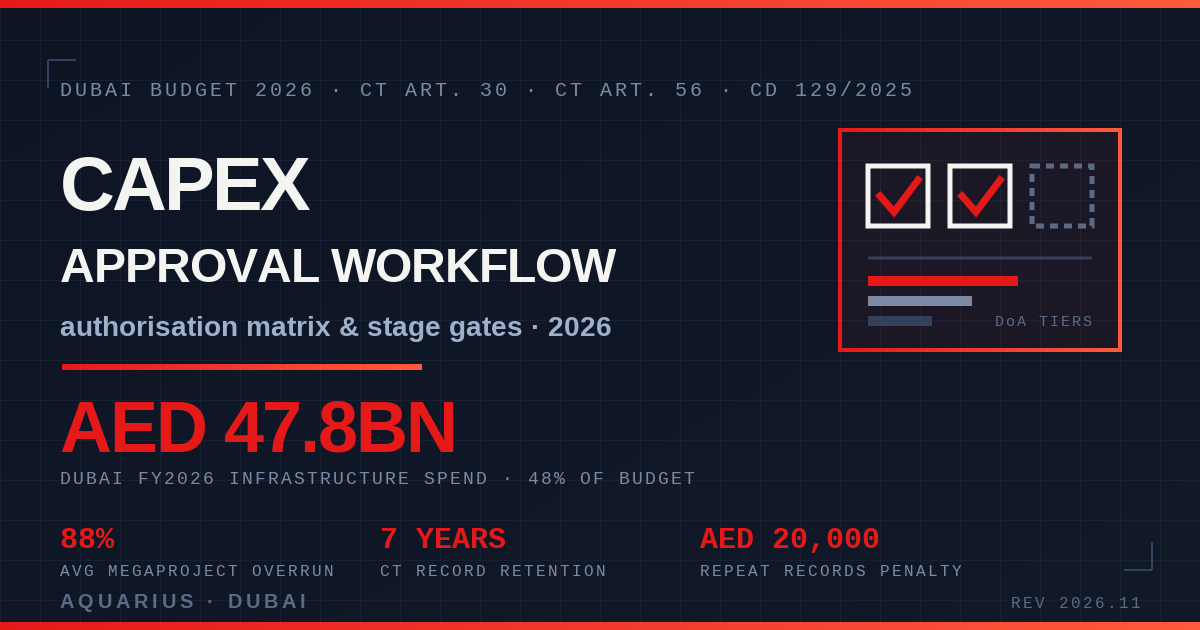
Short answer: a capex approval workflow is the system that turns “we should build this” into a dated, signed, reconstructable decision — a delegation-of-authority matrix that routes each request to the right approver by amount and category, stage gates that kill weak projects before the money moves, and a locked business case you can replay against actuals two years later. Dubai is about to approve more capital spending than at any point in its history: the 2026 budget puts AED 47.8 billion into infrastructure alone, 48% of total expenditure and up 20% year on year. And the research on large capital projects is brutal — KPMG’s 2026 global construction survey found average megaproject cost overruns of 88%, with only 25% of projects landing within 10% of their original budget. The gap between those two numbers is not a forecasting problem. It is a controls problem, and controls are software.
The spending wave is already here
Dubai’s FY2026 budget, approved by His Highness Sheikh Mohammed bin Rashid Al Maktoum, sets expenditure at AED 99.5 billion against revenues of AED 107.7 billion, with an operating surplus of 22% of revenues. The allocation tells you where the capital goes: infrastructure 48% (roughly AED 47.8 billion), social development 28%, security and justice 18%, government development 6%. Zoom out and the three-year 2026–2028 cycle is the largest the emirate has ever published — AED 302.7 billion of expenditure against AED 329.2 billion of revenue.
Underneath the headline sit discrete programmes of a size that forces governance: the AED 30 billion stormwater drainage programme, which lifts network capacity by about 700%, and an AED 1.3 billion Dubai Healthcare City expansion. Private capital follows public capital. The UAE construction and project pipeline is estimated at roughly USD 550 billion, part of a GCC pipeline near USD 2.1 trillion.
Here is the part Dubai CFOs are feeling in Q4 2026: awards are tightening even as the pipeline grows. UAE project awards in Q3 2026 came in at USD 15.6 billion, down 25.8% year on year, after Q1 2026 awards of USD 29.2 billion that were themselves down 18.5%. Money is still enormous, but it is being committed more slowly and scrutinised harder. That is exactly the environment in which a slow, opaque internal approval process costs you the project.
Overruns are a control failure, and the controls that work are measurable
The literature on capital project outcomes is remarkably consistent and remarkably bad. Across studies of major capital projects, roughly 90% run over budget, by an average of about 28%. Among the 300-plus billion-dollar megaprojects tracked globally, about 80% overrun and roughly half run late; for construction megaprojects above USD 1 billion, 98% overrun by more than 30%. Around 65% miss cost, schedule and business objectives together. KPMG’s 2026 survey adds the owner’s view: 69% of respondents experienced overruns, and 91% of public-sector owners and 53% of private owners reported at least one project failure in the past year.
If 90% of capital projects overrun, the exception is not the overrunning project. The exception is the organisation that can tell you, in writing, who approved the original number, on what basis, and what has changed since.
Then there is the leakage nobody budgets for. The ACFE’s 2026 Report to the Nations analysed 2,402 occupational fraud cases across 143 countries involving more than USD 3.4 billion, with a median loss of USD 104,000 per case. Corruption — which includes bribery, kickbacks and conflicts of interest, the classic procurement and capex failure modes — appeared in 45% of cases with a median loss of USD 150,000. Capex approval is where vendor selection, scope definition and payment authority all meet. It is structurally the highest-risk workflow in a Dubai business.
What makes this actionable is that the ACFE also measures which controls reduce losses. The three biggest reducers are process controls, not personnel changes:
- Management review of transactions and processes — associated with a 55% lower median loss.
- Automated data monitoring and continuous auditing — 53% lower.
- Surprise audits — 50% lower.
- Organisations with neither a reporting hotline nor anti-fraud training had a median loss of USD 175,000, versus USD 85,000 where both existed.
Read those four lines as a software specification. Management review means a mandatory approval step that cannot be skipped. Automated data monitoring means the system flags the AED 249,000 request sitting one dirham under a AED 250,000 authority limit. Both are features. Neither is a policy document.
What an authorisation matrix actually is
Most Dubai businesses think they have one. What they usually have is a signature policy in a PDF, last revised when the CFO before this one left, plus an email thread. A real delegation-of-authority (DoA) matrix is a data structure with four dimensions, enforced at the point of request:
- Amount band — the AED thresholds at which authority steps up.
- Category — IT, plant, fit-out, vehicles, intangibles. Software capitalisation follows different rules from a chiller replacement, which is why IAS 38 and SIC-32 capitalisation belongs in the routing logic, not in a reviewer’s head.
- Budget status — in-budget, over-budget, unbudgeted. These are three different approval paths, and conflating them is the single most common design flaw we see.
- Gate — concept, business case, commitment, variation, closeout. Authority to spend AED 5 million is not the same as authority to start studying a AED 5 million idea.
Layered over the matrix are two separation rules that most approval tools implement badly. Segregation of duties means the person who creates a request cannot approve it, the person who approves it cannot create the purchase order, and the person who creates the purchase order cannot release the payment. Maker-checker (four-eyes) means every material change to the request after approval — scope, vendor, amount — requires an independent second confirmation, and re-triggers routing if it crosses a threshold. A workflow engine that lets an approver edit the amount they are approving has no controls at all, however many approval steps it displays.
| Authority tier | Typical Dubai mid-market band | What the tier should actually be allowed to do |
|---|---|---|
| Department head | Up to AED 50,000 | Approve in-budget replacement capex only; no new vendors, no unbudgeted spend |
| Finance manager / controller | AED 50,000 – 250,000 | Confirm budget line, capitalisation treatment and asset class before routing onward |
| CFO | AED 250,000 – 2,000,000 | Approve the business case and the funding route; sign off the discount rate used |
| CEO / managing director | AED 2,000,000 – 10,000,000 | Approve strategic fit and commitment to contract |
| Board / investment committee | Above AED 10,000,000, plus all unbudgeted spend | Approve at gate, with a mandated post-implementation review date set at approval |
| Any tier, variations | Cumulative +10% of approved value | Re-route to the tier that would have approved the revised total — not the original approver |
That last row is where most capex overruns actually hide. A project approved at AED 8 million by the CEO, then varied four times by 9% each, ends up a AED 11.3 million board-level commitment that no board ever saw. Cumulative variation tracking against the original approved value, with automatic re-routing, is a twenty-line rule that prevents a category of failure no amount of reporting will catch after the fact.
The hurdle rate is not one number in the UAE
Here is the thing almost every Dubai capex template gets wrong. Finance teams copy a single hurdle rate into the NPV and IRR calculation and apply it to every project. In the UAE in 2026, that is no longer defensible, for three separate reasons.
First, the base rate moved and is now observable. The CBUAE base rate stands at 3.90%, set in September 2026 and maintained at the October 2026 review. Three-month EIBOR fixed at 4.339930% in mid-November 2026. Add a bank margin and corporate debt pricing is a live, checkable number, not an assumption.
Second, the tax shield is capped. Article 30 of Federal Decree-Law No. 47 of 2022 — the General Interest Deduction Limitation Rule — restricts net interest expenditure deductible in a tax period to the higher of AED 12 million or 30% of adjusted EBITDA, with disallowed amounts carried forward for up to ten tax periods. The practical consequence is startling and almost nobody models it: a company already at its Article 30 cap gets no 9% corporate tax shield on the marginal loan. The same project, with the same cash flows, has two different after-tax NPVs depending on whether the borrower has interest headroom. Banks and insurance providers, natural persons, loans concluded before 9 December 2022 whose terms are unchanged, and qualifying infrastructure projects (Ministerial Decision No. 126 of 2023, Article 14) sit outside the rule — which means a qualifying infrastructure project genuinely should be appraised at a different cost of capital from the fit-out next door.
Third, the rate is now an auditable input. Under Ministerial Decision No. 84 of 2025, audited financial statements are mandatory for taxable persons with revenue above AED 50 million, for every Qualifying Free Zone Person and for every tax group, for periods starting on or after 1 January 2025. The discount rate inside your capital appraisal is an assumption your auditor can now ask you to evidence.
| Option | Indicative 2026 cost | Where it breaks for a Dubai business |
|---|---|---|
| Spreadsheet plus email approvals | Effectively free | No enforced segregation of duties, no variation tracking, no producible audit trail |
| Generic no-code workflow (Kissflow tier) | From ~USD 2,500/month | Routes forms well; has no NPV/IRR engine, no asset-class logic, no ERP posting |
| SAP Ariba core modules | USD 80,000 – 300,000; full suite USD 400,000+ | Procurement-first. Capital appraisal and gate governance are not its centre of gravity |
| Coupa (mid-market) | USD 150,000 – 250,000/year | Strong spend control, heavy implementation, limited UAE tax-rule fit out of the box |
| Custom capex workflow on your existing stack | AED 45,000 – 210,000 one-off | You own the DoA logic and the Article 30 layer; you also own the roadmap |
Your approval chain is a tax record, and the rules just tightened
This is the argument that moves Dubai boards, because it converts a governance preference into a compliance obligation.
Article 56 of the Corporate Tax Law requires a taxable person to keep records for seven years following the end of the tax period, and the records it names explicitly include documents containing the details of any election, assessment, determination or calculation, including the basis or method used. A capital expenditure approval is exactly that: an election about capitalisation versus expense, a determination of useful life and asset class, and a calculation of the appraisal that justified it.
Cabinet Decision No. 129 of 2025, approved in October 2025 and published in November 2025, resets the penalty schedule with effect from 14 April 2026. Record-keeping failures are set at AED 1,000 per violation, rising to AED 20,000 for a repeated violation within 24 months. The first-violation figure came down. The repeat figure did not, and a systemic gap in your approval trail is by definition repeating.
The sharpest change is operational rather than financial. FTA Decision No. 4 of 2026 governs how records must be kept: complete and identical to the originals, with pages in order, legible at a readable screen resolution, and accessible to the Authority — including access to the system in which the records and commercial books are stored, with passwords or encryption keys provided on request. Read that against how capex actually gets approved in most Dubai offices. A WhatsApp “go ahead” from a director is not a producible record. An approval buried in a departed employee’s mailbox is not an accessible system. A spreadsheet whose approval column was overwritten is not identical to the original.
If you already run procure-to-pay automation, capex approval is the upstream gate that is probably missing: P2P controls the commitment, capex approval controls the decision to commit. Downstream, the approved record should flow straight into the fixed asset register with asset class and useful life already set, and for anything built over time into capital work in progress with IAS 23 borrowing costs attached. One approval event, three downstream records, no re-keying.
Nobody closes the loop
Almost every Dubai capex process ends at approval. The project gets funded, delivered, and quietly forgotten; the forecast that won the money is never compared to what happened. A post-implementation review (PIR) is the control that makes every future forecast honest, because people who know their numbers will be replayed submit different numbers.
The one UAE project class where we have hard survey data on this makes the point. ClearTax surveyed more than 500 UAE finance leaders across 11 sectors in April and May 2026 on e-invoicing readiness ahead of the 1 January 2027 mandate. 73.3% had no post-implementation operational plan. Alongside that, 60.5% said their ERP cannot generate compliant e-invoices, 66.2% were unaware of cross-border compliance models, and overall readiness scored 57.5%, with the AED 200 million to AED 1 billion mid-market squeezed hardest. If roughly three in four UAE finance functions have no plan for the period after a mandatory project goes live, the odds on a discretionary capex project being reviewed afterwards are worse.
Building the loop is not complicated. At approval, lock three things: the approved cost, the forecast benefit with its measurement method, and a PIR date. Twelve to eighteen months later the system pulls actual cost from the ledger and actual benefit from whatever metric was named, and shows the variance to the same committee that approved it. Our guide to FP&A budgeting and forecasting software covers the reporting layer this plugs into.
What it costs to build in Dubai, and how we do it
We build capex approval as a module on the stack you already run rather than a platform migration, because the approval workflow is worthless if it sits outside the system holding your budget and your ledger. Typical 2026 Dubai ranges:
| Scope | AED (2026) | Timeline |
|---|---|---|
| Capex request form plus DoA matrix engine, segregation of duties, maker-checker | 45,000 – 95,000 | 4 – 6 weeks |
| Full stage-gate governance with NPV / IRR / payback engine and gate artefacts | 95,000 – 210,000 | 8 – 14 weeks |
| Article 30 and hurdle-rate calculation layer (interest headroom, WACC by funding route) | 60,000 – 140,000 | 4 – 8 weeks |
| ERP posting integration (asset register, CWIP, budget consumption) | 25,000 – 70,000 | 2 – 5 weeks |
| PIR and benefit-realisation dashboard | 35,000 – 85,000 | 3 – 6 weeks |
| Support, rule changes and audit-pack generation | 3,500 – 14,000/month | Ongoing |
Set that against the arithmetic of not doing it. A Dubai business committing AED 20 million of capex over three years, carrying the industry-average 28% overrun, is looking at AED 5.6 million of unplanned spend. A single AED 150,000 build that catches cumulative variations before they cross a tier pays for itself on the first project it stops. Add the ACFE finding that management review of transactions correlates with a 55% lower median fraud loss, and the control has two independent returns.
How we de-risk it: we start by mapping your existing DoA matrix and naming every segregation-of-duties conflict in it before writing code, fixed-fee, so you can stop there with a usable governance document even if you never build the software. Rules stay configurable by your finance team rather than hard-coded in a release, because authority bands change when people change. And the audit pack — every approval, every variation, every basis-of-calculation document, exportable per tax period — is a deliverable, not a feature request.
FAQ
What is the difference between a delegation-of-authority matrix and a capex approval workflow?
The matrix is the rule set: who can approve what, at which amount, in which category, under which budget status. The workflow is the enforcement: routing, locking, segregation of duties, variation re-routing and the record it leaves behind. A matrix without a workflow is a policy nobody can prove was followed; a workflow without a matrix is a chain of signatures with no authority behind it.
Do UAE corporate tax rules actually require capex approval records?
Article 56 of the Corporate Tax Law requires seven years of records, explicitly including documents that evidence any election, assessment, determination or calculation and the basis or method used — which covers capitalisation decisions, useful-life determinations and the appraisal behind them. FTA Decision No. 4 of 2026 adds that records must be complete, legible, in order and accessible to the Authority, including access to the system storing them. Cabinet Decision No. 129 of 2025 sets record-keeping penalties at AED 1,000 per violation and AED 20,000 for a repeat within 24 months from 14 April 2026.
What hurdle rate should a Dubai company use in 2026?
There is no single right number, and that is the point. Build it from an observable base — the CBUAE base rate at 3.90% and three-month EIBOR around 4.34% in November 2026 — plus your actual bank margin and equity cost, then adjust for whether the marginal interest is deductible at all under the Article 30 cap. A company at its cap loses the 9% tax shield on new debt, which raises the effective cost of capital for that project specifically. Document the build-up; your auditor can ask for it.
Can we just use our ERP’s built-in approval workflow?
Sometimes, for simple amount-band routing. The three things ERPs rarely do well are category-aware routing with capitalisation logic, cumulative variation tracking that re-routes to the correct tier, and the UAE-specific tax layer. Audit the three before you buy anything — if your ERP covers them, the cheapest build is no build.
How long does a capex approval build take for a Dubai mid-market company?
Four to six weeks for the request form and DoA engine, eight to fourteen for full stage-gate governance with an appraisal engine. The long pole is almost never the software. It is agreeing the authority bands, which is a board conversation and worth starting before the project does.
If you are about to commit capital into Dubai’s biggest-ever budget cycle, the approval layer is the cheapest part of the project and the only part that protects the rest of it. Tell us what you are about to approve and we will map your authority matrix and its conflicts before anyone writes a line of code. Our pricing is published, and the first deliverable stands on its own.