
FP&A Software in Dubai (2026): Rolling Forecasts, the AED 3m Revenue Cliff, and What a Build Really Costs
Dubai Q1 2026 GDP grew just 2.4%, so last year's baseline is gone. How budgeting and rolling-forecast software models the AED 3m relief ceiling now extended to 2029, plus real AED build costs.
- PUBLISHED
- 10 NOV 2026
- READ TIME
- 12 MIN
- AUTHOR
- AQUARIUS · DUBAI
- UNIT
- REV 2026.09
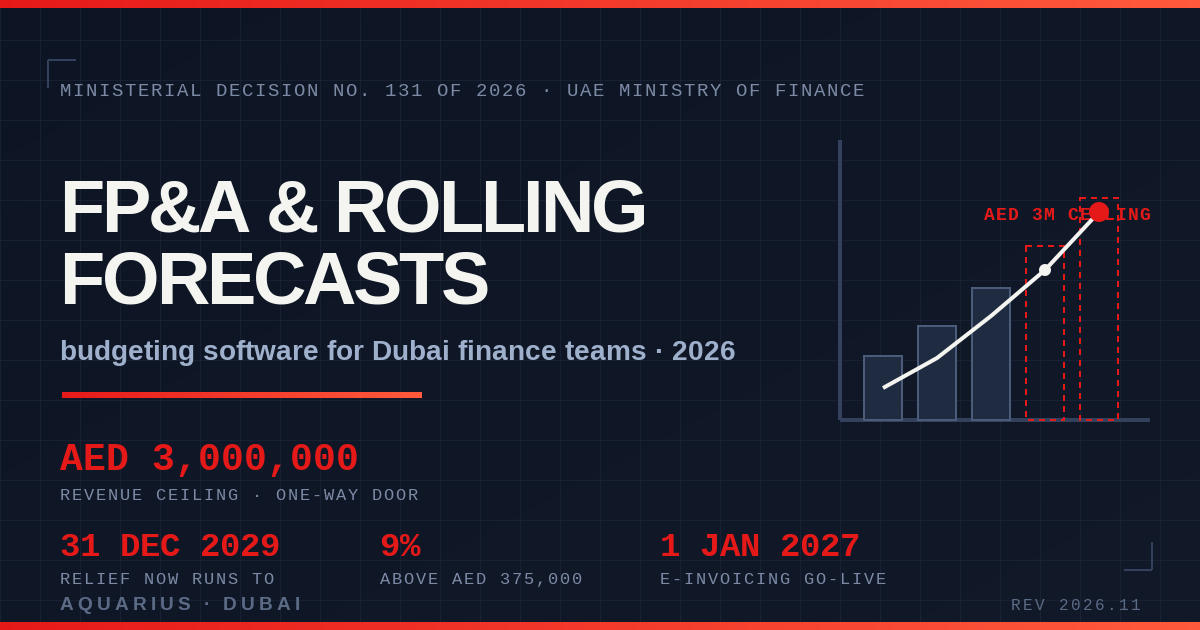
Short answer: FP&A software is the forward half of your finance stack — the driver-based budget, the rolling forecast and the scenario engine that sit on top of your accounting ledger rather than inside it. In Dubai in 2026 it has one job your spreadsheet cannot do reliably: model the AED 3,000,000 Small Business Relief revenue ceiling, which Ministerial Decision No. 131 of 2026 just extended to tax periods ending on or before 31 December 2029, and which you can never elect again once you cross it. A workable build on an existing ERP runs AED 45,000–135,000; a full multi-entity planning platform runs AED 165,000–360,000.
Dubai’s 2026 numbers already broke last year’s budget
Three hard figures set the stakes for anyone planning a Dubai P&L right now.
- Growth decelerated. Dubai’s GDP reached AED 232 billion in Q1 2026, up 2.4% year on year, according to the Government of Dubai Media Office release of 8 July 2026. That is a materially slower print than the mid-single-digit quarters Dubai posted through 2025 — and most 2026 budgets were signed off against those.
- The baseline itself moved. The same release notes that Dubai’s GDP series was revised from previously published estimates with effect from the start of 2026, to align with international statistical standards. If your model indexes revenue to published emirate growth, your comparative moved underneath you.
- Government spending is the demand signal. Dubai’s 2026–2028 budget cycle, approved on 23 November 2025, totals AED 302.7 billion of expenditure against AED 329.2 billion of revenue, with AED 99.5 billion of expenditure and AED 107.7 billion of revenue in FY2026 alone. Contractors, suppliers and services firms whose pipeline tracks that cycle can forecast off a published number instead of a feeling.
There is also no single “Dubai growth rate” to plug into a model. In Q1 2026 wholesale and retail trade contributed 22% of GDP, financial and insurance activities 14%, real estate 11.2% and construction 8.1% — while the fastest-growing activities were human health and social work at 17.5%, utilities and waste at 8.4% and construction at 8.2%. A health-sector operator and a retailer applying the same blended assumption are both wrong, in opposite directions.
Most Dubai businesses get this wrong in the same way: they budget once, in November, against a baseline that is revised in January and obsolete by April.
What FP&A software is — and what your accounting system is not
Your accounting system records what happened. FP&A software models what happens next, and holds the two side by side so the gap is visible within days rather than at year-end. Four layers, in the order most Dubai finance teams actually need them:
- Actuals feed. Trial balance, AR/AP ageing, payroll and sales data pulled on a schedule from your ERP, accounting package and HR system — not re-keyed.
- Driver-based budget. Revenue built from volumes × prices × mix, cost built from headcount, rent, and per-unit assumptions. Change one driver, the whole P&L, balance sheet and cash statement move.
- Rolling forecast. A 12- or 18-month horizon re-cut monthly: actuals replace forecast as they land, and the horizon extends. The annual budget stops being the only number anyone trusts.
- Scenario and variance. Named scenarios (base, downside, a delayed Dubai government payment cycle, a new branch), each tax-effected, each comparable to budget and to prior forecast.
That last word — tax-effected — is where Dubai diverges sharply from generic FP&A advice written for other markets.
The AED 3 million line is a forecasting problem, not a tax-return problem
UAE Corporate Tax is 0% on taxable income up to AED 375,000 and 9% above it. Underneath that, Small Business Relief lets a Taxable Person with revenue at or below a threshold be treated as having no taxable income for the period. Ministerial Decision No. 73 of 2023 sets that threshold at AED 3,000,000 of revenue per tax period (Article 2(1)), determined under the accounting standards accepted in the UAE (Article 2(4)).
Myth-bust first. Through most of 2026 the published advice across Dubai was that relief expires with tax periods ending 31 December 2026 and that this is your “last chance”. That is now wrong. Ministerial Decision No. 131 of 2026, issued 29 July 2026, replaced Article 2(2) of the 2023 decision: the AED 3,000,000 threshold applies to tax periods commencing on or after 1 June 2023 and continues to apply to subsequent tax periods ending on or before 31 December 2029. The threshold itself was left untouched.
That change converts a one-off filing question into a four-year planning constraint, and there are four model-breaking details inside it:
- It is a one-way door. Article 2(3): you cannot elect relief if your revenue in any relevant or previous tax period has exceeded the threshold. Cross AED 3,000,000 once — by a single dirham, in any year — and the election is gone for good, including in later years when revenue falls back.
- It is a revenue test, not a profit test. A business doing AED 3.4m of revenue at thin margin loses relief; one doing AED 2.9m at a fat margin keeps it. Your forecast has to track the revenue line against the ceiling independently of profitability.
- Electing in a loss year burns the loss. Articles 4(1) and 5(1): tax losses and net interest expenditure incurred in a period where relief is elected cannot be carried forward. Electing by reflex in a bad year destroys a deduction you would otherwise carry into a 9% year.
- Splitting the entity is not a plan. Article 6 treats artificial separation of a business whose combined revenue exceeds the threshold as an arrangement to obtain a tax advantage under Article 50 of the Corporate Tax Law, judged on commercial purpose and on financial, economic and organisational links.
Relief is also unavailable to a Qualifying Free Zone Person and to a constituent company of a Multinational Enterprise Group as defined in Cabinet Decision No. 44 of 2020 (Article 3) — and large multinational groups have been inside the 15% Domestic Minimum Top-up Tax since 1 January 2025 regardless.
Put concretely, this is the decision a Dubai forecast model should be making for you every month, not in September next year:
| Forecast FY revenue | Forecast taxable income | Elect relief? | Why the model says so |
|---|---|---|---|
| AED 2.6m | AED 520,000 profit | Yes | Under the ceiling; relief removes 9% on AED 145,000 above the AED 375,000 band |
| AED 2.9m, trending up 14% | AED 300,000 profit | Yes, but flag | Already inside the AED 375,000 band, so relief saves little — the real output is the ceiling-breach date |
| AED 2.8m | AED 400,000 loss | No | Electing forfeits carry-forward of the loss and net interest into a future 9% year |
| AED 3.05m | Any | Not available | Ceiling breached — and the election is permanently unavailable in all later periods |
No off-the-shelf international planning tool ships this logic. It is 40 lines of modelling in a Dubai-specific layer, and it is the single highest-return thing an SME finance model here can contain. If the ledger underneath it is shaky, start with the corporate tax accounting setup before the forecast.
Build or buy: the four rungs, with real published prices
Honest answer: most Dubai SMEs under AED 10m revenue should not buy an enterprise planning platform. The rungs, cheapest first, with list prices as published by the vendors (converted at the pegged USD/AED rate of 3.6725):
| Option | Published list price | Good for | Where it breaks |
|---|---|---|---|
| Spreadsheet, disciplined | Included in your Microsoft or Google licence | One entity, one currency, one planner | Version drift, no audit trail, no scenario comparison, breaks at multi-entity |
| BI on top of the ledger (Power BI) | USD 14/user/month Pro, USD 24 Premium Per User — about AED 51 and AED 88 | Variance reporting and dashboards off clean actuals | Reports the past well; it is not a planning engine |
| SME FP&A SaaS (e.g. Jirav) | From USD 50/month, CFO tier from USD 150/month — about AED 184 and AED 551 | Single-entity SMEs wanting drivers, headcount plans and scenarios fast | Generic tax logic; no UAE relief or ceiling modelling out of the box |
| Enterprise planning (e.g. Jedox on AWS Marketplace) | USD 12,000/year for 3 users, USD 26,640 for 5, USD 47,940 for 10 — about AED 44,070, AED 97,835 and AED 176,060 | Groups with several entities and real modelling depth | Licence is the small half of the bill; implementation and ownership dominate |
| Custom build on your stack | AED 45,000–360,000 one-off (bands below) | Dubai-specific logic, odd revenue models, awkward source systems | You own the roadmap; needs a maintenance budget |
The deciding question is not features, it is where your numbers live. If actuals already arrive clean from one ERP, buy. If they are scattered across an accounting package, a POS, three spreadsheets and a WhatsApp thread, no licence fixes that — you need the pipeline first, which is the same work as a reporting data platform.
2027 e-invoicing quietly makes weekly forecasting possible
Ministerial Decision No. 244 of 2025 sets the UAE eInvoicing rollout: the pilot programme commenced 1 July 2026, with voluntary adoption from the same date; persons with revenue of AED 50,000,000 or more must implement by 1 January 2027; those below AED 50,000,000 by 1 July 2027; and government entities by 1 October 2027.
The rules have already been eased once. Per the Ministry of Finance announcement of 19 October 2026, Ministerial Decision No. 197 of 2026 amends the 2025 framework with effect from 1 October 2026: a 24-month exclusion for transactions between members of the same Tax Group beginning 1 January 2027, removal of the requirement to retain electronic invoices inside the UAE (retention now follows the Tax Procedures Law, with FTA access), and deletion of the two-business-day system-failure notification obligation.
For FP&A this is a gift disguised as compliance work. Once invoices clear through an accredited service provider in a structured format, your revenue actuals stop being a month-end reconciliation exercise and become a daily data stream. That is the precondition for a weekly rolling forecast instead of a monthly one — and it is why the forecast layer should be designed alongside your e-invoicing ERP integration, not two years after it.
What this costs in Dubai, in AED
Our bands for Dubai and UAE clients, fixed-scope, VAT excluded:
| Scope | AED | Typical timeline | What you get |
|---|---|---|---|
| Forecast & relief diagnostic | 16,000–38,000 | 2–3 weeks | Driver map, data-source audit, AED 3m ceiling-breach model, go/no-go on buy vs build |
| Driver-based budget + rolling forecast on your existing system | 45,000–135,000 | 5–9 weeks | Automated actuals feed, driver model, 18-month rolling forecast, budget-vs-actual variance, tax-effected scenarios |
| Multi-entity group planning platform | 165,000–360,000 | 3–5 months | Several entities and currencies, consolidation-ready output, workflow and approvals, scenario engine, board pack automation |
| Forecast care retainer | 3,500–12,000/month | Ongoing | Monthly re-cut, feed monitoring, driver tuning, new scenarios, regulatory updates |
The cost of not doing it is not hypothetical. Under Cabinet Decision No. 75 of 2023 and its amendments, failure to file a corporate tax return on time attracts AED 500 for each month or part month for the first twelve months, rising to AED 1,000 per month from the thirteenth, and late corporate tax registration carries an AED 10,000 penalty. A model that cannot tell you your taxable income until the deadline is a model that files late. Against a 9% rate, a forecast that misses a AED 3,000,000 ceiling breach by one quarter can cost more than the entire build.
How Aquarius builds it
We build the forecast where your data already is. No rip-and-replace: we read your existing accounting system, payroll and sales sources, land them in one place, and put the driver model and rolling forecast on top of that — with the UAE Corporate Tax logic (the AED 375,000 band, the 9% rate, the AED 3,000,000 ceiling and the carry-forward trade-off) written into the model rather than bolted on in a side tab.
Every engagement is fixed-scope and fixed-price after the diagnostic, delivered in two-week increments you review as they land, with the model handed over documented and yours — source files, drivers and all. If the diagnostic concludes you should buy a licence instead of building, we say so and you pay only for the diagnostic. If a group close sits downstream of your plan, we sequence it with your close and consolidation workstream, and with cash and liquidity where the forecast has to drive funding decisions.
FAQ
Did Small Business Relief end in 2026?
No. Ministerial Decision No. 131 of 2026, issued 29 July 2026, extended the AED 3,000,000 revenue threshold to tax periods ending on or before 31 December 2029. Earlier guidance describing 2026 as the final year predates that decision. Electing businesses must still register for Corporate Tax, file returns on time and keep adequate records.
What happens if my revenue crosses AED 3 million mid-year?
Relief is tested on revenue for the tax period, and Article 2(3) of Ministerial Decision No. 73 of 2023 blocks the election if the threshold was exceeded in any relevant or previous period. Practically: once you cross, you are out permanently — so the breach date belongs in your forecast, and the decision to accelerate or defer revenue around a year-end is a modelling exercise, not a year-end scramble.
Is FP&A software different from ERP reporting?
Yes. ERP reporting is historic and transaction-shaped. FP&A is forward and assumption-shaped: it holds drivers, versions and scenarios that do not exist in your ledger. The two connect — the ERP supplies actuals, the forecast supplies the comparison — but an ERP module alone rarely gives you versioned scenarios or a rolling horizon.
Do we need a data warehouse first?
Only if your actuals come from more than two systems. One clean ERP can feed a forecast directly. Three or more sources, or anything hand-exported monthly, and the pipeline is the project — the forecast is the easy part on top.
How long until the first useful forecast?
Two to three weeks for the diagnostic and a first driver model you can argue with, five to nine weeks for an automated rolling forecast with variance reporting on a single entity. Group builds run three to five months, mostly spent on data quality rather than modelling.
Start with the ceiling, not the software
Before you price a licence, answer one question: in which month does your forecast revenue cross AED 3,000,000, and is that decision being made deliberately? If nobody in your business can answer that from a live model, that is the project — and it is a smaller project than it sounds. See our pricing, review what we build, or send us your last two years of numbers and we will tell you in a week whether you need a build, a licence, or just a better spreadsheet.