
14,921 .ae Hostnames Sit in Public Certificate Logs. 177 Staging and Admin Panels Answered.
We pulled every unexpired certificate for 787 .ae domains from Certificate Transparency logs on 30 November 2026: 14,921 hostnames, 1,841 non-production, and 177 that answered HTTP 200 to anyone.
- PUBLISHED
- 30 NOV 2026
- READ TIME
- 12 MIN
- AUTHOR
- AQUARIUS · DUBAI
- UNIT
- REV 2026.09
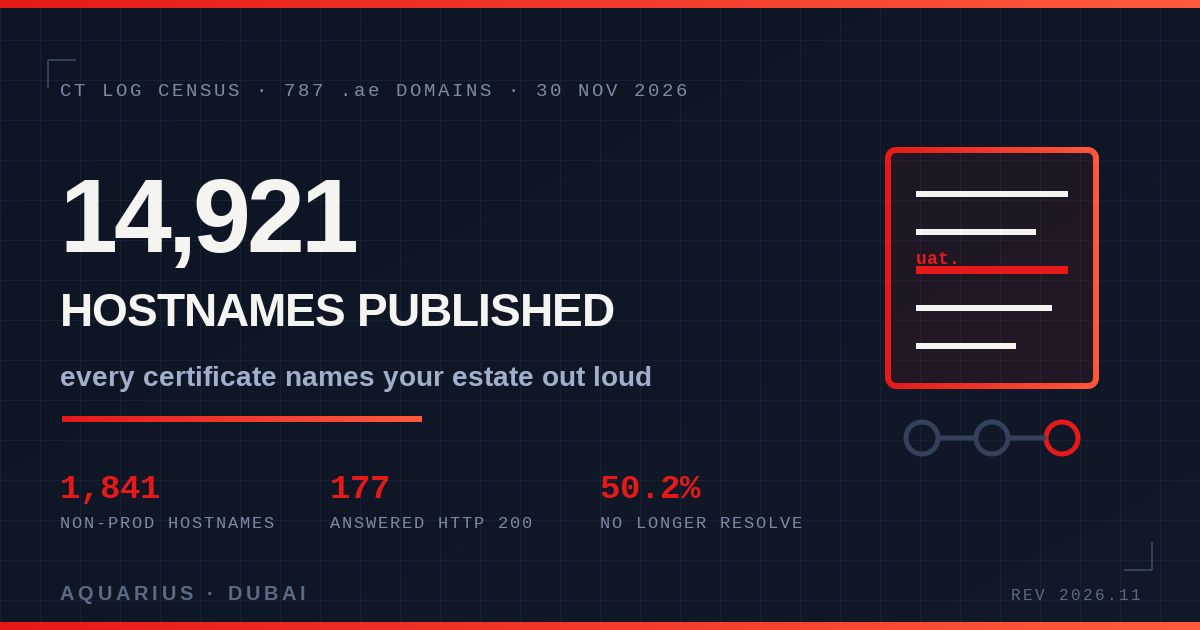
We pulled every currently valid TLS certificate for 787 .ae domains out of the public Certificate Transparency logs on 30 November 2026. They name 14,921 distinct hostnames — and 1,841 of those are staging, UAT, admin, webmail or cPanel hosts that nobody meant to advertise. We then sent one anonymous HTTPS request to each of them: 177 answered with a plain HTTP 200, across 74 different .ae domains, 15 of them on .gov.ae. No scanning of the target networks was needed to find them. The list was published, by their own certificate authorities, the moment each certificate was issued.
This is the part of your attack surface you cannot opt out of. Every publicly trusted certificate is logged, by design, and the logs are free to query. If your DNS is a private asset register, Certificate Transparency is the public index of it.
Why every certificate you buy publishes your hostnames
Certificate Transparency is not a leak. It is a requirement. Chrome will not trust a certificate unless it carries Signed Certificate Timestamps proving it was submitted to public, append-only logs: two SCTs for certificates valid 180 days or less, three for anything longer, and they must come from logs run by distinct operators recognised by Chrome. Safari enforces an equivalent policy. There is no path to a working HTTPS site that avoids publication.
The logs are append-only and mirrored, so nothing can be withdrawn. A certificate your team issued for a 2021 proof-of-concept is still readable today. Three numbers set the stakes for a Dubai business:
- The UAE Cyber Security Council blocks around 600,000 cyberattack attempts a day — roughly 416 every second — according to council head Dr Mohamed Al Kuwaiti in August 2026, with phishing, DDoS, ransomware and data theft the dominant categories.
- IBM’s 2026 Cost of a Data Breach report puts the Middle East average breach at USD 8 million, about AED 29.4 million, of which AED 13.1m is lost business and AED 7.0m is post-breach response. Financial and technology firms average USD 10.67m.
- 26% of malicious breaches in that study were AI-enabled. Automated reconnaissance across CT logs is exactly the kind of work that gets cheaper when an attacker has a model doing the sorting.
The measurement: 787 .ae domains, one query each
This is first-party data. We took a Tranco-ranked list of .ae hostnames, collapsed each to its registrable domain (treating gov.ae, ac.ae, co.ae, net.ae, org.ae and sch.ae as public suffixes), and ended with 787 apexes: 667 commercial second-level .ae, 94 .gov.ae, 19 .ac.ae and 7 others. For each one we queried the crt.sh Certificate Transparency aggregator for every logged certificate whose SAN or common name falls at or under that domain and whose validity period has not yet expired. All 787 returned cleanly.
Result: 14,921 distinct hostnames across 703 domains. Eighty-four domains had no unexpired certificate naming them at all — typically parked names or domains fronted entirely by a platform certificate that does not include them.
The distribution is the first surprise. The median .ae domain publishes just three hostnames. The mean is nineteen. The top of the list is an order of magnitude beyond that.
| Metric | Value | Reading |
|---|---|---|
| Domains with at least one live certificate | 703 of 787 | 89.3% are indexed in CT right now |
| Median hostnames per domain | 3 | Most .ae estates are genuinely small |
| 75th percentile | 9 | — |
| 90th percentile | 26 | The long tail starts here |
| Largest single estate | 1,457 (adia.ae) | Followed by 1,054, 869 and 747 |
| Domains publishing a wildcard | 497 of 787 (63.2%) | 1,438 wildcard names in total |
Wildcards cut both ways. A *.example.ae certificate hides individual hostnames from the log, which is why 63% of .ae domains use one. It also means a single stolen private key covers every subdomain you will ever create, and it tells an attacker nothing about which names are interesting — so they go looking elsewhere, and the per-host certificates you issue for anything the wildcard does not cover become the map.
On issuance, the .ae top tier is more commercial than the global web: the DigiCert group (including GeoTrust, RapidSSL and Thawte) accounts for 47.5% of logged certificate entries, Let’s Encrypt 24.8%, GlobalSign 6.3%, Google Trust Services 4.3%, Sectigo 4.3%, Amazon 3.3% and GoDaddy 2.2%.
The 1,841 hostnames that should never have been named
We then classified every hostname by its labels, looking for environment markers (dev, test, uat, stage, stg, staging, qa, preprod, sandbox, sbx, demo, beta, legacy, backup, training) and infrastructure markers (admin, webmail, cpanel, vpn, internal, intranet, owa, grafana, kibana, jira, gitlab, ftp, bastion and similar). Sub-labels split on hyphens, so uat-harmonize counts.
2,090 hostnames on 214 domains matched — 27.2% of every .ae domain we probed has at least one non-production or infrastructure hostname sitting in a public log.
| Exposure class | Hostnames | Domains affected | Most common labels |
|---|---|---|---|
| Environment-labelled | 1,891 | 163 (20.7%) | uat 541, dev 385, stg 309, staging 145, qa 143, test 134 |
| Infrastructure / admin | 215 | 102 (13.0%) | admin 63, webmail 55, cpanel 23, internal 17, vpn 13 |
On .gov.ae | 236 | 24 of 94 (25.5%) | 202 environment, 34 infrastructure |
| Total non-production | 2,090 | 214 (27.2%) | — |
Those 541 uat hostnames are the headline. User-acceptance testing environments are where real production data most often gets copied for a release cycle, where SSO is most often stubbed out, and where the WAF in front of production usually is not. Under the UAE Information Assurance Regulation, entities are expected to maintain an accurate and current inventory of information assets. A UAT host your CA published and your asset register does not list fails that control twice over.
So we knocked on all 1,841 doors
A hostname in a log is not automatically a live target. We dropped the 1,438 wildcards (nothing to resolve) and sent one HTTPS GET to each of the remaining 1,841 non-production hostnames, following no redirects, from a single residential-grade connection. Here is what came back.
| Outcome | Hosts | Share of 1,841 |
|---|---|---|
| Name no longer resolves (NXDOMAIN) | 925 | 50.2% |
| Resolves, no HTTPS answer (timeout / refused / TLS error) | 280 | 15.2% |
| Answered HTTPS | 636 | 34.5% |
| of which HTTP 200, no authentication | 177 | 9.6% |
| of which 401 or 403 (auth or WAF) | 224 | 12.2% |
| of which 404 / 5xx / redirect | 235 | 12.8% |
The 177 open hosts span 74 distinct .ae domains. Of those, 130 carry an environment label and 54 an infrastructure label; 15 sit on .gov.ae. By label: 26 UAT, 25 test, 19 webmail, 18 staging, 18 cPanel login pages, 17 dev, 15 stg, 11 admin, 10 QA. Two returned an Apache directory index. Several served named internal admin consoles with their product name in the page title.
We are not publishing those hostnames. The point is not any one organisation — it is that the path from “public log” to “open login page on a Dubai company’s staging box” took one query and one request, and cost nothing. Only 12.2% of these hosts were behind any authentication or filtering at all.
Half of them vanished — and that is the worse half
925 of the 1,841 non-production hostnames no longer resolve, across 94 different domains, 115 of them on .gov.ae. That looks like good hygiene. It usually is not. It means the DNS record was deleted or the whole environment was torn down while the certificate was still valid — and it means nobody is watching the name any more.
Where the record was not deleted but the resource behind it was released, you get a dangling DNS record and a subdomain takeover. Published on 24 November 2026, security firm Intruder cycled roughly 450,000 AWS Elastic IPs in 48 hours — 0.56% of Amazon’s published IPv4 space, about 9,400 addresses an hour — and landed 28 live takeovers inside bug-bounty scope, including five treasury.gov subdomains at roughly USD 3 each. Their target list came from exactly this kind of subdomain enumeration. AWS confirmed on 17 November 2026 that it does not plan a fix, which makes the teardown order your problem, permanently.
The pressure is about to increase. Under CA/Browser Forum ballot SC-081v3, maximum TLS certificate lifetime fell to 200 days on 15 March 2026, drops to 100 days on 15 March 2027, and to 47 days on 15 March 2029. Shorter certificates mean more issuance events, which means more CT entries per hostname per year, which means your estate gets re-published to the world roughly eight times a year by 2029 instead of once. Every forgotten subdomain gets re-announced on that schedule.
What to do about it, and what it costs in Dubai
The work is a loop, not a project, and it is cheap relative to an AED 29.4m average breach.
- Enumerate yourself first. Query CT for your own apex, including every suffix you own. Treat the output as the real asset register and diff it against the one your IT function keeps.
- Decide, per hostname: production, or gone. There is no third category for an internet-facing name. Non-production environments belong behind SSO, an allowlist or a private network — not merely behind an unguessable name, because the name is published.
- Tear down in the right order: remove the DNS record before releasing the cloud resource, then revoke the certificate. Reversing those two steps is what creates a takeover window.
- Monitor CT continuously. A new certificate naming a hostname you did not authorise is either shadow IT or mis-issuance, and both are worth an alert in a channel a human reads.
- Pair it with issuance control. CT tells you after the fact; a CAA record refuses beforehand. Our CAA census of the same 787 domains found 94.5% publish nothing at all, so for most readers both halves are open.
We scope this as fixed-price work: AED 2,500–5,000 for a full CT-based external surface audit of a domain portfolio — every logged hostname, liveness and status for each, and a prioritised teardown list. AED 7,000–15,000 to execute it: environments moved behind authentication, dangling records closed, certificate inventory reconciled, and CT monitoring wired to your alerting. Ongoing monitoring runs from AED 900 a month. If the audit finds nothing live that should not be, we say so and you pay the audit fee only.
Two companion datasets from the same .ae sample are worth reading alongside this one: our certificate scan of .ae homepages for how short deployed lifetimes already are, and the DNS resilience and nameserver census for how fragile the lookup layer underneath all of this is. See how we scope technical work.
FAQ
Can I stop my hostnames appearing in Certificate Transparency logs?
Not for a publicly trusted certificate. Chrome and Safari require SCTs from independent public logs, so publication is a condition of being trusted. Your options are a wildcard certificate (which publishes the parent name only), a private internal CA for genuinely internal hosts, or simply not exposing the host to the internet.
Is querying CT logs for someone else’s domain legal?
The logs are public infrastructure and reading them is passive reconnaissance, which is how the ecosystem is designed to work — domain owners are the intended audience. Sending requests to hosts you do not own is a different matter: our liveness check used one unauthenticated GET to the document root, the same request a browser makes, and we have published no hostnames. Anything beyond that needs written authorisation under UAE Federal Decree-Law No. 34 of 2021.
We use a wildcard certificate. Are we safe?
Safer from enumeration, more exposed on key compromise. 63.2% of the .ae domains we measured publish at least one wildcard, and many of them also publish specific hostnames alongside it — which defeats the point. Check what you actually publish rather than what you intended to.
What is the single highest-value fix?
Put every non-production environment behind authentication today, then fix the teardown order. Those two changes remove the 177-host category entirely. CT monitoring is what keeps it removed.
Does this affect small Dubai businesses or only large ones?
The median .ae domain publishes three hostnames, so most small businesses have little to find. The risk concentrates the moment you add a staging site, a client demo, a webmail endpoint or a cPanel login — and 18 of the 177 open hosts we found were cPanel logins, which is a shared-hosting pattern, not an enterprise one.
If you want the same measurement run against your own domains before someone else runs it for you, send us the list. The audit takes a day.