
We Tested 559 .ae Homepages for Clickjacking Protection: 31.8% Ship None
We probed 787 .ae domains on 26 November 2026. Of 559 answering homepages, 178 (31.8%) ship neither X-Frame-Options nor CSP frame-ancestors, 8 ship values every browser ignores, and 22 carry a login form.
- PUBLISHED
- 26 NOV 2026
- READ TIME
- 13 MIN
- AUTHOR
- AQUARIUS · DUBAI
- UNIT
- REV 2026.09
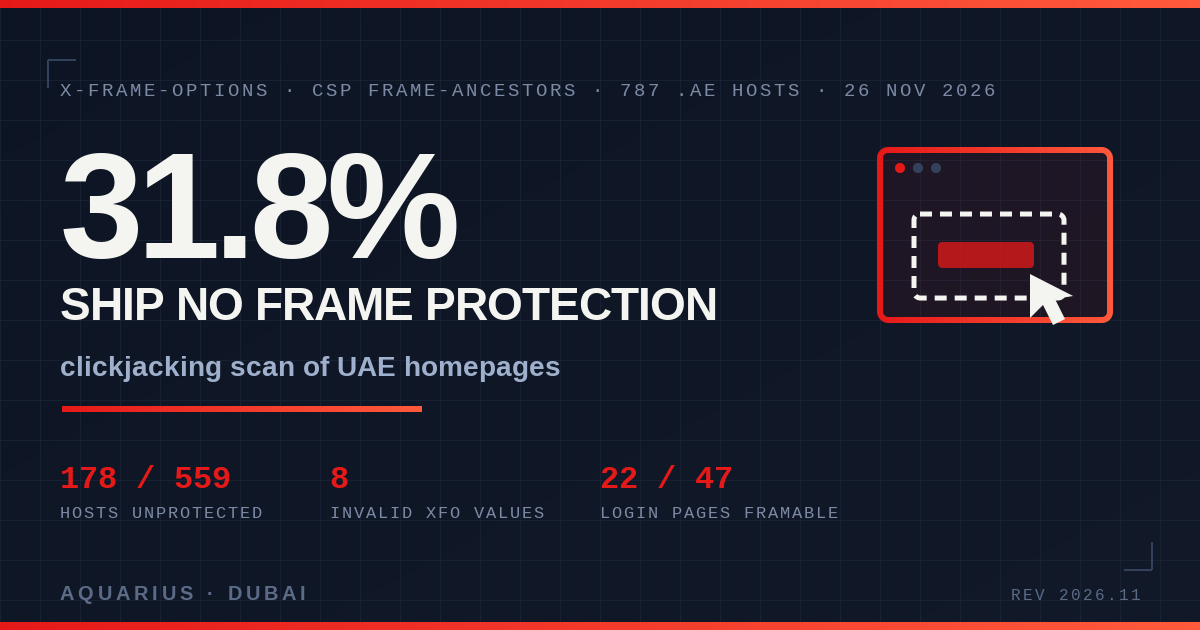
Short answer: we probed 787 UAE .ae domains on 26 November 2026 and read the framing headers off every response. Of the 559 hosts that returned a live HTML homepage, 178 (31.8%) ship neither X-Frame-Options nor a CSP frame-ancestors directive — so any site on the internet can load them inside an invisible iframe. A further 8 ship an X-Frame-Options value that every modern browser silently throws away.
That is the measurement. The uncomfortable part is who is in the 178: uaepass.ae, u.ae, www.dm.gov.ae, www.propertyfinder.ae and dubaiairports.ae all answered with no framing header on the hostname a visitor actually types. And 22 of the unprotected hosts serve a password field on that same framable page.
Why a 2016-era header still matters in the UAE in 2026
Clickjacking sounds like a solved problem. Three current UAE numbers say otherwise, because clickjacking is not an exploit against your server — it is an exploit against your customer's hand.
- More than 75% of cyber breaches begin with a phishing email or fraudulent message, and roughly 3.4 billion phishing messages are sent daily worldwide, the UAE Cyber Security Council told state news agency WAM on 5 April 2026. Clickjacking is what the landing page at the end of that message does for a living: it borrows your real, trusted, logged-in interface and puts an attacker's button on top of it.
- 62% of fraud, AML and compliance leads at UAE banks put annual fraud losses above AED 18.3 million (about USD 5 million), and 58% said losses are rising — BioCatch's UAE survey, published 9 April 2026. 95% named social-media micro-scams as their hardest detection problem, and micro-scams are delivered by exactly the kind of one-click overlay page this header blocks.
- UAE PASS passed 14 million users in 2026 with more than 2.6 billion digital transactions and 15,000+ connected services (Digital Dubai). A national single sign-on turns "approve" buttons into the most valuable click targets in the country — which is precisely why the consent and approval screens behind them must refuse to be framed.
Add the regulator's direction of travel. The Central Bank of the UAE stood up a centralised Anti-Fraud Operations Centre for real-time monitoring of fraudulent activity and rapid incident response (announced 21 May 2026), alongside a push to move banks off SMS one-time passwords. When the authentication step gets stronger, attackers stop attacking the step and start attacking the UI around it.
What we measured, and how
We took the same 787-host Tranco .ae list used in our earlier header scans and sent one desktop-Chrome GET to https://host/ for each, following redirects to the terminal response. For every response we recorded every X-Frame-Options header instance (not just the first — duplicates matter), every Content-Security-Policy and Content-Security-Policy-Report-Only header, the Server banner, and whether the delivered HTML contained a type="password" input.
681 hosts answered, 559 with a 2xx HTML homepage. 108 returned 403 — bot-blocking, not a verdict — and 106 did not connect at all. Every headline host named in this article was then re-probed by hand, apex and www separately, because a bulk scan that reads only the final hop will tell you a site has no header when in fact only its apex is bare. All percentages below are of the 559 usable homepages.
One honest limit: a homepage is not a bank transfer screen. A brochure page with nothing to click has little to lose from being framed. We are measuring header hygiene at the front door, which is the only part of a stranger's estate anyone can legitimately measure — and which Lighthouse's own best-practices audit grades.
The headline numbers
| Framing posture | Hosts | Share of 559 |
|---|---|---|
Valid X-Frame-Options (DENY or SAMEORIGIN) | 356 | 63.7% |
CSP frame-ancestors present | 172 | 30.8% |
| Both headers (belt and braces) | 147 | 26.3% |
| Protected by at least one | 381 | 68.2% |
| No framing protection at all | 178 | 31.8% |
| Any CSP header at all | 241 | 43.1% |
frame-ancestors 'none' (hard deny) | 47 | 8.4% |
In context, the UAE list is doing better than the open web: the SANS Internet Storm Center's November 2026 re-run across the Tranco top 1 million found 29.7% of domains carrying either header, and HTTP Archive's Web Almanac 2025 puts X-Frame-Options at roughly 30% of all sites with frame-ancestors at only 2.37% on desktop. Our 68.2% is flattering partly by selection — the Tranco .ae head is banks, airlines, ministries and large corporates, not the long tail. Compare like with like and the UAE's sharp end still trails: among the top 100 reachable .ae hosts, 16 have no framing header, and across the top 250 it is 46 hosts (27.2%).
The .gov.ae subset is the best-performing bucket: 58 reachable hosts, 48 with valid X-Frame-Options, 24 with frame-ancestors, and only 9 unprotected (15.5%) — roughly half the national rate. Academic .ac.ae sits at 33.3% unprotected, in line with plain .ae at 33.7%.
Which header actually wins? The part most teams get backwards
Both headers exist and they do not cooperate. The rule, from the CSP Level 2 specification and OWASP's Clickjacking Defense Cheat Sheet: when a browser sees a CSP frame-ancestors directive, it uses that and ignores X-Frame-Options entirely. OWASP is blunt about the legacy header — "it has been obsoleted in favor of the frame-ancestors directive from the CSP Level 2 specification" — while noting every major browser still honours it when CSP is absent.
That ordering quietly inverts intent on 7 hosts in our scan, where the two headers disagree and the looser one wins:
| Host | X-Frame-Options says | CSP frame-ancestors says | Browser enforces |
|---|---|---|---|
underarmour.ae | deny | 'self' | 'self' — self-framing allowed |
aba.ae, fanet.ae, ngionline.ae | DENY | 'self' | 'self' |
sba.net.ae | DENY | 'self' + Facebook domains | the allowlist |
mediaoffice.ae | SAMEORIGIN | 'none' | 'none' — stricter than declared |
alainpharmacy.ae | DENY and SAMEORIGIN | 'self' *.meetanshi.com | the allowlist |
Only one of those seven is strict by accident. The other six published DENY, believed they had DENY, and are shipping something weaker. If you run both headers, they have to agree — and the CSP is the one that decides.
Eight headers that do nothing at all
The syntax errors are the most instructive part of the dataset, because each one was written by someone who thought the job was done. All of these were re-verified by hand on 26 November 2026:
| Host | Header as served | Why it is void |
|---|---|---|
toyota.ae, lexus.ae, automall.ae | X-Frame-Options: SAMEORIGIN always | nginx's always flag got typed inside the quotes. The value is now an unknown token, not SAMEORIGIN. |
masdarcity.ae | ALLOW-FROM https://www.youtube.com https://www.google.com/maps | Doubly dead: ALLOW-FROM is obsolete and ignored, and it never accepted two origins. |
emaar.ae | ALLOW-FROM https://uae-cms.emaar.com | Same obsolete value — rescued only because the same response also carries frame-ancestors 'self' https://uae-cms.emaar.com. This is the right migration, with the corpse left in place. |
dfsa.ae | SAMEORIGIN on one hop, DENY; on the next | A trailing semicolon is CSP syntax, not XFO syntax. DENY; is not a recognised value. |
tribalwars.ae | X-Frame-Options: NONE | There is no NONE keyword. The only valid values are DENY and SAMEORIGIN. |
qualys.ae | SAMEORIGIN, then ALLOWALL, plus frame-ancestors * | The CSP wildcard wins and explicitly permits framing by anyone. |
Related finding: 29 hosts send the header more than once — dib.ae and nic.ae send SAMEORIGIN three times, bookswagon.ae sends SAMEORIGIN and sameorigin. Duplicates are usually harmless but they are a reliable fingerprint of two layers (origin plus CDN, or app plus reverse proxy) both trying to own security headers, which is how the dfsa.ae disagreement happens.
And the classic that did not appear even once: zero hosts tried to set framing policy with a <meta http-equiv="X-Frame-Options"> tag. Good. OWASP's guidance on that is in capital letters: meta tags attempting to apply X-Frame-Options DO NOT WORK. One host, sephora.ae, has frame-ancestors in Content-Security-Policy-Report-Only only — it collects reports and enforces nothing.
Where your CDN takes the decision out of your hands
| Server / edge | Hosts | Protected |
|---|---|---|
| Cloudflare | 244 | 178 (73.0%) |
| nginx | 60 | 34 (56.7%) |
| Microsoft-IIS | 20 | 12 (60.0%) |
| Apache | 29 | 13 (44.8%) |
| Vercel | 9 | 4 (44.4%) |
| LiteSpeed | 17 | 4 (23.5%) |
LiteSpeed at 23.5% is the shared-hosting signature: cPanel-class stacks where nobody owns the response headers. The practical read for a Dubai SME is the Cloudflare line — 66 of the 178 unprotected hosts (37.1%) are already behind Cloudflare, which means a Transform Rule in the dashboard fixes them in about ten minutes with no deployment, no code review and no downtime.
The myth-bust: these headers do not stop DoubleClickjacking
If you add frame-ancestors 'none' today and tick clickjacking off the risk register, you have mitigated the 2015 attack and not the 2026 one.
DoubleClickjacking, published by researcher Paulos Yibelo at the end of December 2024, exploits the timing gap between
mousedownandclick. The victim's page is opened in a new window and never framed at all — soX-Frame-Options,frame-ancestorsand SameSite cookies have nothing to catch. It has been demonstrated against OAuth approval flows on major platforms.
As of late 2026 there is no shipped browser defence and no standardised header for it. The mitigation is application-level: keep high-consequence buttons — authorise payment, approve OAuth scope, confirm transfer, delete account — disabled until the page has observed a genuine gesture on itself, and require a second deliberate confirmation for anything irreversible. If your Dubai product has a one-click "approve" anywhere, that is a design review, not a header change.
So frame protection is necessary and not sufficient. It is also the cheapest security control you will ever deploy, which is what makes 178 missing ones indefensible.
What it costs to fix, and what not fixing costs
Honest ranges for UAE work, assuming an existing site:
| Scope | What you get | Timeline | AED |
|---|---|---|---|
| Frame protection only | frame-ancestors set correctly at the edge or server, apex and www, legacy X-Frame-Options reconciled or removed, verified with curl | 1–2 days | AED 1,500 – 4,000 |
| Full header baseline | Framing, HSTS with preload eligibility, Referrer-Policy, Permissions-Policy, X-Content-Type-Options, plus a report-only CSP to start measuring | 1–2 weeks | AED 6,000 – 18,000 |
| Enforced CSP migration | Report-only CSP tuned to zero false positives, nonce-based script policy, unsafe-inline removed, then enforced | 3–6 weeks | AED 18,000 – 45,000 |
| Clickjacking-resistant UX review | Gesture-gating and double-confirm on payment, OAuth and destructive actions — the DoubleClickjacking class | 1–2 weeks | AED 9,000 – 25,000 |
| Quarterly header drift monitor | Automated re-probe of every public hostname, diff alerting, evidence trail for auditors | ongoing | AED 1,200 – 3,000 / month |
Set that against the downside. IBM's Cost of a Data Breach 2026 puts the Middle East average breach at USD 8 million versus USD 4.99 million globally, rising to USD 10.67 million in financial services and technology. A header that takes one afternoon sits on the cheapest end of a very expensive curve — and unlike most security work, you can prove it is done in a single command:
curl -sI https://yourdomain.ae/ | grep -iE 'x-frame-options|frame-ancestors'
Run it against your apex and your www. In our scan the single most common false sense of security was a header present on one hostname and absent on the other.
How Aquarius does it
Every site we build in Dubai ships frame-ancestors from day one, set at the edge so a future framework upgrade cannot quietly drop it, and we verify it from outside the network rather than trusting the config. For clients on someone else's stack we start with the scan: every public hostname, every header, a one-page verdict and a fix list ordered by what breaks first. It is the same method behind our HSTS scan of 787 .ae hosts, our Permissions-Policy survey and our script-integrity and CSP audit. Our pricing page shows where a hardening engagement sits against a full build.
FAQ
Should I use X-Frame-Options or CSP frame-ancestors in 2026?
Use CSP frame-ancestors. It is the current standard, browsers prefer it over X-Frame-Options when both are present, and it accepts a real allowlist instead of one obsolete origin. Keep X-Frame-Options: DENY or SAMEORIGIN alongside it only if you still support something ancient — and make sure the two say the same thing, because six hosts in our scan published DENY and are actually enforcing 'self'.
What is the correct value if nothing should ever frame my site?
Content-Security-Policy: frame-ancestors 'none'. Only 47 of 559 UAE homepages (8.4%) use it. If your own pages legitimately frame each other, use frame-ancestors 'self'; if a named partner embeds you, list that exact origin.
Will adding this break my embedded Google Maps or YouTube videos?
No. frame-ancestors controls who may frame you. What you are allowed to embed is governed by frame-src. Two hosts in our scan tried to allowlist YouTube and Maps in X-Frame-Options — the wrong header entirely, and it did nothing in either direction.
Does a meta tag work if I cannot change server headers?
Not for X-Frame-Options — it is ignored, in every browser, always. A <meta http-equiv="Content-Security-Policy"> tag does work for some CSP directives, but frame-ancestors is specifically among those that are only honoured in a real HTTP header. If you cannot set headers, put a CDN in front of the site; if you already use Cloudflare, a Transform Rule does it from the dashboard.
Is clickjacking still a real risk, or just a scanner finding?
Both. For a static brochure homepage it is close to a scanner finding, which is why Lighthouse grades it under best practices rather than security. For anything with a session — dashboards, booking flows, payment confirmations, UAE PASS approval screens — it is a live risk, and 22 of our 178 unprotected hosts serve a password field on that same framable page. Fix the headers everywhere, then do the harder work on the buttons that move money.
Want your own hostnames checked?
We will run this exact probe across every public hostname you own — apex, www, staging, app, api — and send back the per-host verdict plus the one-line fix for your stack. No obligation, no scanner PDF. Tell us your domains and we will reply with the results.