
Design Tokens & Design System Governance for Dubai Teams (2026): Real AED Costs and the 960-Hour Rebuild Trap
Design tokens plus governance, costed for Dubai teams in 2026: AED 2,354/month tooling against AED 158,179 of avoidable rebuild, the DTCG v2025.10 spec, and RTL-safe naming rules.
- PUBLISHED
- 19 NOV 2026
- READ TIME
- 12 MIN
- AUTHOR
- AQUARIUS · DUBAI
- UNIT
- REV 2026.09
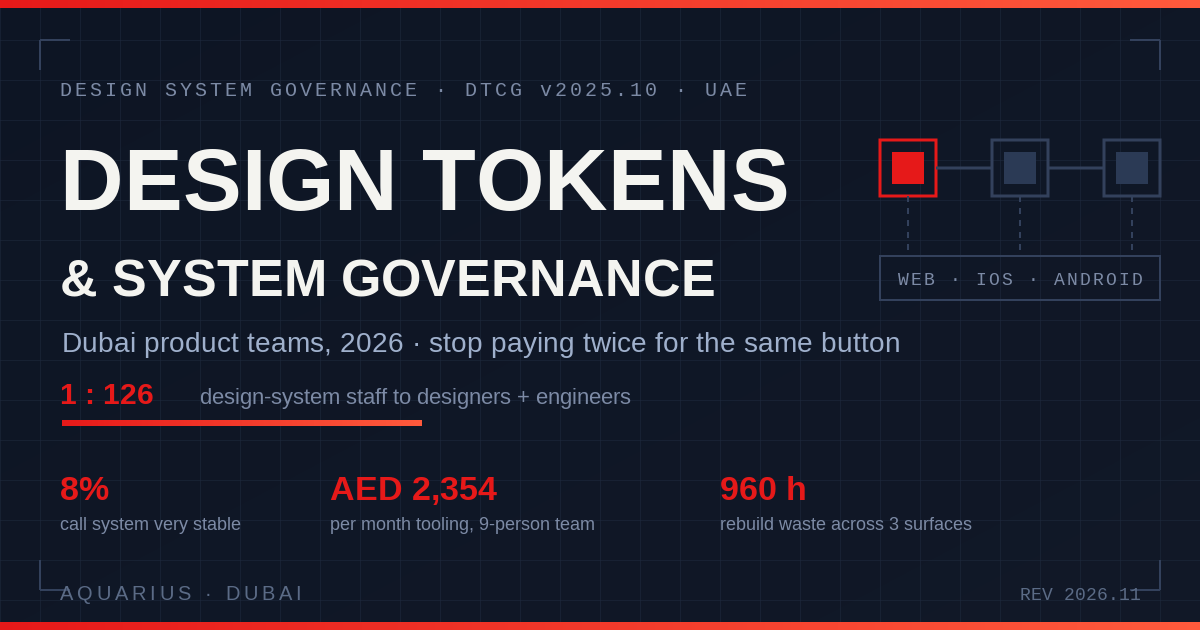
Design tokens are the named, machine-readable values — colour, spacing, type, radius, motion — that every surface of your product reads instead of hard-coding hex codes and pixel values. Governance is the boring part that makes them work: who owns a token, how a change ships, and what breaks if nobody does. For a Dubai product team running web plus iOS plus Android in English and Arabic, getting this right is the difference between building a button once and paying three teams to rebuild it every quarter.
Most Dubai companies get the order wrong. They buy the tooling first and decide ownership never. The 2026 data says that is exactly backwards.
Why this matters now: Dubai's design economy got big before it got organised
The scale is real. Dubai's Creative Economy Strategy targets 15,000 creative companies and 140,000 creative jobs, lifting the creative industries' share of the emirate's GDP from 2.6% in 2020 to 5% by 2026. The baseline it was measured against — the Dubai Framework for Cultural Statistics, published by Dubai Culture with the Dubai Statistics Center in April 2022 — counted 14,771 creative enterprises and 108,444 workers in 2020, about 4.1% of total employment in the emirate.
The visible end of that economy is loud: Dubai Design Week returned for its 12th edition on 5 November 2026 with practitioners from more than 50 countries, and Downtown Design showed 300-plus brands from 35-plus countries. The invisible end — the engineering plumbing under all those product teams — is thin to the point of fragile.
zeroheight's Design Systems Report 2026, drawn from 147 teams, is the clearest read on that gap. The median design-system team is four people, and across respondents there is roughly one design-system team member for every 126 designers and engineers being served. Only 8% describe their system as very stable, even though more than half of these systems are three or more years old. Three in five teams say they simply do not have enough people. Satisfaction with organisational buy-in fell to 32%, down from 42% the year before.
The myth worth busting: a design system is not a Figma library. A Figma library with no token pipeline and no owner is a very expensive mood board.
What a token layer actually is (and the 2026 spec that finally settled it)
Until recently every tool invented its own token JSON, so moving from one vendor to another meant rewriting your source of truth. That ended on 28 October 2025, when the Design Tokens Community Group published the first stable version of the DTCG format — version 1, tagged v2025.10. Note the precise status: it is a Final Community Group Report, explicitly not on the W3C Standards Track. It is a stable interchange format with industry consensus, not a web standard. More than 25 tools already read or write it, including Figma, Penpot, Sketch, Framer, Style Dictionary, Tokens Studio, Supernova, zeroheight and Zeplin.
Practically, that gives a Dubai team a three-tier structure worth copying:
- Primitives — raw values with no opinion:
colour.red.600,space.4,font.size.300. - Semantic tokens — intent, not appearance:
colour.action.background,space.inline.sm. This is the layer your components consume. - Component tokens — only where a component genuinely deviates:
button.primary.background.
One Dubai-specific rule overrides fashion here: spacing and layout tokens must be expressed in logical properties — inline-start and inline-end, never left and right. An Arabic interface mirrors; a token called padding.left is a bug waiting for your first RTL release. We cover the layout side of that in detail in our guide to Arabic and RTL website design best practices for the UAE.
The tooling, and what it costs in AED
Here is the honest 2026 picture for a nine-person Dubai product team: three designers and six engineers. Figures converted at AED 3.6725 per USD, list prices, monthly per seat unless stated.
| Tool / tier | Seat or unit | USD | AED | What it buys |
|---|---|---|---|---|
| Figma Professional | Full seat | $16 | AED 58.76 | Design + library publishing |
| Figma Professional | Dev seat | $12 | AED 44.07 | Dev Mode, inspect, code connect |
| Figma Organization | Full seat | $55 | AED 201.99 | Design-system analytics, branching, SSO |
| Figma Organization | Dev seat | $25 | AED 91.81 | Dev Mode at org governance level |
| Figma Enterprise | Full / Dev seat | $90 / $35 | AED 330.53 / 128.54 | Advanced admin, guest controls |
| Chromatic Free | 5,000 snapshots | $0 | AED 0 | Chrome-only visual review, 25k TurboSnaps |
| Chromatic Starter | 35,000 snapshots | $179 | AED 657.38 | Visual regression CI; overage $0.008 (AED 0.03) |
| Chromatic Pro | 85,000 snapshots | $399 | AED 1,465.33 | Multi-browser, higher parallelism |
| zeroheight Starter | Per editor | $49 | AED 179.95 | Docs site, up to 5 editors, 3 token sets |
| Supernova Pro | 10 editors, flat | $399 | AED 1,465.33 | Unlimited themes, code automation |
A sane stack for that nine-person team — Figma Organization (3 full + 6 dev seats), Chromatic Starter, and zeroheight Starter with 3 editors — comes to $641 per month, or AED 2,354 per month / roughly AED 28,249 per year. That is the whole tooling bill. Hold that number; it is about to look very small.
On the pipeline side, Style Dictionary or Terrazzo compiles your DTCG source into CSS custom properties, iOS and Android resources, and Tailwind config. Storybook is where components get reviewed: Storybook 10.5 shipped in July 2026 with Vitest initialGlobals for switching themes, viewports and locales per test — which is how you get an English and an Arabic snapshot of every component without hand-written duplicate stories. Storybook 10 also cut install size by 29% by going ESM-only. Chromatic then diffs the snapshots; TurboSnap bills five changed-story snapshots as one, which is what keeps the snapshot count inside the Starter tier.
Governance: the four decisions that decide whether it survives
Tooling is a purchase. Governance is a choice, and only four decisions actually matter.
1. Ownership model
Three options. Centralised — one team owns everything; fast to keep consistent, becomes a bottleneck past about six product squads. Federated — a small core team owns primitives and review, product teams contribute components; this is what most nine-to-forty-person Dubai teams should run. Distributed — everyone contributes, nobody reviews; this is how you end up with four greys named grey.
2. Contribution path
Write down, in one page, how a new component enters the system: proposal, token review, accessibility check, EN/AR snapshot, docs, release. zeroheight's 2026 data flags why this gets skipped — product management is absent from more than half of design-system teams, so nobody prioritises the process work. Name an owner with calendar time, not goodwill.
3. Versioning and deprecation
Tokens ship as a semver package. Renaming a semantic token is a breaking change; deleting one without a deprecation window is how you get a 2am rollback. Keep deprecated aliases alive for one minor cycle and log their use.
4. Where the source of truth lives
Either Figma Variables export to DTCG, or a Git-hosted DTCG file that Figma reads. Pick one direction and enforce it in CI. Bidirectional sync without a declared winner is the single most common failure we see. If you are also deciding how the token package sits alongside your apps, our breakdown of monorepo vs multi-repo for Dubai product teams covers the CI side of that call.
The money: what duplication actually costs a Dubai team
This is the number that gets budget approved. Use real Dubai salaries, not vendor marketing.
The Guildhall Dubai Salary Guide 2026, built from 9,784 observations collected between 12 February and 10 July 2026, puts frontend developers at AED 24,000 / 29,000 / 34,000 total fixed monthly package across its lower, median and upper bands, and UI/UX designers at AED 21,500 / 27,000 / 33,000. Michael Page's UAE guide corroborates the design side at AED 20,000 / 27,500 / 35,000. Take the median engineer at AED 29,000 a month over a 176-hour month (8 hours, 22 days): AED 164.77 per engineering hour, or AED 2.75 a minute.
Now the model. A mature component library is roughly 40 components at about 12 engineer-hours each including states, accessibility and tests — 480 hours, or AED 79,090 to build once. Build it separately for web, iOS and Android because there is no shared token layer and you spend 1,440 hours instead: AED 158,179 of pure avoidable rebuild on the two extra surfaces.
| Scenario | Engineer hours | Cost at AED 164.77/h | Annual tooling | Year-one total |
|---|---|---|---|---|
| Tokens + governance, build once | 480 | AED 79,090 | AED 28,249 | AED 107,339 |
| No token layer, three surfaces | 1,440 | AED 237,269 | AED 0 | AED 237,269 |
| Delta | 960 | AED 158,179 | +AED 28,249 | AED 129,930 saved |
The AED 28,249 tooling bill is 18% of the duplication it prevents. And that is before the recurring cost: every brand refresh, every dark-mode request, every accessibility fix is paid three times instead of once in the no-token column.
How Aquarius sets this up
We start with an audit, not a purchase: we extract every colour, spacing and type value already in your product, collapse the duplicates, and show you the list — it is usually four to six times longer than the team expects. Then we stand up a DTCG source of truth, wire Style Dictionary to emit CSS, iOS and Android artefacts, add Storybook with paired EN/AR stories, and put Chromatic in CI so a token change that breaks an Arabic layout fails the pull request instead of shipping. Last, we write the one-page governance doc and hand it to a named owner on your side. Typical first delivery is four to six weeks. Our pricing page has the engagement bands, and if you want the design-side budget context first, see our breakdown of UI/UX design costs in Dubai for 2026.
FAQ
Do we need design tokens if we only ship a website?
If it is one surface in one language, a well-organised CSS custom-property file is enough — that is a token layer in its simplest form. The economics change the moment you add a second surface, a second language, or a white-label theme. Most Dubai businesses hit that second condition first, because Arabic is not optional.
Is the DTCG format an official web standard?
No. Version 1 (v2025.10) was published on 28 October 2025 as a Final Community Group Report and is explicitly not on the W3C Standards Track. It is stable and widely implemented across 25-plus tools, which is what matters for portability — but do not put it in a tender document as a W3C standard.
How many people does a design system need?
The 2026 median is four, serving roughly 126 designers and engineers per team member. For a nine-person Dubai team that scales down to one part-time owner with explicit, protected hours — not a volunteer. Three in five teams in the 2026 survey report being under-staffed, and only 8% call their system very stable; those two findings are the same finding.
Can AI generate our design system?
It can accelerate parts of it. Only about one in ten teams in the 2026 report have AI built into their design-system processes, and Storybook 10.5's agentic review feature — AI-curated visual changesets — is still experimental. AI is useful for migrating hard-coded values to tokens and for drafting docs. It does not decide who owns a token.
What breaks first when governance is missing?
Naming. Within two quarters you get synonyms — brand, primary and action all pointing at the same red — and nobody can safely delete any of them. That is the point where a design system stops saving money and starts costing it. The same root cause shows up in test coverage, which we unpack in our guide to software testing and QA services in Dubai.
The short version
Dubai's creative economy is heading for 5% of GDP and 15,000 companies, but only 8% of design-system teams anywhere call their system stable. The gap is governance, not tooling — and the tooling costs AED 2,354 a month against AED 158,179 of rebuild it prevents. Pick an ownership model, write the one-page contribution path, make your tokens RTL-safe from day one, and ship the token package before the third surface, not after it.
Want the audit first? Tell us what you are running and we will send back the duplicate-value list and a governance model sized to your team — no obligation.