Healthcare Marketing Rules in Dubai (2026): DHA Advertising Approval, the Advertiser Permit and What Clinics Can Legally Publish
Dubai clinics need two permissions, not one: DHA content approval and a UAE Media Council Advertiser Permit, live since 1 February 2026. Fines, fees, CPCs and what you can legally say.
- PUBLISHED
- 24 SEPT 2026
- READ TIME
- 12 MIN
- AUTHOR
- AQUARIUS · DUBAI
- UNIT
- REV 2026.09
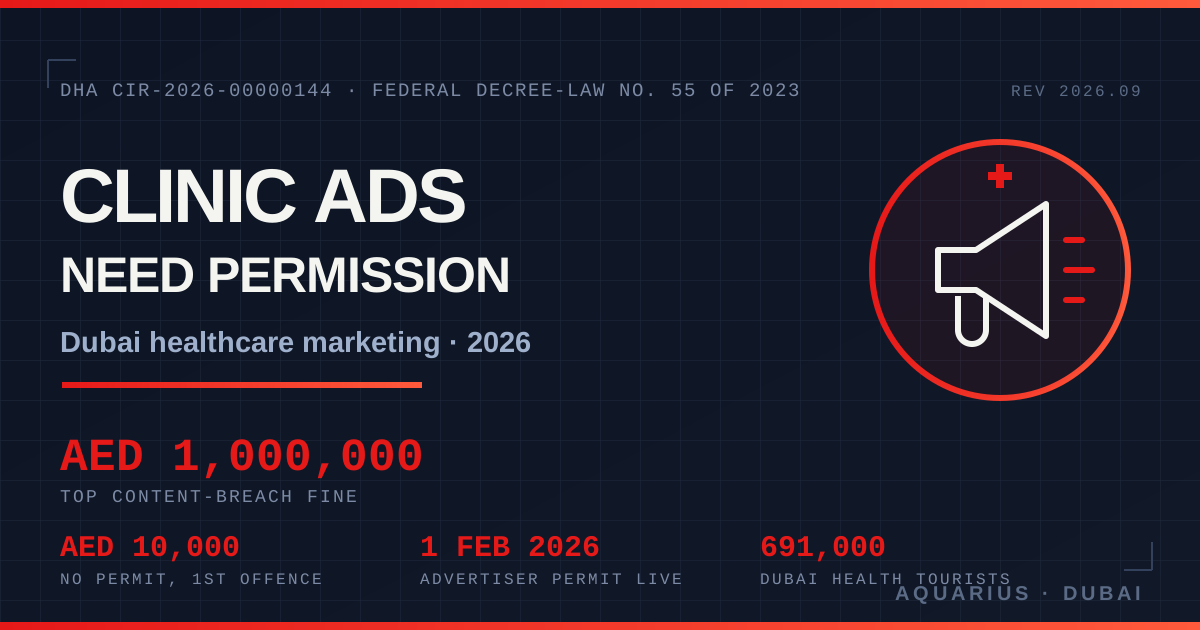
Short answer: In Dubai you need two separate permissions before a clinic ad goes live, and most clinics only hold one. Your DHA-licensed facility needs content approval from the health regulator under the Dubai Health Authority standard for medical advertisement content (Circular CIR-2026-00000144, standard code DHA/HRS/HPSD/ST-21), and whoever publishes the promotion needs a UAE Media Council Advertiser Permit, mandatory since 1 February 2026 under Federal Decree-Law No. 55 of 2023. Publishing without the permit starts at AED 10,000 for a first offence and rises to AED 40,000 for repeat violations, while serious content breaches are penalised between AED 5,000 and AED 1,000,000 under Cabinet Resolution No. 42 of 2025.
Here is the part that catches good clinics. The fine does not usually arrive because someone lied. It arrives because a marketing coordinator posted a before-and-after photo with a beauty filter, or ran a “50% off veneers this weekend” story, or reposted an influencer who filmed in your treatment room without her own permit. All three are ordinary marketing moves everywhere else in the world. In Dubai, in 2026, each one is a regulated act attributable to your facility licence.
The numbers that make this worth getting right
Dubai is not a small healthcare market with a light-touch regulator. It is a large, high-value, heavily licensed market where medical marketing is genuinely lucrative and therefore genuinely policed.
- 691,000 international health tourists visited Dubai in 2023, up from 674,000 the previous year, spending more than AED 1.03 billion directly on healthcare services, per Dubai Health Authority figures published through the Dubai Media Office. Indirect revenue across aviation, hospitality and telecoms exceeded AED 2.3 billion.
- The specialties that advertise hardest are also the biggest: dentistry at 29%, dermatology at 27% and gynaecology at 13% of medical tourism demand.
- Dubai licensed supply is dense: 52 hospitals, 122 clinics, 82 dental clinics, 77 specialised clinics, 58 one-day surgery centres, 1,325 pharmacies and 56,239 licensed healthcare professionals. That is a lot of facilities bidding for the same patient.
- The UAE medical tourism market is forecast to grow at roughly 8.7% CAGR toward USD 2.3 billion by 2033.
Dense supply plus high-ticket elective demand equals aggressive advertising. Aggressive advertising is exactly why the 2026 rules exist, and why enforcement is not theoretical.
Two permissions, two regulators, one licence on the line
Almost every compliance conversation we have with a Dubai clinic starts with the same confusion, so separate the two clearly.
1. Health content approval. This governs what you are allowed to claim about treatment. It sits with the authority that licenses your facility. For a mainland Dubai facility that is the DHA Health Regulation Sector. For a facility inside Dubai Healthcare City it is DHCR. Elsewhere in the UAE, or for federally licensed activity, it is MOHAP. The 2026 DHA standard explicitly covers licensed facilities, licensed practitioners and third-party influencers operating in Dubai, and excludes DIFC and Dubai Healthcare City, which run their own regimes.
2. The Advertiser Permit. This governs who is allowed to publish promotional content at all in the UAE. It came into force on 1 February 2026 and applies regardless of platform, follower count or nationality. A business promoting only its own services through its own accounts on a valid trade licence is generally outside the requirement, but the exemption collapses the moment a third party is involved, even informally. For residents, the permit carries no fee for the first three years, with annual renewal from year four commonly cited at around AED 1,000. Approval typically lands in 3 to 5 working days after applying with UAE PASS. Visiting creators cannot apply directly at all: they need a sponsored visiting permit through a UAE agency accredited by the Media Council, valid 3 months and renewable once to a maximum of 6, generally costing AED 1,000 to AED 2,000.
The practical consequence is blunt. Your clinic may be perfectly exempt on its own page and still be exposed through the aesthetician you paid in vouchers last month.
What the 2026 DHA standard actually bans
The circular is not a vague statement of principle. It targets the specific tactics that work commercially, which is precisely why it stings:
- Absolute, superlative or exaggerated language that creates unrealistic treatment expectations. “Best dentist in Dubai” and “guaranteed results” are not edgy copy, they are the named offence.
- Inducement pricing: flash discounts and bundled promotions on clinical services. Countdown timers on surgery are out.
- Comparative marketing claiming superiority over named or implied competitors.
- Patient content without documented written consent, where the consent form specifies purpose, platform and timeframe.
- Misleading before-and-after imagery using filters, altered angles or inconsistent lighting.
Two governance requirements matter more than the content list, because they change your workflow permanently. First, the Medical Director must pre-approve all promotional content. Second, the facility is liable for anything filmed on its premises, regardless of who distributes it or where. That single clause is why a compliant clinic now needs an approval log, not just a content calendar.
The Dubai clinic marketing permission matrix
Figures below are the commonly published 2026 positions. Authority fee schedules change, so confirm the current number on the relevant portal before you commit a media budget.
| Permission | Authority | Typical cost | Validity / turnaround |
|---|---|---|---|
| Medical advertisement content approval | DHA Health Regulation Sector (Sheryan) | Bundled into facility licensing; no separately published standard fee | Per campaign or per material; no fixed published turnaround |
| Social media advertising licence | MOHAP (federal track) | Reported around AED 100 per application | Monthly or annual; licence number must be displayed on the account |
| Advertiser Permit (resident) | UAE Media Council | Free for first 3 years, then around AED 1,000 per year | Annual; approval in 3–5 working days |
| Visiting Advertiser Permit | UAE Media Council via accredited agency | AED 1,000–2,000, usually paid by the brand | 3 months, renewable once to 6 months |
| Supporting documents | DET / police | Trade licence from around AED 1,070; police clearance around AED 220 | Annual |
What needs pre-approval, and what does not
This distinction is where marketing budget is won or lost, because approval cycles are the single biggest cause of missed launch dates and resubmission is the most common delay.
Submit it: paid search and paid social ad copy promoting treatments, the landing pages those ads point to (reviewers do open the destination), clinic social accounts publishing treatment content, and every influencer collaboration.
Generally no pre-approval needed: genuinely educational content with no outcome claim, doctor biography pages listing credentials and licence numbers, and factual service information. This is the strategic opening. Educational content is the one channel you can publish at speed, and it happens to be the channel that compounds: a well-built clinic content library ranks, earns AI citations and converts without ever entering an approval queue. We cover the technical side of that in our guide to clinic websites and booking systems in Dubai.
The cost of losing the paid channel to a rejection is real money in this market. UAE Google Ads pricing runs roughly 8% above the US average. General dentistry, family medicine and paediatrics in mid-tier Dubai locations sit around AED 6 to AED 15 per click, while cosmetic dermatology, IVF and bariatric keywords climb into the AED 25 to AED 45 band, with top-of-page bids on aesthetic terms reported above AED 120. Typical medical cost per booked appointment lands at AED 80 to AED 250, with return on ad spend of 3x to 6x on elective procedures. Every week a campaign sits in resubmission is a week of that pipeline you do not get back.
What compliant clinic marketing costs in Dubai
Compliance does not raise your marketing budget as much as clinics fear. It changes where the money goes: less into disposable discount creative, more into assets that pass review once and keep working.
| Line item | Typical Dubai range | What it buys |
|---|---|---|
| Compliant clinic website with booking | AED 18,000–65,000 | Service pages written to the claims standard, doctor profiles with licence numbers, Arabic and English, consent-aware forms |
| Content library, ongoing | AED 4,000–12,000 per month | Educational articles and FAQs that need no pre-approval and earn organic and AI-search visibility |
| Paid media management | AED 2,500–15,000 per month | Campaign build, approval submissions, landing pages, reporting |
| Media budget, elective specialties | AED 15,000–60,000 per month | At AED 80–250 per booked appointment, roughly 60–750 appointments |
| Approval workflow in your CRM or site | AED 8,000–30,000 one-off | Medical Director sign-off states, version history, consent record linking, audit export |
Compare that with the downside. A single first-offence publishing penalty is AED 10,000, repeats reach AED 40,000, and a serious content breach is assessed anywhere from AED 5,000 to AED 1,000,000. Operating on an expired permit accrues AED 150 per day up to AED 3,000, and misuse of a licence is set at AED 20,000. Against a mid-range aesthetic clinic running AED 40,000 a month in media, one enforced content breach can erase a quarter of profit, and the reputational file sits with the regulator that renews your facility licence.
How Aquarius builds this so it stops being a monthly panic
We treat clinic marketing compliance as a product problem, not a policy memo. That means four concrete things in the build: service and treatment pages written against the banned-claims list from the first draft rather than sanitised later; a Medical Director approval state on every publishable asset, with version history and an export you can hand to a regulator; patient consent records linked to the specific asset, platform and expiry date so a photo cannot outlive its permission; and an influencer intake that captures the collaborator Advertiser Permit number before anyone films on your premises.
Then we build the part that actually grows the practice: an educational content engine in Arabic and English that does not need pre-approval, on a fast, structured site that clinics can update themselves. If you are also handling patient records and referrals, our work on EMR and NABIDH integration for Dubai clinics covers the clinical side, and medical tourism website development covers the international patient funnel. Indicative build ranges are on our pricing page.
Frequently asked questions
Does my clinic need an Advertiser Permit if we only post on our own accounts?
Generally no. A business promoting exclusively its own services through its own accounts, holding a valid trade licence, sits outside the requirement. The exemption ends as soon as a third party is involved, even informally, which includes influencers, affiliates, gifted collaborations and any external creator publishing about your clinic. Your content still needs health-authority approval regardless.
Who is liable if an influencer breaks the rules on our behalf?
The licence-holding facility carries the exposure, not the agency, and the 2026 DHA standard makes facilities responsible for content filmed on their premises regardless of how it is distributed. Contractually requiring the collaborator Advertiser Permit number and a copy-approval step before posting is the only practical protection.
Can we advertise discounts on treatments in Dubai?
Not in the form most clinics want. Inducement pricing tactics such as flash discounts and bundled promotions on clinical services are named in the DHA standard, as are price-led procedure promotions presented without clinical context. Transparent price information in a service page is a different thing from a countdown-timer offer on surgery.
How long does DHA advertising approval take?
There is no published fixed turnaround. It varies by authority, by material type and above all by submission completeness, with resubmission cited as the main source of delay. Plan a buffer into every launch and confirm current expectations with DHA, DHCR or MOHAP before you commit to a media start date.
Do before-and-after photos still work in Dubai?
Yes, but only unfiltered, with consistent angles and lighting, and with documented written patient consent that names the purpose, platform and timeframe. Filtered or angle-manipulated comparisons are explicitly treated as misleading, and that is the most common reason a compliant-looking aesthetic account gets into trouble.
The move most Dubai clinics should make this quarter
Audit what is already live before you plan anything new. Most enforcement risk in Dubai clinic marketing is sitting in posts published months ago, under rules that changed in February, on accounts nobody has reviewed since. Pull the live inventory, score it against the banned-claims list, fix or remove what fails, and put a Medical Director approval state in the publishing workflow so it cannot recur.
Aquarius builds compliant, fast, bilingual clinic websites and the marketing systems around them for Dubai healthcare operators. If you want your current site and social content scored against the 2026 standards, send us the links and we will come back with a plain list of what passes, what does not, and what to fix first. You can see the full range of what we build on our services page.