
Digital Freight Marketplace Development in Dubai (2026): Match Shippers to Trucks Without the Broker Margin
Dubai has 10,000+ commercial transport companies growing 34% a year and UAE digital freight brokerage hits USD 203.6m by 2030. Build costs in AED, plus the RTA, VAT and payment traps.
- PUBLISHED
- 15 OCT 2026
- READ TIME
- 11 MIN
- AUTHOR
- AQUARIUS · DUBAI
- UNIT
- REV 2026.09
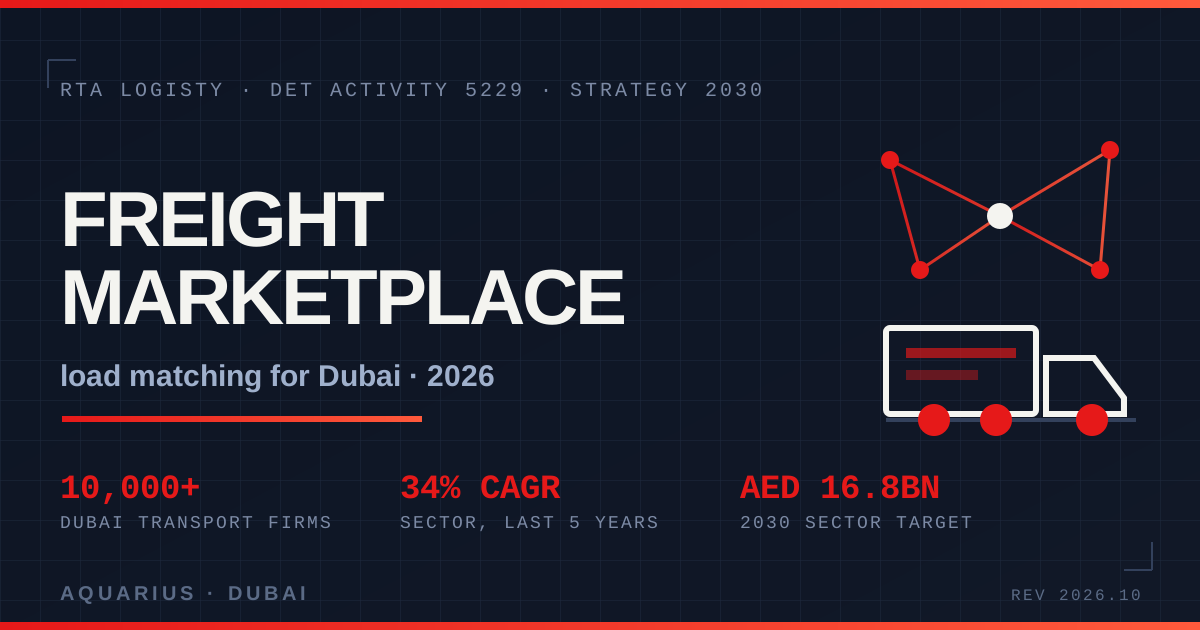
Short answer: A digital freight marketplace that matches Dubai shippers to available trucks costs roughly AED 90,000–180,000 for a working MVP and AED 220,000–480,000 for a production two-sided platform with automated matching, live tracking, e-POD and split payouts. The hard part is not the software. It is the DET activity code, the RTA No Objection Certificate, and never touching the money yourself.
Dubai already has the demand and the trucks. What it does not have is enough software between them. The emirate counts more than 10,000 commercial transport companies, a sector that has grown at a 34% compound annual rate over the last five years, and most of those firms still dispatch by phone call and WhatsApp voice note. That gap is the whole business case.
Key takeaways
- Dubai has 10,000+ commercial transport companies and the Dubai Commercial Road Transport and Logistics Strategy 2030 aims to double the sector contribution to AED 16.8 billion, lift technology adoption by 75% and improve operational efficiency by 10%.
- UAE digital freight brokerage revenue is forecast at USD 203.6 million by 2030, a 22.6% CAGR from 2025 — off a base where roads carry 45.8% of UAE logistics market value.
- Automated freight matching can cut empty running by up to 15%, and telematics lifts capacity utilisation by over 15%. With diesel at AED 4.80 per litre in October 2026, up from AED 4.30 in September, that is the margin.
- Brokerage sits under DET activity code 5229 and needs an RTA NOC before the trade licence completes. Domestic UAE transport is 5% VAT; international movements are zero-rated.
- If your platform holds funds between shipper and carrier you walk into CBUAE RPSCS territory — capital from AED 100,000 to AED 3 million. Use a licensed provider for split payouts instead.
The Dubai numbers that make load matching a real business
Start with market size, because freight tech only works at volume. The UAE freight and logistics market is worth around USD 23.05 billion in 2026, and roadways hold 45.8% of UAE logistics market share as of 2025. More than 180 million tonnes of road and air freight moved to and through the UAE in 2024. Road is not the small sibling of sea and air here. It is the connective tissue between Jebel Ali, the free zones, the industrial belts and every retail shelf in the country.
The digital share of that is still small and growing fast. UAE digital freight brokerage is projected to reach USD 203.6 million in revenue by 2030, compounding at 22.6% a year from 2025. For context on what a mature local network looks like: TruKKer, founded in Dubai in 2016, now connects more than 75,000 trucks to roughly 1,200 enterprise clients across the Gulf, Turkiye, South Asia and parts of Central Asia.
The government is actively pushing this
This is not a market you have to educate. In December 2024 Dubai's RTA launched Logisty with TruKKer as its private-sector partner — a public digital logistics platform for booking, tracking and fleet management, including an AI CBM calculator that estimates shipment volume from photos and video. It sits under the Dubai Commercial Road Transport and Logistics Strategy 2030, whose stated targets are to double the sector's direct economic contribution to AED 16.8 billion, increase technology adoption across sector infrastructure by 75%, and improve operational efficiency by 10%.
Read that as a signal, not a competitor. When the regulator ships its own platform, every transport company in the emirate gets comfortable with digital booking, and niche platforms — reefer-only, bulk, project cargo, cross-border to Saudi — suddenly have an educated buyer.
Empty running is where the money leaks
A truck that returns from Abu Dhabi empty still burns diesel, still pays tolls, still pays the driver. Estimates put the reduction in empty miles achievable through automated freight matchmaking at up to 15%, and telematics adoption at increasing capacity utilisation by over 15%. The cost side makes that matter more every month: diesel was set at AED 4.80 per litre for October 2026, up from AED 4.30 in September — an 11.6% jump in a single pricing cycle. Add Salik at AED 4 to AED 6 per gate depending on time of day and Abu Dhabi's Darb at a flat AED 4 per crossing, and a return leg with no load is pure loss.
What you are actually building
Most teams brief this as "an Uber for trucks" and then discover they built half a product. A freight marketplace is two apps, one engine and one settlement layer, and the carrier side is the one that decides whether you have a business.
The shipper side
Post a load with pickup and drop, truck type, weight or CBM, time window and any special handling. Instant indicative price. Document upload for delivery notes and customs paperwork. Live tracking link to send a customer. Consolidated monthly invoicing, because an enterprise shipper will not approve 400 separate AED 700 invoices. If you serve import and export flows you will also want to align with the paperwork reality covered in our guide to freight forwarding and customs clearance software in Dubai.
The carrier side
This is a driver-first mobile app, built for a user on a mid-range Android phone with gloves on. Load board filtered by current location and truck type, one-tap accept, navigation handoff, arrival and departure timestamps, photo e-POD with signature, and — the feature that actually wins loyalty — a visible payment status. Arabic, English, Urdu and Hindi at minimum. If the driver cannot use it in 20 seconds at a gate, your fill rate dies.
The matching engine
Early on, matching is a filtered broadcast plus a human dispatcher who can override everything. Do not build a machine-learning optimiser before you have liquidity — it has nothing to learn from. Once you are running a few hundred loads a month, score candidate trucks on proximity, truck type fit, historical on-time rate, backhaul potential and price, then auto-assign the top candidate with a dispatcher fallback. Pair it with telematics integration so your ETAs come from the vehicle, not from the driver's optimism. Our breakdown of logistics and fleet software development in Dubai covers that tracking layer in detail.
Build cost by module
| Module | What it does | Build range (AED) |
|---|---|---|
| Shipper web app | Load posting, instant quote, tracking, documents | 25,000 – 60,000 |
| Carrier mobile app | Load board, accept, navigation, e-POD, payment status | 35,000 – 90,000 |
| Dispatcher console | Manual override, exception handling, carrier vetting | 20,000 – 55,000 |
| Matching and pricing engine | Filtered broadcast to scored auto-assignment, lane pricing | 30,000 – 110,000 |
| Tracking and telematics integration | GPS, geofenced arrival, vehicle-sourced ETA | 18,000 – 70,000 |
| Settlement, VAT invoicing and payouts | Take-rate split, 5% or zero-rated logic, e-invoicing-ready output | 25,000 – 80,000 |
| MVP total (dispatcher-assisted) | Shipper app, carrier app, manual matching, basic settlement | 90,000 – 180,000 |
| Production two-sided platform | All of the above, automated matching, telematics, e-POD, split payouts | 220,000 – 480,000 |
| Enterprise network | Multi-country lanes, TMS and ERP integration, carrier financing, API for shippers | 500,000 – 900,000 |
The lane rates your pricing engine has to live inside
Your take rate is a slice of a number you do not control, so model the real market. Intra-UAE full truck load from Dubai to Abu Dhabi runs about AED 600 to AED 950 per trip in 2026. A 12-metre flatbed from Jebel Ali to Abu Dhabi averages around AED 1,100; a 15-metre flatbed to Abu Dhabi's industrial city around AED 950. Less-than-truckload intra-UAE typically prices at AED 80 to AED 180 per CBM.
At a 8% to 15% take rate, a single intra-UAE FTL load nets you roughly AED 50 to AED 140. That is the arithmetic that should drive every product decision: you need volume and low cost-to-serve per load, which means automation on the boring parts and zero manual invoicing. One dispatcher babysitting 30 loads a day does not scale past the first month.
Licences, VAT and the trap that catches software teams
Three things to get right before launch:
- Licence. Freight brokerage falls under DET activity code 5229 (other transportation support activities, including customs clearance and freight brokerage). A transport operation in Dubai typically needs both a DET commercial trade licence and an RTA Operation Card or No Objection Certificate, and the RTA NOC must be in hand before the trade licence is finalised. Where no manual review is triggered the NOC can issue within hours; where it is, budget 3 to 15 working days. If you hold vehicles you register the fleet with RTA, and a Dubai Customs economic operator code applies to import and export flows.
- VAT. Transporting goods between two points inside the UAE is standard-rated at 5%. International transport of goods and directly related services is zero-rated. A domestic leg that forms part of an international movement can be zero-rated under Article 33(1)(d) of the Executive Regulations as amended by Cabinet Decision No. 100 of 2024 and FTA Public Clarification VATP040 (March 2025) — but where a separate logistics company supplies only the domestic leg, that leg is 5%. Your invoicing logic has to carry that distinction per load, not per customer.
- Money. The moment you collect from the shipper and pay the carrier out of your own account, you look like a payment service. The CBUAE Retail Payment Services and Card Schemes regulation licenses nine categories across four tiers, with initial capital from AED 100,000 for a Category IV licence up to AED 3 million for full-scope Category I. As of the July 2026 register there were only 36 licensed retail payment service providers in the country. Federal Decree-Law No. 6 of 2025, in force since 16 September 2025, widened that perimeter further, with newly in-scope entities given until 16 September 2026 to license or get approval. The practical answer for a marketplace: do not hold funds. Use a licensed PSP with marketplace split payouts and keep yourself as the agent of record.
And one date you cannot slide. UAE e-invoicing is mandatory from 1 January 2027 for businesses with revenue of AED 50 million or more, who must appoint an Accredited Service Provider by 30 October 2026; everyone else appoints an ASP by 31 March 2027 and goes live 1 July 2027, with a pilot running July to December 2026. A freight platform issues invoices on behalf of two parties, so build Peppol-shaped output now rather than retrofitting it — see our UAE e-invoicing ERP integration guide.
What it costs to run, and when it pays back
Build is the smaller number. Plan for AED 3,000 to AED 12,000 a month in hosting, maps, SMS and telematics API fees at early volume, plus AED 4,000 to AED 15,000 a month for maintenance and iteration, and a dispatcher or two on the ground. At a 12% take rate on an AED 800 average intra-UAE load, you clear roughly AED 96 per load, so a AED 260,000 production build plus a year of running costs breaks even somewhere around 4,500 to 5,500 completed loads. That is a realistic 12 to 18 month target for a focused lane or cargo type — and an unrealistic one for a platform trying to serve every truck in the Gulf from day one.
The feature most Dubai freight platforms skip, and should not
Carriers do not leave a platform over UI. They leave over cash flow. Shippers commonly want 60 or 90-day terms while small carriers need paying inside 30. The global freight factoring market prices that gap at 1.5% to 4% of invoice value per 30 days with advances of 90% to 100% less the fee. If your platform can offer a verified-POD early payout — funded by a bank partner or a factoring provider, not your own balance sheet — you own carrier supply in your lane. That single feature does more for fill rate than any matching algorithm.
Most Dubai operators get this wrong
The common failure is building the shipper experience beautifully and treating the carrier app as an afterthought. A freight marketplace with no trucks is a quote form. Spend the first AED 100,000 on carrier acquisition and the driver app, run matching manually with a dispatcher and a spreadsheet, and only automate once loads are repeating on the same lanes. The second failure is launching nationwide. Pick one lane pair or one cargo type, win it, then expand — the same liquidity logic we lay out in our multi-vendor marketplace development cost guide.
How Aquarius builds it
We scope freight platforms as a sequence, not a big-bang launch: a dispatcher-assisted MVP in 8 to 12 weeks, live loads running through it while we instrument everything, then automation added where the data says it pays. Fixed AED scope per phase, UAE data residency where required, Arabic and English from the first build, VAT logic reviewed against the load type rather than bolted on, and e-invoicing-ready output from day one. You own the code and the infrastructure accounts — see our pricing.
FAQ
Do I need an RTA licence to run a freight marketplace if I own no trucks?
You still need a trade licence covering freight brokerage — DET activity code 5229 — and in practice an RTA No Objection Certificate before that licence is finalised, because the activity sits inside the commercial transport perimeter. You only register a fleet with RTA if you hold vehicles yourself. Confirm your exact activity list with DET and RTA before you build, because the code you pick also decides whether you can invoice the carrier leg.
How much does a freight marketplace cost to build in Dubai?
About AED 90,000 to AED 180,000 for a dispatcher-assisted MVP with a shipper web app and a carrier mobile app, AED 220,000 to AED 480,000 for a production platform with automated matching, telematics tracking, e-POD and split payouts, and AED 500,000 to AED 900,000 for a multi-country network with TMS and ERP integration plus carrier financing.
What take rate can I charge in the UAE?
8% to 15% is the workable band for brokered road freight. On a Dubai to Abu Dhabi FTL at AED 600 to AED 950, that is roughly AED 50 to AED 140 per load. Thinner than an ecommerce marketplace, which is exactly why cost-to-serve per load, not conversion rate, is the metric to optimise.
Is freight invoicing 5% VAT or zero-rated?
Domestic transport between two UAE points is 5%. International transport of goods and directly related services is zero-rated, and a domestic leg that is part of an international movement can be zero-rated under Article 33(1)(d) as amended by Cabinet Decision No. 100 of 2024 and clarification VATP040. If a separate company supplies only the domestic leg, that leg is 5%. Your platform must decide this per load and record why.
Can my platform hold the shipper payment and pay the carrier later?
Not without regulatory exposure. Holding and transmitting funds pulls you toward the CBUAE Retail Payment Services and Card Schemes framework, where initial capital runs from AED 100,000 to AED 3 million and only 36 providers were licensed as of the July 2026 register. Use a licensed PSP that supports marketplace split payouts, and keep the money out of your own account.
How long does it take to launch?
8 to 12 weeks to a dispatcher-assisted MVP carrying real loads, and typically 5 to 8 months to a production platform with automated matching and telematics. Licensing can run in parallel, though allow 3 to 15 working days for an RTA NOC that triggers manual review.
If you are planning a freight or load-matching platform for the UAE in 2026, start with one lane and a driver app people will actually open. Tell us your cargo type and target lanes and we will send a fixed AED scope for a dispatcher-assisted MVP, with the licence and VAT sequence mapped alongside it — talk to Aquarius.